Tuesday, April 19, 2011

KROQ-FM's Kevin and Bean Drive Past KFI-AM

Southern California is choosing an alternative route for its morning commute, according to a story by Steve Carney for the latimes.com.

KROQ-FM (106.7), with its comedic team of Kevin Ryder and Gene "Bean" Baxter, unseated talk radio station KFI-AM (640) as the most popular outlet during the morning drive period — weekdays from 6 to 10 a.m. — according to figures released Monday by the Arbitron ratings service.

KROQ's audience share rose from 5.4% in February to 6.2% in March, helping it best KFI in the all-important time slot. For years, KFI has held a virtual stranglehold on the a.m. audience by airing local host Bill Handel with the first hour of Rush Limbaugh's program during the morning hours.

Even though it improved its audience share from 5.4% to 5.9% from February to March, KFI fell to second place in morning drive time.

In terms of overall listeners, pop music station KIIS-FM (102.7) topped all Los Angeles-Orange County stations in March, claiming 5.1% of the audience ages 6 and older. Adult-contemporary station KOST-FM (103.5) placed second at 4.6%, based on the survey of listeners from March 3-30.

KFI finished third overall with 4.3% of the audience, improving from its fourth-place showing in February, when it took a 4.1% share.

All-news station KNX-AM (1070), meanwhile, leapt from 3% to 3.5% in March, putting it in a sixth-place tie with KROQ-FM (106.7) for overall listeners.

Andy Ludlum, director of news programming for KNX and sister station KFWB-AM (980), attributed the station's gains to the earthquake and resulting tsunami and nuclear crisis in Japan, as well as the death of Hollywood icon Elizabeth Taylor and a rainy L.A. Marathon.

Read More.

March PPMs rolled out Monday for a dozen markets, Click here to see.

Monday, April 18, 2011

Opinion: Television Is Dead; Long Live Television

From Kit Eaton, Fast Company:
Philips is selling its TV business to a Chinese volume manufacturer, trading dwindling profits for a licensing fee. It's a sign that flatscreen TVs have become a commodity--and the industry could be primed for a digital make-over led by firms like Apple.

Philips has been producing TVs since 1928, but it's now disposing of 70% of its TV business into a partnership with TPV Technology limited, a Hong-Kong-based manufacturer. The Dutch company will retain the last 30% of the business, and stands to receive over €50 million in royalties from the deal, starting in 2013.

That's quite a turn-around from the current situation, which saw Philips' finances take a €87 million loss in the first quarter of this year alone from its TV division. It's not the first time Philips has done a deal with TPV--in 2004 it sold a similar majority stake in its computer monitors business for the equivalent of $358 million. As part of this latest deal, all 4,000 employees of Philips TV division will move to TPV, which will also have a positive impact on the company's bottom line as those staff costs are now borne elsewhere.

As Bloomberg notes, Philips was the last remaining mass manufacturer of TVs in Europe. So what can we conclude from this deal? It's pretty simple at heart: The LCD/plasma flat screen revolution in the TV industry is over. The bulky cathode-ray tube TV of old is now consigned to history, and the rush make millions by getting every consumer in the developed world hooked up to an "HD-ready" 1080p television is completed--to the extent that the TV business isn't about pushing revolutionary changes anymore.

Instead it's a commodity business dominated by narrowing margins and dropping prices that has no room for Philips high-end TVs like the Aurea line which illuminates the wall behind the screen with LED colors that match the TV picture. Philips' new Chinese partner will run the business on a mass-sales, low profit-per-unit basis.
Read More.

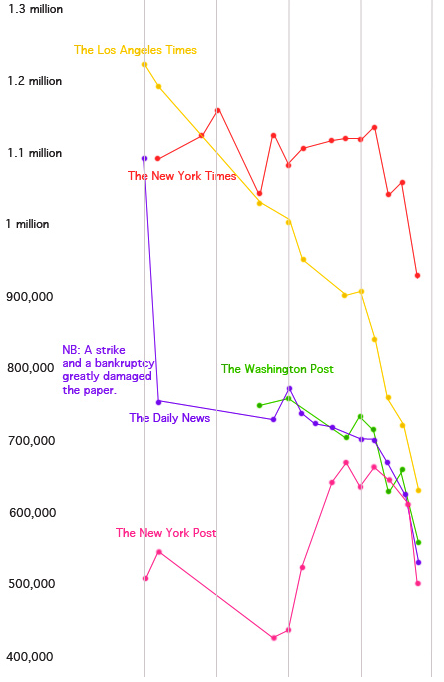
No Bob Woodward, Google Did Not Kill Newspapers


From Derek Thompson, Associate Editor at The Atlantic

The tombstone of Google's former CEO Eric Schmidt will read "I killed newspapers," Bob Woodward said [last weel]. With all due respect to the celebrated reporter and author, this is a misguided way of looking at Google, or newspapers, for at least three reasons.

1. The Decline is Older Than GoogleWoodward has been around newspapers for more than 40 years, so he knows as well as anybody that the decline in newspaper circulation is older than the search engine.* Recently the Washington Post, where Woodward is still assistant managing editor, wrote, "average daily circulation of all U.S. newspapers has been in decline since 1987 as papers have faced mounting competition for reader attention and advertising."

In 1987, Google founder and CEO Larry Page was 15 years old and Google was 11 years away from being a company.

Newspapers have been under assault since the invention of radio, the invention of Time magazine, the invention of television, the invention of cable TV, and so on. Today, 140 years after the Washington Post started publishing, the newspaper industry is a $30 billion national business. That might be decline, but it's not death. Technology is disruptive and successful companies adapt rather than draft the tombstones of their would-be killers.

2. Don't Blame Google, Blame the Whole Internet...

Read More.

Report: VH1 Cultivates Its Female Side

More Focus on Pop Culture to Attract Young Women

After watching its audience erode in recent years, cable channel VH1, known for its celebrity-driven reality shows, is giving itself a makeover.

Seeking to reinvigorate the 26-year-old channel, executives are targeting an audience that was once an afterthought for network strategists, but which advertisers now are clamoring to reach: women 25 to 35, according to a story by Lauren A. E. Schukey at wsj.com.

To attract those viewers, VH1 is introducing a slate of new programming that kicked off Sunday night with a trio of reality shows, including "Mob Wives," which follows several women who were born into, or married into, reputed Mafia families.

"We saw ratings deteriorate, and we were hearing from our audiences that there was a fatigue level with some of our shows," said Tom Calderone, president of VH1, part of Viacom Inc. "So we decided it was time to figure out what our next voice was going to be."

The channel's new voice is about to grow louder—and more female. In May, VH1 plans to introduce a morning talk show about pop culture called "Big Morning Buzz Live," hosted by TV personality Carrie Keagan. Ms. Keagan, 30, is in the same age group as the young professional women VH1 hopes to win over.

Later in the month, the channel plans to launch "Single Ladies," a comedy series from the production company of singer and actress Queen Latifah.

Read More.

TV Meteorologist Thrives In Social Media Tornado

From Cory Bergman, lost remote.com:

To get an idea of the popularity of James Spann, all you have to do is look at his Facebook and Twitter accounts. As far as I can tell, Spann has more combined Twitter fans (19,837) and Facebook followers (42,376) than any local TV talent in the country. For a meteorologist in Birmingham, Alabama — the nation’s 40th TV market — that’s downright impressive.

As tornadoes swirled through Alabama today, Spann was live on ABC 33/40, two radio stations and UStream, tracking storms (like “bullets from a gun,” he said) and urging residents to take cover. While on the air, Spann wasn’t able to post on Facebook or Twitter very often, but the social conversation around him was a storm of its own — and he kept an eye on it on his laptop.

On both Facebook and Twitter, fans and viewers sent him a steady stream of messages — sometimes several per minute — of damage reports, weather questions and general praise. If you were looking for citizen reports about the tornado, all you had to do was look on his Facebook Wall or search for @spann on Twitter. Here are five tweets in one minute:

And this went on for hours. His Facebook page has well over a hundred updates, from short weather updates to dozens of photos and videos. Occasionally on air, Spann would refer to a damage report — even punching up photos from Facebook on his Mac, which was wired straight to TV. At one point, ABC 33/40′s radar crashed, and Spann just punched up a web-based radar on his laptop.
Read More.

Glenn Beck To Leave NYC

Plans To Take On Jon Stewart And Stephen Colbert

Talk show host Glenn Beck announced Saturday he has finally sold his Connecticut home and will be moving out of New York City in the near future, according to a story by Joe Brookes at wireupdate.com.

After a year of teasing on both his radio and television programs, Beck made the announcement during a live broadcast on GlennBeck.com from Albany, New York. Beck said leaving New York would be part of his post-Fox News life.

Other notes from the broadcast:
  • Glenn Beck: @theblaze is only the beginning of news and information that i will be providing for radio, television, and internet.
  • Glenn Beck: I’m about to build a research department that will utilize the idle brains that we have, retired CIA, military, phd’s
  • Glenn Beck: I’m going to make sure that Stephen Colbert and Jon Stewart don’t occupy the space of comedy alone
  • Glenn Beck: What you are about to see in a few months is a new way to communicate with each other
  • Glenn says he going to build a way to deliver news directly to the youth of America.
Read More.

Also Must Read:

THE DAILY CALLER: Conservatives hit Beck for taking content without Attribution

Why Radio Needs To Jump On The Digital Bandwagon

From Rich McLaughlin For The Business Insider

Digital platforms provide opportunities to enhance a terrestrial radio company’s core competency. Yes, I’m referring to content! It might be inaccurate to claim that a lack of diverse and compelling content options on the AM/FM radio dial was singlehandedly responsible for the influx of new offerings and platforms as digital was born. Regardless, that perception certainly played a role in the eyes of the consumer.
Satellite and Internet radio found their wide audience, in part, by exploiting terrestrial radio’s reputation of having narrow and repetitive playlists. How? They emphasized the depth and quality of their content offering. Terrestrial radio must now do the same. Inevitably, superior content will merge with superior technology to form the optimal listening experience. That’s where this will all end up. Terrestrial radio must focus on fighting the content war, and digital platforms enhance the user’s experience.

Digital presents an opportunity, not a threat, for terrestrial radio companies. Contrary to what some industry executives might believe, radio listeners consume the same content digitally as when listening on a frequency. All that’s changing with online and mobile listening is the means by which they consume it. “The Infinite Dial 2011” report confirms the finding that online radio listening is a complement to over-the-air radio, not a substitute. The study concluded that 89% of weekly online radio listeners listened to over-the-air AM/FM radio versus 11% those who listened exclusively to online radio, and not AM/FM. While online only stations, commonly referred to as “pureplay” stations, are an effective means of adding depth and increasing listenership on a platform, they don’t do so at a cost to AM/FM streaming.

Finally, and perhaps most importantly, fighting the transition to digital is not a battle terrestrial radio companies can win. Rather than taking the failed record label approach of ignoring, or worse, attempting to force the hand of technological progress (I’m talking to you HD Radio), the radio industry should accept what it cannot change and use digital to its advantage.

Time will tell if the recent call-to-arms for a digital revolution from radio’s top ranks will galvanize the industry to make the transition with meaningful and significant urgency. The future success and relevance of terrestrial radio companies will depend on it.
Read More.

Rich McLaughlin is the Digital Program Director for Clear Channel's iheartradio platform.

Lady Gaga's 'Judas' Upsets Religious Groups


"She is trying to rip off Christian idolatry to shore up her talentless, mundane and boring performances," says the president of the Catholic League, according to a story by Lindsay Powers for The Hollywood Reporter.

Lady Gaga is stirring up controversy with the lyrics and video for her new song, "Judas."

The tune features lyrics like: "I want to love you,/but something’s pulling me away from you/Jesus is my virtue, and Judas is the demon I cling to….I’m just a holy fool,/ oh baby he’s so cruel,/ but I’m still in love with Judas, baby.”

Fumes Bill Donahue, president of The Catholic League for Religious and Civil Rights, in a statement: "This is a stunt... Lady Gaga tries to continue to shock Catholics and Christians in general: she dresses as a nun... she swallows the rosary. She has now morphed into a caricature of herself.

Read More.

NPR's Andy Carvin Enjoys The Tweet Life

From Pam Harbaugh, Florida Today:
Read More.
It's no wonder Andy Carvin turned out to be a news junky.

While growing up in Indialantic, Florida at least two newspapers always were lying around the house. The local news was on television in the background during dinner.

Andy and his brother, Eric pored over the newspaper at breakfast, discovering a world beyond Brevard County.

So, yes, the world had a strong influence on Carvin. Now, the 1989 Melbourne High graduate is returning the favor.

As National Public Radio's senior strategist specializing in social media, Carvin, 39, is known to more than 43,000 Twitter followers as @acarvin.

From his office in Washington, he spends up to 17 hours sending nearly 300 Twitter tweets a day about minute-by-minute events, mostly in North Africa and the Middle East. Called a curator of information, he re-tweets first-person experiences, often shocking and heart-wrenching, of the so-called Jasmine Revolution. In the process, he puts a human face on the Arab and Muslim freedom fighters.

"If part of my tweeting helps expose the American public to a broader understanding to what Arabs and Muslims are like, so much the better," Carvin said.

His effect is so far reaching that Time magazine recently included him in its poll of "100 Most Influential People." As of Monday, he was ranked 66 out of 203 entries, two places behind Colin Firth.

"Everybody who follows the Middle East owes a debt to Andy," said New York Times columnist and two-time Pulitzer Prize-winner Nicholas Kristof. "He's the maestro of the region's Twitter feed."

Public Radio Listeners Show Off Their Loyalty

Love me, love my NPR

From Andrew Phelps, neimanlab.org:

NPR executives have been known to brag that theirs is just about the only news organization to show up in people’s personal ads. For example: “I am in need of some intelligent male company…I am an avid reader, npr listener, talkative, curious and always up for trying something new.”

Media companies salivate over that kind of loyalty and identification with the brand. “People not only have an affinity for NPR but an affinity for each other, as listeners,” Kinsey Wilson, NPR’s general manager of digital media told me. “We’re the only news organization where public trust has increased over the last decade.”

While there is as yet no dating site for public radio nerds — though Wilson said the idea has come up — his development team recently whipped up a way for listeners to show off their support and discover friends with similar passions. A new Facebook app called I Heart NPR asks fans to put themselves on a map with thousands of others. Users can play games, such as Name That NPR Theme Song (I earned four-of-four virtual tote bags, thank you), and then share the results with friends. Secret games will be “unlocked” with every 100,000 new users, Wilson said.

NPR is already among the most “liked” news organization on Facebook, with 1.4 1.6 million fans. So what’s different about this?
Read More.

Employers Use Social Media To Find Candidates

A new survey from the Society for Human Resource Management (SHRM) reveals that 56% of employers use social networking websites in their search for appropriate candidates, and another 20% said they plan to do so in the near future, according to a posting by blogger David John Walker at socialbarrel.com.
The survey from the world’s biggest association of hiring managers shows that LinkedIn currently dominates this space, with 95% of hiring managers who use social networking website reporting that they use LinkedIn to find and evaluate new candidates.

The SHRM survey underscores what has become increasingly evident to job hunters and employers alike: for the job seeker, an updated LinkedIn profile is a necessity and for the employer, LinkedIn should be the first stop in the recruitment process.  The SHRM report explains that employers are gravitating to social networking websites because they “allow an employer the opportunity to gather initial information about a job candidate before a single word has been exchanged."

A good Linked in profile will provide a potential employer with a concise, clear picture of the candidate’s strengths and talents, experience, and current occupation. A really good LinkedIn profile will also have recommendations prior employers, colleagues, and clients.

Read More.

Sunday, April 17, 2011