Saturday, November 29, 2025

Radio History: Nov 30


➦In 1924...the first radio photo facsimile was transmitted across the Atlantic.

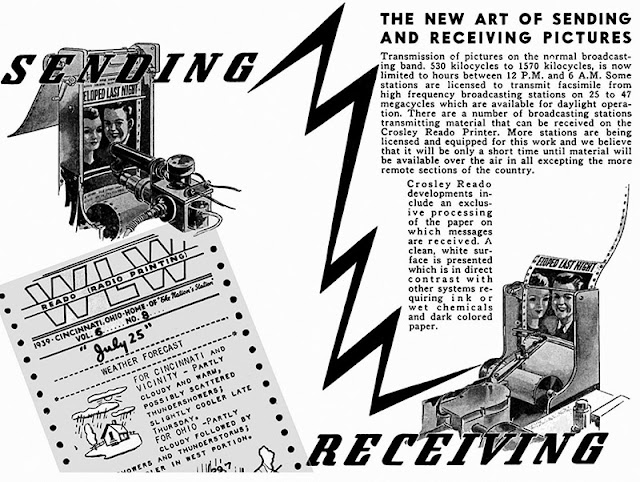
The concept of sending images by wire had been around for a long time before it was ever applied to radio.  The first rudimentary fax patent was issued in Paris in 1843 and used a swinging pendulum to draw the image.  Englishman Edwin Belin first demonstrated his Belinograph in 1913.  Western Union and AT&T both transmitted photos via wire in the early 1920’s, and the technology was quickly accepted by the press as a way to send newspaper photos instantly to cities around the country.  RCA was the first company to adapt facsimile to radio, and sent a transoceanic image of President Calvin Coolidge from New York to London on November 29, 1924.


Two years later, RCA began a commercial service of transmitting transoceanic photos by shortwave radio for the newspaper industry, and transmitting weather maps to ships at sea.  RCA’s patented “Photoradio” technology was invented by RCA scientists Richard H. Ranger and Charles J. Young.  It used a rotating drum and a photoelectric scanner to convert a document into a continuous tone that varied in pitch with changes in the image.  The image was reproduced on the receiving end with another rotating drum having a stylus that pressed black carbon paper against white paper to reproduce the image.

 A few radio broadcasters showed early interest in adapting the technology to send pictures to the public.  KPO in San Francisco, owned by the San Francisco Chronicle, became the first radio broadcaster to transmit a photograph by radio when it transmitted a picture of cartoon character Andy Gump on August 22, 1925.  The image was signed by Chronicle publisher George T. Cameron with the message "Radio's latest wonder - pictures through the air.  What new marvels will this science bring forth?"   The image was received on a single machine invented by C. Francis Jenkins.

➦In 1929...Dick Clark born (Died at age 82 - April 18, 2012). He was a radio and television personality, television producer and film actor, as well as a cultural icon who remains best known for hosting American Bandstand from 1957 to 1988.

As host of American Bandstand, Clark introduced rock & roll to many Americans. The show gave many new music artists their first exposure to national audiences, including Iggy Pop, Ike & Tina Turner, Smokey Robinson and the Miracles, Stevie Wonder, Prince, Talking Heads, Simon & Garfunkel and Madonna. Episodes he hosted were among the first in which blacks and whites performed on the same stage, and likewise among the first in which the live studio audience sat without racial segregation. Singer Paul Anka claimed that Bandstand was responsible for creating a "youth culture". Due to his perennially youthful appearance and his largely teenaged audience of American Bandstand, Clark was often referred to as "America's oldest teenager" or "the world's oldest teenager".

TV Ratings: Macy's Parade Shatters Records


NBC and Peacock’s broadcast of the 2025 Macy’s Thanksgiving Day Parade shattered records with 34.3 million total viewers, an 8% jump from last year’s 31.3 million and the largest audience in the event’s 99-year history.

The live NBC telecast alone averaged 25.4 million viewers, also up 8% year-over-year and marking the most-watched entertainment program on linear television in nearly seven years.Key numbers at a glance:

The surge was fueled by Peacock’s growing subscriber base (roughly 5 million more than in 2024) and an expanded 8:30 a.m. ET start time. Jen Neal, NBCUniversal’s EVP of Live Events, called the numbers “record-breaking” and a perfect holiday kickoff, while Macy’s CMO Sharon Otterman credited the mix of top talent and cultural moments.

The 2025 parade featured 34 giant character balloons (including new entries Buzz Lightyear, Mario, and Pac-Man), more than 5,000 volunteer performers, and standout musical numbers, most notably a bilingual K-pop performance from Netflix’s KPop Demon Hunters cast.

NBC’s rights to air the parade run through 2035, setting the stage for an even bigger 100th anniversary celebration in 2026.

Trump Snaps At CBS News Correspondent


President Donald Trump lashed out at CBS News chief White House correspondent Nancy Cordes on Thanksgiving, calling her a “stupid person” during a tense exchange over the vetting of an Afghan national accused in a deadly Washington, D.C., shooting.

The confrontation unfolded Thursday afternoon as Trump fielded questions from reporters at his Mar-a-Lago estate, just hours after the U.S. Army announced the death of 20-year-old National Guardsman Sarah Beckstrom, one of two service members shot the previous day near the White House. The suspect, 29-year-old Rahmanullah Lakanwal, allegedly opened fire in what authorities described as a targeted attack.Cordes pressed Trump on his repeated blame of the Biden administration for immigration failures, noting a recent Department of Justice Inspector General report that confirmed thorough vetting of Afghan evacuees—including Lakanwal, who had worked closely with the CIA—by the Department of Homeland Security and FBI. 

“Your DOJ IG just reported this year that there was thorough vetting... so why do you blame the Biden administration?” she asked.

Trump interrupted sharply: “Because they let them in. Are you stupid? Are you a stupid person?” He repeated the insult three times, accusing her of ignoring the “disgraceful” influx of unvetted refugees on “big planes” and dismissing her questions as the product of ignorance. 

“You’re just asking questions because you’re a stupid person,” he added, without directly addressing the vetting details.


The outburst marked the fourth public attack on female reporters in two weeks, escalating concerns over Trump’s pattern of personal insults toward women in the press corps. Earlier incidents included:
  • On Nov. 20, Trump snapped at Bloomberg News White House correspondent Catherine Lucey aboard Air Force One, telling her to “quiet, piggy” after she questioned his comments on economic policy.
  • During a Nov. 22 press conference, he berated ABC News chief White House correspondent Mary Bruce as a “terrible person” and suggested she “ought to go back and learn how to be a reporter” while defending Saudi Crown Prince Mohammed bin Salman over the 2018 murder of journalist Jamal Khashoggi.
  • On Nov. 26, Trump took to Truth Social to call New York Times White House correspondent Katie Rogers “ugly, both inside and out,” in response to a story she co-authored implying he was grappling with the “realities of aging in office.”
White House press secretary Karoline Leavitt defended the president’s candor Friday, calling it “frank and honest” and more respectful than avoiding questions. “The president is very frank with everyone in this room,” she said during a briefing.

Critics, including media experts and women’s advocacy groups, condemned the remarks as gendered micro-assaults designed to humiliate and silence.

TWH Debuts 'Media Offender of the Week' Website


The Trump White House launched a new "Media Bias" section on its official website on Friday featuring a "Media Offender of the Week" spotlight and "Hall of Shame" leaderboard aimed at calling out what it calls "false and misleading stories" from mainstream media.

The inaugural weekly offenders include David Ellison-owned CBS News—despite the president's recent praise for its leadership—alongside The Boston Globe and The Independent, accused of misrepresenting Trump's comments on "sedition" by six Democratic lawmakers. 

The page, accessible at whitehouse.gov/mediabias, lists dozens of specific TV segments, articles, and reporters, with categories like "bias," "lie," and "left wing lunacy," and invites users to "Scroll for the Truth" while signing up for "Offender Alerts" newsletters.

CBS News, now under Paramount Global CEO David Ellison and editor-in-chief Bari Weiss, tops the weekly list for coverage of a video by Sens. Mark Kelly (D-AZ), Elissa Slotkin (D-MI), and four other Democrats urging military personnel to disobey "illegal orders" and uphold their oaths. The White House claims outlets falsely portrayed Trump's response—labeling the video a "sick plot" for rebellion—as a call for the lawmakers' "execution," when it was allegedly just accountability for "inciting sedition." 

Named reporters include CBS's Nancy Cordes, The Boston Globe's Alyssa Vega, and The Independent's Andrew Feinberg and Eric Garcia. The Hall of Shame leaderboard ranks The Washington Post (owned by Jeff Bezos) as No. 1, followed by CNN (potentially soon under Ellison influence via a Warner Bros. Discovery bid), MSNBC (rebranded as MS Now), and a rotating cast of "repeat offenders" like The New York Times, Politico, BBC, ABC News, and USA Today.


This move escalates Trump's long-running feud with the press, whom he has dubbed the "enemy of the people," amid data from the Media Research Center showing 92% negative coverage of his administration in early 2025. The inclusion of CBS is particularly notable: Ellison, son of Trump ally Larry Ellison (Oracle co-founder), acquired Paramount in summer 2025 with FCC approval under Trump appointee Brendan Carr, settling a $16M lawsuit over a edited 60 Minutes Kamala Harris interview.

Radio By the Numbers: Non-Com FMs Hit All-Time High


Noncommercial FM stations reached a record 4,730 licensed outlets as of September 30, 2025, adding 41 stations in a single quarter and surging 353 (+8.1%) year-over-year, while AM radio lost another 17 stations (down to approximately 4,366) and commercial FM slipped for the third straight quarter, the FCC reported on November 26, 2025.

The contrasting trends produced only a modest net gain of 24 total radio stations nationwide, meaning every bit of growth — and then some — came exclusively from the noncommercial sector. The Q3 numbers, delayed nearly two months by the partial federal government shutdown that began October 1, crystallize a structural divide that has been widening for the better part of a decade.


What’s Driving the Divergence
  • Noncommercial FM boom: Large faith-based networks (Educational Media Foundation/K-LOVE/Air1, Hope Media, Relevant Radio, etc.) and smaller community/college groups continue to acquire failing commercial signals or build new ones in rural and secondary markets where spectrum remains available.
  • Operating costs are lower: no advertising sales staff, heavy reliance on listener donations, underwriting, and CPB grants.
  • Many new stations are low-power FM (LPFM) conversions to full-power or strategic purchases of silent commercial FMs at distressed prices.
  • AM and Commercial FM erosionAM has now lost more than 250 stations since 2020. Daytime-only operations, skywave interference complaints, and skyrocketing tower/land rents are pushing marginal owners off the air.
  • Commercial FM faces direct competition from Spotify, YouTube Music, podcasts, and SiriusXM. Local ad dollars have shifted to digital, leaving music stations especially vulnerable.
  • Consolidation has reduced the number of unique licensees even faster than the station count itself; iHeartMedia, Cumulus, and Audacy continue to surrender or donate weaker signals.
The FCC’s own data now show that, for the first time in history, virtually all net new terrestrial radio licenses are noncommercial. Industry analysts expect noncommercial FM to surpass 5,000 stations before 2028, while total AM stations could dip below 4,000 in the same timeframe if the current attrition rate holds.

US Households Now Pay $150+ Monthly for TV


The average US household now spends $70 a month on subscription video services — up from $48 a year ago — and adding a live-TV streamer such as YouTube TV or cable pushes the total bill to $150 or more, according to a new Deloitte report.

A wave of 2025 price increases across virtually every major service is driving the surge:
  • YouTube TV: +$10 to $82.99 (another hike expected soon after costly Disney and NBC deals)
  • Fubo: +$5 to $84.99 (currently in NBC carriage dispute)
  • DirecTV: up to +$11
  • Hulu + Live TV: +$7
Netflix (Jan), Peacock (Jul), Apple TV+ (Aug), Disney+/Hulu/HBO Max (Oct), Paramount+ (Jan 2026)Carriage-fee disputes are accelerating the increases. 

In October, 10 million YouTube TV subscribers temporarily lost Disney channels (ABC, ESPN) for two weeks; the settlement reportedly forces YouTube TV to absorb higher costs and add premium ESPN channels to its base tier. Fubo’s 1.6 million users just lost NBC programming, and any resolution will likely mean another price bump.

Industry experts warn of growing viewer frustration. “It feels like we’ve hit an inflection point where people are asking, ‘Is this really the entertainment utopia we were promised?’” said Andrew Hare, senior vice president at media research firm Magid.

Yet streaming companies are posting record profits:
  • Warner Bros. Discovery (Max): $977 million in first three quarters
  • Disney (Disney+, Hulu, ESPN+): $352 million profit in latest quarter
  • Paramount: $340 million pretax earnings in Q3
The money is coming from three main sources beyond pure price hikes:
  1. Rapidly growing ad-supported tiers (younger viewers tolerate ads; 
  2. older viewers pay extra for ad-free)
  3. Expensive exclusive sports rights that force fans to subscribe to multiple services
Near-saturation (90%+ of US homes already subscribe to at least one service), leaving little room for subscriber growth and intensifying competition for existing eyeballs

Sports fragmentation is the biggest wallet-drainer for consumers:
  • Amazon Prime: exclusive Thursday (and Black Friday) NFL games + new NBA deal
  • Netflix: Christmas Day NFL games
  • Peacock: post-Christmas NFL + other exclusives
  • Apple TV+: Friday MLB
  • ESPN+: 50 exclusive NHL games
To watch a favorite team all season, fans increasingly need two, three, or more subscriptions.

Despite the profits, executives acknowledge limits. “The companies know just how price-sensitive people are right now,” Hare said. “I don’t think the long-term strategy is just keep raising prices.” 

Deloitte’s Rohith Nandagiri adds that the dual ad-supported/ad-free model lets streamers extract maximum revenue from every demographic — younger viewers accept ads, boomers pay to avoid them — creating a “win-win” for platforms even as household budgets stretch to the breaking point.

R.I.P. John Moore, Longtime WSB Radio Morning Host

John Moore ('43-'25)
John Moore, the booming-voiced morning host who entertained Atlanta commuters on WSB radio throughout the 1970s, has died at age 82.

Moore, a Georgia Radio Hall of Fame inductee, passed away on Nov. 10, 2025, from complications related to dementia, his stepdaughter Laura Fowler confirmed to the Atlanta Journal-Constitution.

Known for his engaging on-air presence and larger-than-life personality, Moore anchored WSB's morning show from 1972 to 1982, delivering news, weather, traffic, and witty banter that became a staple for Atlanta's early risers. His tenure coincided with WSB's dominance in the city's radio market, where the station's signal reached far beyond Georgia's borders.

In a highly publicized personal transformation, Moore joined the Nutri-System weight-loss program in 1981 and shed nearly 200 pounds over the following year. He chronicled the journey live on air—sharing triumphs, setbacks, and recipes—while starring in Atlanta Journal-Constitution ads that highlighted his progress.  The effort not only boosted his health but also resonated with listeners, turning his story into a motivational touchstone for the era.

After leaving radio in 1982, Moore pivoted to the tech world, working as a software developer in the Atlanta area. He retired in metro Atlanta, where he remained until his death. Colleagues remembered him as a natural storyteller whose warmth and humor defined an era of broadcast radio.

The Georgia Radio Hall of Fame recognized Moore's contributions to the state's airwaves in 2012, honoring his role in shaping Atlanta's morning radio tradition alongside legends like John Howell, his frequent on-air partner.

Fowler described her stepfather as a "gentle giant" whose voice "boomed with kindness," noting that even in his final years battling dementia, he retained a spark of the charisma that captivated thousands daily.Moore is survived by his wife, stepdaughter Laura Fowler, and extended family.

Radio History: Nov 29

Thomas Edison 1878
➦In 1877..U-S inventor Thomas Edison demonstrates his hand-cranked phonograph for the first time. Edison was one of the great inventors and designers in the history of the world. He invented the first practical light bulb, the motion picture camera and the phonograph. Others had attempted to invent the latter but Edison's was the first to actually reproduce the sound.

The phonograph was Edison's first major invention and the one that earned him the moniker "the wizard of Menlo Park" as the invention was so unexpected by the public as to appear magical. His first invention recorded on tinfoil around a grooved cylinder, and although the recordings could only be played a few times due to low quality, Edison's reputation was cemented.

He demonstrated the device on November 29, 1877, having announced its invention days before. He would patent it later that February. Recalling a demonstration in December, an employee of Scientific American magazine wrote: " "In December, 1877, a young man came into the office of the SCIENTIFIC AMERICAN, and placed before the editors a small, simple machine about which very few preliminary remarks were offered. The visitor without any ceremony whatever turned the crank, and to the astonishment of all present the machine said: "Good morning. How do you do? How do you like the phonograph?" The machine thus spoke for itself, and made known the fact that it was the phonograph..."

Edison did not improve on his design but Alexander Graham Bell invented an improved phonograph using wax cylinders in 1880.

Harry Bartell
➦In 1913...Announcer and actor Harry Bartell born (Died at age 90 – February 26, 2004). With his rather youthful sounding voice, Bartell was one of the busiest West Coast character actors from the early 1940s until the final end of network radio drama in the 1960s.

He was the Petri Wines announcer who interacted with “Dr. Watson” on 1940’s episodes of “The New Adventures of Sherlock Holmes,” and in the ’60’s was the announcer on CBS Radio’s “Dear Abby.”  His TV acting credits include Gunsmoke and Dragnet plus Get Smart, I Love Lucy, Wild Wild West, and The Twilight Zone.

➦In 1917...Announcer George Walsh was born in Cleveland (died from heart failure at age 88 -  Dec 5, 2005). He was also a newscaster at KNX 1070 AM L-A from 1952 to 1986.

George Walsh
Beginning in 1952, Walsh opened the weekly series that was broadcast live on radio with these words: “Around Dodge City and in the territory out West, there’s just one way to handle the killers and the spoilers, and that’s with a U.S. marshal and the smell of ‘Gunsmoke.’ ”

The radio version of “Gunsmoke,” which starred William Conrad as Marshal Matt Dillon, aired until 1961. When it moved to television in 1955, James Arness took over the starring role but Walsh remained as the show’s announcer.

For 34 years, Walsh worked at KNX as an interviewer, sports reporter, newscaster and announcer for a number of shows, including a fashion show hosted by film costume designer Edith Head.

One show, “Music ‘Til Dawn,” featured mainly classical music and aired overnight from 1952 until about 1970. The show won a Peabody Award in 1966.  Another, “This Is Los Angeles,” aired nightly at 8:15 and earned him a Golden Mike Award in 1961 from the Radio and Television News Assn. of Southern California.

➦In 1917...Merle Robert Travis born in Rosewood, KY (Died from a heart attack at age 65 – October 20, 1983).  He was a country singer, songwriter, and guitarist.

His songs' lyrics often discussed both the lives and the economic exploitation of American coal miners. Among his many well-known songs are "Sixteen Tons," "Re-Enlistment Blues," "I am a Pilgrim," and "Dark as a Dungeon." However, it is his unique guitar style, still called Travis Picking by guitarists, as well as his interpretations of the rich musical traditions of his native Muhlenberg County, KY for which he is best known today. "Travis Picking" is a syncopated style of guitar fingerpicking rooted in ragtime music in which alternating chords and bass notes are plucked by the thumb while melodies are simultaneously plucked by the index finger.

During the '30 and '40s, he was heard regularly on WLW radio Cincinnati as a member of The Drifting Pioneers.

➦In 1918...Humorist, radio personality ad TV host Herbert Arthur "Herb" Shriner born (Died in a car accident at age 51 – April 23, 1970). He was frequently compared to humorist Will Rogers.

In 1940, Shriner was hired by NBC for occasional radio appearances, which led to a regular spot in 1942 and 1943 on the comedy-variety program Camel Caravan. During World War II, he served in a United States Army special services unit and performed for two years in USO shows for GIs in Europe. After the war, he appeared on a number of radio shows, including The Philip Morris Follies of 1946 with Johnny Desmond and Margaret Whiting.

In 1947 he appeared in a Broadway musical review called Inside U.S.A. The performances were panned by critics, but Shriner's monologues made it a success and carried the show for over a year. Shriner hosted Herb Shriner Time, a CBS Radio weekday program, in 1948 and 1949 with the Raymond Scott Quintet, singer Dorothy Collins, and announcer Durward Kirby. The program was initially titled Alka-Seltzer Time (not to be confused with the later Alka-Seltzer Time that starred Curt Massey and Martha Tilton).  In August 1949, Shriner decided not to continue the program because it was too much work.

➦In 1927...Legendary sportscaster Vin Scully was born in the Bronx NY. (Died at age 94 on August 2, 2022).

His 67-year tenure with the Brooklyn & LA Dodgers is the longest of any broadcaster with a single club in professional sports history. Scully has called six World Series championships and 14 National League pennants for the club.

Vin Scully circa '50s
After serving in the United States Navy for two years, Scully began his career as a student broadcaster and journalist at Fordham University. While at Fordham, he helped found its FM radio station WFUV (which now presents a Vin Scully Lifetime Achievement Award each year), was assistant sports editor for Volume 28 of The Fordham Ram his senior year, sang in a barbershop quartet, played center field for the Fordham Rams baseball team, called radio broadcasts for Rams baseball, football, and basketball, earned a degree, and sent about 150 letters to stations along the Eastern seaboard. He received only one response, from CBS Radio affiliate WTOP in Washington, which made him a fill-in.

Scully was then recruited by Red Barber, the sports director of the CBS Radio Network, for its college football coverage. Scully impressed his boss with his coverage of a November 1949 University of Maryland versus Boston University football game from frigid Fenway Park in Boston, despite having to do so from the stadium roof. Expecting an enclosed press box, Scully had left his coat and gloves at his hotel, but never mentioned his discomfort on the air.  Barber mentored Scully and told him that if he wanted to be a successful sports announcer he should never be a "homer", never listen to other announcers, and keep his opinions to himself.

In 1950, Scully joined Barber and Connie Desmond in the Brooklyn Dodgers radio and television booths. When Barber got into a salary dispute with World Series sponsor Gillette in 1953, Scully took Barber's spot for the 1953 World Series. At the age of 25, Scully became the youngest man to broadcast a World Series game. Barber left the Dodgers after the 1953 season to work for the New York Yankees. Scully eventually became the team's principal announcer. Scully announced the Dodgers' games in Brooklyn until 1957, after which the club moved to Los Angeles.

➦In 1929...NBC began using the iconic chimes as an identification sounder.

Friday, November 28, 2025

iHM Promises To Keep It Real


iHeartMedia has launched nationwide “Guaranteed Human” campaign, declaring that all on-air hosts, podcast creators, and music played across its 860+ stations feature real human voices, not AI-generated personalities or synthetic vocalists.

The country’s largest radio broadcaster is requiring every air personality to say “Guaranteed Human” hourly alongside station call letters, a move first reported by the Los Angeles Times after it obtained an internal memo from Chief Programming Officer Tom Poleman. In the email, Poleman stated unequivocally: “We don’t use AI-generated personalities. We don’t play AI music that features synthetic vocalists pretending to be human. The podcasts we publish are also Guaranteed Human.”

The campaign is backed by new iHeart research showing overwhelming listener preference for human-created content:90% of listeners say it matters that the media they consume is made by real people.
  • 9 in 10 believe human trust cannot be replicated by AI
  • 80% consider their favorite radio hosts “friends.”
President of Insights Lainie Fertick framed the initiative as a response to an algorithm-heavy world: “People crave trust, authenticity, and experiences that feel human. Consumers aren’t just looking for content; they’re looking for connection.”

While iHeartMedia rejects AI hosts and AI vocals on air, Poleman confirmed the company continues using artificial intelligence behind the scenes for scheduling, show prep, editing, insights, and workflow automation, tools that support human talent rather than replace it.

The campaign lands amid broader industry upheaval, with Hollywood striking over AI likeness rights and synthetic influencers gaining millions of followers online. By planting its flag as “Guaranteed Human,” iHeartMedia is positioning live, local, human-hosted radio as the antidote to an increasingly artificial media landscape.

Atlanta Radio: WSTR Now Airing Holiday Hits


Star 94.5 (WSTR) Atlanta flips to all-Christmas music through December 25, becoming the city’s only full-time holiday station in 2025 after the longtime Christmas king, 104.7 The Fish, shut down earlier this year.

The switch happened Wednesday morning, November 26, at 7 a.m., with the new morning hosts — Kevin Avery and Taylor Scott, who spent the last decade running The Fish’s holiday format — leading the charge. Avery wore a Buc-ee’s Santa onesie and drank eggnog from a “Naughty List Survivor” mug while laughing, “I never thought I’d play Amy Grant again.” 

WSTR's Ken Avery
In the first hour alone, listeners heard Amy Grant twice, plus classics from Michael BublΓ©, Donny Hathaway, Johnny Mathis, and Jimmy Durante.

Brand manager Emily Boldon, hired in April, said the station will blend traditional holiday hits with Star’s rhythmic flavor, including Christmas tracks from TLC and Destiny’s Child. “This is so fun,” she said on air. “After a tough year, people need this little bit of joy.”

The move fills the massive void left when Educational Media Foundation bought The Fish from Salem Media in 2025 and replaced local programming with syndicated K-Love content, ending its 23-year streak of all-Christmas Novembers and Decembers that routinely made it Atlanta’s No. 1 station in December.
Star 94.5 last attempted all-Christmas in 2019 (starting late on December 11) and ran weekend holiday music in 2024. This year’s earlier and longer flip is a clear ratings play, chasing the proven December surges The Fish once owned.

TV Ratings: NFL Games Dominate


FOX News Channel (FNC) finished the week of November 17 continuing to pace second in all of television with weekday primetime in 2025, according to Nielsen Big Data + Panel. Year-to-date in weekday primetime, FNC (3,222,000 viewers) leads CBS (3,168,000 viewers) and NBC (3,062,000 viewers). 

In Monday - Sunday primetime FNC nabbed 2.1 million viewers and 189,000 in the 25-54 demo. Across total day (6 AM-6 AM/ET), FNC posted 1.4 million viewers and 122,000 in the 25-54 demo. For the week, FNC commanded 88 of the top 100 cable news telecasts.

The Five averaged 3.7 million viewers and 298,000 in the 25-54 demo, leading cable news across the board. At 6 PM/ET, Special Report with Bret Baier drew 2.7 million viewers and 242,000 in the 25-54 demo. The Ingraham Angle saw 2.4 million viewers and 197,000 in the 25-54 demo at 7 PM/ET. Jesse Watters Primetime commanded 2.9 million viewers and 264,000 in the 25-54 demo at 8 PM/ET. At 9 PM/ET, Hannity posted 2.2 million viewers and 186,000 with A25-54. At 11 PM/ET, FOX News @ Night with Trace Gallagher secured 1.3 million viewers.

FNC’s late-night hit Gutfeld! (weekdays, 10 PM/ET) averaged 2.5 million viewers and 267,000 in the 25-54 demo continuing to outpace the broadcast competition including CBS’ The Late Show with Stephen Colbert (2 million viewers), ABC’s Jimmy Kimmel Live! (1.8 million viewers), and NBC’s The Tonight Show with Jimmy Fallon (938,000 viewers).


FNC continued to see its daytime programs outpace the broadcast competition. The Will Cain Show (weekdays, 4 PM/ET; 2.1 million viewers) led NBC’s Today Third Hour (2 million viewers). The Story (weekdays, 3 PM/ET; 1.8 million viewers) The Faulkner Focus (weekdays, 11 AM/ET; 1.8 million viewers), America’s Newsroom (weekdays, 9-11 AM/ET; 1.7 million viewers), Outnumbered (weekdays, 12 PM/ET; 1.7 million viewers) and America Reports (weekdays, 1-3 PM/ET; 1.7 million viewers) all led ABC’s GMA3 (1.4 million viewers), NBC’s Today with Jenna and Friends (1.3 million viewers) and NBC News Daily (1.3 million viewers).

On Saturday: Kayleigh McEnany’s Saturday in America (Saturday, 10 AM - 12 PM/ET) was the most-watched cable news show of the day with 1.3 million viewers. FOX & Friends Weekend (weekends, 6-10 AM/ET) followed with 1.2 million viewers. In primetime, My View with Lara Trump (Saturday, 9 PM/ET) was the top cable news show with 1.1 million viewers.

On Sunday: Maria Bartiromo’s Sunday Morning Futures (Sunday, 10 AM/ET) was the number one cable news show of the weekend with 1.3 million viewers. In primetime, Sunday Night in America with Trey Gowdy (Sunday, 9 PM/ET) led the way with 1.1 million viewers. The Sunday Briefing (Sunday, 11 AM/ET) hosted by Jacqui Heinrich drew 1.1 million viewers.

Source: Nielsen. Big Data + Panel. Week of 11-17-25 ratings data. Average audience for cable news networks Monday-Sunday based on Total Day and Prime (6a-6a, 8P-11P), P2+, P25-54. Cable News/Broadcast Program averages exclude repeats and include the corresponding program name.


πŸ“ΊBROADCAST EVENING NEWS


The week of November 17–25, 2025 (covering Monday, November 17, through Sunday, November 23, as standard Nielsen weekly averages), saw ABC's World News Tonight with David Muir maintain its strong lead in both total viewers and the key Adults 25–54 demographic among the major broadcast evening newscasts. 

This period benefited from full distribution following the resolution of the Disney-YouTube TV carriage dispute, allowing ABC's program to post gains. NBC's Nightly News with Tom Llamas held second place, narrowing its demo gap with ABC to its closest in six years, while CBS's Evening News with John Dickerson and Maurice DuBois remained in third. 

Ratings are based on Nielsen's national live + same-day big data plus program averages. Note: ABC's Monday broadcast (November 17) was retitled due to NFL coverage and excluded from weekly averages, so figures reflect Tuesday–Friday data.


Key Insights

ABC's World News Tonight: The program delivered its highest weekly demo performance since July 2025, outperforming NBC by 23% in total viewers (1.499 million margin) and 15% in the demo (131,000 margin). It also led CBS by 92% in total viewers and 88% in the demo. Year-over-year, it was up 2% in total viewers but down 10% in the demo. Season-to-date (through November 23), it remains the #1 newscast for the 10th straight year, averaging 7.636 million total viewers.

NBC's Nightly News: Despite week-over-week declines, the show achieved its best A18-49 performance against ABC in six years (594,000 viewers, up 3% week-over-week). It narrowed the A25-54 gap with ABC by 33% and the total viewer gap by 16% compared to the prior year. The broadcast ranked among the top five most-watched TV shows overall for the week.
CBS's Evening News: The program saw minimal movement but continued to trail significantly, down 12% in total viewers and 20% in the demo year-over-year—the only newscast to decline in both metrics annually. Season-to-date, it averages 3.941 million total viewers.


πŸ“ΊBROADCAST MORNING SHOWS


The week of November 17, 2025 (November 17–21) marked a competitive period for the major network morning shows, with NBC's Today maintaining its lead in both total viewers and the key Adults 25–54 demographic for the fourth consecutive week. This came after the resolution of a carriage dispute between Disney (ABC's parent) and YouTube TV, allowing full distribution for ABC's Good Morning America (GMA). Ratings are based on Nielsen's national live + same-day big data plus program averages. All three shows saw some fluctuations week-over-week, but GMA posted gains while Today and CBS Mornings declined.


Key Insights

NBC's Today: Anchored by Savannah Guthrie and Craig Melvin, the show continues its dominance, widening its lead over GMA to the biggest total viewer advantage in 14 years (24,000 viewers). It outperformed GMA by 1% in total viewers and 5% in the demo. Year-over-year, Today was up 2% in total viewers but down 7% in the demo compared to the same week in 2024.

ABC's Good Morning America: Hosted by Robin Roberts, George Stephanopoulos, and Michael Strahan, GMA narrowed the gap with Today thanks to its upward trend. It beat CBS Mornings by 57% in total viewers and 72% in the demo. Year-over-year, it was up 1% in total viewers but down 4% in the demo.

CBS's CBS Mornings: Led by Gayle King, Tony Dokoupil, and Nate Burleson, the show trails significantly but remains steady in its third-place position. It was down 13% in total viewers and 30% in the demo year-over-year from November 2024.These figures reflect a broader industry trend of declining linear TV viewership, but morning shows like these still draw strong audiences due to their mix of news, lifestyle, and entertainment content. For context, Today delivered its largest weekly audience in nearly a year, boosted by holiday-adjacent programming leading into Thanksgiving. Season-to-date (through late November 2025), Today leads overall, with GMA close behind in total viewers.

Fox One App Has Slight Lead Over ESPN App


Fox One has captured 57% of its new subscriptions through Amazon Prime Video Channels in the critical first 10 weeks since its August 21, 2025 launch, giving the $19.99/month service a clear acquisition edge over Disney’s pricier ESPN Unlimited, according to Antenna’s “State of Subscriptions: Sports and Streaming” report.

Between August 21 and October 31, Fox One added roughly 2.3 million subscribers — with Amazon driving the majority (57%) of sign-ups, followed by direct sign-ups (27%) and other partners (16%). In October alone, the service doubled its base with 1.2 million net-new customers, fueled heavily by Prime’s one-click add-on model.

By comparison, ESPN Unlimited reached 3 million subscribers in the same period, but 85% of its growth came through direct sign-ups and Disney ecosystem bundles, not a dominant third-party distributor like Amazon. 

Fox One has outpaced it in raw DTC net adds since launch, positioning Amazon as the most powerful distribution partner in the emerging standalone sports-streaming race. A joint ESPN Unlimited + Fox One bundle ($39.99) is now available, but it has not yet dented the individual momentum of the cheaper Fox offering through Prime Channels.

FCC Ownership Review Heats Up


The Federal Communications Commission's long-delayed 2022 Quadrennial Review of media ownership rules is barreling toward a critical December 17, 2025, comment deadline, putting the spotlight on the Local Radio Ownership Rule that caps single-entity ownership at up to eight stations (with no more than five FM) in the largest U.S. markets. Broadcasters, grappling with a 10% year-over-year drop in traditional ad revenues amid digital streaming competition, are urging the FCC to modernize these 1996-era limits to enable greater consolidation and survival. 

However, critics including public interest groups warn that easing restrictions could erode local programming and viewpoint diversity, while incoming President Donald Trump's recent opposition to relaxing related TV caps threatens to stall the entire process—potentially derailing deals like Nexstar Media Group's $6.2 billion bid to acquire TEGNA's 64 TV stations, one AM, and one FM radio outlet. 

The review, mandated every four years under Section 202(h) of the Telecommunications Act of 1996, requires the FCC to assess whether rules like the Local Radio Ownership Rule, Local Television Ownership Rule, and Dual Network Rule—barring mergers among ABC, NBC, CBS, and Fox—remain "necessary in the public interest" given evolving competition. 

Brendan Carr
FCC Chair Brendan Carr has championed deregulation, invoking hockey legend Wayne Gretzky's philosophy of skating to where the puck is going—framing outdated caps as barriers to broadcasters competing with tech giants like Google and Meta. 

 Yet, on November 24, 2025, Trump threw a curveball via Truth Social, stating he "would not be happy" if changes allowed "Radical Left Networks" like ABC and NBC to "enlarge," calling them a "virtual arm of the Democrat Party." 

 The post, echoing Newsmax CEO Chris Ruddy's critiques, highlights fears of consolidating "fake news" power, though experts note the Big Four networks currently sit well under the 39% national TV ownership cap (NBC at 20%, ABC at 20.1%, CBS at 24.1%, Fox at 26.2%). 

For radio, the stakes are existential. The Local Radio Ownership Rule has gone unrevised since the 1996 Telecom Act, despite the sector's contraction—now just 10,962 commercial AM/FM stations, down from peaks in the early 2000s, with 2,893 firms mostly under $47 million in annual revenue. 

The National Association of Broadcasters (NAB) argues in filings that caps stifle investment in local news and emergency alerts, especially as podcasts and streaming siphon ad dollars—radio's share of U.S. audio ad spend fell to 17% in 2024 from 25% a decade ago. 

 NAB proposes scrapping FM limits in top markets and allowing unlimited AM ownership to foster "scale for competition," citing a July 2025 Eighth Circuit ruling that struck down parts of the 2018 review's TV rules as overly restrictive. 

 Groups like the Prometheus Radio Project counter that consolidation has already homogenized content—post-1996 mergers led to 20% fewer station owners—and further easing could amplify echo chambers, harming minority voices in underserved markets. 

Trump's intervention amplifies cross-medium tensions. His stance targets the Dual Network Rule and 39% national TV cap, but radio advocates fear spillover: Carr's "open-minded" review could hinge on White House alignment, especially with reply comments due January 16, 2026. 

Democratic FCC Commissioner Anna Gomez has already dissented, arguing the agency lacks authority to waive the TV cap without Congress—a view clashing with Carr's deregulatory push. 

 Nexstar's November 18 filing underscores the urgency: The deal would vault the company to 265 stations reaching 80% of U.S. TV homes (up from 39%), including TEGNA's lone AM (WILM in Wilmington, DE) and FM (WDDJ in Paducah, KY), but requires waivers for local TV duopolies and the national cap. 

 Nexstar CEO Perry Sook hailed it as essential for "local journalism to thrive" against Big Tech, but Trump's post—linked to Ruddy's warnings of a "disaster for conservatives"—prompted Nexstar to reaffirm the status quo's flaws while eyeing mid-2026 closure. 

Fox News Requests Newsmax Antitrust Lawsuit Be Dismissed


Fox News has moved to dismiss Newsmax’s antitrust lawsuit, calling the claims “meritless” and insisting that Newsmax’s struggles stem from its own lack of audience and advertiser appeal, not illegal monopolization.

In a 48-page filing in the U.S. District Court for the Eastern District of Wisconsin, Fox attorneys argued that Newsmax “is obviously frustrated that achieving comparable distribution has not translated into comparable popularity,” and that no antitrust violation exists when a rival simply wins in the marketplace.

Newsmax had refiled the suit in Wisconsin just days earlier after voluntarily withdrawing an earlier version in Florida that was dismissed on procedural “shotgun pleading” grounds by Judge Aileen Cannon in September 2025. 

The core allegations remain the same: Fox allegedly used exclusionary carriage deals, financial penalties, guest intimidation, and smear tactics to protect its 70%-plus share of conservative cable news viewership and block Newsmax from broader distribution and growth.

Fox is seeking dismissal with prejudice, which would kill the case permanently. 

The company previously tried to move the Wisconsin suit back to Florida; that venue fight is still pending.

The high-profile legal clash revives 2020-election-era tensions when Newsmax briefly surged among Trump supporters, and comes as conservative media faces heightened scrutiny following Fox’s $787.5 million Dominion settlement and ongoing Smartmatic litigation. A Newsmax victory could force changes to Fox’s carriage contracts and open doors for other right-leaning networks, while dismissal would reinforce Fox’s dominance in the space. No hearing date has been set.

Radio History: Nov 28


➦In 1917...Elliott Lewis was born in New York City (Died from cardiac arrest at age 72 – May 23, 1990). He was active during the Golden Age of Radio as an actor, writer, producer and director, proficient in both comedy and drama. These talents earned him the nickname "Mr. Radio".

Elliot Lewis - 1954
Elliott Lewis made his radio debut in 1936, at the age of 18, in a bit part on a True Boardman-produced biography of Simon Bolivar. Lewis' role was to scream and bang metal chairs, in an earthquake scene.

As an actor, Lewis was in high demand on radio, and he displayed a talent for everything from comedy to melodrama. He gave voice to the bitter Harvard-educated Soundman on the 1940-41 series of Burns and Allen and several characters (Rudy the radio detective, the quick-tempered delivery man, and Joe Bagley) on the 1947-48 series, many characters on The Jack Benny Radio Show (including the thuggish "Mooley", and cowboy star "Rodney Dangerfield"), a variety of comic and serious characters on the Parkyakarkus show, and Rex Stout's roguish private eye Archie Goodwin, playing opposite Francis X. Bushman in The Amazing Nero Wolfe (1945). He played adventurer Phillip Carney on the Mutual Broadcasting System's Voyage of the Scarlet Queen, and appeared on many episodes of Suspense and The Whistler.

But perhaps Lewis' most famous role on radio was that of the hard-living, trouble-making left-handed guitar player Frankie Remley on NBC's The Phil Harris-Alice Faye Show.

During the run of The Phil Harris-Alice Faye Show, Lewis took over as a director of the well-known radio series Suspense.

In the 1970s, Lewis produced radio dramas during a brief reincarnation of the medium. In 1973-74, he directed Mutual's The Zero Hour, hosted by Rod Serling. In 1979, he and Fletcher Markle produced the Sears Radio Theater, with Sears as the sole sponsor. Lewis wrote the episodes "The Thirteenth Governess" and "Cataclysm at Carbon River" (the latter was pulled by CBS due to its subject matter of a nuclear disaster, and was never aired), and acted on the episodes "Getting Drafted", "The Old Boy", "Here's Morgan Again", "Here's Morgan Once More", and "Survival". [11]

In 1980, the series moved from CBS to Mutual and was renamed The Mutual Radio Theater, sponsored by Sears and other sponsors. Lewis scripted the episodes "Yes Sir, That's My Baby" and "Our Man on Omega", and acted on the episodes "Interlude", "Night", "Hotel Terminal", and "Lion Hunt".

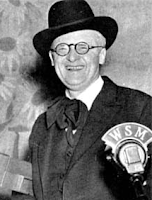
➦In 1925..."The Grand Ole Opry" debuted on WSM, Nashville under the name "Barn Dance". The first artist to perform on the show was fiddler Uncle Jimmy Thompson.

George Hay
In June 1928, the Opry got its name by an unusual coincidence: Soon after Program Director George D. Hay started his show, WSM radio joined the NBC radio network. Since the program followed a performance on the network called the Metropolitan Grand Opera. So, Hay decided to call his program the Grand Ole Opry.

Hay was born in Attica, Indiana. In Memphis, Tennessee, after World War I, he was a reporter for the Commercial Appeal, and when the newspaper launched its own radio station, WMC, in January 1923, he became a late-night announcer at the station. His popularity increased and in May 1924 he left for WLS in Chicago, where he served as the announcer on a program that became National Barn Dance.

On November 9, 1925 he moved on to WSM in Nashville. Getting a strong listener reaction to 78-year-old fiddler Uncle Jimmy Thompson, Hay announced the following month that WSM would feature "an hour or two" of old-time music every Saturday night. He promoted the music and formed a booking agency.

In the 1930s the show began hiring professionals and expanded to four hours; and WSM, broadcasting by then with 50,000 watts, made the program a Saturday night musical tradition in nearly 30 states. In 1939, it debuted nationally on NBC Radio. The Opry moved to a permanent home, the Ryman Auditorium, in 1943. As it developed in importance, so did the city of Nashville, which became America's "country music capital". The Grand Ole Opry holds such significance in Nashville that its name is included on the city/county line signs on all major roadways. The signs read "Music City | Metropolitan Nashville Davidson County | Home of the Grand Ole Opry".


Membership in the Opry remains one of country music's crowning achievements. Such country music legends as Hank Williams, Patsy Cline, Marty Robbins, Roy Acuff, the Carter family, Bill Monroe, Ernest Tubb, Kitty Wells and Minnie Pearl became regulars on the Opry's stage. In recent decades, the Opry has hosted such contemporary country stars as Dolly Parton, Alan Jackson, Garth Brooks, Reba McEntire, Josh Turner, Carrie Underwood, Brad Paisley, Rascal Flatts, Dierks Bentley, Blake Shelton and the Dixie Chicks. Since 1974, the show has been broadcast from the Grand Ole Opry House east of downtown Nashville, with an annual three-month winter foray back to the Ryman since 1999.

The Grand Ole Opry is broadcast live on WSM 650 AM at 7 p.m. CT on Saturday nights.

The Opry can also be heard live on Willie's Roadhouse on channel 59 on Sirius XM Satellite Radio. A condensed radio program, America's Opry Weekend, is syndicated to stations around the United States. The program is also streamed on WSM's website.

➦In 1932...Groucho Marx performed on radio for the first time. Besides, his film work Marx is best know for  his show 'You Bet Your Life' debuted in October 1947 on ABC radio (which aired it from 1947 to 1949) and then on CBS (1949–50), and finally NBC. The show was on radio only from 1947 to 1950; on both radio and television from 1950 to 1960; and on television only, from 1960 to 1961.

The show proved a huge hit, being one of the most popular on television by the mid-1950s. With George Fenneman as his announcer and straight man, Marx entertained his audiences with improvised conversation with his guests. Since You Bet Your Life was mostly ad-libbed and unscripted—although writers did pre-interview the guests and feed Marx ready-made lines in advance—the producers insisted that the network prerecord it instead of it being broadcast live.

There were two reasons for this: prerecording provided Marx with time to fish around for funny exchanges and any intervening dead spots to be edited out; and secondly to protect the network, since Marx was a notorious loose cannon and known to say almost anything.

The television show ran for 11 seasons until it was canceled in 1961.

➦In 1960...The CBS Radio Network expanded its Top of the Hours newscasts from 5 to 10 minutes.

➦In 1987...Pat St. John debuted on WNEW 102.7 FM, New York City. He was previously at WPLJ. In April 1973, St. John began an almost 15-year stint at New York's WPLJ. For most of his years at WPLJ he was rated by Arbitron as the most-listened-to afternoon radio personality in America. He survived the station's transition from AOR to top 40 in 1983.

Thursday, November 27, 2025

Radio History: Nov 27


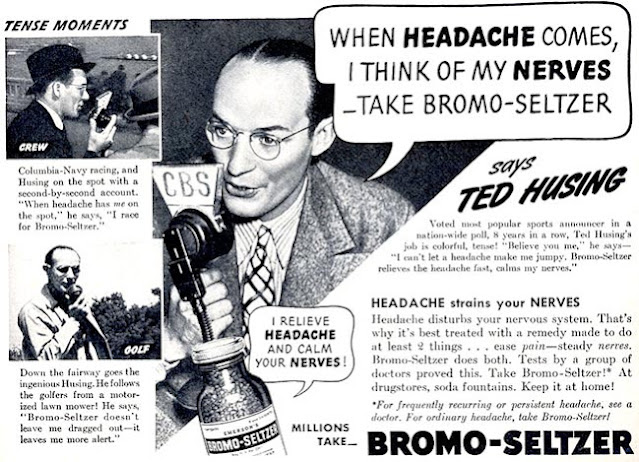
➦In 1901...Early radio sportscaster Ted Husing was born in the Bronx NY.

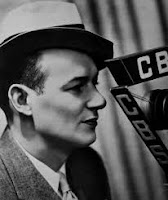
At age 16, he joined the National Guard and during World War I was assigned to stand watch over New York's harbor. Following the war, he floated between jobs such as carnival barker and payroll clerk. After he won an audition over 500 other applicants for announcer at New York City radio station WHN, Husing found his life's calling. He was schooled under the tutelage of pioneer broadcaster Major J. Andrew White. There he covered breaking news stories and political conventions and assisted White during football commentaries.

Ted Husing
By 1926, Husing was working at WJZ and his  rapid manner of speech earned him the nickname Mile a Minute Husing. His use of descriptive language combined with a commanding voice made his broadcasts must-listen events. By 1927, he was voted seventh most popular announcer in a national poll. Following a pay dispute, he moved to Boston, where he broadcast Boston Braves (now Atlanta Braves) baseball games.

Later in 1927, he returned to New York and helped his mentor, J. Andrew White, start the new CBS chain.  After cigar mogul William S. Paley bought the cash-strapped network in 1928, Ted Husing rose to new heights of glory and fame.

At CBS, Husing took on a wide variety of events. In 1929, he was named studio director of WABC (the CBS flagship station) in addition to continuing his work as an announcer for the network.

In addition to his sports preeminence, Husing also did news/special events coverage for the CBS Radio Network. In the 1930s, he gave early tutelage to a budding CBS Radio announcer, Mel Allen, who, like Husing, would become a legendary sportscaster. (And, like Husing, Allen would also understudy in news, with Robert Trout.) In 1933-1934, he was host of the Oldsmobile Program, providing sports news to complement music from other participants on the program.

In both sports and special events areas, Husing developed a bitter rivalry with rising NBC announcer Bill Stern. When the two became the sports stars of their rival networks (and eventually their networks' sports directors), they would battle fiercely not only for events but also for broadcast position.

Husing could be arrogant, coarse, and opinionated. He was the first to bring a candid, editorial style to sports play-by-play.


 In 1946 Husing moved fromCBS to WHN 1050 (later WMGM) to pursue a career as a disk jockey. (He was succeeded as CBS Radio's sports director by Red Barber.) Husing's popular music show the Ted Husing Bandstand ran from 1946 to 1954. He continued to busy himself with sports assignments, including boxing on CBS and DuMont television, one year (1950) as the radio voice of New York Giants football, and as host of DuMont's Boxing From Eastern Parkway from May 1952 to March 1953. Perhaps he was best known as the voice of Army football from 1947 to 1953. By that time, Husing's yearly salary was close to half a million dollars.

In the spring of 1954, an operation to treat a malignant brain tumor left him blind and forced him to retire. He died at age 60 in 1962.

In 1963, Husing became the second inductee of the National Sportscasters and Sportswriters Association Hall of Fame.  In 1984, Husing was part of the American Sportscasters Association Hall of Fame’s inaugural class which included sportscasting legends Red Barber, Don Dunphy, Graham McNamee and Bill Stern.

➦In 1926...KXL AM in Portland, Oregon signed-on with 50 watts of power. Today, the station is owned by Alpha Media, it calls are KXTG and the station airs sports talk at 750 AM.  KXL-FM airs news/talk on 101.9 FM.

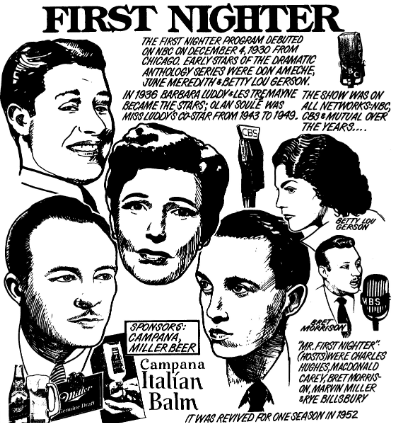
➦In 1930...“First Nighter” was first heard on NBC. It was a long-running 30-minute radio anthology comedy-drama series broadcast from November 27, 1930, to September 27, 1953. The host was Mr. First Nighter (Charles P. Hughes, Macdonald Carey, Bret Morrison, Marvin Miller, Don Briggs and Rye Billsbury (later known as Michael Rye).

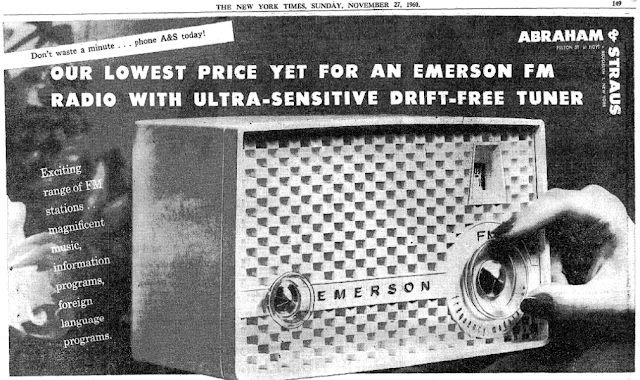
Ad for FM Radio, NY Times 11/27/60: $24.95

➦In 1960...the CBS Radio Network canceled "Have Gun Will Travel".  It was a Western series that was produced and originally broadcast by CBS on both television and radio from 1957 through 1963.

The television version of the series was rated number three or number four in the Nielsen ratings every year of its first four seasons, and it is one of the few shows in television history to spawn a successful radio version.  That radio series debuted November 23, 1958, more than a year after the premiere of its televised counterpart.

This series follows the adventures of a man calling himself "Paladin" (played by Richard Boone on television and voiced by John Dehner on radio), taking his name from that of the foremost knights in Charlemagne's court. He is a gentleman investigator/gunfighter who travels around the Old West working as a mercenary for people who hire him to solve their problems.

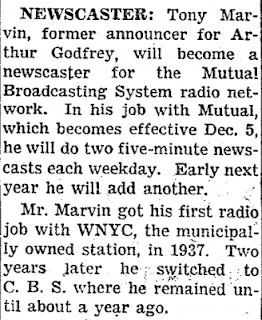
NY Times article 11/27/60

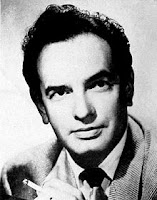
➦In 1960...Veteran announcer, newsman Tony Marvin joined the Mutual Broadcasting System.

Tony Marvin
Marvin's first job in radio was at WNYC in New York City. From there, he went to CBS as a staff announcer, beginning October 1, 1939.  A 1959 article in Radio and Television Mirror reported that at CBS "Tony did everything from daytime serials to symphonies and in 1946, when the Arthur Godfrey morning show was sustaining, Tony was assigned to it." When Godfrey's activities expanded from Arthur Godfrey Time to include Arthur Godfrey's Talent Scouts and Arthur Godfrey and his Friends, Marvin did the announcing for those shows as well.

Godfrey at times stirred controversy with his firing of his show's personnel. Marvin was the last of Godfrey's supporting players to go. He had been with Godfrey 12 years when he learned in 1959 that Godfrey would not need an announcer for the coming year.  Marvin's departure was widely perceived as a more amicable parting than Godfrey's previous dismissals of cast members, which were often abrupt.

Marvin branched out in 1958, adding a two-hour, Monday-Saturday disc jockey show on WABC to his other duties.

➦In 1962...In London, the Beatles recorded their first BBC radio session, performing "Twist and Shout," "Love Me Do," and "P.S. I Love You." The tracks aired later on the BBC program "Talent Spot."

➦In 1975...Bill Winters WCBS 101.1 FM personality died at age 35.