
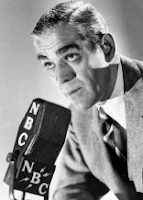
In a 50 year acting career highlighted by four Frankenstein films, he found time to make an impact in horror radio & TV productions. He is still heard today as the narrator of the annual TV cartoon favorite, How the Grinch Stole Christmas.
He died at age 81 Feb 2, 1969 from emphysema.
For his contribution to film and television, Boris Karloff was awarded two stars on the Hollywood Walk of Fame, at 1737 Vine Street for motion pictures, and 6664 Hollywood Boulevard for television.
➦In 1889…In San Francisco, the Palais Royal Hotel installed the first coin-operated machine that, by about 1940, was known as a "jukebox." Juke, at the time, was a slang word for a a disorderly house, or house of ill repute. The unit contained an Edison tinfoil phonograph with four listening tubes. There was a coin slot for each tube. 5 cents bought a few minutes of music. The contraption took in $1,000 in six months!
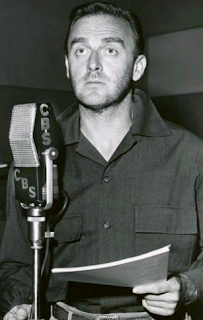 |
| John Dehner |
➦In 1915...actor John Dehner was born in Staten Island NY. After starting as a Disney animator & radio deejay, he started playing heavies in films & on radio shows such as Gunsmoke, Suspense, Escape and Yours Truly Johnny Dollar. He starred in The Hermit’s Cave and Frontier Gentleman on radio, and was Palladin in CBS Radio’s Have Gun Will Travel. TV series credits include Young Maverick, How the West was Won, Temperatures Rising, the Doris Day Show & the Don Knotts Show. He died of emphysema & diabetes Feb 4 1992 at age 76.
➦In 1938…Bob Hope recorded his future theme song with actress Shirley Ross. "Thanks For The Memory," debuted during the movie "The Big Broadcast of 1938." And in 1996, Hope set a record for the longest continuous contract in the history of Radio-TV when his last TV special aired. Hope had been with NBC for 60 years.
Hope's career in broadcasting began on radio in 1934. His first regular series for NBC Radio was the Woodbury Soap Hour in 1937, on a 26-week contract. A year later, The Pepsodent Show Starring Bob Hope began, and Hope signed a ten-year contract with the show's sponsor, Lever Brothers. He hired eight writers and paid them out of his salary of $2,500 a week. The original staff included Mel Shavelson, Norman Panama, Jack Rose, Sherwood Schwartz, and Schwartz's brother Al. The writing staff eventually grew to fifteen.
The show became the top radio program in the country. Regulars on the series included Jerry Colonna and Barbara Jo Allen as spinster Vera Vague. Hope continued his lucrative career in radio into the 1950s, when radio's popularity began being overshadowed by the upstart television medium.
His final television special, Laughing with the Presidents, with host Tony Danza helping him present a personal retrospective of presidents of the United States known to Hope, a frequent White House visitor over the years. Following a brief appearance at the 50th Primetime Emmy Awards in 1997, Hope made his last TV appearance in a 1997 commercial.
Hope died July 27, 2003 at the age of 100.
➦In 1959…Alan Freed was dismissed from his daily WNEW-TV show, "The Big Beat," over allegations that he accepted money to play certain records. Freed denied any wrongdoing.
➦In 1962…The Beatles did a ten-minute audition for BBC Television at St. James' Church Hall in London. But the “Beeb” did not like them. Brian Epstein received a rejection letter. They eventually made it on the BBC in 1963.
➦In 1964…The BBC banned The Rolling Stones after arriving late arriving for two BBC radio shows. The BBC cited the group for their "unprofessionalism."
➦In 1967…San Francisco radio personality Tom Donahue, inventor of "classic rock" and "deep cut" radio, told Rolling Stone magazine, "Top Forty radio, as we know it today and have known it for the last ten years, is dead, and its rotting corpse is stinking up the airwaves."
➦In 1992...country music legend Roy Acuff died of heart failure at age 89. Considered the most influential figure in the history of country music, Acuff rose to fame in the 1930’s when radio was more important than records, so his chart hits were relatively few. But he made country standards of songs like “The Wabash Cannonball,” “The Great Speckle Bird,” “Fireball Mail” and “Night Train to Memphis.”


