➦In 1912...Singer Kenny Baker born (Died from a heart attack at age 72 – August 10, 1985). He was a singer and actor who first gained notice as the featured singer on radio's The Jack Benny Program during the 1930s.
At the height of his radio fame, and after leaving the Benny show in 1939 (succeeded by Dennis Day, whose tenor voice was very similar to Baker's), he appeared in 17 film musicals, including Mr. Dodd Takes the Air (1937), At the Circus (1939), and The Harvey Girls (1946).
Baker returned to radio as a regular performer on Fred Allen's Texaco Star Theater program (1940–1942). He was also heard on Blue Ribbon Town (1943–1944) and Glamour Manor (1945–1947). He had his own programs, the Kenny Baker Show (1954) and Sincerely—Kenny Baker (1946). The latter was syndicated by the Frederick W. Ziv Company via electrical transcription.
➦In 1922...actor/director Lamont Johnson was born in Stockton Calif. When he was 16, Johnson began his career in radio, eventually playing the role of Tarzan in a popular syndicated series in 1951.He also worked as a newscaster and a disc jockey Johnson was also one of several actors to play Archie Goodwin in The New Adventures of Nero Wolfe, opposite Sydney Greenstreet on NBC Radio. He then turned to films and television, first as an actor, then as a director.
He became an active member of the Los Angeles radio acting pool.
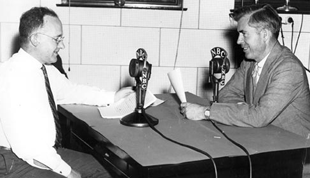 |
| "The National Farm and Home Hour" |
➦In 1929…“The National Farm and Home Hour" started airing as a variety show which was broadcast in various formats from 1928 to 1958. Aimed at listeners in rural America, it was known as "the farmer's bulletin board" and was produced by the United States Department of Agriculture with contributions from, and the cooperation of, various farm organizations (among them the American Farm Bureau, 4-H Club, Farmers Union, Future Farmers of America and the National Grange). Raymond Edward Johnson and, later, Don Ameche appeared in dramatic sketches in the role of the Forest Ranger.
With live coverage of livestock expositions, harvest festivals and "the most spectacular happenings in agricultural America," the program offered tips to farmers, music and news, plus advice from agencies and government officials.
The series first aired on Pittsburgh's KDKA (1928-29), moving to the Blue Network (later ABC) from September 30, 1929 to March 17, 1945, usually heard Monday through Saturday at 12:30 (Eastern). Under the sponsorship of Allis-Chalmers, it continued on NBC as a 30-minute show on Saturdays at noon (Eastern) from September 15, 1945 to January 25, 1958; in its final three years (1955-58), it would be incorporated into the Saturday lineup of NBC's weekend anthology Monitor.

➦In 1930…The radio anthology series "Death Valley Days," created. It also begin airing on TV in 1952. The series featuring true accounts of the American Old West, particularly the Death Valley country of southeastern California. Created in 1930 by Ruth Woodman, the program was broadcast on radio until 1945. From 1952 to 1970, it became a syndicated television series, with reruns (updated with new narrations) continuing through August 1, 1975. The radio and television versions combined to make the show "one of the longest-running western programs in broadcast history."
The series was sponsored by the Pacific Coast Borax Company (20 Mule Team Borax, Boraxo) and hosted by Stanley Andrews ("The Old Ranger") (1952–1964), Ronald Reagan (1964–1965), Rosemary DeCamp (1965), Robert Taylor (1966–1969), and Dale Robertson (1969–1970). With the death of Dale Robertson in 2013, all former Death Valley Days hosts are now deceased. Hosting the series was Reagan's final work as an actor; he left the series to run in 1966 for governor of California.
➦In 1933...WLS (then 870 AM) radio in Chicago's popular program The National Barn Dance went national with a move to NBC radio.


