WBZ's 50,000 watt signal on 1030 AM covered New England and reached into Canada and the Midwest at night. Dick Summer ran his Night-Light show after midnight. This is a small sample from the wee morning hours of May 6, 1964.
Saturday, December 25, 2010
Friday, December 24, 2010
Wednesday, December 22, 2010
Hot 97 DJ Suspended Indefinitely
On-air Haiti HIV crack sparks protests
Hot 97 radio bosses indefinitely suspended DJ Cipha Sounds Tuesday as dozens of Haitian community leaders stepped up their calls for his resignation.
According to a story at nydailynews.com, activists and elected officials gathered outside the radio station on Hudson St. to voice their anger at the DJ's on-air claim he is HIV-negative because he does not "mess with Haitian girls."
Cipha Sounds later apologized to listeners, calling it a "tasteless joke," and the station said he will begin sensitivity training focused on the Haitian community.
"Cipha made an immediate public apology and recognizes his insensitivity and the negative impact his comments have on all Haitians," said Alex Cameron, SVP/Market Manager of Emmis-New York.
Haitian-Americans said an apology was not enough.
Read more here.
 |
| NY Daily News photo |
According to a story at nydailynews.com, activists and elected officials gathered outside the radio station on Hudson St. to voice their anger at the DJ's on-air claim he is HIV-negative because he does not "mess with Haitian girls."
Cipha Sounds later apologized to listeners, calling it a "tasteless joke," and the station said he will begin sensitivity training focused on the Haitian community.
"Cipha made an immediate public apology and recognizes his insensitivity and the negative impact his comments have on all Haitians," said Alex Cameron, SVP/Market Manager of Emmis-New York.
Haitian-Americans said an apology was not enough.
Read more here.
Internet Gets New Rules of the Road
Consumers Guaranteed Right to View Content
Service Providers Allowed to Sell Faster, Priority Speeds for Extra Money
Consumers for the first time got federally approved rules guaranteeing their right to view what they want on the Internet. The new framework could also result in tiered charges for web access and alter how companies profit from the network.
Amy Schatz and Shayndia Raioce at wsj.com report the Federal Communications Commission on Tuesday voted 3-2 to back Chairman Julius Genachowski's plan for what is commonly known as "net neutrality," or rules prohibiting Internet providers from interfering with legal web traffic. President Barack Obama said the FCC's action will "help preserve the free and open nature of the Internet."
 The move was prompted by worries that large phone and cable firms were getting too powerful as Internet gatekeepers.
Most consumers haven't had a problem viewing whatever they want online; few instances have arisen of an Internet provider blocking or slowing services.
Rather, the FCC rules are designed to prevent potential future harms and they could shape how Americans access and use the Internet years from now. In the future, the Internet industry will be increasingly centered around the fastest-growing categories of Internet traffic—online video, gaming and mobile services, analysts say. Cisco Systems Inc., the broadband network provider, has forecast those services could quadruple by 2014.
The FCC's decision is a mixed bag for consumers. The new rules—which haven't been released in full—say that land-line broadband providers can't block legal content from websites, or "unreasonably discriminate" against companies like Skype or Netflix that want to use broadband networks to provide video or voice services. They also require providers to give consumers more information about their Internet service, like actual download speeds or usage limits.
Read more here.
Also read here: FCC's News Release
FCC Approves Net Rules and Braces for Fight (Media Decoder, NYTimes)
Service Providers Allowed to Sell Faster, Priority Speeds for Extra Money
Consumers for the first time got federally approved rules guaranteeing their right to view what they want on the Internet. The new framework could also result in tiered charges for web access and alter how companies profit from the network.
Amy Schatz and Shayndia Raioce at wsj.com report the Federal Communications Commission on Tuesday voted 3-2 to back Chairman Julius Genachowski's plan for what is commonly known as "net neutrality," or rules prohibiting Internet providers from interfering with legal web traffic. President Barack Obama said the FCC's action will "help preserve the free and open nature of the Internet."

Most consumers haven't had a problem viewing whatever they want online; few instances have arisen of an Internet provider blocking or slowing services.
Rather, the FCC rules are designed to prevent potential future harms and they could shape how Americans access and use the Internet years from now. In the future, the Internet industry will be increasingly centered around the fastest-growing categories of Internet traffic—online video, gaming and mobile services, analysts say. Cisco Systems Inc., the broadband network provider, has forecast those services could quadruple by 2014.
The FCC's decision is a mixed bag for consumers. The new rules—which haven't been released in full—say that land-line broadband providers can't block legal content from websites, or "unreasonably discriminate" against companies like Skype or Netflix that want to use broadband networks to provide video or voice services. They also require providers to give consumers more information about their Internet service, like actual download speeds or usage limits.
Read more here.
Also read here: FCC's News Release
FCC Approves Net Rules and Braces for Fight (Media Decoder, NYTimes)
Net Neutrality 101
CNN's Ali Velshi explains net neutrality and talks about the implications of new rules approved by the FCC.
Tuesday, December 21, 2010
Savage Wants Out Of TRN Contract

Savage's contract with Talk Radio expires at the end of December. He claims he's been offered a better syndication deal from Courtside radio.
Savage claims Talk Radio "is attempting to force Dr. Savage into accepting a substandard agreement containing what can only be described as an indentured servitude provision." Weiner is a Ph.D., not a medical doctor.
Talk Radio exercised its right to match the competing offer, but Savage says its offer "does not match the terms of the Courtside proposal." Savage claims the Talk Radio offer not only falls short "in terms of financial upside, but it includes anti-competitive provisions that are illegal, limits Savage's valuable negotiating rights, and imposes additions terms that are not contained in the Courtside proposal."
Savage claims his contract with Talk Radio "contains provisions that are illegal and unenforceable," and that Talk Radio is "attempting to use those provisions to force Savage to sign an agreement he is not interested in, and to force him into an arbitration that wholly ignores his due process rights."
He claims the deal from Courtside is "valued at several million dollars," and he could lose it if "forced to submit to an illegal arbitration."
He seeks a declaration that Talk Radio failed to match Courtside's proposal, that the matching proposal in his contract "has an indefinite term and is therefore unenforceable," and that the arbitration provision also is illegal and unenforceable.
FCC Gives Government Power to Regulate iNet

According to Amy Schatz at wsj.com, a divided Federal Communications Commission approved a proposal by Chairman Julius Genachowski to give the FCC power to prevent broadband providers from selectively blocking web traffic.
The rules will go into effect early next year, but legal challenges or action by Congress could block the FCC's action. Senate Minority Leader Mitch McConnell (R., Ky.) on Tuesday called the FCC's action "flawed" and said lawmakers would "have an opportunity in the new Congress to push back against new rules and regulations."
The new FCC rules, for example, would prevent a broadband provider, such as Comcast Corp., AT&T, Inc. or Verizon Communications Inc., from hobbling access to an online video service, such as Netflix, that competes with its own video services.
The rules would also require Internet providers to give subscribers more information on Internet speeds and service. Broadly, the rules would prohibit Internet providers from "unreasonably discriminating" against rivals' Internet traffic or services on wired or wireless networks.
Read more here.
"Men of Radio" Voting To Start Soon


The list of candidates to fill-in for Regis on an upcoming show has been released (see it here). Most of the names on the list are well-known from Howard Stern on Sirius to Ryan Seacrest on KIIS-FM LA. The list even includes personalities from smaller markets, such as Vijay Leonardo Das from WVRT Williamsport, PA to Foz from Z107 in Wilmington, NC.
They're all competing to co-host the syndicated daytime TV show with Kelly Ripa, when Regis Philbin goes on vacation.
Voting opens January 10
Katie, CBS To Talk Next Month

Couric's five-year, $75 million deal expires in May. A report yesterday that she had already begun renegotiating her contract was shot down by insiders.
"Her contract is up in May. It would make more sense for things to heat up by mid-January," said one industry source.
"There have been no offers extended by CBS."
Couric, who's failed to move the "Evening News" ratings needle since taking over in September 2006, is reportedly being wooed by CNN and by syndicators (to host a daytime talk show).
Read more here.
Tom's Take: the bump in the road is an expected pay cut for Katie.
WGN Radio Announces WGN Sports Night
720 AM WGN Radio has announced that a new program focusing on sports and the day's big stories will air weekdays 7-10 p.m. "WGN Sports Night" will feature a cast including WGN Radio sports veteran David Kaplan, rotating co-hosts, news anchor Andrea Darlas, and many big name guests.
 The co-host roster will include some of the biggest names from the Chicago media and sports world, including Cubs TV play-by-play broadcaster Len Kasper, former Chicago Bears wide receiver and WGN Radio broadcaster Glen Kozlowski, WGN Radio host Brian Noonan, Chicago Tribune sportswriters David Haugh, Teddy Greenstein and Phil Rogers, Big Ten Network personality Tim Doyle and WGN Radio sports director Dave Eanet. The show will also feature regular "insiders" such as Cubs general manager Jim Hendry, Cubs manager Mike Quade, Northwestern football head coach Pat Fitzgerald, Blackhawks radio play-by-play broadcaster John Wiedeman and Blackhawks TV color commentator Eddie Olczyk.
"WGN Sports Night", debuting this Thursday, December 23, will air weekday evenings when the Cubs, Blackhawks and the Northwestern Wildcats are not playing.
Read more here.
"WGN Sports Night", debuting this Thursday, December 23, will air weekday evenings when the Cubs, Blackhawks and the Northwestern Wildcats are not playing.
Read more here.
The Current State Of Podcasting
The Current State of Podcasting 2010 is Edison's fifth annual study of the behaviors, attitudes and consumption habits of the podcast audience in America. This study was originally presented at the Blogworld New Media Expo in Las Vegas on October 15, 2010. This presentation combined previously unreleased data from the Edison Research/Arbitron Internet & Multimedia series, along with previously released data from The American Youth Study 2010 and the Edison/ADM Consumer Attitudes to Podcast Advertising study, also from 2010.
Principal findings of the study included:
- The percentage of Americans who have ever watched or listened to a podcast is 45%, up from 43% one year ago. This equates to approximately 70 million Americans 12+.
- The podcast audience has migrated from being predominantly "early adopters" to more closely resembling mainstream media consumers.
- Podcast consumers continue to prefer consuming content at their desktop, not on dedicated media players, but mobile phone media consumption is surging.
- Podcast consumers index very highly for social networking behaviors.
- Two-thirds of podcast consumers have listened to digital audio files in their vehicles by connecting an iPod or other MP3 player to their car audio system.
Monday, December 20, 2010
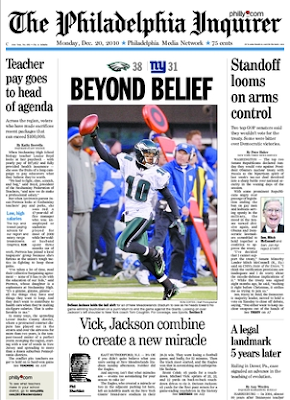
NYPost Wins Giants Debacle Headline War
Depending on your point of view, this is either one of the greatest comebacks or worst chokes in NFL history. Or, more likely, it's a combination of the two. Take a look as the local papers headlines the game.




CNN's New Chief Dives In
As Network Loses Ground, Ken Jautz Moves to Inject 'Passion and Personality'
Ken Jautz, the new head of CNN's U.S. network, is getting his hands dirty.
According to Sam Schechner at wsj.com, since taking over in late September, Mr. Jautz has started shuffling programming and personnel, looking to turn around a steep slide in audience with injections of personality and debate.
Last week, Mr. Jautz overhauled the network's struggling morning show. He also has replaced a daytime anchor and pushed Anderson Cooper to be more confrontational in his evening show.
Now Mr. Jautz is shepherding perhaps the biggest change at the news network: Installing former British tabloid editor Piers Morgan as the 9 p.m. replacement for interviewer Larry King.
"Overall, we have to be more viewer-focused. We have to make our programming more interesting," Mr. Jautz said in an interview. "I think sometimes we have been flat."
 Some viewers agree. So far this year, an average of 436,000 people in the U.S. have watched Time Warner Inc.'s CNN at any given time of day, down 29% from the same point last year, according to Nielsen Co. In the evening, the picture is bleaker—with the audience down 35% from a year ago and off 23% from 2007, before the 2008 election boosted viewership.
By contrast, MSNBC and Fox News have posted sharp gains since 2007.
Read more here.
Ken Jautz, the new head of CNN's U.S. network, is getting his hands dirty.
According to Sam Schechner at wsj.com, since taking over in late September, Mr. Jautz has started shuffling programming and personnel, looking to turn around a steep slide in audience with injections of personality and debate.
Last week, Mr. Jautz overhauled the network's struggling morning show. He also has replaced a daytime anchor and pushed Anderson Cooper to be more confrontational in his evening show.
Now Mr. Jautz is shepherding perhaps the biggest change at the news network: Installing former British tabloid editor Piers Morgan as the 9 p.m. replacement for interviewer Larry King.
"Overall, we have to be more viewer-focused. We have to make our programming more interesting," Mr. Jautz said in an interview. "I think sometimes we have been flat."

By contrast, MSNBC and Fox News have posted sharp gains since 2007.
Read more here.
Opinion: The FCC's Threat to Internet Freedom
'Net neutrality' sounds nice, but the Web is working fine now. The new rules will inhibit investment, deter innovation and create a billable-hours bonanza for lawyers..
From FCC Commissioner Robert M. McDowell, OpEd for the Wall Street Journal:
From FCC Commissioner Robert M. McDowell, OpEd for the Wall Street Journal:
Read more here.Tomorrow morning the Federal Communications Commission (FCC) will mark the winter solstice by taking an unprecedented step to expand government's reach into the Internet by attempting to regulate its inner workings. In doing so, the agency will circumvent Congress and disregard a recent court ruling.
How did the FCC get here?
For years, proponents of so-called "net neutrality" have been calling for strong regulation of broadband "on-ramps" to the Internet, like those provided by your local cable or phone companies. Rules are needed, the argument goes, to ensure that the Internet remains open and free, and to discourage broadband providers from thwarting consumer demand. That sounds good if you say it fast.
Nothing is broken and needs fixing, however. The Internet has been open and freedom-enhancing since it was spun off from a government research project in the early 1990s. Its nature as a diffuse and dynamic global network of networks defies top-down authority. Ample laws to protect consumers already exist.
Furthermore, the Obama Justice Department and the European Commission both decided this year that net-neutrality regulation was unnecessary and might deter investment in next-generation Internet technology and infrastructure.

The Web Passes Newspapers in Ad Spending
Advertisers will spend more on internet ads in 2010 than newspaper ads for the first time, according to new estimates by eMarketer, according to a posting by Clark Fredricksen.
Online ad spending will grow 13.9% to $25.8 billion for the full year in 2010, while advertisers are expected to spend just $22.78 billion on print newspaper ads this year, down 8.2% from 2009, eMarketer estimates.
 Total newspaper ad revenues from print and online ads are expected to hit $25.7 billion this year, still shy of the $25.8 billion advertisers will spend on internet ads.
Read more here.
Online ad spending will grow 13.9% to $25.8 billion for the full year in 2010, while advertisers are expected to spend just $22.78 billion on print newspaper ads this year, down 8.2% from 2009, eMarketer estimates.

Read more here.
Scam: Cracking the NYTimes Popularity Code
Just how many people does it take to propel a story onto the Times' influential most-emailed list? And can it be gamed? Thomas E. Weber at The Daily Beast finds the answers.
 The author instructed a group of people to e-mail the highlighted article within a relatively short timeframe.

The most-emailed articles list on the New York Times website is one of the Internet's key barometers of news and trends, an essential way for the world to stumble onto stories and ideas that might otherwise get lost in the ether of the perpetual news cycle. Thus, careful watchers might have been puzzled by a seemingly out-of-place story last week. Among the latest news, feature and opinion pieces was a three-week-old science section story about a soon-to-close exhibition on cuneiform clay tablets. What could have propelled a stale, bone-dry story to the top of the Internet's importance arbiter?Read more here.
I can tell you: It was me.
More precisely, it was a group of people under my direction who all, at my request, emailed that particular story within a relatively short timeframe to learn exactly what it take to make the most-emailed list.
How we did it—and how many people it took— reinforces a lesson of our viral media age: Even at the biggest newspaper website in the world, the content that is spotlighted as most engaging reflects the judgment of a group far smaller than the overall audience, and can even be gamed by those motivated enough to do so.
So how many emails does it take to make the list? We started several weeks ago by recruiting a cadre of friends and colleagues who agreed to stand by and, when instructed, visit the Times website, view the designated article and use the site's email function to have the article sent to a friend. Next we selected an article that was unlikely to have many, if anyone, emailing it on their own.
Subscribe to:
Posts (Atom)