After years of booming growth, the subscription-based media model is hitting roadblocks, with “streaming fatigue” surging among audio users amid economic pressures. New research indicates this trend could spell opportunity for traditional radio.
A December 2024 survey revealed that 27.8% of Americans feel overwhelmed by the proliferation of paid platforms, driving noticeable behavioral shifts. The average monthly spend on streaming services dropped 23% to $42.38 in 2025 from $55.04 the previous year.
Edison Research’s Share of Ear Q1 2025 report shows that 51% of Americans aged 13 and older pay for at least one audio subscription, a figure unchanged since 2022. However, the trend masks a significant shift: the proportion paying for just one audio service rose from 28% in 2022 to 35% in 2025, while those subscribing to more than two services plummeted from 13% to 6%.
While Americans aren’t abandoning audio subscriptions entirely, they’re clearly cutting back. Digital Music News reported a 5% decline in Spotify’s U.S. paid subscribers since early 2025, though Spotify disputes this, citing 12% global subscriber growth year-over-year in Q1.
Meanwhile, traditional radio continues to dominate ad-supported audio. Nielsen and Edison Research’s The Record Q1 2025 analysis found that radio captures 66% of time spent with ad-supported audio among adults 18+, far ahead of podcasts at 19%. Despite the rise of digital audio, free broadcast radio remains the go-to ad-supported medium.
This shift toward simpler listening habits highlights radio’s enduring appeal: free, seamless access to reliable content without subscriptions, logins, or limits. As listeners pare down streaming services or grow frustrated with complex interfaces, radio is poised to reclaim ground in the audio landscape.
Shocking accounts of sex-fueled marathons involving gallons of baby oil, brutal physical assaults leaving the victim bloodied and vomiting, and a chilling threat to blow up a romantic rival’s car dominated the first week of Sean Combs’s criminal trial in Manhattan federal court.
Casandra Ventura, the music mogul’s former longtime girlfriend, delivered a raw and unflinching testimony that laid bare a world of unchecked excess, implicating both herself and the man known as “Diddy,” “P. Diddy,” or “Puff Daddy.”
Ventura’s testimony marks the opening chapter of an anticipated eight-week trial, aiming to convince jurors that Combs, 55, was not just an abusive partner but the mastermind of a criminal enterprise.
Charged with racketeering conspiracy, sex trafficking, and transportation for prostitution, Combs faces the possibility of life in prison. Prosecutors allege his operation facilitated the sex trafficking of three women and committed crimes including arson, kidnapping, and more, dating back to 2004.
Ventura’s vivid account—detailing coerced sexual encounters with male escorts at Combs’s so-called “freak-offs” while he watched and violent outbursts fueled by jealousy—sets the emotional and factual groundwork for the prosecution. “Her testimony frames the case, both emotionally and in outlining the scope of the alleged crimes,” said Rachel Maimin, a former federal prosecutor in the Southern District of New York.
As the trial progresses, prosecutors will build on Ventura’s testimony with additional witnesses and evidence, potentially including videos of Combs’s notorious sex parties. The goal is to prove he ran a sophisticated criminal network, not merely indulged in a decadent lifestyle.
Combs’s defense, led by attorney Teny Geragos, admits he was a flawed man prone to domestic violence and jealous rages but argues his actions don’t constitute federal crimes. “He’s not on trial for being a jerk,” Geragos said. “He’s accused of running a racketeering enterprise.”
On the second night of his “Land of Hopes and Dreams” tour in Manchester, England, Bruce Springsteen responded defiantly to Donald Trump’s attacks. After Trump labeled him an “obnoxious jerk” and a “dried out ‘prune’ of a rocker” on Truth Social, urging him to “keep his mouth shut,” Springsteen delivered a three-minute speech at the Co-op Live venue.
Springsteen words were short on reality, but what one would expect of someone influenced by legacy media. He addressed the crowd, saying, “Things are happening right now that are altering the very nature of our country’s democracy, and they’re too important to ignore.”
Reiterating points from his first Manchester show that provoked Trump, Springsteen criticized the administration for defunding universities, rolling back civil rights, and aligning with dictators.
Despite Trump’s veiled threat—“We’ll see how it goes for him” upon returning to the U.S.—Springsteen pressed on, condemning the persecution of free speech, the neglect of impoverished children, and the mistreatment of American workers.
He further accused authorities of deporting residents to foreign detention centers without due process and elected officials of failing to curb an “unfit president” and “rogue government.” The crowd roared in support as he declared, “They have no concern or idea of what it means to be deeply American.”
Ending on an optimistic note, Springsteen affirmed, “The America I’ve sung about for 50 years is real… and we will survive this moment.” Quoting James Baldwin, he added, “In this world, there isn’t as much humanity as one would like, but there’s enough.”
A longtime Trump critic, Springsteen campaigned for Kamala Harris in 2024. Trump frequently targets celebrities like Taylor Swift and Robert DeNiro for similar criticisms.
The Corporation for Public Broadcasting (CPB), which oversees taxpayer-funded outlets like NPR and PBS, has revised its bylaws to protect board members from removal.
The new rule states that “no Director may be removed from the Board by any person or authority, including the President of the United States, without a two-thirds vote of the other Directors confirming such removal.”
This change follows President Trump’s outspoken criticism of public broadcasters, accusing them of biased coverage against conservatives and urging GOP lawmakers to cut their federal funding.
The CPB board, appointed by the president and confirmed by the Senate for six-year terms, sets policies and funding priorities.
Tensions escalated last month when Republican lawmakers questioned NPR CEO Katherine Maher and PBS CEO Paula Kerger in a congressional hearing, challenging their editorial decisions and funding models—comprising federal grants, member station contributions, and private donations—for alleged liberal bias.
In response, Maher issued a memo reaffirming NPR’s dedication to serving the entire nation and engaging a politically diverse audience with greater attentiveness.
At the NBCUniversal Upfront on last week Peacock emerged as the star, underscoring NBCU’s pivot to a streaming-first approach for the spring upfront sales season. The company spotlighted Peacock’s expanding role in scripted content, live sports, and major events, positioning it as a cornerstone of its portfolio.
NBCU unveiled five exclusive scripted shows for Peacock, including one comedy and four dramas, while emphasizing the streamer’s dominance in live sports. “Peacock was built on sports,” said Mark Marshall, chairman of NBCUniversal global advertising and partnerships.
He noted that Peacock will offer over 7,500 hours of sports content in the next year, outpacing competitors like AppleTV+, Hulu, Max, Netflix, Paramount+, and Prime Video combined. Key live events include “Sunday Night Football,” the Macy’s Thanksgiving Day Parade, NBA All-Star Weekend, the 2026 Winter Olympics from Milan, and Super Bowl LX, many of which will also air on NBC.
Fox News host Harris Faulkner has been fiercely competitive with ABC’s “The View” in 2025 ratings, despite her show, “The Faulkner Focus,” reaching fewer households. Faulkner credits her success to her commitment to “telling the truth” and presenting diverse perspectives, resonating with viewers seeking an alternative to the network panel show.Since January 2025, “The Faulkner Focus” has averaged 2.3 million viewers per Nielsen ratings, closely trailing The View’s 2.5 million.
In January, during President Donald Trump’s inauguration, Faulkner’s 11:00 a.m. EDT program occasionally surpassed the ABC show, which features hosts like Whoopi Goldberg, Joy Behar, Alyssa Farah Griffin, and Sunny Hostin.
MSNBC hired Sudeep Reddy, a veteran journalist and senior managing editor at Politico, to serve as its first-ever Washington, D.C. Bureau Chief, a move announced on May 15, 2025.
MSNBC needs to establish a standalone D.C. bureau as it prepares to separate from NBCUniversal and Comcast later in 2025, forming a new company called Versant that will include MSNBC and other Comcast cable networks like CNBC and USA Network.
The new bureau, located at the Hall of States building (separate from NBC News’ offices in the same complex), aims to bolster MSNBC’s independent news-gathering capabilities, as the network will no longer rely on NBC News’ reporting resources post-spinoff.
Reddy, who starts on June 16, 2025, brings extensive experience from his eight-year tenure at Politico, where he led a newsroom of 150 journalists, launched products like newsletters, podcasts, and live events, and built the outlet’s first audio team. Before Politico, he spent a decade at The Wall Street Journal, primarily as an economics editor in D.C., covering U.S. and global economic issues, the Federal Reserve, and the financial crisis. His earlier career included roles at The Dallas Morning News and reporting on energy and business in Texas.
YouTube has unveiled a new Weekly Top Podcast Shows Chart, positioning it as a competitor to Spotify and Apple’s rankings. Leading the chart are podcasts like “The Joe Rogan Experience,” “Kill Tony,” and “Rotten Mango.”
Owned by Alphabet, YouTube reports that podcasts on its platform generate over one billion monthly active views. According to Edison Research in October, YouTube surpasses Spotify and Apple as the preferred platform for podcast listening. Ben Meiselas, co-founder of The MeidasTouch Podcast, highlighted YouTube’s superior cost-per-mile (cost per thousand impressions) compared to other platforms. “YouTube isn’t just a dumping ground for content from elsewhere,” Meiselas said. “We aim to make it a primary channel, like cable news.”
With nearly five million subscribers, MeidasTouch averages 350 million monthly views on YouTube, while also distributing on Spotify, Apple Podcasts, Substack, and Patreon. Video podcasts remain a dominant media trend, frequently highlighted at this year’s Upfronts.
Spotify has invested heavily, disbursing over $100 million to podcasters globally in Q1 2025 and enhancing video capabilities. Still, YouTube’s creator payouts and vast user base make it critical for podcasters seeking reach.
The U.S.-focused YouTube chart, updated every Wednesday, ranks podcasts by watch time.
Apple has launched CarPlay Ultra, the next generation of its CarPlay software, marking a significant upgrade to its in-car infotainment system. Announced last week, and initially rolling out with Aston Martin vehicles in the U.S. and Canada, CarPlay Ultra aims to deliver a deeply integrated, customizable, and seamless in-car experience.
Key Features of CarPlay Ultra: Multi-Screen Integration Unlike the original CarPlay, which primarily operated on the main infotainment screen, CarPlay Ultra extends to all driver screens, including the instrument cluster. This means Apple-styled gauges, speedometers, tachometers, fuel levels, and navigation directions appear across the dashboard, creating a unified interface.
The system reflects the automaker’s branding, allowing for customizable layouts, themes, and color schemes that align with the vehicle’s design philosophy (e.g., a Porsche might feature a houndstooth background).
Deeper Vehicle Integration CarPlay Ultra controls core vehicle functions like climate control, seat adjustments, and other systems directly through the interface or via Siri voice commands, reducing reliance on the car’s native controls.
It accesses real-time vehicle data, displaying metrics like torque, horsepower, tire pressure, and electric vehicle charge status, making it a comprehensive in-car operating system.
Enhanced App Support and Widgets New apps include Auto Settings, Climate, and an FM Radio app, with support for third-party apps expected to expand.
Dynamic widgets allow drivers to prioritize information like navigation, calendar events, weather, or music controls on the dashboard. Split-screen functionality enables multitasking, such as viewing maps alongside messages.
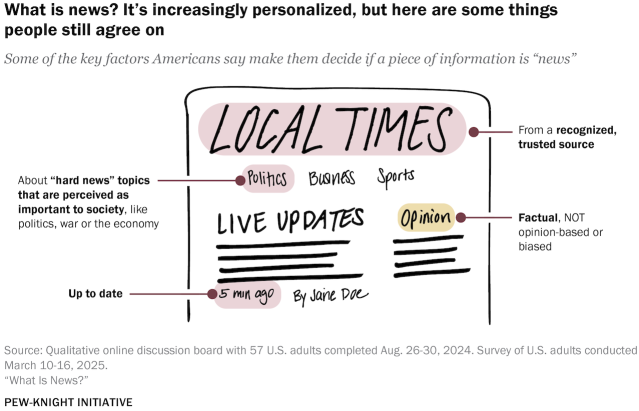
The Pew Research Center’s report, What News Is (and Isn’t) According to Americans, released last week, examines how Americans perceive "news" amid a flood of information sources. Based on surveys and online discussions, here are the findings:
Personal Relevance Matters Americans define news as information that’s personally impactful, like local events or policies affecting daily life, rather than just traditional reporting.
Blur of News, Opinion, and Entertainment
The line between news, opinion, and entertainment is fuzzy, with social media mixing factual reporting with commentary or gossip, making categorization tricky.
Trust Hinges on Evidence
News feels credible with eyewitness accounts, on-the-ground footage, or documented sources.
AI-generated or manipulated media fuels skepticism about visual content.
In-depth, contextual reporting is valued over brief, shallow clips.
Emotional Responses Vary News tied to personal interests sparks curiosity, while sensational or polarizing content breeds frustration or distrust, with some viewing mainstream news as emotionally manipulative.
Source and Political Alignment Trust in sources varies, with traditional outlets, influencers, and social media all in play.
Political alignment matters less than relevance and credibility, though 21% of Americans (37% under 30) get news from influencers, signaling a shift to non-traditional sources.
➦In 1921..Station 9ZAF in Denver broadcast the opera Martha in its entirety from the Denver Auditorium. This event is recognized as one of the earliest instances of an opera being presented complete over the radio in the United States, marking an important step in the use of radio for cultural and entertainment programming. While another source claims Mozart’s The Impresario on WJZ in March 1922 as the first opera broadcast, the Martha broadcast is widely cited as a pioneering achievement in early radio.
➦In 1922..WGN Radio signed-on as WDAP.It was granted the sequentially issued call letters WDAP to Mid West Radio Central, Inc. in Chicago. The corporation was headed by Thorne Donnelley and Elliott Jenkins.
WDAP was originally located at the Wrigley Building. The studios were moved to the Drake Hotel the following July. In mid-1923 ownership was transferred to the Board of Trade, and the next year the Whitestone Company, managers of the Drake Hotel, took control.
The Chicago Tribune purchased WDAP, and on June 1, 1924, renamed it WGN. The call letters came from "World's Greatest Newspaper", a slogan used since 1911.
Elliott Jenkins, left, and Thorne Donnelly, right, are the original owners of WDAP, the predecessor to WGN radio. Jenkins and Donnelly are at their transmitter in the Wrigley Building in 1922. This 50 watt transmitter was built up from component parts by station engineers and was moved over to the Drake Hotel at the latter part of 1922.
The pioneering WDAP shifted its studios to two handball courts atop the Drake Hotel in July 1922 after a sudden violent storm destroyed its inaugural antenna, with pieces “picked up in all directions for weeks,” Jenkins wrote in a 1923 edition of Radio Broadcast. The station gained some early listeners, including Chicago Tribune publisher Col. Robert McCormick, who wrote to his mother, “you cannot help being thrilled at the little box that picks sounds from the air,” according to a WGN history published by the station in 1961.
Early programming was noted for its creativity and innovation. It included live music, political debates, comedy routines, and some of radio's first sporting event broadcasts, including the 1924 Indianapolis 500, and a live broadcast of the 1925 Scopes Trial from Dayton, Tennessee. In 1926, WGN broadcast Sam & Henry, a daily serial with comic elements created and performed by Freeman Gosden and Charles Correll. After a dispute with the station in 1927, Gosden and Correll took the program's concept and announcer Bill Hay across town to WMAQ and created the first syndicated radio show, Amos 'n' Andy.
A perennial ratings powerhouse, WGN Radio had double-digit audience shares and millions of regular listeners from the 1960s through the 1980s, when Wally Phillips, Bob Collins, Roy Leonard and other legendary broadcasters ruled the airwaves. In the spring of 1986, as Phillips was ceding the morning show to Collins after nearly 20 years, he still had a 15.7 audience share, nearly double the nearest competitor.
Today, the station is the only radio station in the Nexstar portfolio.
➦In 1926...inventor Thomas Edison spoke at a dinner for the National Electric Light Association in Atlantic City, NJ. Reportedly, when asked to speak into the microphone, he said, “I don’t know what to say. This is the first time I ever spoke into one of these things … Good night.”
Meredith Wilson (far left) and band at KPO Studios, San Francisco
Meredith Wilson
➦In 1902...Composer/bandleader/radio personality Meredith Willson was born in Mason City, Iowa.
Besides his celebrity as the creator of the Broadway smash, ‘Music Man.’ Willson was a giant in radio.
In San Francisco, Willson was concert director for radio station KFRC, and then as a musical director for the NBC radio network in Hollywood. His on-air radio debut came on KFRC in 1928 on Blue Monday Jamboree.
His work in films included composing the score for Charlie Chaplin's The Great Dictator (1940) (Academy Award nomination for Best Original Score), and arranging music for the score of William Wyler's The Little Foxes (1941) (Academy Award nomination for Best Music Score of a Dramatic Picture).
During World War II, he worked for the United States' Armed Forces Radio Service. His work with the AFRS teamed him with George Burns, Gracie Allen and Bill Goodwin. He would work with all three as the bandleader, and a regular character, on the Burns and Allen radio program. He played a shy man, always trying to get advice on women. His character was ditsy as well, basically a male version of Gracie Allen's character.
He suffered heart failure and died June 15, 1984 at age 82.
➦In 1934...‘The Hour of Charm’ debuted, beginning an intermittent 14-year run on the CBS and NBC radio networks. The musical half-hour featured Phil Spitalny and his All-Girl Orchestra.
➦In 1942...radio’s espionage adventure drama 'Counterspy' premiered on the Blue Network/ABC. The 30-minute show with the distinctive theme (Love of Three Oranges) would last on radio for 15 years, including runs in the 1950s on NBC and Mutual.
➦In 1966...there was a Top 40 battle in Denver between KIMN 950 AM and KBTR 710.
Listeners were tuning in to hear Gary Todd, Robert E. Lee, Jim O’Brien, Chuck Buell, Hal Moore, JayMack, Johnny Presley, George Michael.
KEWB Playlist - circa 1960
➦In 1966...KEWB 910 AM San Francisco switched from Top40 to easy listening. The station was probably anticipating the arrival of Drake-formatted KFRC 610 AM. KEWB switched its call letters to KNEW and mimicked sister station WNEW in NYC.
In Sean "Diddy" Combs' sex trafficking trial, pop singer Dawn Richard testified on Friday that she frequently witnessed Combs physically assault his then-girlfriend, Casandra "Cassie" Ventura, during their 11-year relationship. Richard described a 2009 incident at Combs’ Los Angeles home where he beat Ventura, dragged her upstairs by her hair, and later screamed and assaulted her again in front of others. The next day, Combs allegedly gave Richard and other witnesses flowers, warning that their careers would suffer if they reported the incident.
Combs, 55, faces five felony charges, including racketeering conspiracy, sex trafficking, and prostitution-related offenses, with a potential sentence of 15 years to life if convicted. He has been detained in a Brooklyn jail since his arrest in September and has pleaded not guilty.
Casandra "Cassie" Ventura's Testimony: Ventura, Combs' former girlfriend and a central witness, concluded her testimony after nearly 20 hours over four days. On this final day, she faced cross-examination from Combs' defense attorney, Anna Estevao, who focused on Ventura's relationship with Combs, highlighting affectionate and sexually explicit text messages to suggest mutual consent in their activities, including the "Freak Offs" (drug-fueled sex parties).
Ventura testified that Combs was sometimes kind, but these periods were fleeting, and she reiterated instances of physical abuse, including a 2016 hotel assault captured on surveillance video where Combs dragged and kicked her.
She clarified that Combs' controlling behavior, such as taking her phone or passport when angry, persisted. Ventura also addressed drug use, noting both she and Combs used drugs heavily, but she could not confirm if Combs was in a "blackout" during the 2016 incident. The defense suggested Ventura encouraged some "Freak Offs," but she countered that Combs' texts often implied demands for such events, which she felt compelled to follow due to their long relationship dynamics.
After her testimony, Ventura’s attorney, Douglas Wigdor, read a statement outside court where she thanked supporters and vowed to never forget Combs’ alleged actions, emphasizing her testimony aimed to empower other survivors. Her husband, Alex Fine, commended her bravery in a statement also read by Wigdor.
Dawn Richard’s Testimony: Dawn Richard, a former member of Diddy Dirty Money and Danity Kane, testified about witnessing Combs violently assault Ventura in 2009 at his Los Angeles home. Richard recounted seeing Combs attack Ventura, hitting her in the head, kicking her while she was in a fetal position, and dragging her upstairs amid yelling and breaking glass. She described Combs swinging a skillet at Ventura and demanding his phone and eggs. Richard said she was scared for both Ventura and herself, which prevented her from intervening or calling the police. She further testified that the next day, Combs summoned her and another woman, Kalenna Harper, to his home, gave them flowers, and warned that speaking about the assault would harm their careers. Richard’s testimony was briefly interrupted for a sidebar discussion regarding a defense objection to her description of Combs’ threats.
Special Agent Yasin Binda’s Testimony: Homeland Security Investigations Special Agent Yasin Binda, who handled logistics for Combs’ arrest on September 16, 2024, at the Park Hyatt hotel in Manhattan, testified about evidence recovered during a search of Combs’ hotel room. Jurors were shown photos of items including two Ziploc bags containing Johnson’s baby oil and Astroglide lubricant found in an entryway closet, additional bottles of baby oil and lubricant in the bathroom and on a nightstand, and a device for “mood lighting,” which Ventura had previously linked to "Freak Off" settings. Binda also presented a pill bottle containing clonazepam under the alias “Frank Black,” which Ventura testified Combs used, and glassine bags with pink powder testing positive for ketamine and MDMA. The jury examined these exhibits, which prosecutors tied to the "Freak Off" allegations.
Separately, Justin Bieber’s representative clarified that Bieber is not a victim of Combs but supports victims seeking justice, according to TMZ and People.
In a scathing speech at the 2025 Media Institute Communications Forum in Washington, DC, FCC Commissioner Anna Gomez, a 2023 Biden appointee, accused the agency of being “weaponized to chill speech and punish the press” without directly naming its Trump-appointed chair, Brendan Carr.
Gomez condemned the FCC’s recent actions as a “dangerous precedent,” transforming an independent regulator into a tool of political censorship.
Gomez criticized Carr’s moves to target media outlets unfavorable to President Donald Trump, including investigations into PBS and NPR’s sponsorship practices, a reopened CBS probe for alleged “news distortion,” complaints against ABC over a Trump-Harris debate, and new inquiries into NBCUniversal and Disney’s diversity policies.
“This FCC will go after any news outlet that dares to report the truth if it’s unfavorable to this administration,” she said, praising past FCC chairs who resisted using licensing authority as a weapon.
As the sole Democrat on the five-member commission after Commissioner Geoffrey Starks’ upcoming resignation, Gomez vowed to speak out against the government’s use of regulatory tools to violate the First Amendment.
She warned that some media outlets are yielding to government pressure, citing CBS News and “60 Minutes” as examples. CBS’s parent, Paramount Global, is reportedly considering settling a Trump lawsuit alleging “60 Minutes” manipulated a Harris interview, amid pressures tied to a merger with Skydance Media requiring FCC approval. This has led to editorial changes, with “60 Minutes” executive producer Bill Owens resigning in April, citing a loss of independence, and host Scott Pelley noting Paramount’s new content oversight.
“Pardon my language, but that is a B.F.D.,” Gomez said of the “60 Minutes” situation, emphasizing that a free press requires independent journalists. She concluded by pledging to uphold her duties, even if it leads to her removal: “If I’m removed, it’s because I insisted on doing my job.”
Over 20 conservative organizations and individuals, spearheaded by Heritage Action for America, sent a joint letter to FCC Chairman Brendan Carr, pressing for a major overhaul of outdated broadcast ownership regulations from the 1940s. The coalition argues these rules stifle local radio and TV broadcasters’ ability to compete in today’s digital media environment.
“These rules may have served the public interest in last century’s marketplace,” the letter reads, “but they are now antiquated and harmful, curbing investment and innovation in broadcasting.”
The groups urge the FCC to eliminate the 39% national television ownership cap, local TV duopoly restrictions, and local radio ownership limits. Such changes, they claim, would enable broadcasters to gain the scale and efficiencies needed to compete in a fragmented media market and attract critical investment. The letter highlights regulatory disparities, noting that broadcasters face strict audience reach limits while tech giants like YouTube and Facebook operate without similar constraints.
National Association of Broadcasters President and CEO Curtis LeGeyt welcomed the support, stating, “Arbitrary regulations are hampering local TV and radio stations’ ability to compete with Big Tech. We applaud the call to modernize these outdated rules to level the playing field, ensuring broadcasters can deliver trusted news, sports, and entertainment.”
The letter praises Carr’s prior dissent against upholding the rules, quoting his view that the FCC ignores evidence of a vibrant media market and treats broadcast radio and TV as isolated sectors. This push aligns with recent appeals from over 70 House members, 22 Senators, and various community groups advocating similar reforms.
The coalition warns that without modernization, local broadcast services—vital for trusted information and emergency communications—could vanish, jeopardizing access for communities.
Newly released audio from Special Counsel Robert Hur’s interview with then-President Biden, first published by Axios, reveals memory lapses that contradict earlier White House denials.
In the recording, Biden struggles to recall the year his son Beau died of brain cancer, requiring prompts from his lawyers present during the session.
Despite the transcript’s release, Biden aides, including then-White House spokesman Ian Sams, maintained that the president did not forget the year of Beau’s death.
The audio intensifies debates among Democrats and observers about whether there was a deliberate effort to conceal Biden’s declining mental sharpness and if this contributed to the party’s 2024 election loss.
WATCH: Fox’s @JoeConchaTV reacts to new Biden-Hur tapes audio showing the president’s mental decline: “This is the biggest story in modern American political history, and that's not hyperbole.”
“We had a commander in chief, a sitting US president, whose brain turned to apple… pic.twitter.com/1aOTyKYsIw
Recent books have also shed light on what some insiders reportedly knew about Biden’s condition.
🔥 Fox News’ @greggutfeld: “The Dems and the media are in the same sinking boat, but I think it's worse for the media, and I'll tell you why.”
“It's the Democrats' job to protect their guy even if the guy's losing his mind. So that means they're gonna lie and they're gonna spin,… pic.twitter.com/XtaWANCb2c
The interview, conducted over two days in October 2023, spanned more than five hours as part of Hur’s probe into Biden’s retention of classified documents from his vice presidency. In his final report, Hur described Biden as an “elderly man with a poor memory,” citing these interviews as evidence.
Before NPR’s formation, U.S. public radio consisted of decentralized stations airing educational content. For example WHA in Wisconsin may have shared 4-H club updates and dairy price reports, while KPFA in Berkeley, California, broadcast Beat poets and civil rights leader interviews, according to a story concerning the history of NPR funding.
In the 1960s, Congress developed the Public Television Act, initially focused on television. Lobbyists from the University of Michigan’s radio station persuaded lawmakers to include radio, physically taping “and radio” onto the legislation’s title, renaming it the Public Broadcasting Act. This 1967 law established the Corporation for Public Broadcasting (CPB). NPR was founded shortly after and launched its flagship program, All Things Considered, in 1971.
NPR’s network of stations expanded, funded through a straightforward model: Congress allocated funds to the CPB, which then supported NPR’s program production. By the 1980s, however, NPR faced financial turmoil due to President Ronald Reagan’s push to slash public media funding. Congress cut CPB funding by 20%. “We literally couldn’t pay the rent,” recalled Jack Mitchell, NPR’s first employee and former programming head. “The phones were nearly cut off. We faced going off the air.”
NPR secured a $7 million bailout from the CPB, restructuring its funding model. Instead of direct payments, the CPB directed most funds to local stations, which then purchased NPR programs—an arrangement still in place today. Mitchell noted this shift aligned with the philosophy that public broadcasting should represent the entire nation, while also appeasing Republicans who favored local control over centralized funding.
Currently, NPR receives about 1% of its budget directly from federal sources. Additional revenue comes from donations, endowment returns, and corporate sponsorships. Approximately 30% of NPR’s funding derives from program fees paid by its 246 member stations, which, in turn, receive about 13% of their budgets from CPB grants, with significant variation among stations.
Efforts to eliminate federal funding for public media recur periodically. In the 1990s, House Speaker Newt Gingrich targeted public media budgets. More recently, on May 1, 2025, President Trump issued an executive order halting federal funding to NPR and PBS, aiming to block direct funds to NPR and prevent member stations from using federal money to support NPR’s programs.
CBS News, a division of Paramount Global, has undertaken a discreet reduction in its workforce, signaling broader challenges within the parent company as it braces for significant layoffs.
According to a report from the New York Post Friday, CBS News "quietly trims staff" in anticipation of what is expected to be a "mass layoffs" event this summer. This move contradicts earlier assumptions that CBS and its news division were insulated from cuts ahead of Paramount’s merger with Skydance Media.
The initial trimming at CBS News involved the termination of three high-level positions, including two bureau chiefs—North Bureau Chief Andre Rodriguez and Southern Region Bureau Chief Maryhelen Campa—and a senior executive. These cuts were reported as part of a strategic reduction ahead of larger workforce adjustments.
Paramount Global has been undergoing a significant restructuring, targeting a 15% reduction in its U.S. workforce, which translates to approximately 2,000 jobs. This follows earlier layoffs in 2024, including 800 jobs cut in February and additional rounds throughout the year, as part of a $500 million cost-cutting initiative.
The layoffs are closely tied to Paramount’s pending $8 billion merger with Skydance Media, expected to close in the first half of 2025. The merger has prompted cost-saving measures and restructuring, including the consolidation of teams like the U.S. TV and streaming distribution units, which resulted in additional staff cuts.
Paramount has faced declining revenue in its linear TV business, prompting aggressive cost-cutting measures. The company’s efforts to streamline operations include shutting down its TV studio in August 2024 and integrating streaming and TV distribution teams.
Paramount is navigating a high-profile $20 billion lawsuit from President Donald Trump over CBS News’ handling of a "60 Minutes" interview with Kamala Harris. The lawsuit, combined with scrutiny from the Federal Communications Commission (FCC) over broadcast license transfers needed for the Skydance merger, has added complexity to Paramount’s restructuring efforts.