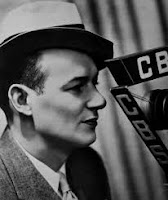
➦In 1917...Elliott Lewis was born in New York City (Died from cardiac arrest at age 72 – May 23, 1990). He was active during the Golden Age of Radio as an actor, writer, producer and director, proficient in both comedy and drama. These talents earned him the nickname "Mr. Radio".
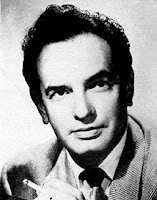 |
| Elliot Lewis - 1954 |
Elliott Lewis made his radio debut in 1936, at the age of 18, in a bit part on a True Boardman-produced biography of Simon Bolivar. Lewis' role was to scream and bang metal chairs, in an earthquake scene.
As an actor, Lewis was in high demand on radio, and he displayed a talent for everything from comedy to melodrama. He gave voice to the bitter Harvard-educated Soundman on the 1940-41 series of Burns and Allen and several characters (Rudy the radio detective, the quick-tempered delivery man, and Joe Bagley) on the 1947-48 series, many characters on The Jack Benny Radio Show (including the thuggish "Mooley", and cowboy star "Rodney Dangerfield"), a variety of comic and serious characters on the Parkyakarkus show, and Rex Stout's roguish private eye Archie Goodwin, playing opposite Francis X. Bushman in The Amazing Nero Wolfe (1945). He played adventurer Phillip Carney on the Mutual Broadcasting System's Voyage of the Scarlet Queen, and appeared on many episodes of Suspense and The Whistler.
But perhaps Lewis' most famous role on radio was that of the hard-living, trouble-making left-handed guitar player Frankie Remley on NBC's The Phil Harris-Alice Faye Show.
During the run of The Phil Harris-Alice Faye Show, Lewis took over as a director of the well-known radio series Suspense.
In the 1970s, Lewis produced radio dramas during a brief reincarnation of the medium. In 1973-74, he directed Mutual's The Zero Hour, hosted by Rod Serling. In 1979, he and Fletcher Markle produced the Sears Radio Theater, with Sears as the sole sponsor. Lewis wrote the episodes "The Thirteenth Governess" and "Cataclysm at Carbon River" (the latter was pulled by CBS due to its subject matter of a nuclear disaster, and was never aired), and acted on the episodes "Getting Drafted", "The Old Boy", "Here's Morgan Again", "Here's Morgan Once More", and "Survival". [11]
In 1980, the series moved from CBS to Mutual and was renamed The Mutual Radio Theater, sponsored by Sears and other sponsors. Lewis scripted the episodes "Yes Sir, That's My Baby" and "Our Man on Omega", and acted on the episodes "Interlude", "Night", "Hotel Terminal", and "Lion Hunt".
➦In 1925..."The Grand Ole Opry" debuted on WSM, Nashville under the name "Barn Dance". The first artist to perform on the show was fiddler Uncle Jimmy Thompson.
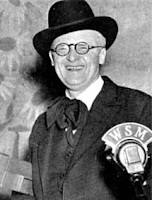 |
| George Hay |
In June 1928, the Opry got its name by an unusual coincidence: Soon after Program Director George D. Hay started his show, WSM radio joined the NBC radio network. Since the program followed a performance on the network called the Metropolitan Grand Opera. So, Hay decided to call his program the Grand Ole Opry.
Hay was born in Attica, Indiana. In Memphis, Tennessee, after World War I, he was a reporter for the Commercial Appeal, and when the newspaper launched its own radio station, WMC, in January 1923, he became a late-night announcer at the station. His popularity increased and in May 1924 he left for WLS in Chicago, where he served as the announcer on a program that became National Barn Dance.
On November 9, 1925 he moved on to WSM in Nashville. Getting a strong listener reaction to 78-year-old fiddler Uncle Jimmy Thompson, Hay announced the following month that WSM would feature "an hour or two" of old-time music every Saturday night. He promoted the music and formed a booking agency.