Showing posts sorted by relevance for query RIAA 2023. Sort by date Show all posts

Tuesday, April 4, 2023

Report: CD Sales Perk Up


A relic of the record industry’s pre-Napster boom period thanks to megastars like *NSYNC, Britney Spears and Eminem, U.S. CD sales accounted for $13.2 billion in 2000, their peak year, according to the RIAA. 

Billboard reports though the format has been in steady decline throughout the streaming era, retail, manufacturing and management sources say the digital discs have gained in popularity as keepsakes. More portable than vinyl albums and less affected by manufacturing delays due to supply chain issues, CDs are once again becoming merch table mainstays, and in the first 10 weeks of 2023, sales are up slightly over the same period last year, according to Luminate — 6.8 million in 2022 to 6.9 million, a 2.5% increase.

This growth could be a sign of a growing coolness factor, similar to the unexpected, and sustained, vinyl revival that began in the early 2000s, which is fueled by limited-edition releases pressed on colored vinyl and other bells and whistles. Taylor Swift took a page from that playbook when she put out Midnights CDs in different collectible colors last year, and BLACKPINK is among the many K-pop acts to sell elaborate CD box sets

Bill Wilson, senior vp of operations and innovation for MNRK Music Group, which oversees 50 independent labels, says specialized CD-buying audiences are keeping the format afloat. “There are still pockets and subgenres of music [fans] — like metal — who like holding and cuddling CDs — and they’re not vinyl collectors,” he says.

For those who can’t afford box sets or to spend upwards of $20 for a standard-issue vinyl album, “the CD is a much more budget-friendly item,” says Tony van Veen, CEO of New Jersey-based vinyl/CD manufacturer Disc Makers, who crunched the latest RIAA sales data and found that vinyl album prices rose last year by 13.5%, to $29.65, while CD prices went up 15.3%, to $14.45. “Music fans are deciding with their wallets.” He adds that his company’s CD sales stabilized in 2022 after years of decline.


Despite the small sales uptick so far in 2023, the 20-year decline in CD sales shows no sign of dissipating: Sales dropped from 40.6 million units in 2021 to 35.9 million last year, an 11.6% decrease, compared with a 4.2% rise in 2022 vinyl sales, according to Luminate.

Wednesday, March 19, 2025

Paid Music Streaming Hits Milestone


In 2024, the U.S. recorded music industry achieved a significant milestone: paid streaming subscriptions surpassed 100 million for the first time. This landmark, highlighted in the Recording Industry Association of America (RIAA) 2024 year-end report, underscores streaming’s dominant role in driving music revenue, accounting for nearly two-thirds of the industry’s total earnings. However, alongside this achievement, the industry saw a notable slowdown in revenue growth, signaling a maturing market.

Total U.S. recorded music revenue reached a record high of $17.7 billion in 2024, up 3% from the previous year, marking the ninth consecutive year of growth. Streaming led the charge, contributing $14.9 billion—or 84% of the total—with paid subscriptions generating $11.7 billion of that figure, a 5% increase from 2023. This growth in subscriptions, while impressive, reflects a cooling trend: the number of paid subscribers rose by just 3 million (from 97 million to over 100 million), a slower pace compared to prior years when annual increases often hit double digits.

Wednesday, March 27, 2024

Streaming Powered Recorded Music Revenue


Streaming powered recorded music revenue to $17.1 billion in 2023, Forbes reports it's the highest topline number the Recording Industry Association of America has registered in its annual report and a surge of 8 percent from the prior year.

Streaming comprises 84% of total revenues and a total of $14.4 billion—an all-time high of 96.8 million paid subscriptions to on-demand services—according to the RIAA report released on March 26.

“Recorded music keeps reaching new heights as labels'... commitment to meet fans everywhere they want to be continued to pay off for the entire music community,” said RIAA chairman and CEO Mitch Glazier in a statement.

“For artists, songwriters, and fans, this strong and sustained growth signals a time of incredible opportunity – with new formats, styles, and sounds rising up across innovative platforms and emerging ways to listen. As new services continue to get fully licensed at rates reflecting music's incredible value, revenue for artists and songwriters will only continue to grow.”

Glazier also sounded a warning about what he called “the mushrooming threat of generative artificial intelligence,” noting that without “thoughtful and effective guardrails,” recorded music’s growth and cultural reach are at risk.

Physical formats also continued to see a resurgence, up 11 percent to $1.9 billion. Vinyl experienced a seventeenth consecutive year of growth, up 10 percent, outsold CDs in units (43 million vs 37 million). Digital downloads accounted for 3 percent of the market, while synch licenses accounted for 2 percent.

Tuesday, March 18, 2025

Where Things Stand: the Music Industry


 The music industry has undergone a profound transformation in the first quarter of the 21st century (2000–2025), driven by technological advancements, shifts in consumer behavior, and evolving business models. 

Her's an overview of the key changes that have reshaped the industry during this period.

1. The Digital Revolution and the Decline of Physical Sales

At the turn of the century, the music industry was heavily reliant on physical formats like CDs, cassettes, and vinyl. In 2000, global recorded music revenue peaked at around $23.8 billion, with CDs accounting for the vast majority of sales. However, the rise of the internet and digital file-sharing platforms, most notably Napster (launched in 1999), disrupted this model. Illegal downloading led to a steep decline in physical sales, with global revenue plummeting to $14.6 billion by 2014—a drop of nearly 40% from its peak.

The industry initially struggled to adapt, with record labels pursuing legal action against file-sharing services and individual users. However, the introduction of legitimate digital alternatives, starting with Apple’s iTunes Store in 2003, marked a turning point. By offering individual song downloads for $0.99, iTunes shifted the focus from albums to singles, fundamentally altering how music was consumed and purchased. By the late 2000s, digital downloads had overtaken physical sales in many markets, though they never fully restored the industry’s former revenue highs.

2. The Rise of Streaming

The most transformative change came with the advent of music streaming, which began to dominate in the 2010s and solidified its position by 2025. Spotify, launched in 2008, pioneered the subscription-based streaming model, offering access to millions of songs for a monthly fee or through an ad-supported free tier. Other players like Apple Music (2015), Amazon Music, YouTube, and Tidal followed, creating a fiercely competitive landscape. By 2025, streaming accounted for over 80% of global recorded music revenue, according to estimates from the International Federation of the Phonographic Industry (IFPI).

Streaming reversed the industry’s revenue decline, with global recorded music revenue reaching $28.8 billion in 2023 (the latest full-year data available) and projected to grow further by 2025. In the U.S. alone, the Recording Industry Association of America (RIAA) reported that streaming generated $14.4 billion in 2023, up from virtually zero in 2005. This shift democratized access to music, allowing listeners to explore vast catalogs instantly, but it also sparked debates over artist compensation, with payouts per stream (e.g., $0.003–$0.005 on Spotify) criticized as insufficient by many musicians.

Wednesday, September 20, 2023

RIAA Reports Music Milestone


The Recording Industry Association of America (RIAA) has released a new report revealing the industry has hit new revenue milestones after a decade of transformation, including data for mid-year 2023 reflecting the ninth consecutive year of growth.

Total revenues grew 9.3% at estimated retail value and marked an all-time, first-half high of $8.4 billion, as paid subscriptions remained the strongest driver, accounting for 78% of streaming revenues.

“This report describes a thriving, growing music ecosystem that continues to reach new heights and shape our culture,” says RIAA Chairman & CEO Mitch Glazier. “And it reflects the creative human genius and hard work of all the artists, songwriters, labels, publishers, and services who make the music happen and meet fans and audiences where they are in today’s forward looking and innovative music community.”

Saturday, April 20, 2024

Vinyl Is Still Far From Its Glory Days


by Felix Richter, Statista

Music lovers around the world will come together on Saturday to celebrate Record Store Day. Conceived in 2007 to highlight the cultural significance of independent record stores and celebrate vinyl record culture, the occasion is now widely honored with live performances, special vinyl releases, artist meet-and-greets and other events taking place at record stores across the globe. One of the original objectives of Record Store Day – keeping vinyl records alive – is no longer a priority though, as they are alive and well.

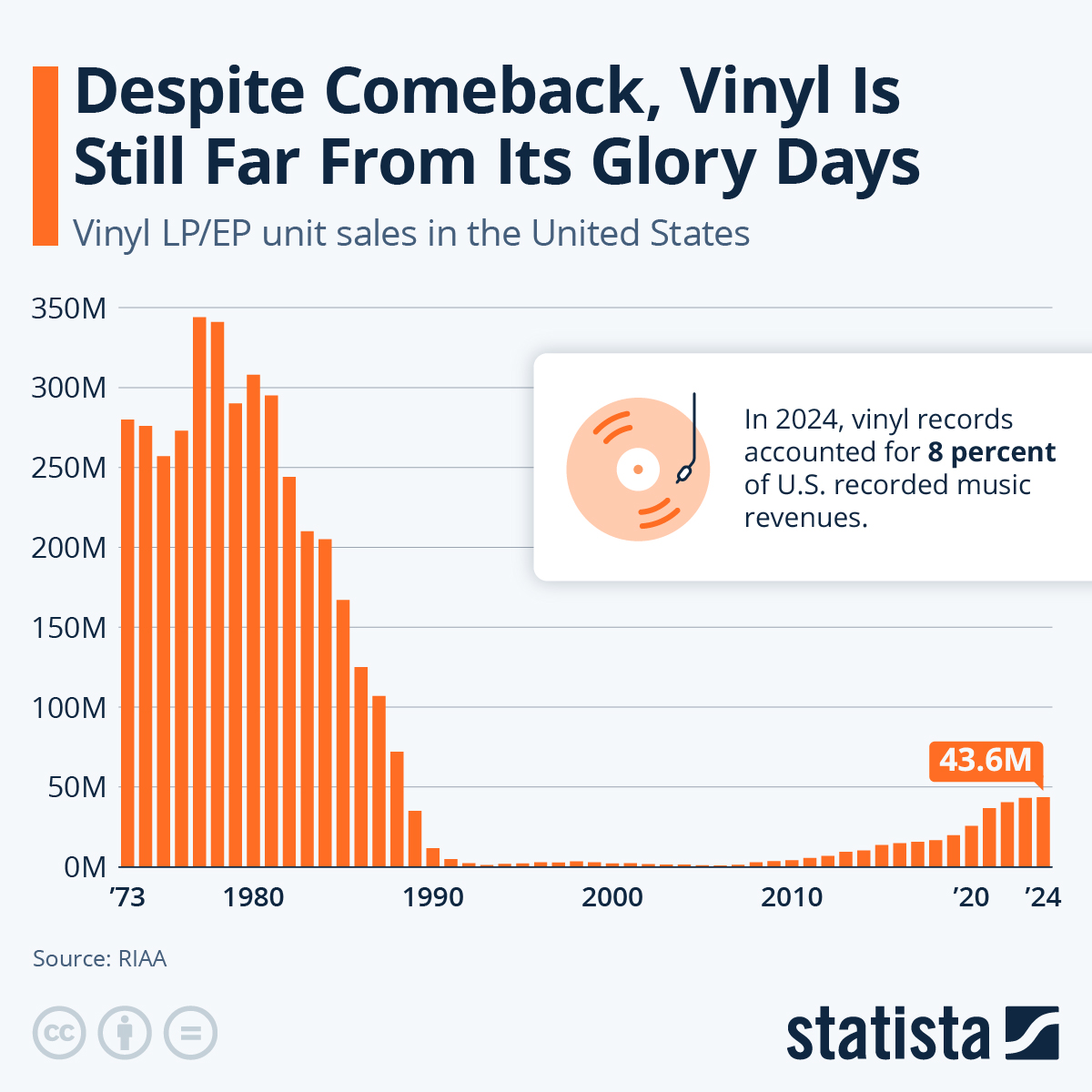
Continuing one of the more surprising comebacks of the digital age, vinyl album sales in the United States have grown for the 17th consecutive year in 2023. According to the Recording Industry Association of America (RIAA), 43.2 million EPs/LPs were sold in the U.S. last year, up from less than a million in 2006, when the vinyl comeback began.

Infographic: Despite Comeback, Vinyl Is Still Far From Its Glory Days | Statista You will find more infographics at Statista

So how big is vinyl's comeback really? Should we all dust off our old record players to prepare for the analog future of music? Vinyl LPs accounted for more than 40 percent of album sales in the United States last year, which is quite substantial. Factoring in streaming and downloads of single tracks, however, that number drops to less than 5 percent of album equivalent music consumption, which puts things in perspective. According to RIAA, vinyl records accounted for 8 percent of record music revenues in the U.S. last year, as streaming continues to be the industry's biggest moneymaker by far. Moreover, as our chart illustrates, vinyl is still far away from its glory days in the 1970s, when more than 300 million LPs and EPs would be sold in a single year.

However big or small the impact of rising LP sales on the music industry’s bottom line may be, it’s fascinating to witness a hundred year-old technology come back from near extinction. Physical goods, it appears, still hold value for many people, even in the digital age. Interestingly, vinyl LPs appear to have become a bit of collectors' item for fans, who listen to music digitally but still want to own a physical object: according to Luminate, only 50 percent of vinyl buyers actually have a record player.

Saturday, December 30, 2023

Vinyl Sales Reach New Heights


Taylor Swift’s global appeal has led to a resurgence in sales of vinyl records — especially in the United Kingdom, where hot wax flew off shelves at the highest level since 1990.

The US has also seen the demand for vinyl spike as a new generation of music junkies ditch high-tech streaming services for a more retro listening format, The NY Post reports.

Revenue from vinyl records grew 1% to $632 million and accounted for 72% of physical format revenues, according to the Recording Industry Association of America.

Across the pond, vinyl sales surged 11.7% this year, to 5.9 million units, according to CNN, citing figures released Thursday by the British Phonographic Industry (BPI), an association of UK record companies and labels.

The figure marks a four-fold increase in sales from 2022, and the 16th consecutive year of increased vinyl sales, CNN reported, as a new generation of music junkies ditch high-tech streaming services for a more retro listening format.

Perhaps unsurprisingly, Swift’s “1989 (Taylor’s Version)” album sold the most copies — capping off a blockbuster year for Time magazine’s Person of the Year, whose record-breaking “Eras Tour” earned her billionaire status.

The album, which was originally released in 2014, was re-released as “Taylor’s Version” on Oct. 27 — part of the 34-year-old’s effort to rerecord all of her discography previously owned by Scooter Braun.

The No. 2 and No. 3 spots were nabbed by The Rolling Stones’ “Hackney Diamonds” and Lana Del Rey’s “Did You Know Know There’s A Tunnel Under Ocean Blvd,” respectively.

In the US, physical music sales — which includes vinyl records, CDs and cassette tapes — saw a revival in the first half of 2023, though streamers like Spotify and Apple Music maintained their market dominance, accounting for 84% of the total revenues in the same six-month period, CNN reported, citing RIAA’s findings. For comparison, in the UK, 80% of recorded music is listened to on streaming platforms, according to the BPI.

Paid subscriptions were the “strongest driver” of revenue growth, RIAA said.

Tuesday, September 3, 2024

Subscription Music Dominates More Than Ever


More than three out of every five dollars earned by U.S. record labels in the first half of 2024 — 60.2% to be exact — came from premium subscription services, according to Billboard citing the RIAA’s mid-year report. That marks the first time subscriptions exceeded a 60% share of total revenue, topping the 59.5% share in the first half of 2023 and the 59.3% mark for full-year 2023.  

Ad-supported on-demand streaming, on the other hand, has lost momentum, growing just 2.5%, half the rate of paid subscriptions. The slowdown has been dramatic: Three years ago, advertising revenue rebounded from a pandemic slowdown by surging 54.1% in the first half of 2021 and another 17.7% in the first half of 2022. Its share of total industry revenue — 10.4% — has slipped, too, from 10.5.%, 11.3% and 10.5% in the three preceding first-half periods.  

Other ad-supported segments also lag paid subscriptions’ growth rate. SoundExchange distributions, which include some ad-supported streaming as well as royalties paid by satellite radio subscribers, rose just 3.8% to $517 million. Other ad-supported streaming, which covers services not operating under statutory licenses, fell 1.5% to $155 million.  


The situation around advertising is worse than the numbers might suggest. Ad-supported, on-demand streaming isn’t confined to services such as Spotify’s free tier and YouTube. A new generation of platforms, such as TikTok and Instagram, are grouped into this category, too. Without these emerging platforms, ad-supported streaming would look even worse off.  

For an industry that must constantly seek growth, advertising is too small to play the role. In the most recent quarter, Spotify got 12% of its revenue from advertising — both music and podcasts — compared to 88% from subscriptions. 

Friday, August 30, 2024

Streaming Dominates Music Revenue


The U.S. recorded music market grew a little bigger in the first half of 2024 — but not by much. The retail value of total industry revenue reached $8.65 billion, according to Billboard citing RIAA figures released Thursday (Aug. 29), thanks mainly to a modest gain in streaming revenue and a jump in vinyl sales.  

While the period’s revenue is a record for the first half of a year, it marked just a 3.9% gain from the prior year’s period. The U.S. market has returned to a more workmanlike trajectory, putting high-single digit and double-digit gains in the rear-view mirror. By contrast, revenue was up 8.8% and 9.0% in the first half of 2022 and 2023, respectively. In the first half of 2021, as paid and ad-supported streaming benefitted from pandemic-era lockdowns that drove consumers to their devices, revenue rocketed 27.0%.

Vinyl EP and LP sales totaled 24.3 million units, up 10.7%, and were valued at $739.9 million, up 17%. Other physical formats gained, too, but the distance between them and vinyl grew larger. CD sales improved just 0.3% to $236.7 million. The other category—encompassing cassettes, CD singles, vinyl singles, DVD audio and SACD—improved 66.6% to $13.2 million. 

Physical sales increased its percentage of total revenue to 11.4% from 10.5% in the prior-year period and 10.2% in the first half of 2022. Vinyl has doubled its share of the market in five years, reaching 8.5% of total U.S. revenue — up from 4.2% in the first half of 2020.  

Streaming still dominates industry revenue and provided the single-biggest dollar gain of all the categories. Total streaming revenue grew 3.8% to $7.3 billion and accounted for 84.1% of total revenue, equal to the year-ago period. Paid subscription revenue hit $5.23 billion, up 5.1%, leading all streaming categories by a wide margin. The average number of subscribers reached 99 million, up just 2.6%, suggesting record labels benefitted from price increases by Spotify and other services. 

Monday, April 1, 2024

Vinyl Continues To Outsell Compact Discs


Almost a century after the first long-playing record was pressed, it seems that vinyl is still spinnin’.

A new report from the Recording Industry Association of America (RIAA) last week revealed that people in the US bought a collective 43 million vinyl records last year — some 6 million more units than the number of CDs sold, marking the second year running that the vintage format has won out.

While streaming remains king, making up ~84% of US recorded music revenues, vinyl sales still raked in an estimated $1.4bn, compared with just $537m for less pricey CD formats.

Turning tables

With sales peaking in the late 1970s, before it was dethroned by CDs/cassettes in the 80s and throughout the 90s and 00s, vinyl’s popularity has seen a resurgence over the past decade, in no small part because of its modern day consumer advantage over other mediums: the “cool factor”.

But, hipsters aside, the recent uptick can also be attributed to vinyl records breaking into the mainstream, with Kendrick Lamar, Harry Styles, and Lana Del Rey all releasing their latest albums on wax — as well as megastar Taylor Swift, whose album 1989 (Taylor's Version) was the best-selling vinyl LP of 2023, making up 7% of all US vinyl album sales last year.

Thursday, April 3, 2025

Report: Market For Music Is Thriving


MusicWatch, a market research firm focused on music consumption trends, 50 million more Americans are buying music in 2024 compared to a decade ago, in 2014. This significant increase highlights a robust growth in the U.S. music industry, driven largely by the rise of streaming services, alongside continued interest in physical formats like CDs and vinyl, as well as digital downloads.

The report indicates that in 2024, approximately 132 million Americans aged 13 to 70—roughly half of that age demographic—paid for a music subscription, such as on-demand streaming services or satellite radio. 

This surge in music buyers far exceeds the U.S. population growth of about 19 million over the same period, suggesting that the increase isn’t just a result of more people but a genuine rise in interest and willingness to spend on music. In total, when factoring in various forms of music purchases (subscriptions, physical formats, and downloads), the number of music buyers in 2024 significantly outpaces the figures from 2014.

Spending on recorded music has also risen. In 2024, Americans spent an average of $112 per capita on recorded music, up from $80 in 2014 (about $91 when adjusted for inflation), marking a roughly 32% increase over the decade. This growth reflects not only more buyers but also higher spending per person, even as the industry has shifted away from digital downloads—which dropped from $2.3 billion in 2015 to $329 million in 2024—toward streaming. Meanwhile, live music spending saw an even steeper rise, increasing 17% from 2023 to $281 per capita in 2024, driven by strong demand for concerts despite some inflationary pressures on ticket prices.

Interestingly, older formats haven’t disappeared. Despite a 61% decline in CD sales over the decade, 56 million Americans still listen to CDs in their cars, and 48 million use digital downloads while driving, showing that these formats retain a substantial audience. Vinyl has also seen a resurgence, contributing to the overall growth in physical music purchases. However, piracy persists as a challenge, with 14 million Americans admitting to stream-ripping music files in 2024, though it’s less pervasive than it was 20 years ago.

The MusicWatch findings align with broader industry data, such as the Recording Industry Association of America (RIAA) reporting an average of 100 million music subscriptions in 2024, with satellite radio provider SiriusXM ending the year with 31.6 million self-pay subscribers.

Thursday, March 7, 2024

Radio History: March 7


➦In 1876...Patent granted to  Alexander Graham Bell for the telephone. Three days later, he and associate Thomas Watson successfully tested their invention. Elisha Gray, Antonio Meucci and Thomas Edison all claimed to have invented the telephone first, and the issue is still a source of controversy.

There has long been a debate over whether Bell was truly the first man to invent the telephone. Bell was presented with more than 600 patent lawsuits, but the courts continually ruled that he was legally the inventor.

There are several controversies about the invention. First is that Bell received a patent before he had a working device, which was unusual. His critics, including Elisha Gray and Thomas Edison—who claimed to have had a working telephone but did not file for a patent—accused Bell’s father-in-law, former Congressman Gardiner G. Hubbard, of persuading the patent office to give Bell his patent over Gray.

➦In 1933... CBS radio debuted its first daytime radio serial, “Marie the Little French Princess”, which had a run of 2.5  years on the air.  Marie, The Little French Princess was the first soap opera on CBS radio. It was daily program at daytime. Hilman Brown as producer and director of the serial was one of respected person in radio broadcast. He was inducted into the  Radio Hall of Fame in 1990.

The Beatles 1963

➦In 1962...The Beatles performed for 52 BBC Radio programs, beginning with an appearance on this date and ending with the special The Beatles Invite You to Take a Ticket to Ride, recorded on 26 May 1965. Forty-seven of their BBC appearances occurred in 1963 and 1964, including 10 on Saturday Club and 15 on their own weekly series Pop Go the Beatles, which began in June 1963. As The Beatles had not accumulated many original songs by this time, the majority of their BBC performances consisted of cover versions, drawing on the repertoire that they had developed for their early stage act.

In total, 275 performances of 88 different songs were broadcast, of which 36 songs never appeared on their studio albums.

Judy Garland, scene from 'Wizard of Oz'

➦In 2001…The National Endowment for the Arts (NEA) and the Recording Industry Association of America (RIAA) reveal their list of the top 365 "Songs Of The Century".

Saturday, March 7, 2026

Radio History: March 7


➦In 1876...Patent granted to  Alexander Graham Bell for the telephone. Three days later, he and associate Thomas Watson successfully tested their invention. Elisha Gray, Antonio Meucci and Thomas Edison all claimed to have invented the telephone first, and the issue is still a source of controversy.

There has long been a debate over whether Bell was truly the first man to invent the telephone. Bell was presented with more than 600 patent lawsuits, but the courts continually ruled that he was legally the inventor.

There are several controversies about the invention. First is that Bell received a patent before he had a working device, which was unusual. His critics, including Elisha Gray and Thomas Edison—who claimed to have had a working telephone but did not file for a patent—accused Bell’s father-in-law, former Congressman Gardiner G. Hubbard, of persuading the patent office to give Bell his patent over Gray.

➦In 1933... CBS radio debuted its first daytime radio serial, “Marie the Little French Princess”, which had a run of 2.5  years on the air.  Marie, The Little French Princess was the first soap opera on CBS radio. It was daily program at daytime. Hilman Brown as producer and director of the serial was one of respected person in radio broadcast. He was inducted into the  Radio Hall of Fame in 1990.

➦In 1938...The St. Louis Dispatch began a two-year experiment delivering newspapers via radio facsimile, with the first transmission sent through station W9XZY. This innovative use of radio waves to transmit printed content showcased the medium’s versatility beyond audio broadcasts.

The Beatles 1963

➦In 1962...The Beatles performed for 52 BBC Radio programs, beginning with an appearance on this date and ending with the special The Beatles Invite You to Take a Ticket to Ride, recorded on 26 May 1965. Forty-seven of their BBC appearances occurred in 1963 and 1964, including 10 on Saturday Club and 15 on their own weekly series Pop Go the Beatles, which began in June 1963. As The Beatles had not accumulated many original songs by this time, the majority of their BBC performances consisted of cover versions, drawing on the repertoire that they had developed for their early stage act.

Friday, March 7, 2025

Radio History: March 7


➦In 1876...Patent granted to  Alexander Graham Bell for the telephone. Three days later, he and associate Thomas Watson successfully tested their invention. Elisha Gray, Antonio Meucci and Thomas Edison all claimed to have invented the telephone first, and the issue is still a source of controversy.

There has long been a debate over whether Bell was truly the first man to invent the telephone. Bell was presented with more than 600 patent lawsuits, but the courts continually ruled that he was legally the inventor.

There are several controversies about the invention. First is that Bell received a patent before he had a working device, which was unusual. His critics, including Elisha Gray and Thomas Edison—who claimed to have had a working telephone but did not file for a patent—accused Bell’s father-in-law, former Congressman Gardiner G. Hubbard, of persuading the patent office to give Bell his patent over Gray.

➦In 1933... CBS radio debuted its first daytime radio serial, “Marie the Little French Princess”, which had a run of 2.5  years on the air.  Marie, The Little French Princess was the first soap opera on CBS radio. It was daily program at daytime. Hilman Brown as producer and director of the serial was one of respected person in radio broadcast. He was inducted into the  Radio Hall of Fame in 1990.

➦In 1938...The St. Louis Dispatch began a two-year experiment delivering newspapers via radio facsimile, with the first transmission sent through station W9XZY. This innovative use of radio waves to transmit printed content showcased the medium’s versatility beyond audio broadcasts.

The Beatles 1963

➦In 1962...The Beatles performed for 52 BBC Radio programs, beginning with an appearance on this date and ending with the special The Beatles Invite You to Take a Ticket to Ride, recorded on 26 May 1965. Forty-seven of their BBC appearances occurred in 1963 and 1964, including 10 on Saturday Club and 15 on their own weekly series Pop Go the Beatles, which began in June 1963. As The Beatles had not accumulated many original songs by this time, the majority of their BBC performances consisted of cover versions, drawing on the repertoire that they had developed for their early stage act.

In total, 275 performances of 88 different songs were broadcast, of which 36 songs never appeared on their studio albums.

➦In 1981...The Federal Communications Commission (FCC) established the General Radiotelephone Operator License (GROL) and ceased issuing the First and Second Class Operator Licenses. This shift marked a significant change in radio broadcasting regulation, simplifying licensing for operators while maintaining technical standards. The GROL became a key credential for those working with radio transmission equipment, reflecting the evolving professional landscape of the industry.

Judy Garland, scene from 'Wizard of Oz'

➦In 2001…The National Endowment for the Arts (NEA) and the Recording Industry Association of America (RIAA) reveal their list of the top 365 "Songs Of The Century".