The 2020 Macy’s Thanksgiving Day Parade was a welcome — but atypical — sight. Though no crowd could be in attendance, 20.7 million TV viewers tuned in from 9 a.m. to noon, when it averaged a 5.3 rating among adults 18-49, according to The Wrap citing Nielsen.
Those numbers made the Thanksgiving parade NBC’s highest-rated and most-watched entertainment broadcast of 2020.
The parade had 4.7 million YouTube streams, NBC said. An encore presentation of the parade got 3.5 million TV viewers and had a 0.9 rating in the key demo.
The year-ago 2019 parade, when people were still allowed to congregate in the New York City streets (and around Thanksgiving tables, for that matter) scored 22.11 million total viewers, the annual event’s smallest TV audience since 2008 (21.69 million viewers). This year’s eclipsed that mark (in the wrong direction).
See how the previous dozen Macy’s Thanksgiving Day Parades have fared here. In 2013, the parade topped 25 million viewers, the largest sum of this grouping.
The Macy’s Thanksgiving Day Parade has been a consistent and reliable ratings hit for NBC. The Manhattan march was last below 20 million total TV viewers back in 1996.
The 2020 National Dog Show followed Santa Claus’ parade arrival, and fetched 11.3 million total viewers to go along with its 3.4 demo rating from noon to 2 p.m. Good dogs.
While the parade and dog show both scored big audiences, NBC suffered a tough (ratings) break later on Thursday. Due to COVID-19 running rampant within the Baltimore Ravens organization, last night’s primetime NFL game vs. the Pittsburgh Steelers was postponed until Sunday afternoon. It’s now been postponed again until Tuesday, according to ESPN’s Adam Schefter. That initial postponement off turkey day likely cost NBC 20 or so million viewers — at least, temporarily. Tuesday night should have a nice haul.
According to Nielsen Scarborough data, at a 20% rate of growth, the audience for podcasting could double by 2023, and the IAB projects that U.S. podcast advertising revenues will surpass $1 billion by 2021.
Given the growth and ad opportunities in the podcast space, Arica McKinnon, VP of Client Consulting, discussed how podcast ads drive brand impact during Podcast Movement 2020. Arica’s presentation leveraged insights from more than 250 Nielsen podcast ad effectiveness studies involving 240 brands across auto, CPG, education, financial services, DTC retail and technology. These studies contain ad engagement findings from 541 podcast clips and 195 podcast shows that were tested across various podcast genres.
She noted that this research, which involves presenting listeners with podcasts’ clips and assessing their engagement versus those not exposed across an array of key brand metrics and content measures allows brands to assess the impact of their advertising and sponsorship on podcasts.
“When we asked podcast listeners to rate the host of the show they were exposed to, an average of 66% rated the talent or host as excellent or very good, with two-thirds describing the talent as likable and 42% describing the talent as credible,” said Arica. “Podcasting is known for having host-read ads, which come off as authentic to listeners because the talent actually has a personal experience with the brand. So it’s natural to select a host that is more credible, reliable and fun to sell your products.”
Arica continued, “Our analysis across our studies demonstrates that exposure to mid-roll ads yield stronger content scores, and shows that 64% of those exposed indicated that they would seek similar content in the future, driving a 5% increase over those who were exposed to the pre-roll ad.”
A wide spectrum of clients and advertisers are coming into the space, and advertisers are finding value and continue to take advantage of host-read ads and tailor-made messages for specific consumer segments.
Following Arica’s presentation, Bruce Supovitz, SVP of National Audio Services, hosted two panels on ways to use industry insights to optimize monetization opportunities in podcasts. Panelists discussed the importance of these metrics in providing accountability to brands and media agencies as well as the impact of host-read advertising as compared to more traditional advertising modalities.
Pierre Bouvard
“What has been a pleasant surprise to me, as someone who sees all the requests coming through from the various podcasters on these studies, is a really wide spectrum of clients and advertisers coming into this space,” said Bruce. “It’s refreshing, and I think it speaks highly of the medium that they are putting their dollars into it, whether it be a direct-response client or a well-known brand.”
Advertising effectiveness is of paramount importance for brands and advertisers, and having ways with which to showcase the differences of specific audiences is a part of the future trajectory of understanding this much coveted space.
As brands and advertisers continue to look for the best places to reach audiences, looking at the audience composition is a way to ensure that brands are resonating most.
“There is a huge interest in the profile of audience,” said Pierre Bouvard, Chief Insights Officer, Cumulus Media/Westwood One. “There were a number of companies measuring raw audience or rank, but no one was showing the buying habits of the consumer. We knew brands were looking for certain consumer profiles to connect to specific titles.”
In describing the importance of understanding the nuances of what kind of content is most appropriate for audiences and advertisers, Paul Riismandel, Sr. Director of Marketing & Insights at Stitcher/Midroll said, “Content is king, but it is certainly for content that advertisers and audiences are interested in. It really helps us to look at how we put shows together into packages, and how we help advertisers reach scale by looking not just at the content vertical but also looking at the audiences themselves.
In an interview Wednesday on FOX Business, iHeartMedia CEO Bob Pittman talked on how the coronavirus pandemic has impacted his company’s concerts, podcasts and other services.
Advertisers ‘really interested’ in podcasting right now: iHeartMedia CEO https://t.co/wK1yNmfRrf
The list of the ten biggest podcast advertisers during October is a sign that the industry continues to shake-off any impact of COVID-19. “This is a back-to-normal. There are a lot of advertisers here that were big advertisers in 2019, and pre-pandemic,” Magellan CEO Cameron Hendrix said during a company webinar last week, reviewing the top ten monthly spenders.
Magellan’s data shows the online mental health service provider BetterHelp and the recruitment company ZipRecruiter were the top two spenders during October, followed by retailer Amazon which nearly doubled its outlay compared to a month earlier. “ZipRecruiter had pulled back spending during the pandemic and have certainly come back pretty strong,” said Hendrix. Seven of the top ten had month-to-month increases with Volvo the biggest mover as it promoted the release of its XC90 and XC90 Hybrid models with a podcast ad budget that was up a whopping 968%. “These brands picking up in October are very much a return back to some of the bigger spenders that we saw last year,” said Hendrix.
Among the various advertising categories, Magellan says financial services was one of October’s standouts with five brands significantly increasing their ad spending – including Chase, Virginia529, Ally, MasterCard, and LoanDepot. Overall, the entire category jumped about 27% between September and October.
“In the financial services jump that we’re seeing in this month, we’re really not seeing a real similarity in the message these advertisers are bringing to market,” said Hendrix. LoanDepot promoted options for loans and refinancing, Virginia529 offered information about saving for children’s future college tuition bills, while Chase promoted a new credit card.
Hendrix noted that although Chase was not new to podcast advertising, Magellan estimates October was the bank’s biggest month ever for podcast ad spending. “Each of these brands had different reasons for getting into the market, but nonetheless October was the month in which all of them really jumped in and increased their spending quite significantly,” he said.
There were also some new advertisers that came roaring into podcasting. Magellan data shows the men’s watch brand Christopher Ward spent about $100,000 on podcast ads in October. Hendrix said that “big splash” followed a much smaller test of the medium during September. And while 72 jewelry brands bought podcasts ads during the month, Christopher Ward accounted for 21% of the category’s overall podcast ad spending during October.
The year-end gift-giving season typically sees an uptick in jewelry ad spending. Last year jewelry companies increased their podcast ad spending by 50% month-over-month during the fourth quarter. “It seems likely they may be increasing their spending again in November and December as we head into the holiday season,” said Hendrix.
Toronto Blue Jays radio announcer Mike Wilner and Sportsnet have parted ways, the network announced Friday.
Sportsnet said Wilner spent more than 20 years on its airwaves, becoming "synonymous with Blue Jays baseball."
The announcer said in a Friday statement released on Twitter his "heart is broken" to not be a part of the Blue Jays broadcast moving forward without citing specific reasoningfor the departure. He called his job "an absolute dream."
Wilner was a backup announcer and hosted the pre- and post- game for "Blue Jays Talk" starting in 2002. In 2018, he called most games after the retirement of former announcer Jerry Howarth before becoming the full-time voice in 2019.
Conservative media outlet Newsmax continues to has enjoy a massive surge in followers across Facebook, Twitter and YouTube over the past month, reports Newsweek.
Rising social media subscribers, viewers and interactions trends continued this weekend after the outlet's content was again amplified by President Donald Trump, who has turned on Fox News in recent weeks, broadly citing its coverage about his election defeat.
On Saturday, Trump tweeted that Fox was "virtually unwatchable" and pointed his vast Twitter following in the direction of Newsmax and the One America News Network (OANN), another outlet sympathetic to the president.
.@FoxNews daytime is virtually unwatchable, especially during the weekends. Watch @OANN, @newsmax, or almost anything else. You won’t have to suffer through endless interviews with Democrats, and even worse!
For Newsmax, a long-running media endeavor overseen by a Trump confidant called Christopher Ruddy, the high-profile endorsements appear to be paying off.
According to data from analytics platform Social Blade, which tracks the daily shifts of profiles, "likes" on the Newsmax Facebook page have spiked by over 1.4 million in the past 30 days, with a daily average rise of 47,241. On Saturday, when the channel was talked about by Trump, its Facebook page attracted over 30,000 new likes.
The pattern was echoed on Twitter, where its account gained 563,735 new followers in the past 30 days, a daily average of 18,791. It amassed 27,105 new fans Saturday.
On YouTube, Newsmax brought in 1.18 million new subscribers over the past 30 days, a daily average rise of nearly 40,000. It gained 20,000 new subscribers on Saturday. Video views on the platform rose by 108 million in the past 30 days, according to Social Blade.
Comcast Corp. will charge more for heavy users of home internet in Northeast states — including Pennsylvania and New Jersey — angering customers who work and study online due to the pandemic, reports The Philadelphia Inquirer.
The vast majority of Comcast’s Xfinity customers won’t be affected by the “data threshold” next year, company officials said last week. But the extra charges come as internet usage soars across the country, with consumers increasingly making video calls and bingeing shows while stuck at home. Average monthly data usage in the United States jumped 40% during the third quarter this year compared with the same period in 2019, according to OpenVault, a Hoboken, N.J., broadband software firm.
Starting in April, Xfinity will let customers use up to 1.2 terabytes of data a month before billing them more — unless they buy an unlimited data plan. Customers without unlimited data will have to pay $10 for every extra 50 gigabytes used. Unlimited data plans cost an additional $25 to $30 a month, depending on whether you rent or own your own router, a Comcast spokesperson said.
The Philadelphia-based cable giant said just 5% of its nearly 28 million home internet customers exceed 1.2 terabytes of data a month. But the news sparked criticism from customers and industry observers, who noted that the pandemic has closed schools and offices and forced consumers to do more online. Some said they would flee to Verizon Fios, which doesn’t have any data caps or thresholds, according to a company spokesperson.
Comcast said 1.2 terabytes is a “massive” amount of data, enough to watch 500 hours of high-definition video, or video conference for nearly 3,500 hours a month. Even with more people working at home, average monthly data usage was 383.8 gigabytes from July through September, OpenVault reported.
Comcast already imposed the data limit in 25 states in western and central parts of the U.S. The company had lifted the data limit on those states from March to July due to COVID-19. Now it’s rolling out the plan in the remaining 14 states across its footprint.
The company’s broadband business has boomed during the pandemic, signing up a record number of internet customers last quarter. But the coronavirus has battered its other businesses, particularly theme parks and film studios. Comcast’s net profit fell 37% during the third quarter, to $2 billion.
The U.S. Federal Communications Commission killed a proposal to allow in-flight voice calls via mobile phones, ending its examination of an idea that evoked fears of air rage from passengers trapped beside jabbering seat mates, reports Bloomberg.
The idea drew “strong opposition” from pilots and flight attendants, the agency said Friday in a four-paragraph order.
The FCC in 2013 proposed allowing mobile telephone conversations above 10,000 feet, adopting practices followed in Europe and elsewhere, where in-flight voice calling is more common.
But the proposal led to strong and immediate pushback, with travelers, flight attendants, members of Congress and others saying they were troubled by the idea of passengers talking on phones in flight. One group raised “the potential for air rage if passengers are using their cell phone.”
FCC Chairman Ajit Pai in 2017 signaled the agency would move to kill the proposal, which was created under a predecessor.
“Taking it off the table permanently will be a victory for Americans across the country who, like me, value a moment of quiet at 30,000 feet,” Pai said at the time.
Restrictions on in-flight calling were put in place to prevent interference with flight controls, radios and navigation equipment. The FCC in 2013 anticipated using technology that funneled calls through an onboard system.
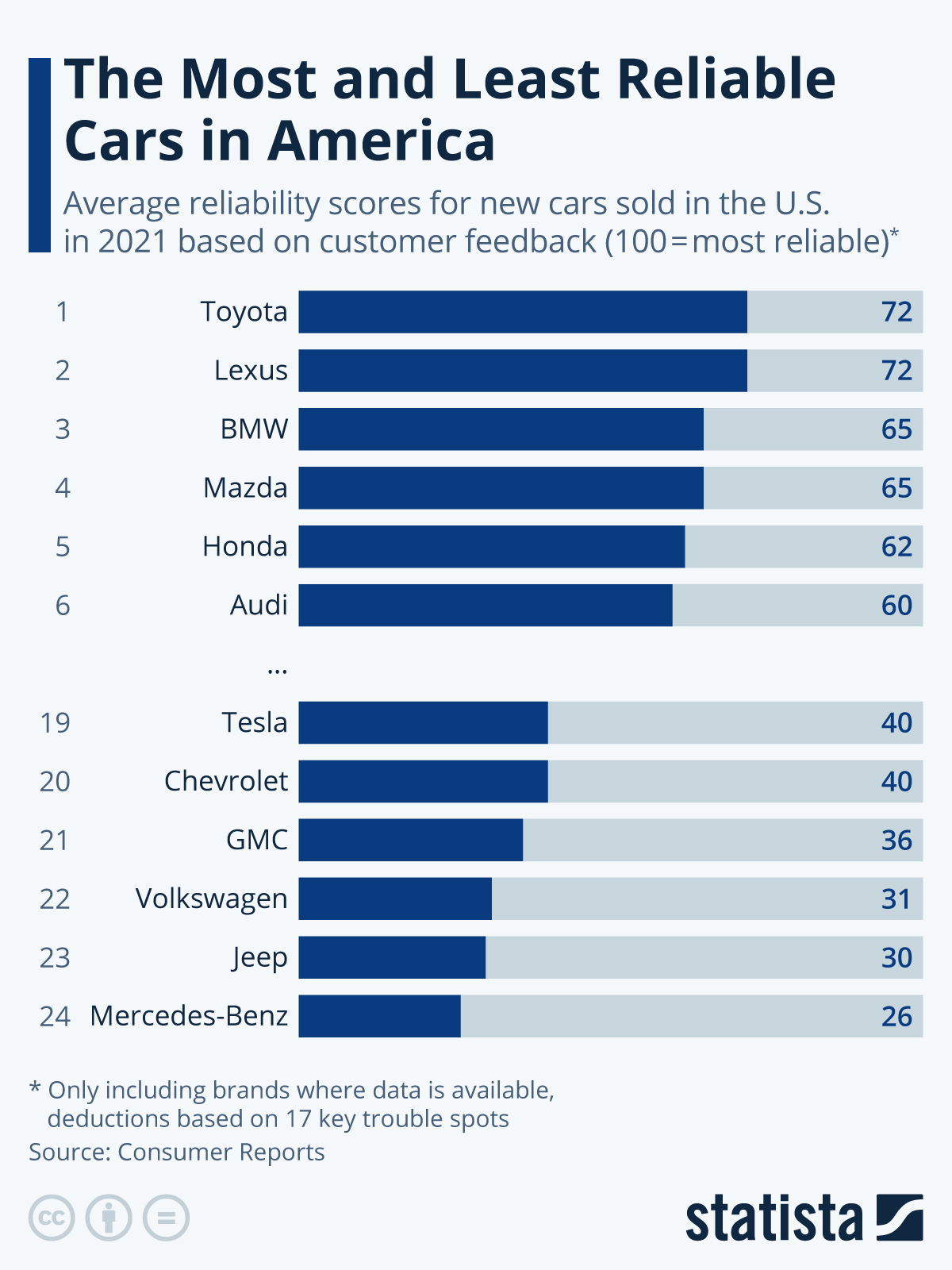
American nonprofit consumer organization Consumer Reports has released its annual study about the reliability of new cars sold in the U.S. and its contents make for grim reading for several automobile manufacturers, especially Tesla. The study's findings are based on customer feedback and they focus on 17 potential trouble spots on cars from the engine to the electrical system and body work. Brands with at least two vehicle models were assigned an index score on a 0-to-100 point scale and the average worked out at between 41 and 60 points.
The three car brands with the highest reliability scores are all from Japan with Mazda ranked top with 83 out of 100. Toyota came second with 74 while Lexus, its luxury vehicle brand, rounded off the top-three with 71. Buick was the first U.S. name on the list with 70 while one European brand, Porsche, was present in the top-10 with a score of 55. That was still better than its parent company Volkswagen which came third last ahead of Tesla.
A report from Reuters attributed Tesla's dire reliability ranking to quality issues present in the new Model-Y crossover. It states that "owners of the Model Y, which began production in January, have reported misaligned body panels that had to be fixed and mismatched paint including, in one case, human hair stuck in the paint". Even though the Model-Y dragged Tesla down towards the bottom of the ranking, its score was not helped by the Model S and X which were both rated "worse than average" for reliability. While quality issues are common on new vehicles, the poor scores of the S and X show that Tesla surely has work on its hands at enhancing build quality across its range. Unsurprisingly, the brands with no major changes to their lineups tended to be ranked higher for reliability.
Former Boston radio personality Paul "Tank" Sferrussa died last Wednesday at age 67. He had been in decliding health in recent years.
Sferrussa was a graduate of Boston Trade School, he originally aspired to be a baker. His radio career radio started in 1977 when he volunteered to answer the "listener line" at WBCN Radio. Paul rose through the ranks as WBCN van driver, producer, voice of "YOOP," and sports reporter/director.
He was also a sports reporter at WZLX until his retirement in 2003.
Buffalo has lost a longtime radio broadcaster whose deep, resonant voice touched so many Western New Yorkers over the years.
Jack Horohoe, known as the gentleman broadcaster, died of coronavirus Friday, reports WIVB-TV4. He was 77-years-of-age.
He grew up in Ken-Ton and first worked as a DJ here back in the 1950s, then was hired by George Lorenz ‘The Hound Dog’ as his newsman.
His lifelong connection to radio stretched on for 49 years. Horohoe also spent decades as a real estate agent.
Most recently, he worked middays on WEBR radio. He returned to the air last summer after a 49-year hiatus. At the time, he told WKBW-TV, "I thought maybe it was time to go back on the radio." Horohoe radio career began in the 1960's with stints at WNIA and WBLK. In 1968 he began doing mid days for WEBR (then 970 AM).
Jack has never really been out of the limelight. Over the years he's done voice over work, commercials and numerous stage productions as an actor.
➦In 1924...the first radio photo facsimile was transmitted across the Atlantic.
The concept of sending images by wire had been around for a long time before it was ever applied to radio. The first rudimentary fax patent was issued in Paris in 1843 and used a swinging pendulum to draw the image. Englishman Edwin Belin first demonstrated his Belinograph in 1913. Western Union and AT&T both transmitted photos via wire in the early 1920’s, and the technology was quickly accepted by the press as a way to send newspaper photos instantly to cities around the country. RCA was the first company to adapt facsimile to radio, and sent a transoceanic image of President Calvin Coolidge from New York to London on November 29, 1924.
Two years later, RCA began a commercial service of transmitting transoceanic photos by shortwave radio for the newspaper industry, and transmitting weather maps to ships at sea. RCA’s patented “Photoradio” technology was invented by RCA scientists Richard H. Ranger and Charles J. Young. It used a rotating drum and a photoelectric scanner to convert a document into a continuous tone that varied in pitch with changes in the image. The image was reproduced on the receiving end with another rotating drum having a stylus that pressed black carbon paper against white paper to reproduce the image.
A few radio broadcasters showed early interest in adapting the technology to send pictures to the public. KPO in San Francisco, owned by the San Francisco Chronicle, became the first radio broadcaster to transmit a photograph by radio when it transmitted a picture of cartoon character Andy Gump on August 22, 1925. The image was signed by Chronicle publisher George T. Cameron with the message "Radio's latest wonder - pictures through the air. What new marvels will this science bring forth?" The image was received on a single machine invented by C. Francis Jenkins.
➦In 1929...Dick Clark born (Died at age 82 - April 18, 2012). He was a radio and television personality, television producer and film actor, as well as a cultural icon who remains best known for hosting American Bandstand from 1957 to 1988.
As host of American Bandstand, Clark introduced rock & roll to many Americans. The show gave many new music artists their first exposure to national audiences, including Iggy Pop, Ike & Tina Turner, Smokey Robinson and the Miracles, Stevie Wonder, Prince, Talking Heads, Simon & Garfunkel and Madonna. Episodes he hosted were among the first in which blacks and whites performed on the same stage, and likewise among the first in which the live studio audience sat without racial segregation. Singer Paul Anka claimed that Bandstand was responsible for creating a "youth culture". Due to his perennially youthful appearance and his largely teenaged audience of American Bandstand, Clark was often referred to as "America's oldest teenager" or "the world's oldest teenager".
Dick Clark
In his off-stage roles, Clark served as Chief Executive Officer of Dick Clark Productions (a financial interest in which he sold off in his later years). He also founded the American Bandstand Diner, a restaurant chain modeled after the Hard Rock Cafe.[vague] In 1973, he created and produced the annual American Music Awards show, similar to the Grammy Awards.
Clark suffered a stroke in December 2004. With speech ability impaired, Clark returned to his New Year's Rockin' Eve show a year later on December 31, 2005. Subsequently, he appeared at the 58th Primetime Emmy Awards in 2006, and every New Year's Rockin' Eve show through the 2011–12 show. He died on April 18, 2012, of a heart attack, at the age of 82, following prostate surgery.
In 1945, Clark began his career working in the mailroom at WRUN 1150 AM (now silent) in Rome, NY, that was owned by his uncle and managed by his father. Almost immediately, he was asked to fill in for the vacationing weatherman, and within a few months he was announcing station breaks.
While attending Syracuse, Clark worked at WOLF-AM, then a country music station. After graduation, he returned to WRUN for a short time where he went by the name Dick Clay. After that, Clark got a job at the television station WKTV in Utica, New York. His first television-hosting job was on Cactus Dick and the Santa Fe Riders, a country-music program. He later replaced Robert Earle (who later hosted the GE College Bowl) as a newscaster.
In addition to his announcing duties on radio and television, Clark owned several radio stations. From 1964 to 1978, he owned KPRO (now KFOO) in Riverside, California under the name Progress Broadcasting. In 1967, he purchased KGUD-AM-FM (now KTMS and KTYD respectively) in Santa Barbara, CA.
In 1952, Clark moved to Drexel Hill, Pennsylvania, a suburb of Philadelphia, where he took a job as a DJ at radio station WFIL 560 AM, adopting the Dick Clark handle. WFIL had an affiliated television station (now WPVI) with the same call sign, which began broadcasting a show called Bob Horn's Bandstand in 1952. Clark was responsible for a similar program on the company's radio station, and served as a regular substitute host when Horn went on vacation. In 1956, Horn was arrested for drunk driving and was subsequently dismissed. On July 9, 1956, Clark became the show's permanent host.
Bandstand was picked up by the ABC television network, renamed American Bandstand, and debuted nationally on August 5, 1957.
➦In 1959...In a Billboard magazine article, disc jockey Alan Freed said his career had gone "down the drain" due to the recent "payola" scandal. In their story, Billboard claimed the scandal "will substantially damage the careers of at least twenty-five DJs."
➦In 1966...the radio time signal, WWV, moved from Greenbelt, Maryland to Boulder, Colorado.
➦In 1977...Newsman, commentator Eric Sevareid retired from CBS after 38 years with the company. He was one of a group of elite war correspondents dubbed "Murrow's Boys," because they were hired by pioneering CBS newsman Edward R. Murrow.
🎂HAPPY BIRTHDAY:
Country singer-record company executive Jimmy Bowen is 83.
Director Ridley Scott is 83.
Writer-director Terrence Malick (“The Thin Red Line”) is 77.
Bassist Roger Glover of Deep Purple is 75.
Tyla Harris
Singer-actor Mandy Patinkin is 68.
Guitarist Shuggie Otis is 67.
Country singer Jeannie Kendall of The Kendalls is 66.
Singer Billy Idol is 65.
Guitarist John Ashton of Psychedelic Furs is 63.
Comedian Colin Mochrie (“Whose Line Is It Anyway?”) is 63.
Rapper Jalil of Whodini is 57.
Actor-director Ben Stiller is 55.
DJ Steve Aoki is 43.
Singer Clay Aiken (“American Idol”) is 42.
Actor Elisha Cuthbert (“24”) is 38.
Actor Kaley Cuoco (“The Big Bang Theory”) is 35.
Model Chrissy Teigen is 35.
Actor Christel Khalil (“The Young and the Restless”) is 33.
Actor Rebecca Rittenhouse (“The Mindy Project”) is 32.