Monday, April 27, 2020

BIA Revises Local Advertising Revenue Forecast Downward


As the coronavirus continues to significantly impact the U.S. economy, BIA Advisory Services has adjusted its revenue projections for 2020 local advertising. The company now estimates the total local advertising market for all of 2020 will be $144.3 billion, which is a 10.6 percent decrease from BIA’s prior estimate of $161.3B in November 2019. The new estimate also represents a 3.6 percent decline from 2019, even with the added political advertising revenue of $7.1B anticipated this year.

The media industry has been especially hard hit in the current crisis. As of April 21, 2020, the media/entertainment sector had the second highest percentage of issuers affected by ratings actions by S&P (including downgrades, negative outlook revisions, and negative CreditWatch placements) due to COVID-19, oil prices, or both, second only to the automotive industry.

“To formulate the update to our local advertising estimates, we considered all the different angles of the economic impact of COVID-19 on the economy, including unemployment, local market specific factors, and the declining ad spend of key business verticals,” said Mark Fratrik, SVP and Chief Economist, BIA Advisory Services. “A realistic view of the virus is that it will continue to have a negative impact on the second quarter, with some continuation into the 3rd quarter. We have assumed that there will be a strong rebound in the latter part of the year, but we will have to re-evaluate as the on-going economic impact becomes clearer.

BIA’s forecast tracks spending across all media platforms. BIA’s pre-COVID and post-COVID estimates for different media channels indicates that advertisers are pulling back on spending (see chart below). Media is being impacted by different verticals, including:
  • Local Radio and Local Television both effected by decreased ad spend by Leisure and Entertainment, Restaurants and Retail companies, as well as sports cancellations.
  • Direct Mail impacted by a considerable decrease in ad spend by Retail and Financial companies.
  • Out-of-Home (OOH) outlets impacted by decrease in spend from Leisure and Entertainment companies, typically the largest advertiser for OOH, and from the decreased travel of commuters.
  • Online (desktop) ad spending is showing a significant decline because it’s largely driven by SMBs. Many of these businesses have sharply reduced ad spending due to service reductions, closures, sharply reduced sales especially for those businesses deemed “non-essential” by local and state governments.
  • Local cable systems are seeing a decline as the lack of live sports has affected their viewing and selling advertising time for companies that typically advertise on such programming.
One encouraging element is that political advertising will keep the decrease in both local cable and local OTA television smaller than other media. Other media, without that buffer, will see larger percentage decreases from what BIA originally projected for 2020. The health sector business vertical is also expected to see a slight increase in ad spending, as hospitals and health professionals will become highly sought after.


“As this situation unfolds, we are continually running our forecast models to make sure our estimates reflect economic conditions,” said Thomas Buono, CEO and Founder, BIA Advisory Services. “This unprecedented moment is greatly affecting our clients’ revenue opportunities, and we believe businesses can use solid data and insights to take steps to minimize their losses and take steps to plan for the recovery.”

Buono says that he has been advising client companies in the media industry to take several steps now to keep their companies going and then preparing for the economic rebound in three key areas: preserving liquidity; emphasize and manage relationships; and, think forward as a team.

The Rundown: Some States Re-Opening


While some hard-hit states like New York and Michigan aren't lifting their coronavirus lockdown restrictions until at least the middle of May, governors in some other states are starting to take steps to reopen their economies, as are some European nations. Georgia, Oklahoma and Alaska are among the states allowing some businesses to reopen, and some church services returned yesterday in Montana. People flocked to beaches in some parts of California amid a heat wave, as beaches were open in Ventura and Orange Counties while remaining closed in Los Angeles and San Diego Counties. However, authorities saying beach-goers were following social distancing guidelines.

In Europe, Spain let children under 14 go outside and play for up to an hour, accompanied by one parent, for the first time in six weeks. Hard-hit Italy recorded its lowest daily death toll in over a month, 260, and Prime Minister Giuseppe Conte said that starting on May 4th, parks will reopen, funerals will be allowed, athletes can resume training, and people will be able to visit relatives who live in the same region, but masks must be worn and social distancing observed. Conte said if all goes well, stores and museums will reopen on May 18th, and restaurants, cafes and salons on June 1st. China, where the virus first emerged, said hospitals in the original epicenter of Wuhan no longer have any coronavirus patients.


Tyson Foods, one of the nation's biggest meat processors, warned in a full-page New York Times ad Sunday that the, quote, "food supply chain is breaking." Tyson is among the meat processing companies that have had to shut down some of their plants because of coronavirus outbreaks among their employees. Chairman of the Board John Tyson wrote, "As pork, beef and chicken plants are being forced to close, even for short periods of time, millions of pounds of meat will disappear from the supply chain. As a result, there will be limited supply of our products available in grocery stores until we are able to reopen our facilities that are currently closed." Tyson detailed measures it has instituted to protect workers, including taking temperatures, requiring masks, and doing "additional daily deep cleaning and sanitizing."

In other developments:
  • More than 205,000 people have died worldwide from the coronavirus, according to the Johns Hopkins University count, which shows U.S. deaths as of last night at nearly 55,000. The number of diagnosed U.S. cases is over 965,000.
  • After President Trump had a much briefer than usual coronavirus news briefing on Friday, there wasn't one at all on Saturday and Sunday, amid reports that Trump likely won't be doing the daily briefings any more. Trump tweeted Saturday that they were, quote, "Not worth the time & effort." AP reported White House officials are considering whether to continue holding them in a modified form without Trump. The change comes after Trump came under widespread criticism for suggesting during the briefing on Thursday that research should be done on whether injecting disinfectants could help cure the virus.
  • After recovering from the coronavirus, British Prime Minister Boris Johnson, who was hospitalized and in intensive care for several days, will be returning to work today. 
NORTH KOREAN LEADER KIM'S TRAIN SEEN AT COMPOUND AMID HEALTH RUMORS: Satellite images show that a train that's likely the one used for travel by North Korean leader Kim Jong Un has been at his compound on the country's east coast since last week, amid rumors about his health, including that he could be gravely ill. The speculation about his condition, including that he recently underwent a heart procedure, has swirled in part because he hasn't been seen in public for some time, and missed North Korea's most important holiday on April 15th, which commemorates the birthday of his late grandfather, Kim Il Sung, the founder of North Korea. The satellite photos released by 38 North, a website that specializes in studying North Korea, supports South Korean intelligence that Kim is staying outside the capital. South Korea has also repeatedly said there haven't been unusual signs that could indicate Kim is ill. Moon Chung-in, the top foreign policy adviser to South Korean President Moon Jae-in, told CNN, "Our government position is firm. Kim Jong Un is alive and well."

LAST HOSPITALIZED PATIENT FROM EL PASO WALMART SHOOTING HAS DIED: The last patient still hospitalized after the mass shooting at a Walmart in El Paso, Texas, last August died on Saturday (April 25th). Youth soccer coach Guillermo "Memo" Garcia is now the 23rd victim of the attack. He was outside the store with his wife and their two children fundraising for his daughter's soccer team that he helped coach when the attack began. His wife was also shot, but survived. Dozens of other were also injured when suspect Patrick Crusius allegedly opened fire. Crusius is in custody and has been indicted on 90 federal charges. Police said he confessed to the massacre and to targeting Mexicans in the attack. Authorities said he posted a racist screed online railing against Hispanics coming into the U.S.

San Diego Radio: Investor Plans ‘Mightier 1090'

Planning to relaunch San Diego radio station 1090-AM but with less sports content, the owner of an Arizona advertising agency has obtained broadcast rights to the far-reaching radio signal that beams from Baja California.

49-year-old Bill Hagen, the buyer, said Sunday the former sports-talk station known as The Mighty 1090, which fell off the airwaves last April for financial reasons, will be recast as The Mightier 1090.

This summer, if not sooner, is the target date for the launch, Hagen said.

“We have to a ton of work to do,” he told the Union-Tribune. “We just wanted to announce that it is coming back.”

The signal operator, Andres Bichara Assad of Interamericana de Radio in Rosarito, referred comment to Hagen, who said the lease runs five years.

A year ago when its parent company took it off the airwaves, 1090 was the highest-rated sports talk station in San Diego. It was a market fixture for 16 years.

Hagen said Scott Kaplan, a former 1090 talk-show host, will be part of the station’s afternoon lineup but that he has no other broadcasters under contract.

“Sports is going to be just part of it,” Hagen said. “There will be sports there — but it’s not going to be just 24/7 talking about sports. Absolutely, it will be about lifestyle.”

1090 AM (50 Kw)
The station will target listeners throughout Southern California, not just San Diego, Hagen said. Because of the 50,000-watt signal, 1090 broadcasts can be heard clearly as far north as Santa Barbara.

The San Diego radio market includes two sports-talk stations, XTRA 1360 Fox Sports San Diego and 97.3 The Fan. Each station has a show that used to be on 1090, with Darren Smith working afternoons at 1360 and Ben Higgins and Steven Woods on mornings at 97.3.

Ted Cruz Proposes Bill to Ban Chinese Radio Propaganda

Sen. Ted Cruz, R-Texas, announced Friday that he intends to introduce legislation that would prevent outlets -- like China's Phoenix TV -- from using Canadian or Mexican stations to spread foreign propaganda across U.S. airwaves.

Fox News reports the move comes as the U.S. has criticized the Chinese government for its role in spreading disinformation about the coronavirus, which is thought to have originated in a lab in Wuhan. Cruz's office specifically mentioned Phoenix TV, which is reportedly using a Mexican broadcast tower to transmit Chinese propaganda into the U.S.

According to a press release, this particular legislation would amend communications law in a way that would preclude the Federal Communications Commission (FCC) from granting licenses to "broadcast applicants who intend to change the language of the station they are purchasing, unless the FCC can certify that the programming of the station will never be influenced by a foreign government or governing party."

"China should not be able to set up shop in Mexico and blanket America with propaganda," Cruz said in the press release.

Phoenix TV previously caught attention when Trump questioned one of its reporters at a press briefing earlier in April on the coronavirus.

"Sounds like a statement more than a question," Trump said at the time. The reporter went on to cite a Chinese ambassador's op-ed calling for cooperation with the United States. "Are you personally working directly with China?" she asked.

XEWW 690 AM (77.5 Kw-D, 50 Kw-N
After Trump cited his trade agreement with China, the reporter again asked whether he was cooperating with China. "Who are you working for? China?" Trump responded.

Phoenix TV is partially owned by a company backed by China's government, and U.S. intelligence has reportedly identified the station as a propaganda outlet.

Since July 2018, XEWW 690 AM  near Tujuana has been airing proogramming in Cantonese and Mandarin.  A filing on the sale of radio station XEWW radio near Tijuana revealed the buyer has ties to Phoenix Satellite Television US, a subsidiary of Hong Kong's pro-Beijing Phoenix TV.

Phoenix TV has been identified by U.S. intelligence agencies as a major overseas outlet used to spread propaganda and promote the policies of the communist government in Beijing. The Hong Kong television station also has close ties to China's intelligence service and military.

The deal for XEWW, a 77,500-watt station capable of reaching all of southern California, was brokered in early 2018 by a New York financial company, H & H Capital Partners.

Quarantine Fatigue Increasing

Researchers tracking smartphone data say they recently made a disturbing discovery: For the first time since states began implementing stay-at-home orders in mid-March to limit the spread of the novel coronavirus, Americans are staying home less.

The Washington Post reports the nationwide shift during the week of April 13 was relatively slight. However, any loss of momentum, particularly when stay-in-place orders remain in effect across most of the country, has some public health experts worried about “quarantine fatigue.” Any increase in travel, they say, is premature when staying home remains the most effective way to limit the spread of the virus until widespread testing and contact tracing become available.

“We saw something we hoped wasn’t happening, but it’s there,” said Lei Zhang, lead researcher and director of the Maryland Transportation Institute at the University of Maryland. “It seems collectively we’re getting a little tired. It looks like people are loosening up on their own to travel more.”

Zhang said he anticipates the number of people staying home will continue to drop as some states begin allowing businesses, beaches and other public facilities to reopen. That process began last week in South Carolina and Georgia.


Public health experts say any data showing widespread public resolve or cooperation beginning to wane is noteworthy. Because this is the first U.S. pandemic in 100 years, they don’t know how long people are willing to tolerate cabin fever for the greater good.

They say they’re not surprised, however, that a slide occurred in a week that saw the first highly publicized challenges to such orders by protesters and President Trump, who tweeted his support to “liberate” states from shutdowns. The White House also released federal guidelines that week for states seeking to reopen their economies. And a growing number of governors, including in Texas, Minnesota and Vermont, set dates for when they planned to gradually lift restrictions.

By April 17, the researchers found, the share of people presumed to have stayed home — meaning their phones didn’t move at least a mile that day — declined from a national average of 33 percent to 31 percent, compared with the previous Friday. That came after six weeks of the staying-home percentage increasing or holding steady.

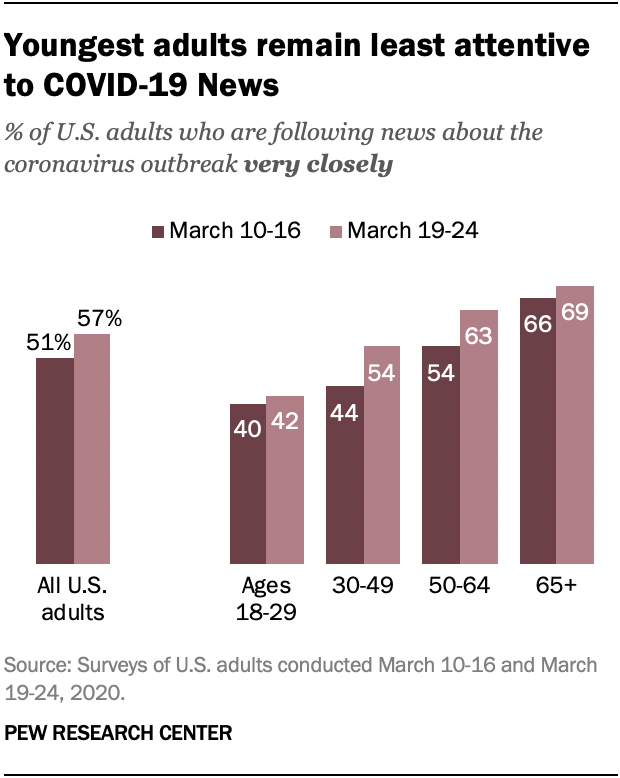
Youngest Adults Least Attentive To COVID-19 News


Chart shows youngest adults remain least attentive to COVID-19 News

An overwhelming majority of all U.S. adults (92%) said in late March that they were "fairly" or "very" closely following news about the COVID-19 pandemic.

But within that large share, notable differences emerge by age, according to surveys conducted as part of Pew Research Center's Election News Pathways project. 

More than two-thirds of adults ages 65 or older (69%) said they were following news about the pandemic very closely. At the other end of the spectrum, about four-in-ten Americans between the ages of 18 and 29 (42%) said they were paying as much attention to COVID-19 news. 

And while some age groups have started paying more attention to news about the outbreak over time, the youngest and oldest U.S. adults have largely remained unchanged. 

Chart shows more than half of all U.S. adults now following COVID-19 news very closely

The current analysis stems from two surveys conducted on the Center’s American Trends Panel: One on March 10-16, 2020 among 8,914 U.S. adults and a second on March 19-24, 2020 among 11,537 U.S. adults. 

Official Website Launches For Thursday's Feeding America Radiothon

Feeding America Emergency Radiothon and thousands of radio stations across the U.S. spanning companies across the radio industry are staging The Radio Cares: Feeding America Emergency Radiothon Thursday.

It's a one-day fundraising event benefiting Feeding America, the largest hunger relief organization in the U.S..  The official website at www.RadioCares.org where participating stations can find all related imaging and branding, including audio promos, sweepers, rejoiners, liner copy, :15, :30 and :60 spots, and a web banner for station websites will be provided to participating stations by the radio imaging specialists at Benztown, and hosted by Vipology, which also developed the www.RadioCares.org website. 

YEA Networks has donated the use of the URL to the Radio Cares initiative, a new grassroots charitable effort bringing U.S. radio stations and companies together to benefit select charitable causes. All donations go directly to Feeding America.

Any radio station wishing to participate in this industry effort to raise money for Feeding America and its 200-member network of local food banks across the U.S. may sign up online at www.RadioCares.org.  Also, a nationwide prep call will be hosted on Monday, April 27th, at 1:00pm Eastern by the Radio Cares committee for all interested and participating radio stations.

To register for the call, sign up at: http://www.anymeeting.com/PIID=EE57DE8383473C, If stations cannot join by computer, use the dial-in number: 206-331-4836, and PIN: 709-903-384#.

The Radio Cares: Feeding America Emergency Radiothon will be heard on radio stations across the U.S. on Thursday, April 30, 2020, from 12:00am Eastern until 11:59pm Eastern.
Feeding America established the COVID-19 Response Fund on March 13th. Since then, Feeding America has distributed $112.4 million and over 94 million pounds of food to food banks across the U.S., helping provide nearly 79 million meals to people facing hunger. 

Feeding America announced earlier this month that an estimated $1.4 billion in additional resources will be needed over the next six months to sustain operations and continue to provide food for people struggling with hunger—a 30% increase to the baseline six-month operating costs of its 200 member food banks nationwide. U.N. experts foresee a second pandemic on track to follow COVID-19 – a global hunger pandemic. Now, more than ever, U.S. food banks need cash donations to continue to meet the needs of the growing number of people struggling to feed themselves and their families.
To donate, please visit: www.RadioCares.org or text “Feed” to 95819.

Newsday Secures $10M Paycheck Protection Program Loan


Long Island's Newsday has secured a $10 million Paycheck Protection Program loan to preserve jobs in the economic downturn caused by the coronavirus pandemic, publisher Debby Krenek said.

“We are a local, independent media organization with no large corporate resources behind us while our advertising revenue continues to significantly decline,” she said in a memo to employees on Thursday. “The temporary relief we are receiving from the PPP is essential for us to maintain our staff as we all work harder than ever to serve our community.”

Debby Krenek
Newspapers, magazines, websites, television stations and other media have reported steep declines in ad revenue since the coronavirus hit. Many have seen subscription revenue increase, though not enough to make up for lost ad dollars, according to industry trade groups.

The number of layoffs and furloughs in the industry totals about 30,000 since the coronavirus outbreak and shutdown of nonessential activities last month, according to the Poynter Institute, a journalism think tank in Florida that received a $737,400 PPP loan.

Other media companies receiving PPP loans include the Seattle Times, which got $9.9 million; Tampa Bay Times, $8.5 million, and the Axios website, $5 million.

The PPP program, created as part of a $2 trillion federal stimulus package, exhausted its initial $349 billion in federal loan guarantees last week. Congress approved additional funding to restart the program Thursday night.

The closure of small papers and widespread layoffs at small radio and television stations has spurred four industry advocacy groups — the News Media Alliance, National Newspaper Association, National Association of Broadcasters and America's Newspapers — to ask Congress for a bailout. “Local news operations are in immediate peril due to COVID-19 and we need Congress to act now,” they said in an April 9 letter.

Biden Accuser Rips CNN For 'Blatant Bias'

Tara Reade, Joe Biden
The woman who has accused Joe Biden of a sexual assault in the early 1990s says she's disappointed that CNN anchor Anderson Cooper failed to ask the presumptive Democratic presidential nominee about the allegation when he had the chance -- not once, but twice, Fox News reports.

Tara Reade, a former staffer for then-Sen. Biden, told her story about the former vice president over a month ago with progressive podcast host Katie Halper. Since then, Biden has done nearly a dozen TV interviews with news anchors including NBC News' Chuck Todd, ABC News' George Stephanopoulos, and twice with Cooper -- all of whom failed to ask Biden about her public claim.

"I think it's shocking that this much time has passed and that he is an actual nominee for president and they're not asking the questions," Reade told Fox News. "He's been on 'Anderson Cooper' at least twice where he was not asked."

Larry King - 1993
"I guess my question is, if this were Donald Trump, would they treat it the same way? If this were Brett Kavanaugh, did they treat it the same way?" Reade said. "In other words, it's politics and political agenda playing a role in objective reporting and asking the question."

Reade believes that the news anchors who have interviewed Biden "don't want to ask him" about her assault allegation.

On Friday evening, a clip from 1993 surfaced showing an anonymous California resident phoning in to CNN's "Larry King Live" asking the TV host and his panel about "problems" her daughter had with a "prominent senator."

Reade confirmed to Fox News that the woman heard in the clip was her late mother, Jeanette Altimus.

CNN waited until Saturday afternoon to issue a report on its website and briefly mentioned on-air, which was the first time the network has addressed the Biden assault claim since Reade came forward in March.


Reade's story first resurfaced in an article in The Intercept on March 24. Halper then interviewed Reade, who said that in 1993, a more senior member of Biden's staff asked her to bring the then-senator his gym bag near the U.S. Capitol building, which led to the encounter in question.

"He greeted me, he remembered my name, and then we were alone. It was the strangest thing," Reade told Halper. "There was no like, exchange really. He just had me up against the wall."

Reade said that she was wearing “a business skirt,” but “wasn’t wearing stockings — it was a hot day.”

She continued: “His hands were on me and underneath my clothes, and he went down my skirt and then up inside it and he penetrated me with his fingers and he was kissing me at the same time and he was saying some things to me.”

“I pulled away, he got finished doing what he was doing,” Reade said. “He said: ‘Come on, man. I heard you liked me.’”

CNN did not immediately respond to Fox News' request for comment.

El Paso TV9 Apologizes For Commie Comments


El Paso NBC affiliate KTSM posted an apology over the weekend for comments made by news anchor, Patricia Maese, The El Paso Times reports.

Ruby Montana, an ethics and philosophy professor at UTEP, who was a guest on KTSM to speak out against the Reopen El Paso rally Saturday, posted a screenshot of post by Maese on KTSM's Facebook page by Maese that has since been removed.

In the deleted comment, Maese questions Montana's credibility, saying "Just because she can quote some communist philosopher, doesn't make her an expert." Montana quoted 19th century British philosopher John Stuart Mill in the interview.

Ruby Montana
Maese then goes on to accuse her of being a "Bernie supporter" who "never really worked a day in her life and is still collecting a paycheck ..." She finishes with "If anyone is a threat to life ... it's her."

KTSM later posted an apology for her Facebook comments to their site, calling them "unprofessional and unacceptable."

"The views she expressed are her own and do not represent the station or our parent company, Nexstar Media Group," news director Victor Venegas wrote in the post. "We have tremendous respect and admiration for all of our educators, who are working tirelessly to share their knowledge and expertise on all levels."

He went on to say they are "currently addressing this matter with Ms. Maese." Maese does not appear as a member of the news team on the the station's website.

Slow Times For Baseball Websites


Tim Dierkes and Sean Forman changed baseball with their ideas, creating websites that made it easier for fans, executives, players, agents, and journalists to follow and appreciate the sport.

Now, with baseball indefinitely shut down because of the coronavirus, they’re trying to survive, The Boston Globe reports.

“It’s been very stressful time to run a business,” said Forman, who owns Baseball-Reference.com, part of the Sports Reference family of sites. “You’re trying to do right by your employees and their families. Nobody saw this coming.”

Dierkes is the founder and owner of MLBTradeRumors.com, a site that reports on the latest transactions and gossip from around the game. Walk around a major league clubhouse close to the trade deadline in July and you’ll find many of the players and most of the reporters frantically checking the site’s phone app for the latest news.


Outside of MLB.com, MLB Trade Rumors and Baseball Reference are the two most popular baseball sites on the web. In normal times, MLBTR would be getting an average of 1 million page views a day. That’s down by more than 40 percent, and advertising revenue has dropped by 50 percent.“It’s a double whammy,” said Dierkes, who has three full-time employees. “It’s devastating for the business.”

The same is generally true for Baseball Reference, which during the season generates 1.5 million page views daily. The site, which started in 2000 as a hobby for Forman, has grown into a company with 11 full-time employees.

Baseball Reference is the industry standard for looking up statistics, box scores, and the other minutia of baseball. Any time you read a story with some mention of statistics, traditional or advanced, it’s likely the writer went to Baseball Reference to look it up.

Forman also created sites for the NFL, NBA, NHL, professional soccer, NCAA basketball, and NCAA football. That traffic has helped Sports Reference stay afloat.“Overall we’re holding fairly steady,” he said. “Baseball traffic is down, but the NFL offseason took on new meaning with Tom Brady [leaving the Patriots]. The Michael Jordan documentary [on ESPN] was a big win for us, too.

But Forman is leaving one open position unfilled and shuttered the company’s summer intern program. The drop in Web advertising hit hard, but he’s making payroll.

“If the NFL plays in September, we’ll be fine,” he said. “If not …”

Announcer George Gray Survives 3 'Widow Maker' Heart Attacks


George Gray, the announcer on CBS' "The Price Is Right" actually told a cardiac surgeon to come on down Friday – to perform a quadruple bypass operation after he suffered multiple heart attacks days earlier.

Gray's wife, Brittney, told USAToday that he woke up Monday with what he thought was indigestion but it progressed to severe chest pain and weakness in his arms.

"If this isn't a heart attack, I don't know what it is," he told her.

The paramedics arrived a few minutes later to their place in Tucson, Arizona, where he's been staying during the production hiatus forced by the COVID-19 pandemic, "and hooked him up to an EKG "and then just looked at each other and went, 'Yep' " she recalled.

"Are you allowed to tell me I'm having a heart attack?" George asked.   "Yeah," they confirmed. "It's a big one."

Due to restrictions on visitors due to the COVID-19 pandemic, Brittney wasn't allowed to accompany him to the hospital's catheter lab, where they attempted to install a stent in his left anterior descending artery, which the largest of the three arteries supplying blood to the heart.

"It was 100% blocked," Brittney said, adding that a second artery was 60% blocked.

George Gray
Minutes later, the stent failed, filling with plaque after the doctor left the cath lab.

"He basically had a second heart attack right there," she said. "The doctors were luckily able to rush back in and stent the stent."

In the recovery room, the doctors told George that he would need bypass surgery and an operation was scheduled for Friday.

"He recovered and he was getting stronger, but as he was being wheeled into the operating room, he started having a heart attack right on the operating table," Brittney recalled in an interview from outside his hospital room Saturday evening.

Attempting to calm him, the anesthesiologist fibbed and said he was just giving George some oxygen. "But they actually knocked him out and hurried to get him open," she said. "And instead of just one bypass, they did a quadruple bypass."

Gray, who just turned 53 in March, was not an obvious candidate for a heart attack, either, she said. "He has low cholesterol. He ran a mile the day before. No blood pressure problems, nothing. The doctor said this is most likely genetic. There are no signs beforehand – until the heart attack."

He is one of the 3% of U.S. men and 2% of U.S. women who have heart attacks between ages 40 and 59, according to the American Heart Association.

R.I.P.: Hamilton Bohannon, Motown and Disco Artist

Hamilton Bohannon
The US disco, funk and soul musician Hamilton Bohannon, who backed Motown’s greats before starting a respected solo career, has died.  Je was 78, according to the Newnan, GA Times-Herald.

No official cause of death has been released.

Bohannon was born in Newnan in 1942, the son of a working-class family who ran a barbershop and cafe. He started drumming – initially on family furniture – and began playing professionally after moving to Atlanta following high school, including alongside his friend Jimi Hendrix at the city’s Royal Peacock venue.

He was hired by Stevie Wonder as his live drummer and came into the orbit of Motown Records, who later employed him as a bandleader. His group Bohannon & The Motown Sound backed numerous label stars on tour, including Marvin Gaye, the Four Tops, the Temptations, and Diana Ross and the Supremes.

After Motown moved to Los Angeles, he stayed in the label’s first home of Detroit and started a solo career, beginning with 1973 album Stop & Go, and eventually released 19 studio albums by the end of the 1980s. He struggled to cross over in the US pop market – only one of his singles reached the Top 100 – but he became a mainstay in the disco boom of the mid-1970s onwards with tracks like Let’s Start the Dance.

In a discography ranging from 1973 to 1990, Bohannon released 22 albums. As a pioneer of disco and funk, his sounds have been sampled by the likes of Jay Z, Snoop Dogg, Craig Mack and Kool G Rap.

In February 2020, Bohannon released his last single – "Bohannon Combination Gumbo Mix”.


The sounds coming from WAOK in Atlanta fed Bohannon’s passion for music with the latest hits from Johnny Ace, Etta James, Ray Charles and The Clovers.  Bohannon fell in love with drums after watching The Bobcats – a Dixieland jazz group with members from the Bob Crosby Orchestra – on television.

By the time he was in seventh grade, he formed his own group – the Bob Dads. Dressed to the nines, the group looked as sharp as they sounded. Anything that came across the WAOK airwaves, the Bob Dads learned and performed for anyone willing to listen.

R.I.P.: Richard Hake, WNYC News Anchor

Richard Hake 1969-2020
WNYC news host, reporter and producer for the past 28 years, Richard Hake died on Friday at his home in Manhattan. He was 51, according to The NYTimes.

Goli Sheikholeslami, the chief executive of WNYC, confirmed the death on Saturday. A cause of death was not yet known.

“For all of us at New York Public Radio and in WNYC’s listening community, Richard was one of the first voices we heard every morning,” Ms. Sheikholeslami said, adding that he loved to say he “woke up New York.”

Hake produced and created live radio feature segments for WNYC that focused on breaking news, culture and artistic sound portraits.

His work was also featured on local and national NPR programs, including, “Morning Edition,” which he hosted, “Weekend Edition,” “All Things Considered” and “On the Media.”

Hake earned awards from The Associated Press Broadcasters Association, the Society of Professional Journalists and other organizations for his feature and documentary work, including the “Coney Island Cyclone Anniversary” and “The Perfume of the Bronx.”

Karen Frillmann, Hake’s editor and colleague at WNYC for nearly 20 years, said he was a “very local young man who brought his passions for New York to the WNYC newsroom.”

“He was unflappable as a broadcaster,” she said. “He really had an appetite for everything that New York offered.”

Ms. Frillmann said Mr. Hake could deliver breaking news as it was still coming in, noting that “he had to fill time and tap dance a little bit and say the right things and not misspeak, live on the radio, which is really a trick.”

April 27 Radio History


Samuel Morse 1840
➦In 1791...Samuel Morse was born Samuel Finley Breese Morse (Died – April 2, 1872). He was an American painter and inventor.

After having established his reputation as a portrait painter, in his middle age Morse contributed to the invention of a single-wire telegraph system based on European telegraphs. He was a co-developer of the Morse code, and helped to develop the commercial use of telegraphy.

Original Morse Telegraph
In 1825 New York City had commissioned Morse to paint a portrait of Lafayette in Washington, DC. While Morse was painting, a horse messenger delivered a letter from his father that read, "Your dear wife is convalescent". The next day he received a letter from his father detailing his wife's sudden death.   Morse immediately left Washington for his home at New Haven. By the time he arrived, his wife had already been buried.  Heartbroken that for days he was unaware of his wife's failing health and her death, he decided to explore a means of rapid long distance communication.

While returning by ship from Europe in 1832, Morse encountered Charles Thomas Jackson of Boston, a man who was well schooled in electromagnetism. Witnessing various experiments with Jackson's electromagnet, Morse developed the concept of a single-wire telegraph. The original Morse telegraph, submitted with his patent application, is part of the collections of the National Museum of American History at the Smithsonian Institution.  In time the Morse code, which he developed, would become the primary language of telegraphy in the world. It is still the standard for rhythmic transmission of data.


➦In 1927..Pacific Coast Biscuit Company launched KPCB in 1927 from Seattle.  Queen City Broadcasting took over the station in 1935, changing the call letters to the KIRO.  The station boosted its signal to 1,000 watts in 1937, and CBS soon moved its Seattle affiliation to KIRO. On June 29, 1941, KIRO's new 50,000-Watt transmitter on Maury Island became operational.

During the radio’s golden age in the 1940s and 1950s, KIRO recorded countless hours of CBS programming for time-delayed broadcast.  Many of these discs are the only extant recordings of CBS’ news coverage of World War 2, according to Faded Signals.

Bonneville International purchased KIRO-AM-FM-TV in 1964. By this time, KIRO-AM was carrying a full-service format of news, talk and middle-of-the-road music.  In 1973, it dropped CBS and affiliated with Mutual.  The station became “KIRO Newsradio 71” in 1974, replacing most music programming with news and talk.  The station spent the 1980s, 1990s and 2000s at the top of Seattle’s radio ratings.


On August 12, 2008, KIRO began simulcasting their programming on sister station KBSG-FM, which dropped their long-running classic hits format. This began the transition of KIRO Newsradio from AM to FM.  To complete the transition, KIRO switched to a sports radio format (as 710 ESPN Seattle) on April 1, 2009, and began carrying Seattle Mariners games, beginning in the 2009 season.[6] KIRO also simulcasts the Seattle Seahawks games with KIRO-FM, and has extensive team-related programming throughout the year. KIRO-FM continues the news/talk format.

Bonneville sold KIRO-TV to Belo in 1995 and then sold KIRO-AM-FM to Entercom.  Bonneville bought back the stations in 2007.

In 2008, KIRO-AM’s news/talk format moved to Bonneville-owned KBSG-FM.  The FM station’s call letters were changed to KIRO-FM.  KIRO-AM flipped to a sports format, picking up the ESPN affiliation in Seattle.

As of 2014, Bonneville owns the KIRO radio stations. Today the station airs sports-talk programming.


➦In 1932...Kemal Amin "Casey" Kasem born in Detroit (Died at age 82 – June 15, 2014).  He was the host of several music radio countdown programs, notably American Top 40 from 1970 until his retirement in 2009. He also provided the voice of Norville "Shaggy" Rogers in the Scooby-Doo franchise from 1969 to 1997, and again from 2002 until 2009.

In the 1940s, "Make Believe Ballroom" reportedly inspired Kasem to follow a career in radio and later host a national radio hits countdown show.  Kasem received his first experience in radio covering sports at Northwestern High School in Detroit. He then attended Wayne State University, where he voiced children on radio programs such as The Lone Ranger and Challenge of the Yukon. In 1952, Kasem was drafted into the U.S. Army and was sent to Korea. There, he worked as a DJ/announcer on the Armed Forces Radio Korea Network.

After the war, Kasem began his professional broadcasting career in Flint, Michigan. From there, he spent time in Detroit as a disc jockey for radio station WJBK-AM, WBNY in Buffalo, New York and a station in Cleveland before moving to California. At KYA in San Francisco, the general manager suggested that he tone down his delivery and talk about the records instead. At KEWB in Oakland, California, Kasem was both the music director and an on-air personality.  He created a show that mixed in biographical tidbits about the artists and songs he played, and attracted the attention of Bill Gavin, who tried to recruit him as a partner. After Kasem joined KRLA in Los Angeles in 1963, his career began to blossom and he championed the R&B music of East L.A.

Kasem earned roles in a number of low-budget movies and acted in radio dramas. While hosting "dance hops" on local television, he attracted the attention of Dick Clark, who hired him as co-host of a daily teenage music show called Shebang, starting in 1964.

Casey Kasem on 1110 KRLA
Kasem's voice was the key to his career. At the end of the 1960s, he began working as a voice actor. In 1969, he started one of his most famous roles, the voice of Shaggy on Scooby-Doo, Where Are You! He also voiced the drummer Groove from The Cattanooga Cats that year.

Kasem co-founded the American Top 40 franchise in 1970, hosting it from its inception to 1988, and again from 1998 to 2004. Between January 1989 and early 1998, he was the host of Casey's Top 40, Casey's Hot 20 and Casey's Countdown. From 1998 to 2009, Kasem also hosted two adult contemporary spin-offs of American Top 40: American Top 20 and American Top 10. He helped found the American Video Awards in 1983 and continued to co-produce and host it until its final show in 1987.

Between January 1989 and early 1998, he was the host of Casey's Top 40, Casey's Hot 20, and Casey's Countdown. Also beginning in 1998 Kasem hosted two adult contemporary spinoffs of American Top 40, American Top 20 and American Top 10. Kasem retired from AT20 and AT10 on July 4, 2009 and both shows ended on that day.

In October 2013, Kerri Kasem said her father was suffering from Parkinson's disease, which a doctor had diagnosed in 2007; a few months later, she said he was diagnosed with Lewy body dementia, which is often difficult to differentiate from Parkinson's. Due to his condition, he was no longer able to speak during his final months.

On June 15, 2014, Kasem died at St. Anthony's Hospital in Gig Harbor, Washington at the age of 82.


➦In 2008...Radio Personality Big Ron O'Brien died from complications of pneumonia at age 57.

O'Brien grew up in Des Moines, IA, and worked at the high school radio station.  Ron worked at KBAB in Indianola, IOWA and then in May of 1970, he arrived at KUDL (1380 AM) where he did the 6 PM to 10 PM shift.  KUDL-FM (98.1 now KMBZ-FM) was automated with a MOR format but did simulcust KUDL-AM at 9 each night.  Ron left KUDL to go back to Des Moines (his hometown) in February of 1971 where he did afternoons at KYNA-FM.

During the ensuing years,he worked for many stations, including KTLK in Denver, WCAR in Detroit, WQXI in Atlanta, WCFL (now WMVP) in Chicago, WOKY in Milwaukee, WFIL in Philadelphia, KFI and KIIS in Los Angeles, KWK (now WARH) in St. Louis (where he stayed for nine years), KZDG in Denver, WYXR (which became WLCE during his tenure and is now WRFF) in Philadelphia, WNBC (now WFAN) and WXLO (now WRKS) in New York, WPGC in Washington, D.C., and WRKO in Boston.

Big Ron had been the host of the syndicated radio program "On the Radio" from 1985 until 1992. WOGL 98.1 FM in Philadelphia was his employer for the final six years of his life.

Sheena Easton
HAPPY BIRTHDAY: 
  • Singer Ann Peebles is 73.
  • Singer Kate Pierson of The B-52’s is 72.
  • Singer Herbie Murrell of The Stylistics is 71.
  • Guitarist Ace Frehley (Kiss) is 69.
  • Singer/actress Sheena Easton (Miami Vice) is 61.