Tuesday, December 30, 2025

Google’s Top Trending Searches of 2025


Google's Year in Search 2025 reveals that conservative activist Charlie Kirk topped the list of trending U.S. searches, driven by a massive surge following his assassination on September 10 at Utah Valley University in Orem, Utah.


The 31-year-old founder of Turning Point USA was shot and killed during a campus event. Authorities charged 22-year-old Tyler Robinson with aggravated murder, and prosecutors are seeking the death penalty in the politically motivated attack.

Ranking second was the One Big Beautiful Bill Act, the sweeping tax and spending legislation signed by President Donald Trump on July 4 that extended 2017 tax cuts, introduced new deductions, and reshaped federal programs.

Other top trending searches included"
  1. Charlie Kirk
  2. KPop Demon Hunters (Netflix's animated hit musical fantasy film)
  3. Labubu (the viral collectible toy phenomenon)
  4. iPhone 17 (Apple's latest tech release)
  5. Zohran Mamdani (New York City's Democratic socialist mayor-elect)
  6. DeepSeek (the emerging AI platform)
  7. Government shutdown (the prolonged federal disruption)
  8. FIFA Club World Cup
  9. Tariffs (renewed trade policy debates)
The year also saw notable spikes in searches for the No Kings protest, the election of a new pope, and renewed interest in the Jeffrey Epstein files, reflecting a mix of political controversy, cultural moments, and global events that captured public attention.

Louisville Radio: WHAS' Terry Meiners Reaches Career Milestone


Terry Meiners, the longtime host of the afternoon drive-time show on NewsRadio 840 WHAS in Louisville, Kentucky, recently marked 50 years in radio broadcasting as of 2025.

His career spans from starting in 1975 (or around 1976 based on some accounts) at stations like WLRS and WQMF, to joining WHAS in 1985, where he has hosted weekday afternoons (typically 3-6 PM or similar) for 40 years.


He is celebrated for his humorous style, including impersonations of local figures, satirical interviews with celebrities, politicians, and comedians, and engaging conversations with newsmakers and everyday people. Meiners has also appeared on WHAS-TV, co-hosting shows like Great Day Live for several years.


Also in December 2025, local media (including the Courier-Journal) highlighted his milestone with photo galleries and tributes, recognizing his 50 years in the industry and 40 years specifically at WHAS.

 Podcasts and special segments, such as "50 Years of Terry Meiners Radio Bits," have featured highlights from his career, including comedy sketches, interviews, and monologues from across stations.

His show remains active on WHAS, with recent episodes and podcasts still airing. He continues to be a staple of Louisville media, and his bio and schedule on the WHAS/iHeartMedia site show him as the current host.

Radio History: Dec 30


➦In 1911...Actress Jeanette Nolan born (Died at age 86 from a stroke – June 5, 1998). Nominated for four Emmy Awards, she had roles in the television series The Virginian (1962–1971) and Dirty Sally (1974); and in films such as Macbeth (1948).

Nolan began her acting career at the Pasadena Playhouse in Pasadena, California, and, while a student at Los Angeles City College, made her radio debut in 1932 in Omar Khayyam, the first transcontinental broadcast from station KHJ. She continued acting into the 1990s.

Nolan made more than three hundred television appearances.

➦In 1914...Radio & TV host Bert Parks born (Died at age 77 from lung cancer – February 2, 1992).  He is best known for hosting the annual Miss America telecast from 1955 to 1979.

Parks entered radio broadcasting at age 16, for Atlanta's WGST. Three years later, he moved to New York City and was hired as a singer and straight man on The Eddie Cantor Show, then becoming a CBS Radio staff announcer. Parks was the host of Break the Bank, which premiered on radio in 1945 and was telecast from 1948 to 1957, as well as Stop the Music on radio in 1948 and television from 1949 to 1952.
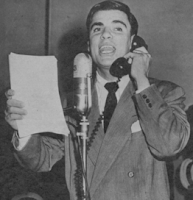
Bert Parks
The success of Stop the Music took a toll on the ratings of the popular radio show hosted by satirist Fred Allen, who began spoofing Parks's program with skits mocking the premise of the show, one called Cease The Melody.

With other celebrities, he hosted NBC radio's Monitor during the 1960s.

Parks' first game show was Party Line on NBC (broadcast from New York City NBC flagship station WNBT), which involved viewers calling in to answer questions and win $5 prizes; Party Line ran from June 8 to August 31, 1947, making its one surviving episode the oldest known game show and one of the oldest surviving television shows to have been recorded. Commercial kinescopes did not come out until fall 1947 (co-sponsored by NBC, DuMont, and Kodak), and the only kinescopes known to predate Party Line are a few episodes of Kraft Television Theater from February and June 1947.

Parks is most famous for hosting the Miss America telecast from 1955–79; each telecast ended with Parks singing "There She Is, Miss America", as the winner was crowned. Following the 1979 pageant, he was unceremoniously fired by the organization (he heard a newscast while on vacation) in an attempt to attract a more youthful audience. The Tonight Show host Johnny Carson led an on-air campaign to get Parks rehired, but was unsuccessful. In 1990, for the 70th anniversary of the Miss America pageant (during which Miss America 1991 was crowned), Parks was brought on by host Gary Collins to sing "There She Is" to the new Miss America, Marjorie Judith Vincent. It was the last time Parks performed the song live.

➦In 1917...actress Nancy Coleman born (Died at age 82 – January 18, 2000). After working on radio and appearing on the Broadway stage, Nancy Coleman moved to Hollywood to work for Warner Bros. studios.

Early in her career as an actress, Coleman portrayed Alice Hughes on the radio version of the soap opera Young Doctor Malone.  Coleman also appeared as the lead in the 04/13/1943 episode of "Suspense", entitled "Fear Paints a Picture". On television, she played Helen Emerson on Valiant Lady.
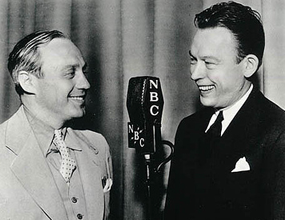
Jack Benny and Fred Allen

➦In 1936...The famous radio feud between Jack Benny and Fred Allen began. Good friends in real life, Fred Allen and Jack Benny inadvertently hatched a running gag in 1937 when a child prodigy, violinist Stuart Canin, gave a very credible performance on the Allen show, inspiring an Allen wisecrack about "a certain alleged violinist" who should hide in shame over his poor playing.

Allen often mentioned his show-business friends on the air ("Mr. Jacob Haley of Newton Highlands, Massachusetts" was Allen's way of saying hello to his pal Jack Haley), and on the Canin broadcast Allen knew Benny would be listening. Benny, according to Allen biographer Taylor, burst out laughing, then responded in kind on his own program. The rivalry gag went on for a decade and convinced some fans that the two comedians really were blood enemies.

The Allen-Benny feud was the longest-playing, best-remembered running gag in classic radio history.  The gag even pushed toward a boxing match between the two comedians and the promised event was a sellout, though the match never occurred.

➦In 1942...the radio program, "Mr. and Mrs. North", began it's run on the NBC Radio network. The show was a radio mystery series that aired on NBC and CBS from 1942 to 1954. Alice Frost and Joseph Curtin had the title roles when the series began in 1942.

The characters, publisher Jerry North and his wife Pam, lived in Greenwich Village at 24 St. Anne's Flat. They were not professional detectives but simply an ordinary couple who stumbled across a murder or two every week for 12 years. The radio program eventually reached nearly 20 million listeners.

➦In 1942...Frank Sinatra opened at New York's Paramount Theater for what was scheduled to be a four-week engagement, but turned into eight weeks because of its popularity.

Monday, December 29, 2025

Atlanta Journal-Constitution Ending Print Edition


The Atlanta Journal-Constitution (AJC), a major newspaper serving Atlanta and the Southeast for over 157 years, announced in August 2025 that it would end its printed edition and transition to a fully digital-only model starting January 1, 2026.

The final print edition was published on December 31, 2025 — marking the end of physical newspaper production after more than a century and a half. This shift was driven by rapid changes in media consumption, with far more readers engaging via digital platforms (website, app, podcasts, video) than print. 

Publisher Andrew Morse noted in his announcement that digital audiences had already surpassed print significantly, and the move allows the AJC to focus resources on expanding journalism, including new reporting hires, podcasts, newsletters, and video content.

Key Details
  • Historical Context — The AJC traces its roots to The Atlanta Constitution (founded 1868) and The Atlanta Journal (1883), which merged in 2001. It was owned by Cox Enterprises since the 1930s/1950s.
  • Subscriber Impact — At the time of the announcement, the AJC had about 115,000 total paid subscribers, with roughly 75,000 digital-only and around 40,000 still receiving print. The goal was to grow digital subscribers to 500,000.
  • What Continues — The AJC remains active with daily journalism on AJC.com, a new/updated mobile app, an ePaper replica (digital version of the print layout), newsletters, podcasts, and more. Print subscribers were encouraged to transition to digital plans (e.g., $9.99/month or $99/year).
  • Job Impact — The change resulted in the elimination of about 30 full- and part-time roles related to print design and distribution.
  • Broader Significance — This made Atlanta the largest U.S. metro area without a major daily printed newspaper, though smaller local papers continue. The decision reflects industry trends: declining print circulation (from over 600,000 at its peak in the early 2000s) and the need to adapt to digital revenue and audience growth.
The AJC emphasized that it is not stepping away from local journalism but evolving to deliver it more effectively in a digital era.

Key FCC Initiatives Impacting News Media in 2025


Under Chairman Brendan Carr (appointed January 2025), the FCC prioritized deregulation, empowering local broadcasters, and addressing perceived bias in media. These efforts focused on broadcast TV and radio, which remain core to news delivery, though the agency has limited direct authority over online platforms.

Empowering Local Broadcasters and Modernizing Rules
  • Accelerated Next Gen TV (ATSC 3.0) transition: Promoted this technology to modernize over-the-air TV, enhancing local news and information delivery.
  • Deregulation of broadcast rules: Eliminated 98 obsolete rules (some from the 1970s) to reduce burdens on broadcasters.
  • Review of ownership rules: Launched the 2022 Quadrennial Review to assess local TV/radio limits and dual network restrictions, citing digital competition (e.g., streaming). This could lead to relaxed caps on station ownership in markets.
  • Approved mergers with conditions: Approved Skydance's acquisition of Paramount (CBS parent), requiring commitments to viewpoint diversity in programming, measures to address bias in national news, and enhanced local reporting.
Investigations and Accountability
  • Public interest obligations: Launched inquiries into network-affiliate relationships and held broadcasters accountable for obligations.
  • News distortion probes: Reopened or pursued complaints against networks (e.g., CBS "60 Minutes" editing), emphasizing editorial independence while investigating alleged bias.
Other Actions
  • Eliminated DEI initiatives: Rescinded prior DEI programs, advisory groups, and related priorities.
  • No net neutrality reinstatement: A 2025 court ruling invalidated prior efforts to restore rules, aligning with Carr's opposition.
These initiatives emphasized localism, reduced regulation, and trust in media amid competition from digital platforms. Carr described 2025 as "historic" for advancing these goals, though critics raised First Amendment concerns over content-related actions. 

For details, see FCC announcements and Carr's year-end summary.

MN Fraud Viral Video Largely Ignored By MSM


Mainstream news outlets have largely ignored Nick Shirley's viral 42-minute video exposing alleged fraud in Minnesota's Child Care Assistance Program (CCAP), with no coverage from major sources like The New York Times, Washington Post, CNN, MSNBC, ABC, or CBS.

Right-leaning and conservative media, however, have amplified the report extensively. Fox News published a detailed article highlighting the "misspelled learning center" with no children visible despite receiving millions in funds, tying it to broader criticism of Gov. Tim Walz (D) and demanding explanations. 

Other outlets like Mediaite, American Greatness, PJ Media, The Wrap, Twitchy, and KOMO News echoed similar coverage, focusing on the empty facilities, confrontations with staff, and political fallout, including Rep. Tom Emmer (R-MN) calling for Walz to respond.

The video has exploded online, surpassing 30 million views on X in under 24 hours (over 100 million combined with clips), with shares from figures like Elon Musk (who called for Walz's prosecution) and praise from conservative commentators. 

Nick Shirley
Supporters hail Shirley as a citizen journalist exposing taxpayer waste amid ongoing federal probes into Minnesota's social services fraud (estimated in billions across programs like Feeding Our Future).

Criticism and skepticism are limited but present, mostly in online forums. Some Reddit users accuse Shirley of grifting, staging elements, or inflating claims, noting that daycare violations are common and not always indicative of fraud. 

Others dismiss the video as racially charged or partisan. 

No formal fact-checks debunking the core allegations have emerged yet, though critics argue the footage relies on visual observation without full verification of records or operations.

Overall, the response remains polarized: widespread enthusiasm on social media and right-leaning platforms, silence from legacy media, and scattered online pushback.

Indy Reporter's MN Fraud Story Goes Viral On Social Media


A viral investigation by independent journalist Nick Shirley has ignited outrage over alleged widespread fraud in Minnesota's Child Care Assistance Program (CCAP), with claims that taxpayer-funded daycares—many operated by Somali-owned businesses—received millions despite appearing empty and nonoperational.

In a 42-minute video posted on December 26, 2025, titled "I Investigated Minnesota’s Billion Dollar Fraud Scandal," the 23-year-old content creator and his team visited multiple licensed Minneapolis daycares. 

They reported no children or active operations visible during business hours, even as public records showed facilities licensed for 99+ kids and receiving substantial funds (e.g., one center allegedly got $1.9 million in 2025 alone, with up to $4 million total).Shirley claims his one-day probe uncovered over $110 million in potential fraud, calling it "open and blatant" and accusing state officials, including Gov. Tim Walz (D), of complicity through poor oversight. The video amassed tens of millions of views on X and YouTube, amplified by shares from figures like Elon Musk and Rep. Tom Emmer (R-MN), who demanded explanations from Walz.

The allegations tie into broader ongoing federal and state probes into Minnesota's social services, including the high-profile "Feeding Our Future" nutrition fraud case (involving over 70 indictments) and estimates of billions lost across programs since 2018—some allegedly linked to Somali communities and even foreign transfers.

No new charges stem directly from Shirley's video, and critics note his claims rely on on-site footage and public records without full independent verification. Supporters praise it as citizen journalism exposing taxpayer waste, while others caution against unproven allegations and potential inflammatory framing.

Hannity Florida Estate On The Market for $45M


An ocean-to-lake estate near West Palm linked to Fox News host Sean Hannity is now listed for sale at $44.9 million, including furnishings.

The property at 1840 S. Ocean Blvd. entered the multiple listing service on Dec. 23, 2025, as reported first by the Palm Beach Post. This marks a significant increase from the $23.5 million (recorded price) the trust connected to Hannity paid in November 2024, even though the original listing price was $25.95 million.

Sean Hannity
The Mediterranean-style residence, built in 1990, spans about 2 acres with 150 feet of frontage on both the Atlantic Ocean and Intracoastal Waterway. It features 12,378 square feet of air-conditioned space (20,106 total including outdoor areas), eight bedrooms, multiple terraces, a private dock, and a beachfront cabana across the road. The home is located roughly six-tenths of a mile north of the Boynton Inlet for easy boating access.

Hannity's longtime financial adviser, William G. Lako Jr. (CEO of Hennsler Financial in Georgia), serves as trustee for the owning trust, per property records.

Hannity resides in nearby Palm Beach, where he owns two adjacent oceanfront townhouses purchased for a combined $20.5 million (one in April 2021 for about $5.6 million, the other in January 2025 for $14.9 million). He has plans to merge them into a single residence and has declared Palm Beach as his primary home.

Radio's Future Ad Sales Success Is Digital


Borrell Associates forecasts a resilient 2026 for radio advertising, with the industry facing the smallest year-over-year decline among traditional media—just 0.9%—despite conflicting predictions elsewhere. The overall U.S. local advertising market is expected to grow 3%.

This relative stability stems from radio's successful integration of digital offerings, which offset declines in traditional spot sales. 

iHeartMedia stands out as the only major publicly held media company reporting total ad revenue growth through Q3 2025, thanks to a 12% digital increase that countered a 5% drop in core radio revenue. Other firms, like Beasley Media Group (digital up 4.6% amid 15.8% core decline) and Townsquare (digital up 2.6% despite 11% core drop), show similar trends.

Gordon Borrell
Gordon Borrell, the firm's CEO, noted: “Radio seems to just have a really good message, and they might have found the formula.”

Streaming audio is projected to grow 9.2% in 2026—faster than OTT video or any other tracked format—driven by platform partnerships, cross-media buying, and radio inventory in digital marketplaces.

Radio's future success will hinge less on spot ad rebounds and more on strong digital sales execution, bundling, and positioning. 

When combined effectively, radio and digital enhance advertiser recall, brand awareness, and multichannel reach.AI is reshaping expectations, with 10% of small and medium-sized businesses already using it for marketing recommendations and 23% planning to adopt it soon. Radio sellers must adapt to automation-driven budget shifts and educate advertisers on the evolving media mix, ROI strategies, and AI tools to seize new opportunities.

Radio/TV Broadcasting & Media Stories: Month-by-Month


2025 was a pivotal year for broadcasting and media, marked by regulatory deregulation, accelerating NextGen TV (ATSC 3.0) adoption, major mergers, AI-driven production tools, and the ongoing decline of traditional cable networks amid cord-cutting and streaming dominance.

January
  • Wildfires devastated Los Angeles production facilities and local broadcast operations.
  • CES 2025 showcased AI in content creation and early NextGen TV receiver advancements.
  • FCC began reviewing media ownership rules, signaling potential deregulation.
February
  • NAB Show preparations emphasized AI and NextGen TV innovations.
  • Ongoing recovery from 2023 strikes impacted radio and TV production schedules.
March
  • Realscreen Summit highlighted unscripted content trends.
  • FCC advanced ownership rule proceedings.
April
  • NAB Show Las Vegas (April 6-9) focused on ATSC 3.0 deployments, AI tools, and cloud virtualization.
  • U.S. Court of Appeals vacated FCC's Top-4 TV ownership prohibition, easing local mergers.
May
  • TV Upfronts: Networks unveiled slates amid ad shifts to streaming.
  • International events like CABSAT discussed regional media trends.
June
  • FCC NPRMs on ATSC 3.0 flexibility and ownership rules progressed.
  • BroadcastAsia emphasized global broadcasting advancements.
July
  • FCC approved Paramount-Skydance merger with conditions on viewpoint diversity.
  • Court decision enabled more top-four TV station combinations.
August
  • NAB Show New York prep intensified AI discussions.
  • Streaming dominance: Netflix led U.S. viewing share, Disney+ bundles gained traction.
September
  • IBC 2025 (Amsterdam) featured AI Media Zone and NextGen TV progress.
  • FCC launched 2022 Quadrennial Review of local radio/TV ownership and dual network rules.
October
  • INMA World Congress focused on news media transformation.
  • Nexstar-TEGNA merger advanced toward FCC review.
November
  • FCC eased LPTV/translator operations.
  • Political scrutiny on public media funding and bias.
December
  • FCC revised LPTV rules after decades.
  • Major deals: Netflix pursued Warner Bros. assets; Paramount-Skydance closed.
  • Cable networks shut down (e.g., Universal Kids, HBO Family); NextGen TV reached ~75% U.S. coverage.
Overall, 2025 saw deregulation easing consolidation (e.g., mergers, station swaps), NextGen TV maturation with new receivers and services, AI integration in production, and cable's continued decline as streaming solidified its lead. Challenges like cord-cutting persisted, but local broadcasters gained flexibility to compete.

Trump Snaps At Reporter For 'Dumb Question'


President Donald Trump snapped at a reporter on Sunday, calling a question about signing security guarantees for Ukraine "dumb" just moments before entering high-stakes peace talks with Ukrainian President Volodymyr Zelenskyy at Mar-a-Lago in Palm Beach, Florida.

]The exchange occurred as the two leaders greeted each other outside the resort and posed for photos. When a reporter asked if Trump was prepared to sign a security agreement that day, he responded sharply: "What a dumb question. Nobody even knows what the security agreement is going to say." He added that there would be "a strong agreement" with significant European involvement in protection efforts, describing their role as "terrific."


The incident highlighted ongoing tensions over security guarantees, a core element of Zelenskyy's revised 20-point peace plan (now about 90% complete), which seeks NATO Article 5-style protections, maintenance of Ukraine's 800,000-troop army, a demilitarized zone in Donbas, substantial aid, and EU membership timelines.

Trump, who has shown no commitment to direct U.S. military defense of Ukraine, expressed optimism about broader talks, calling them in the "final stages" with both Russia and Ukraine eager to end the conflict. Earlier that day, he had a "good and very productive" phone call with Russian President Vladimir Putin and planned to brief Zelenskyy on it before calling Putin again.

Discussions covered Donbas, the Zaporizhzhia nuclear plant, air defense, and sanctions, with a joint call to European leaders planned. No firm deadline was set for a deal, and reporters were briefly allowed into the dining room before being escorted out.

This was the sixth meeting between Trump and Zelenskyy in 2025, following improved relations after a heated February Oval Office clash.