New CBS Evening News anchor Tony Dokoupil sparked backlash on social media after releasing a New Year's Day video promising to prioritize the "average American" over "advocates, academics or elites" and criticizing legacy media for missing major stories.
In the video posted to CBS platforms, Dokoupil cited examples like NAFTA, the Iraq War, Russiagate, COVID lockdowns, Hunter Biden's laptop, and "the president's fitness for office" as issues where the press relied too heavily on elite perspectives, eroding public trust.
"We’ve taken into account the perspective of advocates and not the average American," Dokoupil said. "Or we put too much weight in the analysis of academics or elites, and not enough on you. And I know this because at certain points, I have been you."
He pledged transparency and accountability, stating viewers come first—"not advertisers, not politicians, not corporate interests," including CBS owners—and urged audiences to hold him accountable starting with his debut on January 5, 2026.
Critics on X were swift and skeptical. One user, Dr. Kevin Young, wrote, “CBS News has fallen. Americans must now rely on international news outlets rather than US based state run media for factual journalism.”Another mocked: “Why is CBS posting Tony Dokoupil’s Fox News audition tape?”
"On too many stories, the press has missed the story. Because we've taken into account the perspective of advocates and not the average American. Or we put too much weight in the analysis of academics or elites, and not enough on you."
Conservative outlets and commentators largely praised the moves as a long-overdue acknowledgment of media bias and a step toward rebuilding trust.
Fox News highlighted Dokoupil urging viewers to "hold him accountable," framing it as addressing the "media trust crisis."
The Gateway Pundit called it "panic mode" for legacy media, applauding his vow to report "for you, not the left."
Commentators like Jonathan Turley expressed delight, noting Dokoupil's promise of transparency and fairness.
Some X users encouraged the shift, with one calling it a "high bar" for old-school journalism.
Supporters view this as an effort to counter perceived liberal bias on issues like Hunter Biden's laptop, COVID lockdowns, and Russiagate.
Negative Reactions
Critics on the left and within CBS accused the changes of pandering to right-wing audiences or injecting pro-Israel bias (tied to Dokoupil's past interview with Ta-Nehisi Coates and Weiss's views).Outlets like The Daily Beast mocked promotional stunts as "humiliating" and "awkward."
Staffers reportedly called Dokoupil "mediocre" and the role a "toilet seat," per reports in The Independent.
Progressive voices, including Cenk Uygur and Mehdi Hasan's Zeteo, criticized the appointment as favoring "pro-Israel" alignment over merit.
X reactions included mockery, with users joking it's a "Fox News audition tape" or declaring "CBS News has fallen," urging reliance on international outlets instead.
Mixed or Skeptical Views
Many expressed doubt that real change would occur, citing CBS's history and Dokoupil's prior roles at MSNBC and CBS Mornings.
Skeptics noted "too little, too late" or predicted he'd remain constrained by corporate interests.
Some highlighted irony, pointing to recent CBS controversies as undermining his trust pledges.
Overall, the announcement and video amplified debates about media credibility, with enthusiasm from the right, disdain from the left, and widespread skepticism about whether CBS can genuinely shift under new ownership and leadership.
Former CBS News investigative correspondent Catherine Herridge revealed that network executives blocked a potential live interview with Elon Musk in fall 2023, citing fears over his unpredictable statements and insisting on pre-recording the segment for editing control, as well as airing it exclusively on a CBS platform.
Herridge, speaking in a recent video posted to X on January 1, 2026, described pitching the interview opportunity amid her reporting on the Twitter Files—internal documents released by Musk after his acquisition of Twitter (now X) that exposed how the platform suppressed certain stories, including those related to Hunter Biden's laptop under pressure from the Biden administration and federal agencies.
"We don't know what [Elon Musk] is going to say," Herridge recounted executives telling her, adding that she was stunned by the response: "Isn't that the point of journalism? You don't know what the person's going to say?"
Straight to the Point: When Corporate Media Bias Is Baked In
In the fall of 2023, I brought CBS News a proposed interview opportunity with Elon Musk.
CBS Executives said the interview couldn’t be done live, rather it had to be pre-recorded so they had the ability to edit Musk… pic.twitter.com/nuS3A4cDsL
Musk had proposed a live interview on his own platform, aligning with his advocacy for free speech. Herridge suggested compromises, such as simulcasting on X and CBS's streaming service, but all proposals were rejected. Feeling "ashamed" that a news organization would impose such restrictions—typically demanded by interview subjects, not networks—she never followed up with Musk.
This incident echoes Herridge's earlier accounts from late 2024, where she first publicly detailed the blocked interview during appearances on NewsNation and in subscriber videos. She has tied it to broader internal resistance at CBS, including delays in her Hunter Biden laptop reporting and her eventual firing in February 2024 amid layoffs.
Herridge, an Emmy-winning journalist fired by CBS despite her high-profile national security and investigative work, now operates independently on X and through her newsletter.
CBS News, under different management at the time of the Musk proposal, did not respond to requests for comment in her latest video.
The revelation has fueled criticism of legacy media's approach to high-profile figures like Musk, highlighting tensions over editorial control versus unfiltered discourse, especially on topics like government influence on social media censorship.
Citing phenomenal growth of his Sunday afternoon show, WABC Radio has added Joe Concha to their weeknight line-up from 9 to 10 PM ET, Monday through Friday, beginning January 5. Concha, a sought-after contributor on FOX News, will continue to host his Sunday radio program from 11 AM to 12 Noon ET.
Since Concha took over that time slot he has grown 85% in Average Share and 78% in Weekly Cume, Persons 12+, May 2025 to December 2025, in the New York Metro, according to Nielsen Audio.
Joe Concha
“Joe is exactly the kind of smart, credible, non-nonsense voice we promised our listeners,” said John Catsimatidis, Owner and CEO of Red Apple Media and WABC Radio. “Listeners trust Joe and his ratings success backs that up. We are delighted to add him to our weeknight programming.”
A nationally recognized columnist, author, and Fox News contributor, Concha has carved out a reputation as one of the most respected and relatable voices in News Talk. Joe delivers his signature commentary, candid interviews, and no-nonsense breakdowns of the most pressing stories, while cutting through the noise with clarity, humor, and authenticity.
Joe Concha’s Sunday program is syndicated nationally on the Red Apple Audio Networks, as is Joe Concha Sounds Off, a hard hitting two-minute feature packed with opinion and punch.
Media coverage of Zohran Mamdani's inauguration as New York City's mayor has been polarized, reflecting his status as a divisive progressive figure.
Left-leaning and mainstream outlets largely celebrated the historic event, portraying it as a triumphant milestone for diversity and working-class politics. The Guardian described Mamdani's swearing-in on a Quran as marking a "new era," while NPR and CNN highlighted his "soaring rhetoric" and coalition with figures like Bernie Sanders and Alexandria Ocasio-Cortez, framing his affordability agenda as inspirational for progressives nationwide.
Centrist sources, such as The New York Times and BBC, emphasized the milestones—Mamdani as the city's first Muslim, South Asian, and Africa-born mayor, and youngest in over a century—while noting looming challenges in implementing bold policies amid economic pressures and scrutiny from opponents.
Conservative reactions were sharply critical, with some Republicans labeling his democratic socialism as dangerous, though coverage noted post-election cordiality, including a meeting with President Trump.
Overall, outlets across the spectrum depicted Mamdani's rise as a national phenomenon driven by social media and grassroots energy, with his early actions—like revoking certain prior executive orders and signing tenant protections—seen as immediate steps toward his "agenda of abundance."
Mamdani, a 34-year-old former state assemblyman, won an upset 2025 election after defeating Andrew Cuomo in the Democratic primary and then in the general as Cuomo ran independently, alongside Republican Curtis Sliwa. His campaign focused on rent freezes, free buses, universal childcare, and municipal groceries, resonating with young and cost-burdened voters.
The January 1, 2026, inauguration drew massive crowds despite freezing weather, featuring performances, a block party, and oaths administered privately at midnight and publicly by Sanders.
Despite the seasonal surge in holiday tunes, KOIT couldn't overtake the top spot in the 6+ ratings. KQED held firm at #1 for its 12th consecutive month, dipping slightly (9.3–9.1). Audacy's all-news KCBS (740 AM/106.9 FM) stayed steady at #2 (8.1–8.1), picking up an additional 0.3 share from streaming.
Bonneville AC KOIT, which flipped to all-Christmas the day before Thanksgiving, climbed to #3 with a strong gain (4.7–7.0)—though it trailed its #2 finish a year ago (7.2). USC's classical KDFC slipped to #4 (5.1–5.0), while Bonneville hot AC KMVQ (99.7 Now) rose to #5 (4.3–4.1). iHeartMedia soft AC KISQ (98.1 The Breeze) hit its lowest share in more than a year, falling to #7 (4.6–3.3).KOIT saw its #1 cume grow 8.8% (1,068,400–1,162,300). Overall market share declined 0.5%, with persons using measured media (PUMM) down 3.3% from November but up 16.6% year-over-year.
In the 25-54 demo, relentless holiday jingles propelled KOIT from #4 to #1—its strongest performance since February. KQED dropped to #2, ending a three-month winning streak. KMVQ eased to #3, while iHeartMedia pop CHR KYLD (WiLD 94.9) advanced to #4; both saw minor dips. Audacy alternative KITS (Live 105) posted its weakest numbers since March, sliding from #2 to #5.
Market PUMM rose 0.4% from the prior month and 18.0% from a year ago.
Boston: Magic 106.7 Works Its Holiday Spell
Audacy AC WMJX (Magic 106.7) flipped to all-Christmas the day before Thanksgiving and conjured a massive surge, leaping from #2 to #1 in the 6+ rankings (6.1–10.3)—outperforming its #1 finish last year (8.3).
Beasley sports WBZ-FM (98.5 The Sports Hub) slipped to #2, ending a four-book climb (6.9–6.2). Beasley classic hits WROR held steady at #3 (5.6–5.3), while iHeartMedia pop CHR WXKS (Kiss 108) returned to #4 (5.3–4.9).
Two stations advanced to tie at #5: iHeartMedia news/talk WBZ-AM rose from #6 (4.7–4.6), and Audacy sports WEEI climbed from #7 (4.4–4.6). Boston University news/talk WBUR tumbled four spots to #9 with its lowest share since last holiday season (5.0–4.0).WMJX broke the one-million cume barrier, boosting its total by 19.9% (843,600–1,011,400).
Overall market share dipped 0.3%, with persons using measured media (PUMM) down 4.0% from November but up 2.0% year-over-year.
In the 25-54 demo, WMJX rocketed from #7 to #1, more than doubling its previous share and posting double-digit numbers. That flipped a five-share deficit to WBZ-FM into a lead of more than a full share, ending The Sports Hub's three-book winning streak as it fell to #2. WXKS eased to #3, halting a four-book surge. Audacy hot AC WWBX (Mix 104.1) slipped to #4 with a minor dip, while iHeartMedia classic rock WZLX dropped to #5 with its weakest performance since June. WBUR plunged from #5 to #8. Market PUMM declined 0.9% from the prior month but rose 12.6% from a year ago.
Atlanta: Santa's Sleigh Lands at Star 94.1
The traditional home for all-Christmas music in Atlanta—long held by the station once known as The Fish—has changed hands this year. Audacy's rhythmic AC WSTR (Star 94.1) flipped to holiday hits the day before Thanksgiving, delivering a solid lift from #10 to #8 (3.6–4.2). Who will claim the Santa crown next year? Stay tuned.
In the 6+ rankings, Cox Media news/talk WSB-AM held onto #1 for the fourth consecutive book, though it gave back all of last month's gain (8.5–7.4). Cox Media classic hits WSRV (97.1 The River) snapped a five-book decline, climbing from #5 to #2 (5.6–6.2). Cox Media AC WSB-FM (B98.5) eased to #3 (6.8–6.1), followed by Cox Media urban AC WALR (Kiss 104.1) at #4 (6.5–6.0). Urban One urban AC WAMJ (Majic 107.5/97.5) slipped to #5 (6.2–5.9), while Audacy urban AC WVEE (V-103) landed at #6 with its lowest share in more than a year (5.6–5.1).WSB-FM remained the market's cume leader despite a 4.1% drop (851,300–816,100). Overall market share edged up 0.1%, with persons using measured media (PUMM) down 5.2% from November and 4.6% year-over-year.
In the 25-54 demo, WVEE stayed #1 for the third straight survey despite a softer book. WSB-FM reclaimed #2, ending a three-month upward run. Audacy sports WZGC (92.9 The Game) rose to #3 with a minor dip, while WSB-AM fell to #4, snapping a four-book surge. WALR held steady in share ranking but tied for #4 with its smallest number in over a year. Holiday-powered WSTR jumped from #10 to #8.
Market PUMM declined 5.3% from the prior month and 1.8% from a year ago.
Washington, DC: Christmas Surge Falls Short at the Top
Mirroring trends in other markets, the holiday music express couldn't derail the news/talk dominance in the 6+ rankings. Hubbard news WTOP extended its streak to six consecutive #1 finishes, edging up slightly (12.1–12.2). American University news/talk WAMU held steady at #2, though it dipped (11.6–10.9).
iHeartMedia AC WASH flipped to all-Christmas on the second day of the survey, rocketing from #5 to #3 with a massive gain (4.9–8.7)—surpassing its #3 performance last year (7.3). Howard University urban AC WHUR slipped to #4 (7.0–6.0), while iHeartMedia alternative WWDC (DC101) eased to #5 with a slight uptick (5.0–5.2).
WASH boosted its market-leading cume by 13.9% (794,200–904,500). Overall market share rose 0.4%, with persons using measured media (PUMM) down 5.1% from November but up 19.9% year-over-year.
In the 25-54 demo, WASH's holiday format vaulted it from #3 to #1, posting double-digit shares. WAMU, still in double digits, dropped to #2—snapping an remarkable 11-book winning streak. WTOP fell to #3, ending a two-month climb. WWDC held at #4 with a rebound, while WHUR advanced to #5 with its strongest performance in exactly a year. Atlantic Gateway contemporary Christian WGTS slid to #6 amid a significant share drop. Market PUMM declined 1.2% from the prior month but surged 22.6% from a year ago.
Philadelphia: B101 Becomes the Sleigh
Audacy AC WBEB (B101) flipped to all-Christmas on the second day of the survey and harnessed the full power of the holiday format, soaring from #5 to #1 in the 6+ rankings with a dramatic leap (5.0–10.1)—outpacing its #3 finish last year (7.8).
Beasley active rock WMMR fell to #2 (7.7–6.4), while iHeartMedia urban AC WDAS rose to #3 with its best performance since May (5.4–6.3). Audacy sports WIP (94 WIP Sportsradio) slipped to #4 (6.6–5.8), gaining a 2.3 share from streaming. Beasley classic rock WMGK recorded its lowest share in over a year, dropping from #2 to #5 (6.7–5.5).
WBEB grew its market-leading cume by a remarkable 28.2% (1,088,900–1,396,200). Overall market share increased 1.1%, with persons using measured media (PUMM) down 1.2% from November but up 20.5% year-over-year.
In the 25-54 demo, WBEB nearly doubled its previous share, surging from #4 to #1 and posting double-digit numbers. That ended WMMR's impressive 10-book reign at the top, relegating it to #2. WDAS held at #3 with its third consecutive upward book. EMF contemporary Christian WKVP (106.9 K-Love) dropped to #4 after relinquishing about half of last month's gain. WIP and WHYY Inc. news/talk WHYY fell from a tie at #4 to #5 and #6, respectively. Market PUMM dipped 2.3% from the prior month but rose 25.8% from a year ago.
Global consumers' spending outlook shows remarkable stability heading into 2026, with little change from the prior year in perceived financial situations or planned expenditures, according to NielsenIQ's (NIQ) latest Consumer Outlook: Guide to 2026 report.
Approximately one-third of consumers worldwide (around 33%) report feeling worse off financially than a year ago—a figure virtually unchanged from 2025. Similarly, about 30% feel better off, holding steady compared to the previous survey.Pragmatic behaviors dominate, with over half (52%) committed to avoiding waste by buying only what's needed, and 40% spending more time at home while reducing outings.
These attitudes translate directly into spending plans for the coming year, featuring moderated increases for essentials like groceries and household items, alongside ongoing reductions in discretionary areas such as out-of-home entertainment and dining. This aligns with separate U.S. survey data from Ipsos indicating that roughly 69% of adults have recently shifted spending toward home-cooked meals while cutting back on experiences like travel and eating out.
NIQ calculates net spending intent by subtracting the percentage planning to spend less over the next 12 months from those intending to spend more. The largest planned cutbacks remain in out-of-home entertainment (-21 percentage points, unchanged from last year) and out-of-home dining (-21 points, slightly worse than -19.1 last year).
Net negative sentiment has held steady in categories like in-home entertainment (-10 points, vs. -10.4 last year), socializing (-14 points), and holiday celebrations (-15 points).On the positive side, utilities again lead planned increases (+15 points, down from +18.9 last year), followed by education/child care (+14 points).
Spending intent for groceries and household items has cooled to +8 points (from +12.2 last year), though fresh produce retains strong positives (+18 points). Health and wellness intent has nearly doubled to +7 points.
Alcohol faces ongoing negatives at -19 points, coinciding with U.S. adult drinking rates reaching a record low. Within groceries, snacks and confectionery show the weakest outlook at -20 points, potentially influenced in part by growing use of GLP-1 weight-loss medications.
For the complete details, refer to NIQ's full Consumer Outlook: Guide to 2026 report.
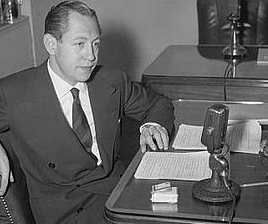
➦In 1929...William Paley incorporated the Columbia Broadcast System.
William S Paley
The origins of CBS date back to January 27, 1927, with the creation of the "United Independent Broadcasters" network in Chicago by New York talent-agent Arthur Judson. The fledgling network soon needed additional investors though, and the Columbia Phonograph Company, manufacturers of Columbia Records, rescued it in April 1927; as a result, the network was renamed "Columbia Phonographic Broadcasting System." Columbia Phonographic went on the air on September 18, 1927, with a presentation by the Howard Barlow Orchestra from flagship station WOR in Newark, New Jersey, and fifteen affiliates.
Operational costs were steep, particularly the payments to AT&T for use of its land lines, and by the end of 1927, Columbia Phonograph wanted out. In early 1928, Judson sold the network to brothers Isaac and Leon Levy, owners of the network's Philadelphia affiliate WCAU, and their partner Jerome Louchenheim. None of the three were interested in assuming day-to-day management of the network, so they installed wealthy 26-year-old William S. Paley, son of a Philadelphia cigar family and in-law of the Levys, as president. With the record company out of the picture, Paley quickly streamlined the corporate name to "Columbia Broadcasting System". He believed in the power of radio advertising since his family's "La Palina" cigars had doubled their sales after young William convinced his elders to advertise on radio. By September 1928, Paley bought out the Louchenheim share of CBS and became its majority owner with 51% of the business.
During Louchenheim's brief regime, Columbia paid $410,000 to A.H. Grebe's Atlantic Broadcasting Company for a small Brooklyn station, WABC (no relation to the current WABC), which would become the network's flagship station. WABC was quickly upgraded, and the signal relocated to a stronger frequency, 860 kHz. The physical plant was relocated also – to Steinway Hall on West 57th Street in Manhattan. It was where much of CBS's programming originated. Other owned-and-operated stations were KNX in Los Angeles, KCBS in San Francisco (originally KQW), WBBM in Chicago, WCAU in Philadelphia, WJSV in Washington, D.C. (later WTOP, which moved to the FM dial in 2005; the AM facility today is WFED, also a secondary CBS affiliate), KMOX in St. Louis, and WCCO in Minneapolis. These remain the core affiliates of the CBS Radio Network today, with WCBS (the original WABC) still the flagship, and all except WTOP and WFED (both Hubbard Broadcasting properties) owned by CBS Radio. By the turn of 1929, the network could boast to sponsors of having 47 affiliates.
Paley moved right away to put his network on a firmer financial footing. In the fall of 1928, he entered into talks with Adolph Zukor of Paramount Pictures who planned to move into radio in response to RCA's forays into motion pictures with the advent of talkies. The deal came to fruition in September 1929: Paramount got 49 percent of CBS in return for a block of its stock worth $3,800,000 at the time. The agreement specified that Paramount would buy that same stock back by March 1, 1932 for a flat $5,000,000, provided CBS had earned $2,000,000 during 1931 and 1932. For a brief time there was talk that the network might be renamed "Paramount Radio", but it only lasted a month – the 1929 stock market crash sent all stock value tumbling. It galvanized Paley and his troops, who "had no alternative but to turn the network around and earn the $2,000,000 in two years.... This is the atmosphere in which the CBS of today was born." The near-bankrupt movie studio sold its CBS shares back to CBS in 1932. In the first year of Paley's watch, CBS's gross earnings more than tripled, going from $1,400,000 to $4,700,000.
The extraordinary potential of radio news showed itself in 1930, when CBS suddenly found itself with a live telephone connection to a prisoner called "The Deacon" who described, from the inside and in real time, a riot and conflagration at the Ohio Penitentiary; for CBS, it was "a shocking journalistic coup". Yet as late as 1934, there was still no regularly scheduled newscast on network radio: "Most sponsors did not want network news programming; those that did were inclined to expect veto rights over it." There had been a longstanding wariness between radio and the newspapers as well; the papers had rightly concluded that the upstart radio business would compete with them on two counts – advertising dollars and news coverage. By 1933, they fought back, many no longer publishing radio schedules for readers' convenience, or allowing "their" news to be read on the air for radio's profit. Radio, in turn, pushed back when urban department stores, newspapers' largest advertisers and themselves owners of many radio stations, threatened to withhold their ads from print. A short-lived attempted truce in 1933 even saw the papers proposing that radio be forbidden from running news before 9:30 a.m., and then only after 9:00 p.m. – and that no news story could air until it was twelve hours old.
In the fall of 1934, CBS launched its independent news division, shaped in its first years by Paley's vice-president, former New York Times man Ed Klauber, and news director Paul White. Since there was no blueprint or precedent for real-time news coverage, early efforts of the new division used the shortwave link-up CBS had been using for five years to bring live feeds of European events to its American air.
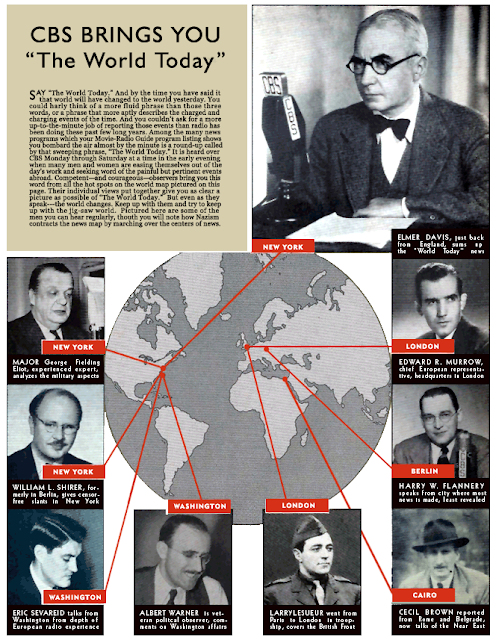
A key early hire was Edward R. Murrow in 1935; his first corporate title was Director of Talks. He was mentored in microphone technique by Robert Trout, the lone full-timer of the News Division, and quickly found himself in a growing rivalry with boss White. Murrow was glad to "leave the hothouse atmosphere of the New York office behind" when he was dispatched to London as CBS's European Director in 1937, a time when the growing Hitler menace underscored the need for a robust European Bureau. Halberstam described Murrow in London as "the right man in the right place in the right era".
Edward R. Murrow pictured with CBS' London-based D-Day team. Front row (left to right): Bill Downs,
Charles Collingwood, Gene Ryder, Charles Shaw. Back row (from left): Larry LeSueur,
Edward R. Murrow, Richard C. Hottelet, Bill Shadel.
Murrow began assembling the staff of broadcast journalists – including William L. Shirer, Charles Collingwood and Eric Sevareid – who would become known as "Murrow's Boys". They were "in [Murrow's] own image, sartorially impeccable, literate, often liberal, and prima donnas all". They covered history in the making, and sometimes made it themselves: on March 12, 1938, Hitler boldly annexed nearby Austria and Murrow and Boys quickly assembled coverage with Shirer in London, Edgar Ansel Mowrer in Paris, Pierre Huss in Berlin, Frank Gervasi in Rome and Trout in New York. The News Round-Up format was born and is still ubiquitous today in broadcast news.
➦In 1938... the first broadcast of Irna Phillips‘ soap opera “Woman in White” was presented on the NBC Red network. The program ran 10 years and was one of the first radio shows to feature doctors and nurses as leading characters.
➦In 1940...WPG-AM in Atlantic City NJ consolidated with WBIL & WOV as "new" WOV.
WPG had been in operation since 1923 operating on one of the cleared national channels of the first zone on a frequency of 1100 kilocycles.
WPG in Atlantic City shared time on 1100, with WBIL in NYC. The cumbersome arrangement ended in 1940 in a complicated series of events when Arde Bulova's Greater New York Broadcasting Corporation bought WPG and absorbed it into WOV, shut down both WOV and WPG on January 3, 1940 because they interferred with WBIL, asked the FCC to cancel WOV's license and move WBIL to 1130 (today is WBBR) , and immediately changed WBIL's calls to WOV, which today is WADO 1280 AM.
WPG was unique in radio. Approximately, fifteen million visitors come to the resort in a year. They are all interested in Atlantic City and it's happenings when in their homes wherever that may be.
Today, the WPG calls are used for branding by Townsquare Media's WPGG 1450 AM in Atlantic City, NJ. Since October 22, 2012, the station broadcasts a talk radio format under the branding "WPG Talk Radio 1450".
Cast from the Gunsmoke radio show. Howard McNear as Doc, William Conrad as Matt Dillon,
Georgia Ellis as Kitty and Parley Baer as Chester.
➥In 1969...actor Howard McNear, “Doc” on radio’s Gunsmoke, and “Floyd the Barber” on TV’s Andy Griffith Show, died after a long illness at age 63.
➦In 1970... “I Me Mine” was recorded by the Beatles without John, who was on vacation. It was the last song the band would record together. George Harrison later used that title for his autobiography.
➦In 1973... the Columbia Broadcasting System got out of the baseball business by selling the New York Yankees to a 17-person syndicate headed by George Steinbrenner. The price tag: just $10 million, about a 20th of the team’s current player payroll each year.
➦In 1975...legendary radio announcer Milton Cross, for 43 years the voice of the Metropolitan Opera on Saturday afternoon, died after a heart attack at age 87.
Born in New York City, Milton Cross started his career just as network radio itself was in its earliest stages. He joined the New Jersey station WJZ in 1921, not just as an announcer but also as a singer, often engaging in recitals with the station's staff pianist, Keith McLeod. By 1927, WJZ had moved to Manhattan and had become the flagship station of the Blue Network of NBC's new national radio network. Cross' voice became familiar as he not only delivered announcements for the Blue Network but also hosted a number of popular programs. Cross was the announcer for the quiz program Information Please and the musical humor show The Chamber Music Society of Lower Basin Street, among others. In the 1940s Cross hosted a Sunday morning show featuring child performers, called Coast To Coast on a Bus.
From 1931 to 1975 Cross served as host for the weekly live broadcasts of the Metropolitan Opera, the job for which he is most remembered. His distinctive voice conveyed the excitement of live performances "from the stage of the Metropolitan Opera House in New York City" for generations of radio listeners.
➦In 1977...Apple Computers incorporated.
➦In 1986...A major shakeup in the media world as Capital Cities closed on it acquisition ABC-TV for $3.5 billion. Five years later Disney purchased Capital Cities/ABC Inc. for almost six times that price.
Following the death of French icon Brigitte Bardot this week , at age 91, only three individuals named in Billy Joel's 1989 hit "We Didn't Start the Fire" remain alive.
The survivors are:
Bob Dylan (born 1941, age 84), the legendary musician and Nobel laureate;
Chubby Checker (born 1941, age 84), known for popularizing the Twist dance craze;
Bernie Goetz (born 1937, age 88), infamous for the 1984 New York subway shooting incident.
Those also listed in the song include: Harry Truman, Doris Day, singer Johnnie Ray, columnist Walter Winchell, Joe DiMaggio, Joe McCarthy, Richard Nixon, Marilyn Monroe, Soviet spies the Rosenbergs, Sugar Ray Robinson, Marlon Brando, Dwight Eisenhower, Queen Elizabeth II, boxer Rocky Marciano, Liberace, philosopher George Santayana, Joseph Stalin, Soviet Prime Minister Georgy Malenkov, former Egyptian President Gamel Abdel Nasser, Russian composer Sergei Prokofiev, Winthrop Rockefeller, baseball player Roy Campanella, Roy Cohn, former President of Argentina Juan Peron, Italian conductor Arturo Toscanini, Albert Einstein, James Dean, Elvis Presley, Soviet Prime Minister Nikita Khrushchev, Princess Grace, Russian novelist Boris Pasternak, Mickey Mantle, Jack Kerouac, former Chinese Premier Chou En-Lai, former French President Charles de Gaulle, murderer Charles Starkweather, Buddy Holly, mafioso Vito Genovese, Fidel Castro, first South Korean President Syngman Rhee, John F. Kennedy, Chubby Checker, Ernest Hemingway, Nazi Adolf Eichman, Bob Dylan, John Glenn, Pope Paul VI, Malcolm X, Ho Chi Minh, former Israeli Prime Minister Menachem Begin, Ronald Reagan, former Iranian leader Ruhollah Khomeini, Sally Ride and Goetz.
The song, a rapid-fire list of historical headlines and figures from 1949 (Joel's birth year) to 1989, references 59 notable people, including Bardot as a 1950s-1960s sex symbol.
Bardot, famed for films like ...And God Created Woman (1956) and La Vérité (1960), retired from acting in 1973 to focus on animal rights activism. Her foundation announced her passing, emphasizing her lifelong dedication to animal welfare.
The song's origins stem from Joel, then turning 40, countering a young friend's claim that the 1950s were boring by rattling off decades of events and figures, creating what he described as a symmetrical chronicle.
Bardot's death further underscores the song's enduring legacy as a cultural time capsule of mid-20th-century history.
A federal judge has granted Cumulus Media a sweeping preliminary injunction against Nielsen, blocking the ratings giant from enforcing its controversial "Network Policy" and capping prices for its standalone national radio ratings product while an antitrust lawsuit proceeds.
In a Tuesday, order from the U.S. District Court for the Southern District of New York, Judge Jeannette A. Vargas ruled that Cumulus demonstrated a strong likelihood of success on the merits, along with irreparable harm, a balance of hardships in its favor, and alignment with the public interest.
The injunction prohibits Nielsen from tying access to its Nationwide national ratings service to the purchase of local market data, a practice Cumulus alleges unlawfully leverages Nielsen's monopoly power. Additionally, Nielsen cannot charge Cumulus a "commercially unreasonable" rate for the standalone national product; any price at or below the highest 2026 rate charged to any other broadcaster is presumed reasonable, effectively imposing a price ceiling.
The order, which requires Cumulus to post a $100,000 bond, remains in effect throughout the litigation and preserves the status quo to prevent immediate harm to Cumulus's national network operations, including its Westwood One subsidiary.
Judge Vargas's ruling followed an evidentiary hearing and extensive record review. A detailed opinion is currently sealed due to sensitive competitive information, with a redacted public version expected later.
Practically, the decision restricts Nielsen's negotiation leverage with Cumulus and could influence broader dynamics in the radio ratings industry. It safeguards Cumulus's access to essential national data amid claims that Nielsen's policies foreclose competition in both national and local markets.
The underlying lawsuit, filed in October 2025, accuses Nielsen of violating Section 2 of the Sherman Act by abusing monopoly power to stifle rivals and inflate prices. The preliminary injunction does not resolve the full case but signals the court's view of the claims as substantial.
The Trump administration has frozen all federal child care payments to Minnesota and imposed new nationwide verification requirements, including photo evidence or receipts for reimbursements, following viral allegations of widespread fraud in state-funded day care centers primarily operated by Somali immigrants.
The actions, announced by the Department of Health and Human Services on December 31, 2025, cite a video by conservative YouTuber Nick Shirley claiming up to $100-110 million in misuse at Minneapolis facilities that appeared empty despite receiving public funds. HHS has demanded a comprehensive state audit of the identified centers, including attendance records and inspections, while the FBI and Homeland Security have surged resources for ongoing probes.
Mainstream media outlets (e.g., NPR, NYT, CNN, The Guardian, PBS, BBC) have covered the Minnesota child care fraud allegations extensively but frame the recent surge in attention as largely driven by a viral conservative video rehashing older, known scandals—primarily the $250–300 million Feeding Our Future COVID nutrition fraud—rather than evidence of new widespread daycare scams.
They note that specific centers highlighted in the video face no formal fraud charges, with recent inspections finding no fraudulent activity (though some safety issues). Proven large-scale fraud cases, involving dozens of convictions (mostly Somali Americans), were investigated under the Biden administration.
Coverage often criticizes the Trump administration's funding freeze on Minnesota and new nationwide verification rules as politically motivated, targeting Democratic Gov. Tim Walz and the state's Somali community, with Trump's rhetoric frequently labeled xenophobic.
Walz's defenses and accusations of politicization are prominently featured. Reports reject claims of media ignoring the story, citing years of prior investigative coverage.
For similar unproven claims in Ohio, mainstream reporting is minimal, noting state officials (including GOP Gov. DeWine) assert strong safeguards and no confirmed widespread fraud. Overall, the media acknowledges past serious fraud but portrays latest developments as social-media-amplified political attacks.
More than 17,000 jobs were cut in the U.S. entertainment and media industry through the first 11 months of 2025, an 18% increase from the same period in 2024, according to outplacement firm Challenger, Gray & Christmas.
The layoffs, spanning television, film, broadcast, news and streaming, reflect ongoing consolidation, restructuring and the rising influence of artificial intelligence amid shifting consumer habits and declining traditional revenue streams.
Restructuring and mergers were primary drivers. The FCC approved the Paramount Global-Skydance Media merger in summer 2025, triggering significant job reductions across Paramount's operations. Disney also eliminated hundreds of positions as part of CEO Bob Iger's multiyear cost-cutting plan, initiated in 2023 to address falling cable subscriptions and the pivot to streaming.
News outlets saw 2,254 cuts—including broadcast, digital and print—with 179 in November alone. However, this marked a 50% decline from the prior year's pace.AI played an expanding role, with Challenger data showing it cited in nearly 55,000 planned layoffs economy-wide in 2025. A World Economic Forum survey indicated 41% of global companies anticipate workforce reductions due to AI over the next five years, though generative tools have sometimes underdelivered on promised efficiencies. Conversely, the WEF forecasts doubling of jobs in big data, fintech and AI by 2030.The sector's losses mirrored broader labor market weakness: U.S. employers announced over 71,000 cuts in November across industries—the second-highest monthly total in five years.Historical trends show escalation.
Media job cuts averaged 7,305 annually from 2010-2017 but rose to 14,298 per year since 2018, as companies avoid year-end announcements post-2008 financial crisis.
Amid contraction, the creator economy showed growth: While Los Angeles motion picture and sound recording employment dropped 27% from 2022-2024 (per Bureau of Labor Statistics), creator-related jobs and companies each rose 5%.
Media firms increasingly rely on AI amid fragmented audiences and shorter attention spans. New York became the first state in 2025 to mandate disclosure of AI as a layoff reason. A Columbia University journalism report noted AI currently assists rather than replaces news workers but warned: "AI is sufficiently mature to enable the replacement of at least some journalism jobs."