A federal judge on Sunday ordered the Trump administration to stop airing taxpayer-funded television advertisements that prominently feature and promote the president, ruling that the ads are likely illegal.
U.S. District Judge Jennifer Rochon in New York issued a four-page order late Sunday barring the administration from using government funds to distribute the ads. The judge, appointed by former President Joe Biden, directed officials to cancel “any slot, placement, reservation, or arrangement for the airing or dissemination of the challenged advertisements.”
The order took effect immediately for any ads scheduled later Sunday night. It was not immediately clear whether the ruling blocked additional spots from airing.
The advertisements, which predominantly feature President Trump and highlight administration policies, began running on national television in September. They were funded by the Department of Homeland Security. The Wall Street Journal has reported that Trump personally pushed for the ads and was involved in their creation.
The ruling responded to a lawsuit filed by the advocacy group Common Cause and a Democratic candidate for office in Alabama.
The plaintiffs argued that the spending was not authorized by Congress and violated restrictions on using public funds for political propaganda.
“There is no legal justification—and no precedent—for the president to use the machinery of the government and funds set aside by Congress for other uses to influence electoral outcomes that further his own agenda,” the plaintiffs said after the decision.
The White House did not immediately respond to a request for comment. In a weekend court filing, the Justice Department said the ad buy was scheduled to end on Sunday.
Last week, Trump said he plans to continue the advertisements using money from his MAGA Inc. super PAC rather than federal funds.
Fox News attacks the media roughly every 14.5 minutes—far more often than MSNBC (every 61 minutes) or CNN (every 140 minutes)—according to a new analysis of 15 years of cable news transcripts.
“Disparaging journalism is a far more central part of Fox News programming than it is of either MSNBC or CNN programming,” researchers concluded. The study examined “inter-journalism disparagement,” defined as negative statements about the conduct or content of an explicitly identified journalism target, such as a specific outlet or the news media in general.
According to Niemanlab, tesearchers from Duke University’s DeWitt Wallace Center for Media & Democracy analyzed a random sample of one week of programming per year from 2011 to 2025 across CNN, Fox News, and MSNBC (later MS NOW). The resulting dataset included 3,543 transcripts and nearly 19 million words—roughly 62,000 pages of text. Because of the volume, they trained OpenAI’s GPT-5.5 model with a detailed 20-page instruction document; the model achieved 99.5% accuracy in identifying instances of disparagement compared with human coding.
The stark difference between the networks held across the full 15-year period. Fox News showed some dips in the two years leading up to the 2016 and 2024 elections, but levels rebounded to near-peak in 2025. CNN and MSNBC rates converged somewhat after 2017, with MSNBC declining slightly and CNN rising slightly. Researchers noted that the networks should not be viewed as mirror images of partisan journalism on this dimension.
On Fox News, the most common target by far was “the media,” followed by CNN and the “mainstream media,” with The New York Times, MSNBC, and The Washington Post also appearing frequently. The network focused more on attacking journalism as an institution than on specific outlets. In contrast, both CNN and MSNBC most often targeted Fox News, followed by “the media” and “right-wing media,” though at much lower overall frequencies. The most frequent individual disparagers were predominantly Fox hosts, led by Sean Hannity, Greg Gutfeld, and Tucker Carlson.Niemanlab
The findings come amid record-low trust in journalism. Gallup data from 2025 showed only 8% of Republicans expressing trust in the news media, compared with 51% of Democrats, with the partisan gap remaining wide even after a slight recent uptick among Republicans. The researchers suggest high-volume disparagement of journalism may contribute to this decline and plan further study of whether exposure reduces trust. They also note that some scholars describe this pattern as moving beyond traditional partisan journalism into “anti-media media,” which uses the appearance of journalism to undermine the institution’s democratic role—a characterization they say fits Fox News based on the data.Niemanlab
The study was led by Philip M. Napoli of Duke University, with contributions from Adam Meskouri, Anjini Mani, Grant Socol, and Harrison Walley. Full methodological details appear in a related paper.
ABC News removed and then republished a corrected version of an Oct. 7 investigation into financial ties between President Donald Trump’s sons and defense contractors, including a major Navy deal with Anduril Industries, after initially telling subjects the story had been published “prematurely.” The network later acknowledged factual errors in company investments, government contracts, and event timelines, according to reporting by Semafor.
The episode drew broader attention amid ongoing tensions between the Trump administration and major media outlets, including prior ABC settlements and FCC-related scrutiny.
The original story, headlined “Trump sons’ investments have won billions in Pentagon contracts since his election,” focused on a new $6.6 billion public-private partnership between Anduril and the U.S. Navy to build a high-tech submarine shipyard in Maryland. It highlighted Donald Trump Jr.’s role as a partner at the venture firm 1789 Capital, stating that the firm “claimed a major stake in Anduril in June 2025 from a $2.5 billion investment into the company.” An ABC analysis claimed defense companies linked to the president’s sons had secured more than $6 billion in active or promised government contracts after related investments. The piece also referenced other firms.
By Thursday, ABC removed the article from its website without a public explanation, resulting in 404 errors on the original URL. An unnamed source familiar with the matter and ABC producer communications to Anduril and another company described the removal as due to premature publication while reporting was finalized. Reporter Nathan Lee, who wrote the original piece, used similar language in outreach.
On Friday evening, ABC republished a substantially revised version under the new headline “New shipyard announced amid earlier Democratic concerns about potential conflicts of interest.” It carried a generic “ABC News” byline (replacing Lee’s) and this editor’s note: “CORRECTION: A version of this story published on Oct. 7 contained errors in the description of certain company investments, government contracts and event chronologies. After subsequent reporting, this version contains corrected information and additional context regarding some of those investments, contracts and events.”
The revised reporting clarified that 1789 Capital invested $50 million in Anduril as part of a broader $2.5 billion funding round—a relatively small stake in a company valued at more than $60 billion. It noted that Trump Jr. is one of six partners (alongside three founders) and does not sit on the three-person investment committee that makes allocation decisions, according to the firm. Earlier characterizations of a “major stake” and the scale of the investment were corrected.
Radios have long been standard equipment in cars, and the vast majority of vehicles still include them. In recent years, however, automakers including Tesla, Volkswagen, and Volvo have dropped analog AM radios from some newer models—particularly electric vehicles and plug-in hybrids—because EV motors and high-voltage systems can generate electromagnetic interference that distorts AM signals and produces static.
John Bozzella, CEO of the Alliance for Automotive Innovation, told Congress in April 2024 that “EVs and AM broadcasting technologies don’t always mix,” describing the interference as creating a “really staticky” listening experience. Auto industry research also indicates that drivers rarely tune in to traditional analog AM, preferring streaming services, satellite radio, or digital AM and FM broadcasts.
The National Association of Broadcasters (NAB) counters that analog AM remains essential for public safety. Fewer households keep a traditional radio at home, yet it can serve as a critical source of emergency alerts during hurricanes, wildfires, or other crises when cell networks fail or become overloaded. “When the power goes out, radio can often be that sole lifeline, and AM radio in particular has a reach and a durability that other media just don’t simply have,” said NAB CEO Curtis LeGeyt.
Car listening is also economically vital for radio: according to the NAB, 53 percent of the AM/FM audience tunes in while driving. More than 4,000 AM stations still operate nationwide, per the Federal Communications Commission, carrying sports, talk, religious programming, and foreign-language content. The NAB estimates that 82 million Americans listen to AM radio each month, with the service especially important in rural and tribal areas where internet and cellular service can be unreliable.
Four Democratic candidates accuse the FCC of deliberately delaying a decision on political advertising rates so its expanded lowest unit rate policy—covering certain party-coordinated ads and joint fundraising committees—stays in place through Election Day. In a Supreme Court filing, they call the delay “blatant procedural trench warfare” meant to block judicial review before November, and they highlight a contradiction: the government previously told the justices that broadcasters need not offer discounted rates for party spending, yet the FCC’s March guidance requires those rates for qualifying party-coordinated expenditures.
The Supreme Court is considering emergency requests from the FCC and Republican congressional committees to block a Fourth Circuit order forcing the agency to act within 48 hours. The candidates argue the FCC has already shown how it plans to rule but is withholding a formal decision to keep the policy insulated from review until after the election.
The FCC rejects the accusations and defends the delay as reasonable, saying the Fourth Circuit overstepped and that its guidance reflects a longstanding approach. Changing the rules now, it argues, would create uncertainty for broadcasters and advertisers. Republican committees similarly warn that another shift could disrupt existing ad contracts in the campaign’s final weeks. With the election less than a month away and the Supreme Court having previously kept the expanded rates in place after a lower-court setback, the justices must now decide whether the policy continues until the FCC finishes its review.
The Justice Department is investigating whether ABC, CBS, CNN, NBC, and Fox News violated federal antitrust laws (Sherman Act) when they briefly suspended the shared White House television press pool in September.The networks halted pooled coverage for several days after President Trump barred CNN, MS NOW, and Politico from White House grounds (preventing CNN from participating in the pool). This left some events, such as a meeting with China’s Xi Jinping, without major network footage.
DOJ officials contacted the networks on Friday with civil investigative demands for communications and materials related to the pool. A DOJ spokesperson described the action as a “proudly boycotted” group boycott among competitors and said the Antitrust Division is examining potential violations.
Bruce Brown, president of the Reporters Committee for Freedom of the Press, told The Hill the probe appears to be “a pretext for seeking records from the networks” on how they cover regular White House events amid Trump’s ban.
“The decisions news organizations make about coverage are protected by the First Amendment, and summoning antitrust authority, on top of the retaliatory actions the White House has already taken to bar certain outlets, is another and even more brazen attempt to try to intimidate journalists,” Brown said in a statement.
The probe widely viewed as a sharp escalation in the administration’s tensions with the press. Related litigation by the barred outlets continues, with a temporary court pause on the ban
NFL viewership rebounds to average 20.2 million viewers through Week 4
The NFL has recovered from early-season declines, with the average regular-season game drawing a Nielsen-measured 20.2 million viewers from Sept. 9 through Oct. 7—up 4% from the same period a year ago.
NBC’s “Sunday Night Football” is the strongest performer at 23.2 million viewers. CBS Sunday games average 20.5 million, ABC/ESPN’s “Monday Night Football” 19.3 million, Fox Sunday afternoon games 17.9 million, and Amazon Prime Video 17.4 million. CBS is up 7% year-over-year and Prime Video up 9%, while NBC is down 2%. Fox’s average is lower than its 23.2 million figure from the comparable period last year.
Kim Leslie, a longtime Nashville radio personality, music industry executive, and Country Music Association staffer who helped create key industry awards, died Oct. 9 in Gallatin, Tennessee, from Lewy body dementia. She was 64.
A Bronxville, New York, native, Leslie built a multi-decade career that bridged on-air radio work, music direction, label promotion, and organizational leadership in the country music industry. She began at WMZQ in Washington, D.C. (98.7), then moved to Nashville, where she served as afternoon host and music director at WSM-FM (95.5). She later worked in promotion at Asylum Records.
In 2001 she joined the Country Music Association as senior manager of industry relations, where she oversaw the creation of the CMA National Broadcast Personality of the Year award. She co-hosted afternoons at WKDF (103.3) starting in 2003, added part-time work at Sirius Satellite Radio in 2007, and spent more than a decade as a morning co-host on Midwest Communications’ adult contemporary “Mix 92.9” WJXA. She also served nearly a decade on the Country Radio Broadcasters board.
Mike Horn, founder of CRN Digital Talk Radio and a longtime Los Angeles radio personality, has died. He was 74.
Horn died after a long illness. He spent his career finding new outlets for radio, from local cable systems to platforms for talk hosts including Ed McMahon and Robert Conrad.
Horn founded Cable Radio Network in 1983 to supply commercial radio programming to local cable television systems. The idea began after he learned that KMET in Los Angeles was earning ratings in the Phoenix market because a local cable system carried the signal. He took the concept to King Cable in the San Fernando Valley, programming a country music channel that later switched to oldies. Valley Cable and Falcon Cable soon showed interest, and the business grew as more local systems signed on.
When phone-line distribution became too costly, Horn moved the network to satellite. As noncommercial music channels from Digital Planet and DMX reached cable providers, he shifted CRN to talk radio. The network became CRN Talk, then CRN Digital Talk Radio in 2007.
➦In 1937...'Mr. Keen, Tracer of Lost Persons' debuted on the NBC Blue Network. It was one of radio's longest running shows, airing to April 19, 1955, continuing well into the television era. It was produced by Frank and Anne Hummert, who based it upon Robert W. Chambers' 1906 novel The Tracer of Lost Persons. The sponsors included Whitehall Pharmacal (as in Anacin, Kolynos Toothpaste, BiSoDol antacid mints, Hill's cold tablets and Heet liniment), Dentyne, Aerowax, RCA Victor and Chesterfield cigarettes. It aired on the NBC Blue network until 1947, when it switched to CBS.
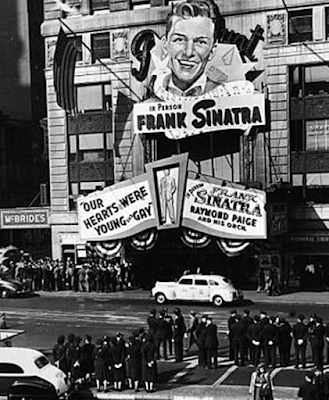
➦In 1944...What would come to be known as the "Columbus Day Riot" took place in New York City, when 35,000 hysterical teenage girls crowded into the Paramount Theatre for a chance to see the return of Frank Sinatra. The crowd of teen "bobbysoxer" girls stopped traffic in Times Square and refused to leave between shows.
➦In 1950…The George Burns and Gracie Allen Show, sometimes called The Burns and Allen Show, made it debut on TV. The is a half-hour series broadcast from 1950 to 1958 on CBS.
Burns and Allen were headliners in vaudeville in the 1920s, and radio stars in the 1930s and 1940s.
Their show was initially staged live and broadcast every other Thursday at 8 pm ET. In fall 1952, it became a weekly series filmed on the West Coast. From March 1953 through September 1958, The Burns and Allen Show aired Mondays at 8 pm ET.
The show was an immediate success.
➦In 1955...Chrysler introduces the world's first sound system for it cars. The system consisted of -- record player mounted under the dashboard.
➦In 1969...Pop Culture's "Paul is Dead" hoax began when Tom Zarski, a student at Eastern Michigan University, called WKNR in Detroit and informed DJ Russ Gibb on air of the rumor that Paul McCartney died in a car crash, perhaps as long ago as 1966. Zarski told Gibb that by playing a section of the band's "Revolution 9" backwards, a clue emerges: the phrase "Turn me on, dead man." Gibb proceeds to do just that. Many listeners were stunned.
🗼The Radio Hall of Fame inducted its Class of 2026 on October 8 in Chicago (hosted by Bobby Bones). The eight honorees are Boomer Esiason (WFAN New York), Dennis Green (COO, Sun & Fun Media/Key Networks), Shotgun Tom Kelly (SiriusXM 60s Gold), Helen Little (WLTW New York), Bob Pittman (Chairman/CEO, iHeartMedia), Rickey Smiley (Urban One/Reach Media), Charlie Van Dyke (voiceover/veteran personality), and Fred Winston (Chicago veteran). Nine legends were also recognized posthumously.
🗼The Supreme Court, via Chief Justice John Roberts, paused a 4th Circuit order that had required the FCC to rule by noon on October 9 on Democratic candidates’ challenge to the agency’s public notice extending lowest-unit-charge political ad rates to party committees and joint fundraising committees. The pause (with responses due from challengers by October 10) keeps the expanded policy in place for now amid the midterms.
🗼Nominations (Call for Entries) opened for the 52nd Annual Gracie Awards (honoring 2026 work by, for, and about women). Podcasts now have a dedicated division; new categories include local radio PSAs/community engagement and various video/podcast formats. Eligibility is January 1–December 31, 2026; early-bird deadline December 10, 2026; final January 21, 2027. National winners will be recognized May 25, 2027, in Beverly Hills.
🗼Spotify renewed its multi-year licensing agreement with Joe Rogan for The Joe Rogan Experience (announced October 8). Terms are reportedly similar to the prior deal (estimated ~$250 million earnout); the show remains non-exclusive and available on other platforms, with new episodes continuing weekly. It has 18 million Spotify followers and ranked as a top podcast.
🗼Audacy’s WCBS-FM (101.1, New York Classic Hits) launched “The Morning Show with Trey and Loren Raye” (Trey Morgan and Loren Raye) weekdays 6–10 a.m. ET, filling the slot left by Race Taylor’s September exit. Both have major-market experience, including New York and Boston.
🗼The Paramount–Warner Bros. Discovery merger closed October 6, valued at roughly $110–111 billion, creating the combined company Skydance under Chairman/CEO David Ellison (with co-CEO Ynon Kreiz). It unites major studios, networks (including CBS, CNN, MTV, TBS), and streaming services Paramount+ and HBO Max, with ~$70 billion in annual revenue (and significant debt). Shares trade as SKYD.
🗼A federal judge in Washington heard arguments October 6 in Disney/ABC’s lawsuit seeking to block the FCC’s early review of licenses for its eight owned-and-operated stations (not due until 2028–2031). Disney argues the process (tied to employment-practice inquiries) chills First Amendment rights and is retaliatory; the FCC seeks dismissal on jurisdictional and procedural grounds. No immediate ruling; further filings were ordered.
🗼Edison Research’s Q3 2026 Podcast Metrics (via SSRS) show YouTube as the platform used most often by U.S. weekly podcast consumers. Spotify ranks second (17%), Apple Podcasts third (9%), and Netflix seventh (3%). This underscores the shift toward video platforms.
🗼Audacy Insights’ NFL Attention Index ranks top fandom markets by avidity/engagement/performance: Buffalo (135), New Orleans (120), Cincinnati (119), Dallas-Fort Worth and Kansas City (tied at 115), followed by Baltimore, Milwaukee, Harrisburg-Lancaster-Lebanon-York (113), Philadelphia (111), and Columbus, OH (110). Audio is highlighted for high concentrations of avid sports fans.
🗼WHYY named Fred Vigeant (formerly VP/Chief Audience Officer at WITF Harrisburg) as General Manager of WPSU (news/talk FM and PBS TV) in State College, PA, effective October 26. This follows WHYY’s October 1 acquisition of the Penn State-owned public media outlets.
🗼K-Love closed its $2 million purchase of the 94.5 FM facility in the San Jose/Gilroy area from Connoisseur Media. The station is now KJNV-FM for Christian programming; Connoisseur retained the KBAY Country brand and moved it to 98.5 FM (with classic rock KUFX shifting to HD2/online).Mediaconfidential.blogspot
🗼Urban One realigned programming across its Dallas-Fort Worth cluster: KBFB (97.9 The Beat) features Rickey Smiley in mornings (5 a.m.), Jazzi Black middays, Bryhana Monegain afternoons, and “Posted on the Corner” evenings; KKDA (K104) keeps DeDe McGuire mornings, with Michael Shawn middays, Hollywood Bay Bay afternoons, and Lil D evenings; KRNB shifts to a 1990s–today R&B focus as “105.7 RnB.”
➤Look Ahead: October 12–16, 2026
Watch for further developments in the political ad-rate litigation (as responses and potential Supreme Court action play out before the November midterms)
The Disney/ABC license-review case (additional filings due).
Industry gatherings include the Ohio Association of Broadcasters Exchange (October 14)
CBI National Student Media Convention (October 14–17 in Philadelphia).
Broader themes such as audio’s role in sports fandom, podcast platform shifts, and post-merger integration at Skydance are likely to remain in focus, alongside any FCC agenda items or station-level programming moves.
➦In 1919...Actress/voice actor Jean Vander Pyl was born in Philadelphia. Her two main broadcast roles were as the wife Margaret in NBC Radio’s Father Knows Best, and as the voice of Wilma Flintstone in several cartoon series on TV. She also provided the voice of Rosie the robot maid from the animated series The Jetsons,
She succumbed to lung cancer April 10 1999 at age 79
➦In 1936...the first radio quiz show premiered, "Professor Quiz".
➦In 1940...in New York City, Glenn Miller recorded “Make Believe Ballroom Time” for RCA Victor’s Bluebird label, featuring the vocal group The Modernaires for the first time. It would become the theme song for Make Believe Ballroom on WNEW, New York, with host Martin Block.
Martin Block
Block created the aura of doing a “live” radio program, complete with performers (on records) like Harry James or Frank Sinatra, from the “Crystal Studios” at WNEW. Copycat versions of the ‘Ballroom’ featured Keith Sandy at CKEY in Toronto, and Al Jarvis at KHJ Los Angeles.
In 1935, while listeners to New York's WNEW-AM in New York (now information outlet WBBR) were awaiting developments in the Lindbergh kidnapping, Block built his audience by playing records between the Lindbergh news bulletins. This led to his Make Believe Ballroom, which began February 3, 1935 creating the illusion that he was broadcasting from a ballroom with the nation’s top dance bands performing live. He bought some records from a local music shop for the program as the radio station had none. Block purchased five Clyde McCoy records, selecting his "Sugar Blues" for the radio show's initial theme song.
Because Block was told by the station's sales staff that nobody would sponsor a radio show playing music, he had to find himself a sponsor. Block lined up a producer of reducing pills called "Retardo"; within a week, the sponsor had over 3,000 responses to the ads on Block's radio show. Martin Block's style of announcing was considerably different than the usual manner of delivery at the time. Instead of speaking in a voice loud enough to be heard in a theater, Block spoke in a normal voice, as if he was having a one-on-one conversation with a listener.
➦In 1948...One of radio’s last premiering soap operas, “The Brighter Day”, took to the air for the first time on NBC. It’s interesting to take a look at the cast and see which names are still recognizable, like Hal Holbrook and William Redfield. After six years on radio “Day” moved to TV.
➦In 1976...“Disco Duck (Part 1),” by Rick Dees & His Cast of Idiots was the Number One songs on Billboard's Hot 100 singles chart. At the time he was a morning DJ at Memphis radio station WMPS.
➦In 1937...'Mr. Keen, Tracer of Lost Persons' debuted on the NBC Blue Network. It was one of radio's longest running shows, airing to April 19, 1955, continuing well into the television era. It was produced by Frank and Anne Hummert, who based it upon Robert W. Chambers' 1906 novel The Tracer of Lost Persons. The sponsors included Whitehall Pharmacal (as in Anacin, Kolynos Toothpaste, BiSoDol antacid mints, Hill's cold tablets and Heet liniment), Dentyne, Aerowax, RCA Victor and Chesterfield cigarettes. It aired on the NBC Blue network until 1947, when it switched to CBS.
➦In 1944...What would come to be known as the "Columbus Day Riot" took place in New York City, when 35,000 hysterical teenage girls crowded into the Paramount Theatre for a chance to see the return of Frank Sinatra. The crowd of teen "bobbysoxer" girls stopped traffic in Times Square and refused to leave between shows.
➦In 1950…The George Burns and Gracie Allen Show, sometimes called The Burns and Allen Show, made it debut on TV. The is a half-hour series broadcast from 1950 to 1958 on CBS.
Burns and Allen were headliners in vaudeville in the 1920s, and radio stars in the 1930s and 1940s.
Their show was initially staged live and broadcast every other Thursday at 8 pm ET. In fall 1952, it became a weekly series filmed on the West Coast. From March 1953 through September 1958, The Burns and Allen Show aired Mondays at 8 pm ET.
The show was an immediate success.
➦In 1955...Chrysler introduces the world's first sound system for it cars. The system consisted of -- record player mounted under the dashboard.
➦In 1969...Pop Culture's "Paul is Dead" hoax began when Tom Zarski, a student at Eastern Michigan University, called WKNR in Detroit and informed DJ Russ Gibb on air of the rumor that Paul McCartney died in a car crash, perhaps as long ago as 1966. Zarski told Gibb that by playing a section of the band's "Revolution 9" backwards, a clue emerges: the phrase "Turn me on, dead man." Gibb proceeds to do just that. Many listeners were stunned.
Two days after the WKNR broadcast, The Michigan Daily published a satirical review of Abbey Road by University of Michigan student Fred LaBour under the headline "McCartney Dead; New Evidence Brought to Light". It identified various "clues" to McCartney's death on Beatles album covers, including new clues from the just-released Abbey Road LP. As LaBour had invented many of the clues, he was astonished when the story was picked up by newspapers across the United States. WKNR-FM further fuelled the rumor with a special two-hour program on the subject, "The Beatle Plot", which aired October 19, 1969.
In the early morning hours of October 21, 1969, Roby Yonge, a disc jockey at New York radio station 77WABC, discussed the rumor on the air for over an hour before being pulled off the air for breaking format. At that time of night, WABC's signal covered a wide listening area and could be heard in 38 states and at times, other countries.
Later that day, the Beatles' press office issued statements denying the rumour which were widely reported by national and international media.
Various 'clues' were used to suggest the following story: three years previously on November 9, 1966. The rumored story was that McCartney, after an argument during a Beatles' recording session, had angrily driven off in his car. He had crashed it and died as a result. To spare the public from grief, the Beatles replaced him with "William Campbell", the winner of a McCartney look-alike contest.
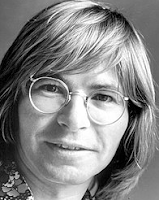
➦In 1997...Henry John Deutschendorf Jr. died in a light plane accident (Born December 31, 1943). He was known professionally as John Denver, was an American singer-songwriter, record producer, actor, activist, and humanitarian, whose greatest commercial success was as a solo singer.
John Denver 1974
After traveling and living in numerous locations while growing up in his military family, Denver began his music career with folk music groups during the late 1960s. Starting in the 1970s, he was one of the most popular acoustic artists of the decade and one of its best-selling artists. By 1974, he was one of America's best-selling performers, and AllMusic has described Denver as "among the most beloved entertainers of his era".
Denver recorded and released approximately 300 songs, about 200 of which he composed, with total sales of over 33 million records worldwide. He recorded and performed primarily with an acoustic guitar and sang about his joy in nature, his disdain for city life, his enthusiasm for music, and his relationship trials. Denver's music appeared on a variety of charts, including country music, the Billboard Hot 100, and adult contemporary, in all earning 12 gold and four platinum albums with his signature songs "Take Me Home, Country Roads", "Annie's Song", "Rocky Mountain High", "Calypso", "Thank God I'm a Country Boy", and "Sunshine on My Shoulders".
The Justice Department is investigating ABC, CBS, CNN, Fox News, and NBC over whether their coordinated refusal to cover certain White House events amounted to an illegal group boycott under federal antitrust law.
The probe, announced Saturday, focuses on the television press pool’s decision to suspend shared coverage of select events after the Trump administration moved to bar CNN, MS NOW, and Politico from the White House. DOJ spokesperson Emily Covington said in a statement that “members of the television press pool have proudly boycotted covering White House events” and that “group boycotts among commercial competitors can violate the Sherman Act.” The Antitrust Division is examining whether the networks broke antitrust laws.
The networks were contacted Friday about the investigation, according to The New York Times, which cited six people familiar with the matter.
The dispute began Sept. 18, when President Trump said he was barring CNN, Politico, and MS NOW for publishing “purposely negative stories.” The three outlets sued, arguing the ban violated the First and Fifth Amendments. A federal judge issued a temporary restraining order, later extended through the following Tuesday.
In response, ABC, CBS, Fox News, and NBC declined to step into the rotation to replace CNN, creating gaps in the shared pool footage normally distributed worldwide. Coverage of events including Chinese President Xi Jinping’s visit was affected. The pool resumed full rotation on Sept. 25.
President Trump on Friday appointed Katie Zacharia, a conservative commentator, as White House press secretary, replacing Karoline Leavitt weeks before the November election.
Zacharia, a California native, is a communications adviser to Trump Media & Technology Group, which operates Truth Social, the platform where Trump frequently posts. She worked briefly at the Department of Homeland Security earlier in Trump’s second term and has appeared as a commentator on CNN, Fox News and Newsmax. Trump said she was also involved in his previous campaigns.
“She has an unblemished record of support, and has been a loyal and brilliant supporter, right from the beginning,” Trump wrote on Truth Social. “She is, likewise, a devoted fan and member of MAGA!”
Zacharia called serving Trump and the American people “the honor of a lifetime.”
Mike Ditka, the Hall of Fame tight end and Super Bowl-winning coach who became the face of Chicago Bears football, died at 86, his family said Friday.
No one embodied the franchise more. Ditka was a Pro Football Hall of Fame tight end, the coach of the 1985 Bears — the only team in franchise history to win a Super Bowl — and, for decades afterward, a ubiquitous television analyst and celebrity promoter. His face, once described as “a clenched fist,” even resembled the bear on the team logo and became familiar to millions, first as a player starting in 1961, then as Bears coach from 1982 to 1992, and finally from the broadcast booth.
After the Bears dismissed him following the 1992 season, Ditka moved almost immediately into television, joining NBC as an analyst on NFL Live and as a color commentator. Fired by the New Orleans Saints in 2000, he spent the 2000 and 2001 seasons as a studio analyst on CBS’s The NFL Today. He joined ESPN in 2004, appearing on Sunday NFL Countdown, NFL Live and Monday Night Countdown, and worked the booth for Monday Night Football games in 2007 and 2008 alongside Mike Greenberg and Mike Golic. In 2016 ESPN shifted him to remote SportsCenter analysis so he could work from home. He also appeared regularly on Chicago’s ESPN 1000 radio.
WFAN co-host Gregg Giannotti was barred from a private jet to Chicago on Thursday after he could not produce a REAL ID, preventing him from attending the Radio Hall of Fame ceremony Thursday where partner Boomer Esiason was inducted.
The pilot checked identification for the private flight carrying Esiason, WFAN executives and staff. When he reached Giannotti, the host offered only a standard driver’s license. According to Awful Announcing, the pilot asked if it was a REAL ID or enhanced ID; Giannotti said it was neither. After checking further, the pilot returned and told him, “We’ve got a problem. I can’t take you.” Giannotti was escorted off the plane while the rest of the group continued to Chicago.
Giannotti recounted the episode on Friday’s Boomer & Gio show.
FCC Chairman Brendan Carr says he would defer to Defense Secretary Pete Hegseth on whether to livestream the firing-squad execution of the Fort Hood shooter on public airwaves.
Carr, speaking on CNBC’s “Squawk on the Street,” stated that the Federal Communications Commission would ultimately follow Hegseth’s lead. “Ultimately we’re going to defer to Secretary Hegseth and his decision on how to move forward with this,” he said when asked about the proposed broadcast.
Hegseth announced earlier this week that the public would be able to watch a livestream of the execution of former Army Maj. Nidal Malik Hasan. Hasan was convicted in 2009 of killing 13 people and injuring 31 others in a shooting at Fort Hood, Texas.
Homeland Security Secretary Markwayne Mullin sparred with reporters Friday at a Washington briefing on a New York ICE shooting, cutting off questions he said were meant to change the subject and calling the exchange an example of “fake news.”
The briefing, held with ICE officials, was called to defend Thursday’s operation in the Marble Hill section of the Bronx and to blame New York’s sanctuary policies. Officers fired several rounds at 28-year-old Oscar Belgal as he was in a car with his 5-year-old son. Belgal was hit in the neck, treated, and held in a detention facility outside the state. Mullin said agents identified themselves, gave lawful orders, and did not know a child was in the car. He said Belgal accelerated, rammed vehicles, and drove toward officers, and he called Belgal a “gangbanger” and “thug” with a criminal record, including a grand larceny conviction and a pending 2025 drug case. The public outcry, Mullin said, should be aimed at Belgal, not the officers. “I’ll never apologize about our men and women doing their job,” he said.
Ella Langley canceled her sold-out concert at Tulsa’s BOK Center on Friday night hours before showtime over a “serious security threat,” even though Tulsa police said they found no credible danger after multiple sweeps of the venue, Billboard is reporting.
Statements posted shortly before 5 p.m. CT on both Langley’s and the venue’s social media accounts said the show could not proceed. “Due to a serious security threat involving the safety of my fans, venue personnel, and the artist, Ella Langley’s scheduled performance tonight at BOK Center in Tulsa has been canceled,” the post read. It continued that “the safety and well-being of everyone involved is our absolute priority” and that ticket refund information would be forthcoming.