➦In 1919...Radio Corporation of America (RCA) was created.
At the end of World War I, the Marconi Wireless Telegraph Company of America was the only company in the United States that was equipped to operate transatlantic radio and telegraph communications. The United States government found this unacceptable since the Marconi Wireless Company of America was entirely owned by a foreign company—the British Marconi Company.
At the prompting of Franklin D. Roosevelt, who was undersecretary of the navy at the time, General Electric (GE) formed a privately owned corporation to acquire the assets of American Marconi from British Marconi. On October 17, 1919, the Radio Corporation of America (RCA) was incorporated and within a month had acquired those assets.
General Electric was the major shareholder of RCA and the two companies cross licensed their patents on long distance transmission equipment. A year later American Telephone & Telegraph (AT&T) bought into RCA and also cross licensed patents with the new company. Transoceanic radio service began that same year with a major station in New Jersey broadcasting to England, France, Germany, Norway, Japan, and Hawaii. The world’s first licensed radio station also began transmitting in 1920. This station, KDKA of Pittsburgh, was owned by the Westinghouse Company.
In 1921, Westinghouse, too, joined the ranks of asset holders of RCA; in exchange for selling Westinghouse radio equipment to the public, RCA was permitted access to Westinghouse patents.
RCA entered the broadcasting field in 1921 with its transmission of the Dempsey-Carpentier fight in Jersey City, New Jersey. Using a transmitter borrowed from the navy. The company began full-time radio broadcasting shortly afterwards when it became an equal partner with Westinghouse in station WJZ of Newark, NJ.
RCA continued to expand its transoceanic communications operations and opened two more broadcasting stations, in New York and Washington, D.C. In 1924 RCA transmitted the first radio-photo, a portrait of Secretary of State Charles Hughes. This transmission was made from New York to London and back to New York, where it was recorded and marked a pioneering development in the history of television. Two years later, in 1926, RCA formed the National Broadcasting Company (NBC). NBC controlled the radio stations owned by RCA, produced radio programs, and marketed these programs to other radio stations, activities which constituted the first radio network. David Sarnoff, the leading figure at RCA during these formative years, had envisioned the radio network as a form of public service, free from advertising, but this proved financially impossible and sponsors were solicited. At this time RCA began selling components manufactured by the Victor Talking Machine Company of Camden, New Jersey.
Product innovation abounded in this era. In 1927 RCA introduced the first Radiotron tube. This radio tube was the first to operate on alternating current, thereby eliminating the need for batteries—a crucial step in the development of mass-produced electric radios.
 |
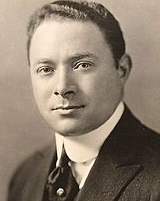
| David Sarnoff |
In the following year RCA purchased the Victor Talking Machine Company. Sarnoff had always wanted to market a radio and phonograph housed in the same box, but the phonograph companies were suspicious of radio, fearing the loss of their market. So Sarnoff decided to purchase a phonograph company. Several years of negotiation preceded RCA’s 1929 purchase of Victor. RCA owned 50% of Victor, General Electric owned 30%, and Westinghouse owned the remainder. RCA formed the RCA-Victor Company (and the RCA Radiotron Company) only after it had acquired tube-manufacturing assets from General Electric and Westinghouse. The trademark of the Victor company, a dog staring at an old phonograph above the caption “His Master’s Voice,” was also purchased by RCA and became one of the most famous trademarks in marketing history.
David Sarnoff became president of RCA in 1930, the year legal problems concerning the company’s monopoly status began. The Justice Department filed an antitrust suit against RCA seeking to strip RCA of all the patents it had gained. The battle ended two years later; RCA retained all of its patents but General Electric, AT&T, and Westinghouse were forced to sell their interests in the company. The General Electric association was remembered in NBC’s trademark three-note chime—G,E,C—which stands for General Electric company.
By this time RCA’s various businesses included broadcasting, communications, marine radio, manufacturing and merchandising, and a radio school. The year after it became an independent company, RCA moved into its new headquarters—the RCA Building in Rockefeller Center in New York City.
➦In 1934..."The Aldrich Family" premiered on radio.