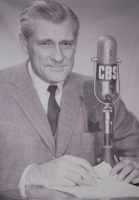
➦In 1901...Early radio sportscaster Ted Husing was born in the Bronx NY.
At age 16, he joined the National Guard and during World War I was assigned to stand watch over New York's harbor. Following the war, he floated between jobs such as carnival barker and payroll clerk. After he won an audition over 500 other applicants for announcer at New York City radio station WHN, Husing found his life's calling. He was schooled under the tutelage of pioneer broadcaster Major J. Andrew White. There he covered breaking news stories and political conventions and assisted White during football commentaries.
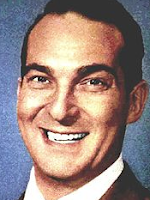
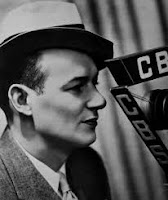 |
| Ted Husing |
Later in 1927, he returned to New York and helped his mentor, J. Andrew White, start the new CBS chain. After cigar mogul William S. Paley bought the cash-strapped network in 1928, Ted Husing rose to new heights of glory and fame.
At CBS, Husing took on a wide variety of events. In 1929, he was named studio director of WABC (the CBS flagship station) in addition to continuing his work as an announcer for the network.
In addition to his sports preeminence, Husing also did news/special events coverage for the CBS Radio Network. In the 1930s, he gave early tutelage to a budding CBS Radio announcer, Mel Allen, who, like Husing, would become a legendary sportscaster. (And, like Husing, Allen would also understudy in news, with Robert Trout.) In 1933-1934, he was host of the Oldsmobile Program, providing sports news to complement music from other participants on the program.
In both sports and special events areas, Husing developed a bitter rivalry with rising NBC announcer Bill Stern. When the two became the sports stars of their rival networks (and eventually their networks' sports directors), they would battle fiercely not only for events but also for broadcast position.
Husing could be arrogant, coarse, and opinionated. He was the first to bring a candid, editorial style to sports play-by-play.
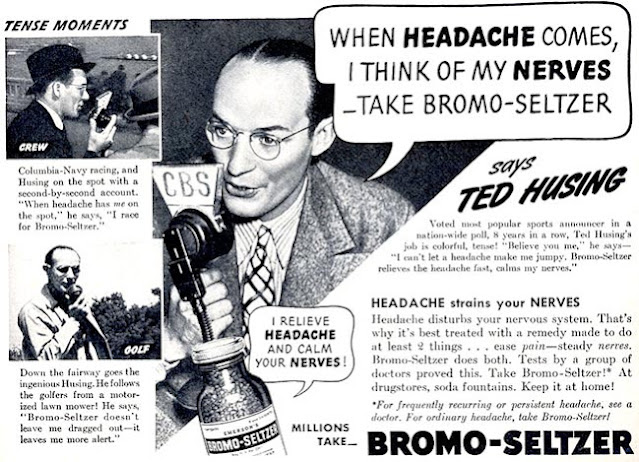
In 1946 Husing moved fromCBS to WHN 1050 (later WMGM) to pursue a career as a disk jockey. (He was succeeded as CBS Radio's sports director by Red Barber.) Husing's popular music show the Ted Husing Bandstand ran from 1946 to 1954. He continued to busy himself with sports assignments, including boxing on CBS and DuMont television, one year (1950) as the radio voice of New York Giants football, and as host of DuMont's Boxing From Eastern Parkway from May 1952 to March 1953. Perhaps he was best known as the voice of Army football from 1947 to 1953. By that time, Husing's yearly salary was close to half a million dollars.
In the spring of 1954, an operation to treat a malignant brain tumor left him blind and forced him to retire. He died at age 60 in 1962.
In 1963, Husing became the second inductee of the National Sportscasters and Sportswriters Association Hall of Fame. In 1984, Husing was part of the American Sportscasters Association Hall of Fame’s inaugural class which included sportscasting legends Red Barber, Don Dunphy, Graham McNamee and Bill Stern.
➦In 1926...KXL AM in Portland, Oregon signed-on with 50 watts of power. Today, the station is owned by Alpha Media, it calls are KXTG and the station airs sports talk at 750 AM. KXL-FM airs news/talk on 101.9 FM.
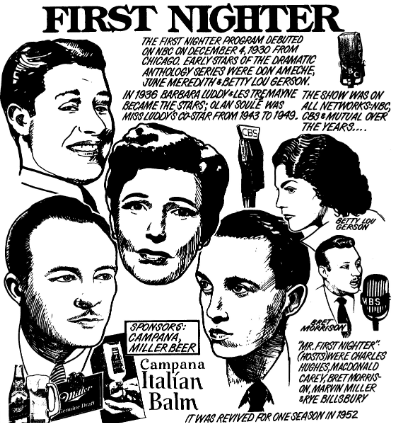
➦In 1930...“First Nighter” was first heard on NBC. It was a long-running 30-minute radio anthology comedy-drama series broadcast from November 27, 1930, to September 27, 1953. The host was Mr. First Nighter (Charles P. Hughes, Macdonald Carey, Bret Morrison, Marvin Miller, Don Briggs and Rye Billsbury (later known as Michael Rye).
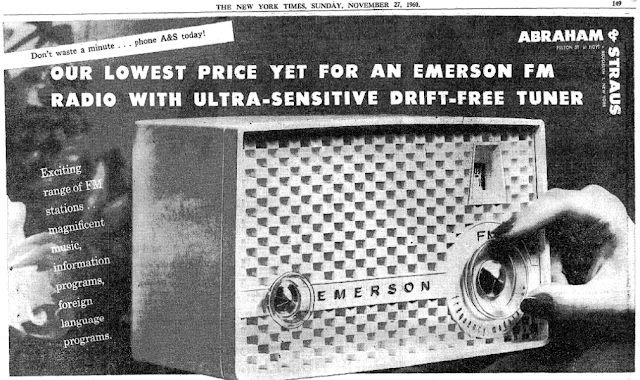 |
| Ad for FM Radio, NY Times 11/27/60: $24.95 |
➦In 1960...the CBS Radio Network canceled "Have Gun Will Travel". It was a Western series that was produced and originally broadcast by CBS on both television and radio from 1957 through 1963.
The television version of the series was rated number three or number four in the Nielsen ratings every year of its first four seasons, and it is one of the few shows in television history to spawn a successful radio version. That radio series debuted November 23, 1958, more than a year after the premiere of its televised counterpart.
This series follows the adventures of a man calling himself "Paladin" (played by Richard Boone on television and voiced by John Dehner on radio), taking his name from that of the foremost knights in Charlemagne's court. He is a gentleman investigator/gunfighter who travels around the Old West working as a mercenary for people who hire him to solve their problems.
 |
| NY Times article 11/27/60 |
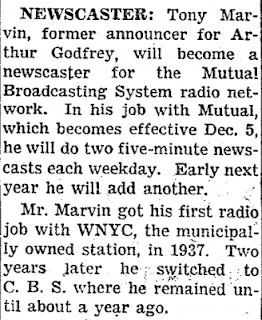
➦In 1960...Veteran announcer, newsman Tony Marvin joined the Mutual Broadcasting System.
 |
| Tony Marvin |
Godfrey at times stirred controversy with his firing of his show's personnel. Marvin was the last of Godfrey's supporting players to go. He had been with Godfrey 12 years when he learned in 1959 that Godfrey would not need an announcer for the coming year. Marvin's departure was widely perceived as a more amicable parting than Godfrey's previous dismissals of cast members, which were often abrupt.
Marvin branched out in 1958, adding a two-hour, Monday-Saturday disc jockey show on WABC to his other duties.
➦In 1962...In London, the Beatles recorded their first BBC radio session, performing "Twist and Shout," "Love Me Do," and "P.S. I Love You." The tracks aired later on the BBC program "Talent Spot."
➦In 1975...Bill Winters WCBS 101.1 FM personality died at age 35.