
➦In 1901...singer Morton Downey was born in Wallingford Connecticut. His national radio appearances began in 1930, in 1932 he was voted Radio Singer of the Year. In 1949 he debuted on TV, hosting the show Star of the Family in the 1950′s.
He died of a stroke at age 83, Oct. 25 1985.
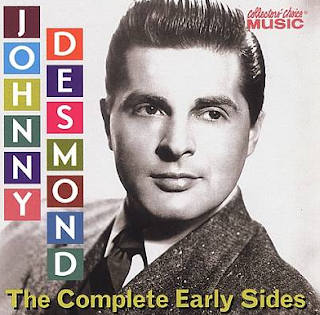
➦In 1920...singer Johnny Desmond was born in Detroit. He was featured on Don McNeill’s Breakfast Club (radio& TV), and was a regular on TV’s Your Hit Parade, Face the Music & Songs for Sale. He died from cancer Sept. 6 1985 at age 64.
➦In 1921...Chicago radio station KYW broadcast the first opera by a professional company. Listeners heard ‘Samson Et Dalila’ as it was being performed at the Chicago Auditorium.
The first words ever broadcast in Chicago were, "My God, but it's dark in here!"
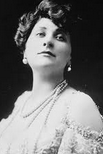 |
| Mary Gardner |
Ms. Garden said what she said because she couldn't see: the area where she was standing was lit by a single bare light bulb.
In 1934, the assignment of clear channels took a frequency away from Illinois and gave it to Pennsylvania, resulting in Westinghouse moving KYW to Philadelphia. KYW used the frequency of 1020 AM at the time.
In March 1941, KYW changed frequencies to 1060 AM as part of a nationwide shift of radio frequencies mandated by the North American Radio Broadcasting Agreement. KYW and the other Westinghouse radio stations remained with NBC after RCA was ordered by the FCC to break up its radio networks, aligning with the former Red Network (the predecessor of modern-day NBC) in 1942. KYW acquired a television counterpart when Westinghouse bought WPTZ (channel 3) – the nation's third commercial television station and NBC's second television affiliate – in 1953.
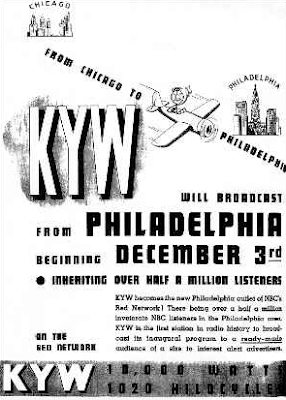
After clearing final regulatory hurdles, the swap went into effect on February 13, 1956. NBC took over the Philadelphia stations, rechristening 1060 AM as WRCV (for the RCA-Victor record label), and Westinghouse moved the KYW call letters to Cleveland.
However, almost immediately after the trade was finalized, Westinghouse complained to the FCC and the Department of Justice about NBC's coercion and an lengthy investigation was launched. In August 1964, NBC's license for WRCV radio and television was renewed by the FCC – but only on the condition that the 1956 station swap be reversed. Following nearly a year of appeals by NBC, Westinghouse regained control of WRCV-AM-TV on June 19, 1965 and subsequently restored the KYW call letters to the radio station (the television station became KYW-TV at this point). To this day, the KYW stations insist that they "moved" to Cleveland in 1956 and "returned" to Philadelphia in 1965.
➦In 1922...The British Broadcasting Corporation (BBC) began its domestic radio service.

The Emergency Alert System (EAS) is a national warning system in the United States put into place on January 1, 1997, when it superseded the Emergency Broadcast System (EBS), which in turn superseded the CONELRAD System.
It is jointly coordinated by the Federal Emergency Management Agency (FEMA), the Federal Communications Commission (FCC) and the National Oceanic and Atmospheric Administration (NOAA). The EAS regulations and standards are governed by the Public Safety and Homeland Security Bureau of the FCC.


