Organizers of the CES tech conference in Las Vegas, under fire for not canceling the event during a Covid-19 surge, said they will close the expo one day early as “an additional safety measure.”
Bloomberg reports the in-person gadget conference will now end on Friday, Jan. 7, rather than running through the next day, according to the Consumer Technology Association, which puts on the show.
The group, led by Chief Executive Officer Gary Shapiro, has cited the event’s importance to small companies and entrepreneurs in pushing ahead with the gathering. Most large tech companies have scrapped plans to attend in-person, opting instead for online presentations. T-Mobile CEO Mike Sievert canceled his speech altogether, with the company saying it would look ahead to the 2023 show.
“As the world’s most influential technology event, CES is steadfast in its pledge to be the gathering place to showcase products and discuss ideas that will ultimately make our lives better,” Shapiro said Friday. “We are shortening the show to three days and have put in place comprehensive health measures for the safety of all attendees and participants.”
CES was held virtually last January, and the latest show was meant to mark a comeback for live tech events. But as the Covid-19 omicron variant spread around the world this month, companies quickly abandoned plans to go.
Hong Kong online media portal Citizen News announced it will shutter Tuesday, the third pro-democracy outlet to fold in six months as national security police probe journalists in the former British colony, reports Bloomberg.
“At the center of a brewing storm, we found ourself in a critical situation,” the outlet wrote in a statement late Sunday. “In the face of a crisis, we must ensure the safety and well-being of everyone who is on board.”
“We announced with a heavy heart that Citizen News will cease operation starting from Jan. 4, 2022,” it added. “Our website will stop updates and will shut down later.”
The announcement comes days after pro-democracy media outlet Stand News collapsed under a national security investigation that saw 200 officers raid its newsroom, seven people arrested and its assets frozen. Six months earlier, the city’s largest independent news source, Apple Daily, also shut under an intense police probe that left it unable to pay staff.
Hong Kong has gone from being one of Asia’s freest media markets to one of its most regulated since Beijing implemented a national security law in June 2020. Dozens of activists and media professionals have been arrested under that law, and authorities have also begun charging journalists under a colonial-era sedition law that can jail a writer for up to two years.
Citizen News had come under official pressure in recent months. The Hong Kong government issued a statement in October accusing the portal of “misleading” readers that Security Secretary Chris Tang had “refused to guarantee” freedom of speech under possible future legislation.
The Communist Party’s Global Times newspaper wrote Monday that Citizen News had published articles “harshly criticizing the central government and also the Communist Party of China.” It cited as evidence the outlet’s description of the CCP as a “dictatorship” that abused power.
Citizen News said in its statement that it had been founded “against the backdrop of growing worries about Hong Kong’s press freedom” on Jan. 1, 2017, and since gone on to employ dozens of reporters.
Bob Iger, former Disney CEO, sits down with CNBC’s David Faber in a CNBC exclusive interview where the two discuss the erosion of traditional media players and any missteps Iger may have made during his tenure.
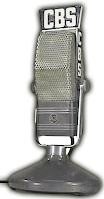
➦In 1929...William Paley incorporated the Columbia Broadcast System.
William S Paley
The origins of CBS date back to January 27, 1927, with the creation of the "United Independent Broadcasters" network in Chicago by New York talent-agent Arthur Judson. The fledgling network soon needed additional investors though, and the Columbia Phonograph Company, manufacturers of Columbia Records, rescued it in April 1927; as a result, the network was renamed "Columbia Phonographic Broadcasting System." Columbia Phonographic went on the air on September 18, 1927, with a presentation by the Howard Barlow Orchestra from flagship station WOR in Newark, New Jersey, and fifteen affiliates.
Operational costs were steep, particularly the payments to AT&T for use of its land lines, and by the end of 1927, Columbia Phonograph wanted out. In early 1928, Judson sold the network to brothers Isaac and Leon Levy, owners of the network's Philadelphia affiliate WCAU, and their partner Jerome Louchenheim. None of the three were interested in assuming day-to-day management of the network, so they installed wealthy 26-year-old William S. Paley, son of a Philadelphia cigar family and in-law of the Levys, as president. With the record company out of the picture, Paley quickly streamlined the corporate name to "Columbia Broadcasting System". He believed in the power of radio advertising since his family's "La Palina" cigars had doubled their sales after young William convinced his elders to advertise on radio. By September 1928, Paley bought out the Louchenheim share of CBS and became its majority owner with 51% of the business.
During Louchenheim's brief regime, Columbia paid $410,000 to A.H. Grebe's Atlantic Broadcasting Company for a small Brooklyn station, WABC (no relation to the current WABC), which would become the network's flagship station. WABC was quickly upgraded, and the signal relocated to a stronger frequency, 860 kHz. The physical plant was relocated also – to Steinway Hall on West 57th Street in Manhattan. It was where much of CBS's programming originated. Other owned-and-operated stations were KNX in Los Angeles, KCBS in San Francisco (originally KQW), WBBM in Chicago, WCAU in Philadelphia, WJSV in Washington, D.C. (later WTOP, which moved to the FM dial in 2005; the AM facility today is WFED, also a secondary CBS affiliate), KMOX in St. Louis, and WCCO in Minneapolis. These remain the core affiliates of the CBS Radio Network today, with WCBS (the original WABC) still the flagship, and all except WTOP and WFED (both Hubbard Broadcasting properties) owned by CBS Radio. By the turn of 1929, the network could boast to sponsors of having 47 affiliates.
Paley moved right away to put his network on a firmer financial footing. In the fall of 1928, he entered into talks with Adolph Zukor of Paramount Pictures who planned to move into radio in response to RCA's forays into motion pictures with the advent of talkies. The deal came to fruition in September 1929: Paramount got 49 percent of CBS in return for a block of its stock worth $3,800,000 at the time. The agreement specified that Paramount would buy that same stock back by March 1, 1932 for a flat $5,000,000, provided CBS had earned $2,000,000 during 1931 and 1932. For a brief time there was talk that the network might be renamed "Paramount Radio", but it only lasted a month – the 1929 stock market crash sent all stock value tumbling. It galvanized Paley and his troops, who "had no alternative but to turn the network around and earn the $2,000,000 in two years.... This is the atmosphere in which the CBS of today was born." The near-bankrupt movie studio sold its CBS shares back to CBS in 1932. In the first year of Paley's watch, CBS's gross earnings more than tripled, going from $1,400,000 to $4,700,000.
The extraordinary potential of radio news showed itself in 1930, when CBS suddenly found itself with a live telephone connection to a prisoner called "The Deacon" who described, from the inside and in real time, a riot and conflagration at the Ohio Penitentiary; for CBS, it was "a shocking journalistic coup". Yet as late as 1934, there was still no regularly scheduled newscast on network radio: "Most sponsors did not want network news programming; those that did were inclined to expect veto rights over it." There had been a longstanding wariness between radio and the newspapers as well; the papers had rightly concluded that the upstart radio business would compete with them on two counts – advertising dollars and news coverage. By 1933, they fought back, many no longer publishing radio schedules for readers' convenience, or allowing "their" news to be read on the air for radio's profit. Radio, in turn, pushed back when urban department stores, newspapers' largest advertisers and themselves owners of many radio stations, threatened to withhold their ads from print. A short-lived attempted truce in 1933 even saw the papers proposing that radio be forbidden from running news before 9:30 a.m., and then only after 9:00 p.m. – and that no news story could air until it was twelve hours old.
In the fall of 1934, CBS launched its independent news division, shaped in its first years by Paley's vice-president, former New York Times man Ed Klauber, and news director Paul White. Since there was no blueprint or precedent for real-time news coverage, early efforts of the new division used the shortwave link-up CBS had been using for five years to bring live feeds of European events to its American air.
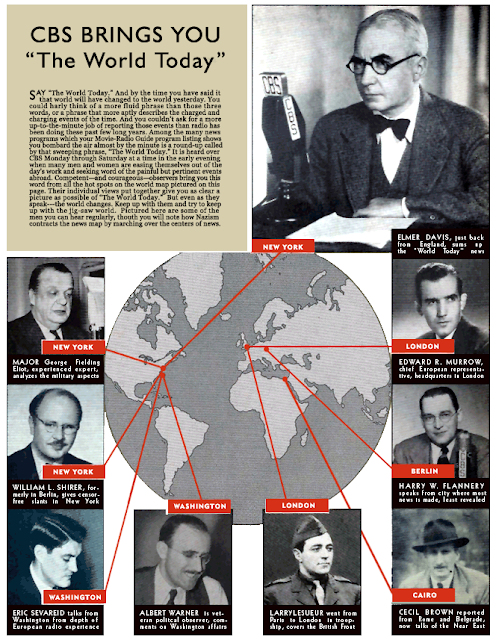
A key early hire was Edward R. Murrow in 1935; his first corporate title was Director of Talks. He was mentored in microphone technique by Robert Trout, the lone full-timer of the News Division, and quickly found himself in a growing rivalry with boss White. Murrow was glad to "leave the hothouse atmosphere of the New York office behind" when he was dispatched to London as CBS's European Director in 1937, a time when the growing Hitler menace underscored the need for a robust European Bureau. Halberstam described Murrow in London as "the right man in the right place in the right era".
Edward R. Murrow pictured with CBS' London-based D-Day team. Front row (left to right): Bill Downs,
Charles Collingwood, Gene Ryder, Charles Shaw. Back row (from left): Larry LeSueur,
Edward R. Murrow, Richard C. Hottelet, Bill Shadel.
Murrow began assembling the staff of broadcast journalists – including William L. Shirer, Charles Collingwood and Eric Sevareid – who would become known as "Murrow's Boys". They were "in [Murrow's] own image, sartorially impeccable, literate, often liberal, and prima donnas all". They covered history in the making, and sometimes made it themselves: on March 12, 1938, Hitler boldly annexed nearby Austria and Murrow and Boys quickly assembled coverage with Shirer in London, Edgar Ansel Mowrer in Paris, Pierre Huss in Berlin, Frank Gervasi in Rome and Trout in New York. The News Round-Up format was born and is still ubiquitous today in broadcast news.
➦In 1938... the first broadcast of Irna Phillips‘ soap opera “Woman in White” was presented on the NBC Red network. The program ran 10 years and was one of the first radio shows to feature doctors and nurses as leading characters.
➦In 1940...WPG-AM in Atlantic City NJ consolidated with WBIL & WOV as "new" WOV.
WPG had been in operation since 1923 operating on one of the cleared national channels of the first zone on a frequency of 1100 kilocycles.
WPG in Atlantic City shared time on 1100, with WBIL in NYC. The cumbersome arrangement ended in 1940 in a complicated series of events when Arde Bulova's Greater New York Broadcasting Corporation bought WPG and absorbed it into WOV, shut down both WOV and WPG on January 3, 1940 because they interferred with WBIL, asked the FCC to cancel WOV's license and move WBIL to 1130 (today is WBBR) , and immediately changed WBIL's calls to WOV, which today is WADO 1280 AM.
WPG was unique in radio. Approximately, fifteen million visitors come to the resort in a year. They are all interested in Atlantic City and it's happenings when in their homes wherever that may be.
Today, the WPG calls are used for branding by Townsquare Media's WPGG 1450 AM in Atlantic City, NJ. Since October 22, 2012, the station broadcasts a talk radio format under the branding "WPG Talk Radio 1450".
Cast from the Gunsmoke radio show. Howard McNear as Doc, William Conrad as Matt Dillon,
Georgia Ellis as Kitty and Parley Baer as Chester.
➥In 1969...actor Howard McNear, “Doc” on radio’s Gunsmoke, and “Floyd the Barber” on TV’s Andy Griffith Show, died after a long illness at age 63.
➦In 1970... “I Me Mine” was recorded by the Beatles without John, who was on vacation. It was the last song the band would record together. George Harrison later used that title for his autobiography.
➦In 1973... the Columbia Broadcasting System got out of the baseball business by selling the New York Yankees to a 17-person syndicate headed by George Steinbrenner. The price tag: just $10 million, about a 20th of the team’s current player payroll each year.
➦In 1975...legendary radio announcer Milton Cross, for 43 years the voice of the Metropolitan Opera on Saturday afternoon, died after a heart attack at age 87.
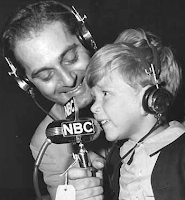
Born in New York City, Milton Cross started his career just as network radio itself was in its earliest stages. He joined the New Jersey station WJZ in 1921, not just as an announcer but also as a singer, often engaging in recitals with the station's staff pianist, Keith McLeod. By 1927, WJZ had moved to Manhattan and had become the flagship station of the Blue Network of NBC's new national radio network. Cross' voice became familiar as he not only delivered announcements for the Blue Network but also hosted a number of popular programs. Cross was the announcer for the quiz program Information Please and the musical humor show The Chamber Music Society of Lower Basin Street, among others. In the 1940s Cross hosted a Sunday morning show featuring child performers, called Coast To Coast on a Bus.
From 1931 to 1975 Cross served as host for the weekly live broadcasts of the Metropolitan Opera, the job for which he is most remembered. His distinctive voice conveyed the excitement of live performances "from the stage of the Metropolitan Opera House in New York City" for generations of radio listeners.
➦In 1977...Apple Computers incorporated.
➦In 1986...A major shakeup in the media world as Capital Cities closed on it acquisition ABC-TV for $3.5 billion. Five years later Disney purchased Capital Cities/ABC Inc. for almost six times that price.
➦In 1993...Sportscaster John M. Most died (Born - June 15, 1923). He was known primarily as the raspy radio voice of the Boston Celtics of the National Basketball Association from 1953 to 1990.
After distinguished Air Force service in World War II, he began his basketball broadcasting career in the late 1940s as a protégé of New York Knickerbockers announcer (and 1936 Olympics track star) Marty Glickman. He was hired in 1953 by Boston Celtics owner Walter Brown and coach Red Auerbach to replace Curt Gowdy as the team's radio play-by-play man on the Celtics radio network. He also served as sports director for WCOP radio in Boston at that time.
In addition to his work with the Celtics, he served as host of a rudimentary Boston Red Sox baseball post-game show on WHDH-TV, sister station to WHDH radio which carried Celtics games.
In the early 1970s, Most hosted an evening sports talk show on WORL radio which lasted from 5 to 7 PM. WBZ, owner of the Celtics' radio rights, allowed Most to appear only on the first hour of the program, which was broadcast live from a Boston nightspot, so as not to compete with WBZ's Calling All Sports broadcast.
➦In 1995... popular CKLW Detroit newscaster Byron MacGregor, son of Calgary radio legend Clarence Mack, died at age 46 of complications from pneumonia.
Byron MacGregor
Born Gary Lachlan Mack in Calgary, Alberta, by the age of nineteen he became the youngest news director at the AM radio station, CKLW in Windsor, Ontario, which also served Detroit, Michigan as well as Toledo and Cleveland in Ohio and covered twenty eight states and six provinces. This was during its "Big 8/20·20 News" period, and also around the time RKO General was forced to sell the station, due to a change in Canadian ownership rules that prohibited foreign firms from controlling Canadian licensed stations.
In 1973, he read a Toronto newspaper editorial written by Gordon Sinclair of CFRB in Toronto, a commentary about America. MacGregor then read the patriotic commentary on CKLW Radio as part of a public affairs program; and, due to the huge response he was asked to record "The Americans" with "America the Beautiful" performed by The Detroit Symphony Orchestra as the background music. Both MacGregor and Sinclair released recorded versions of the commentary. MacGregor's version of the record (released on Westbound Records) became a bigger hit than Sinclair's in the United States, reaching #1 on the Billboard Hot 100 chart the week of February 9, 1974.
MacGregor was known for his deep voice and high-energy announcing style at CKLW; and for writing copy in a manner that was compared to that of sensational tabloid newspapers.
He later made the transition to a more traditional anchoring and interviewing style when he moved to WWJ Newsradio 950, the CBS Radio all-news station in Detroit, where he served as both morning and afternoon drive anchor during his thirteen-year occupancy. MacGregor also became the first newsman in Detroit to simultaneously anchor prime-time newscasts on both radio (WWJ) and television (WKBD-TV 50).
By the mid 1980s MacGregor held dual citizenships in Canada and the United States. His wife of nineteen years, Jo-Jo Shutty-MacGregor. She was the first female helicopter news and traffic reporter in North America, and today works for WWJ and WOMC and the Metro News Networks.
➦In 2005...Adam Carolla returned to morning drive-time radio with the premiere of “The Adam Carolla Show” on several CBS Radio stations including 97.1 FREE FM in Los Angeles (KLSX-FM), KIFR-FM San Francisco, KSCF-FM San Diego, KZON-FM Phoenix, KUFO-FM Portland and KXTE-FM Las Vegas. With originating station KLSX-FM about to change format, Carolla’s program ended Feb. 20 2009 but continued as a podcast.
➦In 2016...longtime Chicago radio newsman Barry Keefe, who spent 30 years as an anchor at WTMX-FM and its predecessor, WCLR-FM, bringing an authoritative, deep-bass voice and a friendly, chatty manner to a raft of morning radio shows, died of complications from pancreatic cancer at age 62.
Dabney Coleman is 90
🎂HAPPY BIRTHDAYS:
Actor Dabney Coleman is 90.
Singer-songwriter Van Dyke Parks is 79.
Singer Stephen Stills is 77.
Bassist John Paul Jones of Led Zeppelin is 76.
Actor Victoria Principal is 72.
Florence Pugh is 26
Actor Mel Gibson is 66.
Actor Shannon Sturges (“Port Charles”) is 54.
Jazz saxophonist James Carter is 53.
Contemporary Christian singer Nichole Nordeman is 50.
Musician Thomas Bangalter of Daft Punk is 47.
Actor Jason Marsden (“Ally McBeal”) is 47.
Actor Danica McKellar (“The Wonder Years”) is 47.
Actor Nicholas Gonzalez (“The O.C.”) is 46.
Singer and former “American Idol” contestant Kimberley Locke is 44.
Actor Kate Levering (“Drop Dead Diva”) is 43.
Actor Nicole Beharie (“Sleepy Hollow”) is 37.
Drummer Mark Pontius (Foster the People) is 37.
R-and-B singer Lloyd is 36.
Guitarist Nash Overstreet of Hot Chelle Rae is 36.
➦In 1904... Bernardine Flynn born (Died at age 73 – March 20, 1977). She was a radio actress and announcer best known for playing the role of Sade Gook on the long-running comic radio serial Vic and Sade.
Bernadine Flynn
Flynn graduated from the University of Wisconsin–Madison (Class of 1926), moving to Chicago in 1927. In Chicago, Flynn became a radio actress and announcer. She was used as a radio announcer, a rarity for women in the 1920s, as she was known for controlling her emotions. This quality of not becoming emotional was exploited in the Vic and Sade show, where she would play the role of straight man to the comic daffiness.
One of Flynn's earliest activities on radio was on WJZ in New York City. She replaced Virginia Carter in the ingenue's role on the Empire Builders program. The following year, she was heard on Rin Tin Tin. Also in the summer of 1931, she portrayed Mrs. Jones in The Private Affairs of the Jones Family. Sponsored by Montgomery Ward, the show was one of four tested by the company to test audience response. A newspaper story about it related, "Miss Flynn [has] been heard in many dramatic productions from Chicago stories." She was heard in Malik Mystery Drama in 1932.
In 1932, Paul Rhymer chose Flynn to play Sade as the character lacked a sense of humor. Even in the most humorous of situations, Flynn's emotional self-control ensured that Sade would never break character. The 15-minute program was aired from 1932 to 1945, and in 1946, it was put back on the air as a one-hour show.
Flynn and Durward Kirby co-starred in Daytime Radio Newspaper in 1943. The 15-minute program on CBS had Kirby delivering straight news items and Flynn handling human-interest reports.
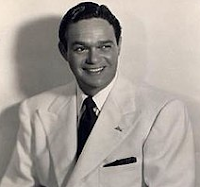
➦In 1904...Singer and radio actor James Melton born (Died from pneumonia at age 56 – April 21, 1961) He was a popular singer in the 1920s and early 1930s, later began a career as an operatic singer when tenor voices went out of style in popular music around 1932–35.
John Melton
Melton usually catered to popular music fans, singing romantic songs and popular ballads in a sweet style. He was born in Moultrie, Georgia but was raised in Citra, FL. In 1920, he graduated from high school in Ocala, and then attended the University of Florida, Vanderbilt University and the University of Georgia. He received vocal instruction from Gaetano de Luca in Nashville from 1923 to 1927 before moving to New York where he studied with Beniamino Gigli's teacher, Enrico Rosati. Melton also worked in dance bands, playing saxophone in a college jazz ensemble and performing with Francis Craig's Orchestra in Atlanta in 1926.
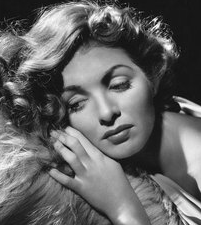
The following year, he began singing on New York radio for no pay. He joined "Roxy's Gang", a cabaret group led by Samuel Roxy Rothafel, who worked with the Sieberling Singers. He made records for Victor Records, singing as one of the tenors with The Revelers and for Columbia Records with the same group under the pseudonym of The Singing Sophomores. He frequently sang with popular singer Jane Froman and appeared with her in film as well.
Melton recorded his first songs under his own name for Columbia in the autumn of 1927. On radio, Melton was heard on The Firestone Hour in 1933, on Ward's Family Theater in 1935, The Sealtest Sunday Night Party (1936), The Palmolive Beauty Box Theater (1937), The Song Shop (1938), the Bell Telephone Hour (1940), Texaco Star Theater (1944) and Harvest of Stars (1945). In 1941, a newspaper columnist described Melton as "currently one of radio's busiest singers." In the thirties, Melton also sang and acted on the Jack Benny Radio Shows.
➦In 1908...announcer Ben Grauer was born in New York City. Grauer's greatest fame lies in his legendary 40-year career in radio. In 1930, the 22-year-old Benjamin Franklin Grauer joined the staff at NBC. He quickly rose through the ranks to become a senior commentator and reporter. He was the designated announcer for the popular 1940s Walter Winchell's Jergens Journal. Perhaps, most importantly, he was selected by Arturo Toscanini to become the voice of the NBC Symphony Orchestra. Grauer took over as announcer in late 1942, and remained until the orchestra was disbanded in June 1954. Toscanini said he was his favorite announcer.
Ben Grauer
Starting in 1932, Grauer covered the Olympic Games, presidential inaugurations and international events. During his radio career, Grauer covered nearly every major historic event, including the Morro Castle fire, the Paris Peace Conference and the US occupation of Japan. Millions remember his NBC coverage of the New Year's celebrations on both radio and TV. Between 1951 and 1969, Grauer covered these events 11 times live from New York's Times Square. He continued covering New Year's Eve for Guy Lombardo's New Year's Eve specials on CBS in the 1970s, with his last appearance on December 31, 1976, the year before both he and Lombardo died.
From the mid-1950s until the mid-1960s, Grauer's reports were part of the NBC television network's The Tonight Show, where he worked with Johnny Carson and prior to that, Jack Paar, and Steve Allen. Grauer was also one of NBC Radio's Monitor "Communicators" from 1955 to 1960.
Grauer as the host of WNBT-TV's (later WNBC-TV) tenth anniversary special. He provided the commentary for NBC's first television special, the opening in 1939 of the New York World's Fair. In 1948, Grauer, working with anchor John Cameron Swayze, provided the first extensive live network TV coverage of the national political conventions.
In 1954, NBC began broadcasting some of their shows in living color, and in 1957, the animated Peacock logo made its debut. It was Grauer who first spoke the now famous words, "The following program is brought to you in living color on NBC," behind the Peacock graphic. During his 40-year broadcast career, he hosted numerous TV programs on NBC, including game shows, quiz shows, concerts and news programs.
Grauer suffered a heart attack at age 68 and died May 31 1977.
➦In 1921...KDKA 1020 AM in Pittsburgh aired the first religious program on radio. Listeners heard Dr. E.J. Van Etten of the local Calvary Episcopal Church preach. The service became a regular Suday program and aired until 1962.
➦In 1930...Pop singer and radio personality Julius La Rosa born (Died of natural causes at age 86 – May 12, 2016). Hired in 1951 to be a member of Arthur Godfrey’s performer on his radio & TV shows, Larosa has the distinction of being fired on the air after he hired an agent and manager, contrary to Godfrey’s wishes. Godfrey told the press Larosa was terminated because he “lacked humility.”
In 1970, the singer/actor became a very successful and amiable disc jockey at one of America's biggest radio stations in the top market, Metromedia's WNEW 1130 AM (now WBRR) in New York City.
➦In 1936...Bing Crosby began a 10-year tenure as host of the "Kraft Music Hall" on the NBC Radio Network.
➦In 1944...WJZ 770 AM (later WABC) transmitter moved to Lodi, NJ.
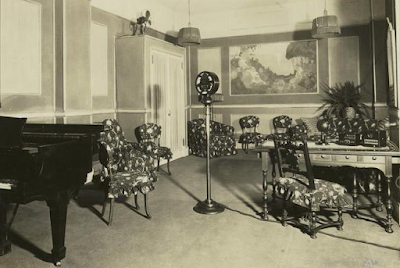
WABC made its first broadcast as a federally-licensed commercial radio station on October 1, 1921, as WJZ, owned by the Westinghouse Electric Corporation and was originally based in Newark, New Jersey. The call letters stood for their original home state, New Jer(Z)sey.
WJZ Studio - Date Unknown
In July 1926, WEAF also became an RCA station and on November 15, 1926, both WJZ (then on 660 kHz) and WEAF (then on 610 kHz) were under the umbrella of the newly formed National Broadcasting Company.
On January 1, 1927, the NBC Blue Network debuted, with WJZ as the originating station. WJZ and the Blue Network presented many of America's most popular programs, such as Lowell Thomas and the News, Amos 'n' Andy, Little Orphan Annie, America's Town Meeting of the Air, and Death Valley Days. Each midday, The National Farm and Home Hour brought news and entertainment to rural listeners. Ted Malone read poetry and Milton Cross conveyed children "Coast To Coast on a Bus," as well as bringing opera lovers the Saturday matinée Metropolitan Opera radio broadcasts.
In 1942, the Federal Communications Commission (FCC) ruled that no broadcaster could own more than one AM, one FM and one television station in a single market. On January 23, 1942, the FCC approved the transfer of WJZ's operating license from Radio Corporation of America to the Blue Network, Inc. A year later, on October 12, 1943, WJZ and the NBC Blue Network were sold to Edward J. Noble, then the owner of WMCA. Technically, this spun off network was simply called "The Blue Network" for little over a year.
On June 15, 1945, "The Blue Network" was officially rechristened the American Broadcasting Company, when negotiations were completed with George B. Storer, who had owned the defunct American Broadcasting System and still owned the name.
In November 1948, WJZ and the ABC network finally got a home of their own when studios were moved to a renovated building at 7 West 66th Street. On March 1, 1953, WJZ changed its call letters to WABC, after the FCC approved ABC's merger with United Paramount Theatres, the movie theater chain owned by Paramount Pictures which, like the Blue Network, was divested under government order. The WABC call letters were once used previously on CBS Radio's New York City outlet, before adopting their current WCBS identity in 1946.
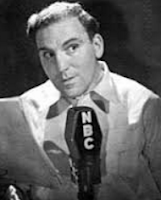
William Bendix
After acquiring Channel 13 WAAM in Baltimore, Maryland in 1957, Westinghouse applied to change the calls to WJZ-TV in honor of its pioneer radio station. The FCC granted the unusual request (perhaps because Westinghouse was highly regarded as a licensee by both the industry and the FCC at that time), and the Baltimore TV station, now owned and operated by CBS, retains the call letters to this day, along with sister radio stations WJZ 1300 AM and WJZ 105.7 FM.
➦In 1953...After ten years on radio starring William Bendix, and a one-year TV version with Jackie Gleason as the title character, "The Life of Riley" with William Bendix began a six-season run on NBC-TV. Life of Riley radio show aired from January 16, 1944 - June 8, 1945 on the Blue Network/ABC and aired September 8, 1945 - June 29, 1951 on NBC.
➦In 1959...the CBS Radio Network dropped the curtain on four soap operas. Our Gal Sunday, This is Nora Drake, Backstage Wife and Road of Life all signed off for the last time.
Courtesy of Bob Dearborn
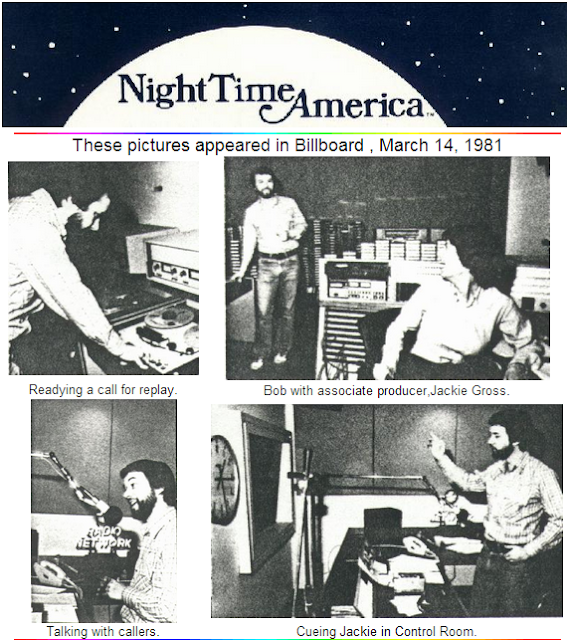
➦In 1981...The late-night radio feature “Night Time America” with Hamilton, Ont.-born host/producer Bob Dearborn began as a live satellite-distributed music program. The show was a groundbreaking five-hour music and call-in show originating in New York City on the RKO Radio Network.
Eventually, the program was heard on 154 affiliate radio stations throughout the U.S., from Bangor to Hilo, from West Palm Beach to Fairbanks, and in major cities including Chicago, Detroit, Boston, Pittsburgh, Houston, Seattle, Denver, St. Louis, San Diego, Memphis, Cincinnati, Sacramento, Raleigh-Durham, Salt Lake City, Nashville, Buffalo, and New Orleans. (Airchecks, Click Here)
Dearborn began his radio career in Hamilton, Ontario at the age of 15. He later moved on to the U.S., stopping first at WPRO in Providence and then WIXY Cleveland, WPTR Albany, WKNR Detroit, and WCFL Chicago. Between WPRO and WIXY, Dearborn helped launch and spent a year as production manager of WRTH-St. Louis. And he was involved in radio station ownership and management in the last half of the 1980s. Along with three friends, he co-owned 10 stations (5 AM/FM combos ... in Bath/Brunswick, Maine; Utica, NY; Birmingham, AL, Knoxville, TN and Nashville, TN). They were at the end of the '80s.
He also made a couple stops in Tampa Bay to do mornings – at WDAE (1976-77) and WPLP (1979-80) – and then joined Pittsburgh’s WTAE. In January 1981 RKO Radio hand-picked him to host its syndicated all night music show. Broadcast from Manhattan, it ran for four years live.
For the next sixteen years he was back in Chicago with WJMK-FM and sister station WJJD-AM before moving to Seattle to program adult standards KIXI. Dearborn also hosted mornings at CHWO-Toronto in 2003 and retired in 2009. (H/T: Radioyears.com)
Margot Stevenson
➦In 2004..legendary agriculture broadcaster Orion Samuelson at age 69, aired his last farm report on WGN 720 AM, concluding a 43 year run.
➦In 2011...longtime stage actress Margot Stevenson died at age 98. In 1938 she had played the female lead Margo Lane on radio’s The Shadow, opposite Orson Welles.
➦In 2007...WNEW-FM NYC adopted a soft contemporary format called "Fresh" and 7-days later changed call letters to WWFS.
The 102.7 FM frequency was first assigned in the mid-1940s as WNJR-FM from Newark, New Jersey. Intended to be a simulcasting sister to WNJR (1430 AM, now WNSW), the FM station never made it to the air despite being granted several extensions of its construction permit. WNJR gave up and turned in the FM license to the Federal Communications Commission (FCC) in 1953.
In 1955 the FCC awarded a new permit for 102.7 FM to a group called Fidelity Radio Corporation, based in West Paterson, New Jersey. The station was later granted the call sign WHFI, and a year later the community of license was moved back to Newark from West Paterson. Once again, the owners failed to put the station on the air.
In November 1957, the WHFI construction permit was purchased by the DuMont Broadcasting Corporation, which already owned WABD (later WNEW-TV) and earlier in the year bought WNEW radio. In January 1958, WHFI was renamed WNEW-FM and DuMont completed its build-out, moving the license to New York City. The station finally came on the air on August 25, 1958, partially simulcasting WNEW 1130 AM with a separate popular music format. DuMont Broadcasting, meanwhile, would change its corporate name twice within the next three years before settling on Metromedia in 1961.
Billboard - December 1967
WNEW-FM's early programming also included an automated middle-of-the-road format, followed quickly by a ten-month-long period (July 4, 1966, to September 1967) playing pop music—with an all-female air staff. The gimmick was unique and had not before been attempted anywhere in American radio. The lineup of disc jockeys during this stunt included Margaret Draper, Alison Steele (who stayed on to become the "Night Bird" on the AOR format), Rita Sands, Ann Clements, Arlene Kieta, Pam McKissick, and Nell Bassett. The music format, however, was a pale copy of WNEW (AM)'s adult standards format and only Steele, Sands, and Bassett had broadcast radio experience. The all-female disc jockey lineup endured for more than a year, changing in September 1967 to a mixed-gender staff.
On October 30, 1967, WNEW-FM adopted a progressive rock radio format, one that it became famous for and that influenced the rock listenership as well as the rock industry.
Today, WNEW-FM airs a hot AC format and is owned by Entercom Communications.
Ed Goodman
➦In 2015…Veteran radio personality Ed Goodman, who logged almost five decades on the air in St. Louis, died of cancer. Goodman began on local radio with KSHE and other stations in the 1970s and 1980s, and then began an 18-year stint at KEZK in 1992.
Kate Bosworth is 39
🎂HAPPY BIRTHDAYS:
TV host Jack Hanna (“Jack Hanna’s Into the Wild”) is 74.
Actor Wendy Phillips (“I Am Sam”) is 70.
Actor Cynthia Sikes (“St. Elsewhere”) is 68.
Actor Gabrielle Carteris (“Beverly Hills, 90210″) is 61.
Actor Tia Carrere is 55. Actor Cuba Gooding Jr. is 54.
Model Christy Turlington is 53.
Actor Renee Elise Goldsberry (Broadway’s “Hamilton”) is 51.
Actor Taye Diggs (“The Best Man,” ″How Stella Got Her Groove Back”) is 51.
Singer Doug Robb of Hoobastank is 47.
Actor Dax Shepard (“Parenthood”) is 47.
Sax player-guitarist Jerry DePizzo Jr. of O.A.R. is 43.
Singer Kelton Kessee of Immature and of IMX is 41.
➦In 1923...the very first radio broadcast of the Rose Bowl aired in Los Angeles over KHJ radio — some 42 years before 93/KHJ became Boss Radio.
➦In 1925...Lucrezia Bori and John McCormack of the famous Metropolitan Opera made their singing debuts on radio. The broadcast over New York’s WEAF Radio soon to be the NBC flagship.
➦In 1927...The Blue Network aired its first program. The Blue Network (previously the NBC Blue Network) was the on-air name of the now defunct American radio production and distribution service, which ran from 1927 to 1945. Beginning as one of the two radio networks owned by the National Broadcasting Company, the independent Blue Network was born of a divestiture in 1942, arising from anti-trust litigation, and is the direct predecessor of the American Broadcasting Company (ABC..see below) - organized 1943-1945 as a separate independent radio network and later TV broadcaster.
The Blue Network dates to 1923, when the Radio Corporation of America acquired WJZ Newark from Westinghouse (which had created the station in 1921) and moved it to New York City in May of that year. When RCA commenced operations of WRC, Washington on August 1, 1923, the root of a network was born, though it did not operate under the name by which it would later become known. Radio historian Elizabeth McLeod states that it would not be until 1924 that the "Radio Group" formally began network operations.
The core stations of the "Radio Group" were RCA's stations WJZ and WRC; the Westinghouse station WBZ, then in Springfield, Massachusetts; and WGY, the General Electric station in Schenectady, New York.
RCA's principal rival prior to 1926 was the radio broadcasting department of the American Telephone & Telegraph Company. AT&T, starting in 1921, had been using this department as a test-bed for equipment being designed and manufactured by its Western Electric subsidiary.
The RCA stations operated at a significant disadvantage to their rival chain; AT&T used its own high-quality transmission lines, and declined to lease them out to competing entities, forcing RCA to use the telegraph lines of Western Union, which were not as well calibrated to voice transmission as the AT&T lines.
Nevertheless, the WJZ network sought to compete toe-to-toe with the AT&T network, which was built around WEAF (today's WFAN). For example, both stations sent announcer teams to cover the 1924 Democratic National Convention, which was held in Madison Square Garden in New York City. Promotional material produced in 1943 claimed certain "firsts" in broadcasting by WJZ, such as the first educational music program in April 1922, the first World Series broadcasts in 1922, and the first complete opera broadcast, The Flying Dutchman, from the Manhattan Opera House.
RCA (as well as its consortium partners General Electric and Westinghouse) were to receive a break in 1926, when AT&T made a corporate decision to exit the broadcasting business and focus on its telecommunications business.
The Decatur Review (Illinois) for Sunday, December 12, 1926 reported the following in an article describing a broadcast to be sponsored by the Victor Talking Machine Company and aired the following New Year's Day, January 1, 1927, which is a description of this first Blue Network broadcast—note that it makes it clear that January 1, 1927 marked the debut of the Blue Network:
"TWO BIG NETWORKS: The network to be used for the first concert will consist of a combination of chains of stations affiliated with WEAF and WJZ, New York. It is also announced that this opening Victor program inaugurates a new chain system to be operated by the National Broadcasting Company, with WJZ as the "key" station. This new chain, which will be known as the "blue" network, will allow simultaneous broadcasting from WJZ through WBZ, Springfield and Boston, KDKA, Pittsburgh, and KYW, Chicago. For broadcasting of the first program, therefore, the "blue" network will be joined with the "red" network, as the WEAF chain is designated, as well as other stations in various cities. Following the New Year's night program, the concerts will be given bi-monthly, through the "blue" network (...)
Allegedly, the color designations came from the way the networks were represented on maps, with red lines (or pushpins) denoting the WEAF network circuits, and blue the WJZ circuits.
➦In 1927...the very first coast-to-coast network radio broadcast of the Rose Bowl was made. Graham McNamee provided the play-by-play on NBC Radio.The Rose Bowl football game was aired for the first time, coast-to-coast, on network radio.
➦In 1930..."The Cuckoo Hour" was broadcast for the first time on the NBC-Blue Network (it later became the ABC Radio Network).
➦In 1934...the classic radio horror show Light’s Out was heard for the first time on WENR Chicago. The show became an ‘almost midnight’ NBC thriller 16 months later.
➦In 1940…Broadcasting from the Empire State Building in New York City, radio station W2XDG, the first FM station licensed by the U.S. Federal Communications Commission, became the first to broadcast with the new Frequency Modulation technology.\
➦In 1941...Lorne Greene was appointed first announcer for the Canadian Broadcasting Corporation's new national radio news service. His authoritative baritone on nightly wartime newscasts caused him to be nicknamed ‘The Voice of Doom’, nearly two decades before his reincarnation as Pa Cartwright on NBC-TV’s popular western series, Bonanza.
➦In 1947...WKSE, Buffalo signed on as WHLD-FM in 1947. It changed its call sign to WZIR in 1980, WRXT in 1984, and the current call sign in 1985. It currently runs a Top 40 format, which has been in place since September 1984. The station is now owned by Entercom.
➦In 1950... 26-year-old disc jockey Sam Phillips opened his Memphis Recording Service (later renamed Sun Studios) at the corner of Union and Marshall in the Tennessee city. Some 3 and 1/2 years later, Elvis Presley walked in and spent $3.98 to make his first recording.
➦In 1953...legendary Hank Williams died at the young age of 29 from a drug/alcohol-related heart attack. Hank wrote or co-wrote: “Cold, Cold Heart”, “Half as Much”, “Jambalaya”, “Your Cheatin’ Heart”, “Hey, Good Lookin”, & “I’m So Lonesome I Could Die.” Indisputedly the biggest star in the history of country music, Williams’ legacy is being carried on by his son, Hank Williams, Jr.
➦In 1961...WLTW 106.7 FM In NYC signed-on the air as WRVR, a religious station owned by Riverside Church that also played some jazz. A remnant of this period is a 5 A.M. Sunday morning sermon from the church that aired on the station. As time went on, WRVR was a full-time jazz station with a strong following, but low ratings.
In 1976 WRVR was purchased by Sonderling Broadcasting, owner of WWRL, with the hope that it could move to an urban format and compete against WBLS, which had cut into WWRL's ratings. However, community opposition prevented the format change and WRVR remained a jazz station under Sonderling ownership. At that time it developed the precursor to what would later become known as the "smooth jazz" format.
In 1980 Viacom bought the Sonderling chain, and the station adopted a country music format as "Kick" WKHK. The station was known as "Kick 106.7 FM." The format change, from jazz to country, took place in the middle of the night. The change brought many protests from New York jazz fans, and a petition to the FCC to deny the station's license renewal, which was denied.
The WRVR calls were then moved to Memphis, TN.
However, ratings were low, as they were unable to compete with WHN, which also had a country music format at the time. In 1988, a new jazz station appeared on the New York airwaves, with the call letters WQCD "CD101.9" later changing calls to WEMP, then back to WRXP, and now WFAN-FM.
On January 23, 1984, Viacom dropped country and changed the calls to WLTW. The station became an MOR station known as "Lite FM 106.7 WLTW". the station is now top rated and owned by iHeartMedia.
➦In 1968...the ABC Radio Network split into 4 networks: the Information, Entertainment, Contemporary and FM networks.
ABC Radio originally began after the split of NBC Red and NBC Blue (later Blue Network) networks with ABC taking over operations from RCA in 1943 before adopting its name 2 years later.
ABC Radio was known to broadcast the first nationwide report of the assassination of President John F. Kennedy. Kennedy was shot in a motorcade in Dallas, Texas at 18:30 UTC on November 22, 1963 and ABC Radio's Don Gardiner anchored the network's initial bulletin at 1:36:50 EST, minutes before any other radio or television network followed suit.
Despite a number of different owners (Capital Cities Communications and later Disney), the radio division remained under ABC's wing until June 12, 2007 when it was sold to Citadel Broadcasting as well as its O&O stations (not including Radio Disney and ESPN Radio nor its affiliates) in a restructuring effort. The radio division has kept the ABC name for about 2 years until Citadel renamed it Citadel Media. Then sometime in September 2011, Cumulus Media has absorbed the now-defunct Citadel Broadcasting and rebranded it to the current Cumulus Media Networks. In 2013, Cumulus Media Networks merged with Dial Global Radio Networks to form Westwood One.
On August 7, 2014, the Walt Disney Company announced that ABC will relaunch its radio network division on January 1, 2015. When its current distribution deal with Cumulus comes to an end, ABC will revamp its radio programming services under a new deal with Skyview Networks. ABC will continue to make its radio news programming as ABC News Radio.
Alison Steele
➦In 1968...Alison Steele started at AOR WNEW 102.7 FM.
Steele was born in Brooklyn, New York. In the 1950s while running errands for a local television station at the beginning of her career, at the age of nineteen, she met and married orchestra leader Ted Steele, who was twenty years her senior. They eventually went their separate ways.
Steele achieved her greatest following as a disc jockey on WNEW-FM, where she hosted the night shift in a new format when contemporary rock music began to be featured on FM radio. FM stations broadcast in high fidelity and, typically, had featured classical or instrumental music in the New York market. This all changed in the 1960s when this station led the switch to FM stations for the musical preferences of the counter culture of the 1960s and 1970s. After a major change in station programming from a briefly instituted all-female middle of the road (MOR) music format to what was becoming known as progressive rock radio occurred at WNEW-FM, she took the new late night position.
Steele acknowledged that she did not know much about progressive rock when she started the program, and apparently, neither did the management of the station, but the new programming was being extended to the growing market. Steele was given complete freedom to plan and present her program. In the process, she developed her persona as The Nightbird, and acquired a massive, loyal audience. Her audience was estimated in 1971 at approximately 78,000 nightly, with the majority of listeners being men between the ages of 18 and 34.
Steele began her show by reciting poetry over Andean flute music, before introducing her show in her well-known sultry, smoky voice with,
“The flutter of wings, the shadow across the moon, the sounds of the night, as the Nightbird spreads her wings and soars, above the earth, into another level of comprehension, where we exist only to feel. Come, fly with me, Alison Steele, the Nightbird, at WNEW-FM, until dawn.”
She then made a transition to recordings of some of the more exceptional and experimental music being recorded at the time, as well as featuring the best of the familiar favorites of her audience.
Her show became an instant hit and did much to push WNEW 102.7 FM into the forefront of progressive rock radio. At one point, she also served as the music director of the station. Steele became the first woman named as Billboard Magazine FM Personality of the Year.
Steele left WNEW-FM 102.7 in 1979 and worked as a writer, producer, and correspondent for Limelight on CNN until 1985. Steele held several positions that overlapped during the decades of the 1980s and 1990s. She worked as a disc jockey on New York's WNEW from 1980–1981. She served as the announcer for the daytime soap opera, Search for Tomorrow, from 1981 to 1984, after replacing Dwight Weist; Her announcing jobs on SFT started in the final months on CBS and the first few years on NBC. In late 1984/early 1985 she left Search and was replaced by The Edge Of Night's announcer Hal Simms. For a number of years, Steele was also the "disc jockey" for the pop/rock in-flight audio entertainment channel on board Trans World Airlines.
From 1989 to 1995, she was on WXRK along with some work for VH1.
Steele died of stomach cancer on September 27, 1995, aged 58.
➦In 1968…Billboard magazine reported Record Albums have started to outsell 45-RPM singles.
➦In 1971...We no longer heard “Winston tastes good like a cigarette should” or heard the “Marlboro Theme” on US radio and TV. As of this date tobacco ads representing $20 million dollars in advertising were banned from broadcast.
➦In 1974...NBC Radio Network began on-the-hour news, 24 hours-a-day.
➦In 1975...NBC launched the NBC News and Information Service (NIS) in 1975. It allowed local radio stations to launch all-news formats, providing affiliates with up to 55 minutes of news per hour.
NBC aired the service on its Washington station, WRC. It also added the all-news format on its network-owned FM stations in New York City, Chicago and San Francisco.
Many stations signed on with the service, but by 1976, NBC was not sure if its network would ever become profitable. Affiliates got a six-month notice that the service would end. NIS closed in 1977.
Keith Olbermann
➦In 1992...The ESPN Radio Network launched.
ESPN Radio launched on January 1, 1992. Keith Olbermann hosted the first program. The top story that night was that Danny Tartabull signed with the New York Yankees as a free agent.
At first, ESPN Radio broadcast only on weekends. By 1996, it expanded to weekdays with a show hosted by The Fabulous Sports Babe, Nancy Donnellan. One hour of that show was simulcast on ESPN2 (1-2 p.m. Eastern time). Two years later, Tony Bruno and Mike Golic were brought together for a new morning show, the "Bruno & Golic Morning Show" which aired until Bruno left the network in 2000. Mike Greenberg was named as Bruno's replacement, and the morning show became "Mike & Mike", which still airs today (and is also simulcast on ESPN2). In January, 2010, Mike & Mike celebrated their 10 year anniversary on ESPN Radio. Dan Patrick was a mainstay in afternoons until his departure from ESPN in 2007.
Gradually, ESPN added more dayparts and became a 24-hour service.
➦In 1997...The FCC's EAS Rules went into effect
➦In 2006...Former Chicago radio personality, Alan Stagg, died of complications from pneumonia.
A classic rock disc jockey with a deep, booming voice--"He had the voice of God, if God was a cowboy," said his onetime boss the late-Bill Gamble. Stagg was on the air in Chicago for most of the 1990s on stations that included WCKG-FM and WDRV-FM.
"Sanctuary" aired in the late 1990s on WXCD-FM, where Gamble was program director. A re-creation of the early days of FM radio, "Sanctuary" was a free-form melange of rock from the 1960s and 1970s, audio clips from movies and other sources, and Stagg's sometimes skewered take on life. Wind chimes tinkled in the background.
Alan Stagg
"He did radio like actors do theater; it wasn't just time and temp," said Gamble, now program director at 92.5 "The Wolf" in Denver. "He created theater of the mind."
The show later migrated to WCKG-FM, where Stagg was hired by former station executive Jeff Schwartz.
"To me, `Sanctuary' is exactly what radio is all about," said Schwartz, now a radio and media consultant. "It was like the hippier version of [former Chicago rock jock] Ron Britain's `Subterranean Circus.'"
Allan Stagg was the longest-running of several names Stagg used professionally, but he also used the name in everyday life, his wife said. Stagg grew up in Grand Rapids, Mich., and started as an intern at a local radio station while in high school.
He knew he wanted to get into radio ever since having listened to the far-reaching signal of Chicago's WLS 890AM as a boy. "He loved Dick Biondi," his wife told the Chicago Tribune.
Stagg's radio career took him throughout Michigan and to stations in Colorado and Oregon before he arrived in Chicago in the late 1980s. Voice-over work supplemented his income, supplanting it when his stations changed formats or program directors and he found himself out of a job.
🎂HAPPY BIRTHDAYS:
DeeDee Pfeiffer s 58
Actor Frank Langella is 84.
Singer-guitarist Country Joe McDonald of Country Joe and the Fish is 80.
Comedian Don Novello (Father Guido Sarducci) is 79.
Actor Rick Hurst (“The Dukes of Hazzard”) is 76.
Rapper Grandmaster Flash is 64.
Actor Renn Woods is 64.
Actor Dedee Pfeiffer (“Cybill”) is 58.
Actor Morris Chestnut (“The Brothers,” ″The Best Man”) is 53.
Singer Tank is 46.
Actor Eden Riegel (“The Young and the Restless”) is 41.