Monday, January 2, 2017

Mariah Carey Claims 'Meltdown' Was A Set-Up

(Reuters photo)
46-year-old Mariah Carey suffered through a performance train wreck in Times Square on New Year’s Eve as technical malfunctions left her at a loss vocally during her hit song “Emotions,” struggling to reach notes and to sync the lyrics and music, reports The NY Times.

The trouble continued when she gave up on another of her best-known numbers, “We Belong Together,” while a prerecording of the song continued to play, a confirmation that she had been lip-syncing.

It was a rare meltdown on national television by one of the top-selling recording artists of all time. Ms. Carey, a pop phenomenon in the 1990s who won five Grammys out of 34 nominations over the years, was the final pre-midnight act on ABC’s “Dick Clark’s New Year’s Rockin’ Eve with Ryan Seacrest.” She had just finished “Auld Lang Syne” when her star turn began to spiral out of control.

“We can’t hear,” she said in the opening seconds of “Emotions” after she sashayed down the stage before more than 1 million people gathered to watch the ball drop in Manhattan.


Standing still with her left hand on her hip while music played, Ms. Carey told the audience that there had not been a proper sound check before her performance. Then she said, “We’ll just sing,” and noted proudly of her song, “It went to No. 1.”

But she could not manage the notes that followed, and she either forgot lyrics or did not want to deliver a subpar performance.

“We’re missing some of these vocals, but it is what it is,” she said. “Let the audience sing.”


ABC quickly cut to shots of the Times Square crowd as Ms. Carey tried to perform some of her choreography. She continued suggesting fixes from the stage, and at one point seemed to defend herself. “I’m trying to be a good sport here,” she said.

On Sunday. Carey claimed her disastrous New Year’s Eve performance was an intentional set-up by the gig’s producers to raise ratings, according to The NY Post.

The singer’s team even sent in a written complaint Sunday to Dick Clark Productions that the sound and microphone systems she was given to use were deliberately sabotaged “so they could get Mariah drama,” TMZ said.

Carey’s staff pointed out the singer even complained about the sound during an interview with host Ryan Seacrest an hour before she took the stage in Times Square.

“It’s hard for me to hear you,” she told Seacrest, appearing visibly strained.

During the hour between talking to Seacrest and taking the stage, her handlers reportedly continually complained about her ear pieces — and the fact her mic pack was not working properly.

Once on stage, Carey encountered even more woes when she discovered the teleprompter wasn’t working, causing her to miss stage cues, her staff complained.

Variety reports Dick Clark Productions late Sunday issued a lengthy statement challenging Carey’s claims.

“As the premier producer of live television events for nearly 50 years, we pride ourselves on our reputation and long-standing relationships with artists. To suggest that DCP, as producer of music shows including the American Music Awards, Billboard Music Awards, New Year’s Rockin’ Eve and Academy of Country Music Awards, would ever intentionally compromise the success of any artist is defamatory, outrageous and frankly absurd,” the statement said.

“In very rare instances there are of course technical errors that can occur with live television, however, an initial investigation has indicated that (Dick Clark Productions) had no involvement in the challenges associated with Ms. Carey’s New Year’s Eve performance. We want to be clear that we have the utmost respect for Ms. Carey as an artist and acknowledge her tremendous accomplishments in the industry,” the statement said.

WSJ Editor Says Reporting A 'Lie" Could Imply Moral Intent

Gerard Baker
Wall Street Journal Editor-in-Chief Gerard Baker said his newspaper would not refer to false statements from the Trump administration as “lies,” because doing so would ascribe a “moral intent” to the statements, according to The Huffington Post.

Baker appeared on NBC’s “Meet The Press” Sunday, where he described some of President-elect Donald Trump’s falsehoods as “questionable” and “challengeable.” But, he said, “I’d be careful about using the word ‘lie.’ ‘Lie’ implies much more than just saying something that’s false. It implies a deliberate intent to mislead.”

He said reporters should state the facts, but leave classifying them to readers, citing the example of Trump’s claim that thousands of Muslims in New Jersey were celebrating on 9/11 (which is false).

“I think it’s then up to the reader to make up their own mind to say, ‘This is what Donald Trump says. This is what a reliable, trustworthy news organization reports. And you know what? I don’t think that’s true.’”

Baker's comments about reporting the word 'lie' starts at 3:31 mark:


The New York Times editorial board has used “lie” to describe Trump’s rampant abuse of facts. And Washington Post conservative columnist Jennifer Rubin has taken the media to task for not using the word. Other outlets ― including MSNBC, New York Magazine and HuffPost ― will use the word when it’s merited.

But Baker said that in doing so, “you run the risk that you look like you are, you’re not being, objective.”

NFL Eagles Eject Writer From Press Box


The Eagles on Sunday ejected Inquirer beat writer Jeff McLane from the stadium after he and a member of the Eagles media relations team got into an argument over how loudly other reporters were talking in the press box.

According to philly.com, McLane, who has covered the team for eight seasons, was escorted from Lincoln Financial Field during the second half of the Eagles' final regular-season game against the Dallas Cowboys.

Anne Gordon, the team's senior vice president of marketing, media, and communications and a former Inquirer managing editor, said McLane violated the press box's "well-understood code of conduct" while arguing with the Eagles employee.

Jeff McLane
The ejection brought a sharp rebuke from Inquirer Senior Vice President and Executive Editor Stan Wischnowski.

"We find the actions taken by the Eagles media relations staff to be extremely disappointing and unprofessional," Wischnowski said. "Jeff has spent eight years covering the Eagles exhaustively in a fair, accurate and thorough manner."

McLane said that during the game, Zach Groen, a member of the Eagles media relations team who also sits in the press box, told journalists sitting in McLane's row that they were speaking too loudly.

McLane said he and the other reporters snapped back at Groen. Gordon said McLane told Groen to "shut up," though McLane said he did not use those words.

McLane said after the initial sparring, he decided to talk about the issue with Groen in a room outside the press box.

About 15 minutes later, McLane said, an Eagles security employee returned with Gordon and told McLane he was being kicked out. Daily News columnist Marcus Hayes posted a picture of the encounter on Twitter.

Gordon said: "I asked for security to eject Jeff from our press box, a press box that has a standard code of behavior that every reporter understands and actually participates in endorsing and policing. . . so that people can watch the game and can follow and do their jobs carefully."

McLane said that while other members of the press box were objecting to his ejection, Gordon threatened to throw them out, as well.

Former Flight Attendant: Redstone Made Weird Demands

Sumner Redstone
Betsy Dwyer Loomis thought she’d seen it all.

The former flight attendant had worked corporate jets for years and had flown around the world with demanding billionaires — but nothing, she said, could prepare her for Viacom boss Sumner Redstone, according to The NY Post.

The media mogul’s weird habits while in flight included asking a flight attendant to not only undo his seat belt when he had to go to the restroom — but also unzip his fly, said Loomis, who worked on Viacom’s Paramount Pictures corporate jet in 2002.

Betsy Dwyer Loomis
The now 93-year-old mogul would also “offer me money to clip his toenails,” Loomis recalled. “He told me how he wanted to have it done and it wasn’t your typical pedicure. He said: ‘You have to straddle me and sit on my legs facing my feet.’ ”

Redstone would offer Loomis and other attendants extra money if they removed their underwear while they clipped away, she said.  Loomis claims he offered her between $500 to $1,000 for the panty-less toenail-clipping — although some could negotiate on price.

To gently sidestep the request, Loomis would tell Redstone she “wasn’t supposed to touch passengers.”

But instead of mollifying the mogul, Redstone would go “insane,” said Loomis, 62, now retired and living in Connecticut.

One time Loomis refused toenail duty while the Paramount jet landed in Kansas to refuel.

Redstone promptly ordered Loomis off the jet, she said.

“You’ll have to find your own way home,” Redstone told her, Loomis said. She made her way back to the East Coast via a commercial flight.

Phoenix Radio: Matt McAllister OUT At Country KNIX-FM

Personality Matt McAllister has confirmed he is out at iHeartMedia's KNIX 102.5 FM.

McAllister, who joined the station in 2008, posted Friday on his Twitter account: “Unfortunately the rumors are true. Producer Joe (Wallace) and I were let go on 12/21 and will no longer be a part of the morning show.”

Working with on-air partner Ben Campbell, the team of Ben and Matt were named Personalities of the Year by the Academy of Country Music in 2009 and the Country Music Association in 2015, according to AZCentral.com.


McAllister, who said via text message that he was unable to comment on the issue, also responded to a fan on Twitter that he had recently signed a five-year contract with the show.

In March, the show added Brooke Hoover to the morning team; later, the show’s branding changed to “Ben, Matt and Brooke.” On Twitter, a listener suggested that had something to do with the change, which McAllister denied.

“That was actually my idea,” he wrote on Dec. 28. “@KNIXBrooke is a star and I wanted her to name to be included. But that doesn't mean I wanted my name taken off!”

On Friday, Dec. 30 and Saturday, Dec. 31, Tim Hattrick of Tim and Willy fame appeared during the morning slot. He posted on Facebook. “What the Front Door? Yep- I'm guest DJ-ing on KNIX right now! I can't believe they invited me back and are letting me play all this music.”

Beginning in the mid '90s, Hattrick and his partner, Willy D. Loon, had a wildly successful 10-year run at KNIX-FM sandwiched in between stints at KMLE 107.9 FM. The duo parted ways with KMLE in 2012, then later moved to a podcast edition of their show, which ended in 2014.

Kelly Manders, senior director of marketing for iHeartMedia, indicated "an official press release (will be) out the week of January 9th. We will be back on the air with a morning show in early January."

CNN Cuts Don Lemon's Mic During Broadcast


The CNN host Don Lemon, who paired off with colleague Brooke Baldwin as part of the network’s New Year’s Eve coverage, started downing drinks on live TV more than three hours before midnight in New Orleans, reports philly.com.

“This is way too early to start this,” Baldwin told Lemon in a video shared by their colleague Anderson Cooper.

Before long Lemon was shown doing tequila shots at The Spotted Cat Music Club on Frenchmen St.

"I hope you guys are counting how many times he's doing this," Baldwin said of Lemon's shot frequency.

"I'm up to 13," said co-host Kathy Griffin, who was broadcasting from New York alongside Cooper.
Soon, Griffin began to encourage Lemon to pierce his nipple. Lemon didn’t need much prodding, and began to unbutton his shirt before being talked out of it by Baldwin.


Finally, just after midnight, CNN appeared to cut Lemon’s mic just as he began talking about how much he disliked 2016.

R.I.P.: William 'Father Mulcahy' Christopher


(Reuters) -- William Christopher, who played the unassuming U.S. Army chaplain, Father Mulcahy, struggling to bring spiritual comfort to an anarchic surgical unit during the Korean War on the long-running hit TV series "M*A*S*H," died on Saturday. He was 84.

Christopher, who was diagnosed with cancer about 18 months ago, died in his bed at his home in Pasadena, California, according to his longtime New York-based agent, Robert Malcolm. The actor's wife of nearly 60 years, Barbara Christopher, was with him at the time, Malcolm said.

Christopher landed his signature role of Father Francis Mulcahy on "M*A*S*H" after another actor played the part on the show's pilot episode. He went on to portray the soft-spoken priest assigned to the fictional 4077th Mobile Army Surgical Hospital for the duration of the series, which ran from 1972 to 1983 on the CBS network and continued to air in syndication for decades after.

Together with Alan Alda as Captain "Hawkeye" Pierce, Loretta Swit as Major Margaret "Hotlips" Houlihan and Jamie Farr as cross-dressing Corporal Maxwell Klinger, Christopher was among the only cast members to remain on the show for all 11 seasons.

Its 1983 finale drew 106 million viewers, making it the most-watched U.S. TV show to date.

In his portrayal of Father Mulcahy, a character originated in the 1970 film that inspired TV's "M*A*S*H," Christopher was a supporting player, but his role grew as the series went on.

After producers of the show decided to replace George Morgan, the actor originally cast as the chaplain, Christopher got a chance to audition for the part. Although he irked producers by ad-libbing lines in his tryout, he impressed them with his quirky performance, and they offered him the job, provided he followed the script.

As portrayed by Christopher, Mulcahy was a mild-mannered, sometimes timid presence amid the chaos of "meatball surgery" on troops wounded in the 1950-53 Korean War. The character resisted offering a religious hard-sell to the hard-boiled Army medical personnel and the wounded patients.


'I LIKED FATHER MULCAHY'

The Mulcahy character was Roman Catholic (Christopher actually was Methodist) but ministered to all faiths. Mulcahy affectionately referred to Hawkeye as "that crazy agnostic." In one episode, Alda's character instructs Mulcahy by radio how to perform an emergency tracheotomy on a wounded soldier under enemy fire.

"I liked the character. I liked Father Mulcahy. The character is pretty real to me," Christopher told the Fayetteville Observer newspaper in North Carolina in 2011.

Christopher joined fellow "M*A*S*H" alumni Farr and Harry Morgan in the short-lived spin-off series "After MASH," set in a veterans' hospital, which aired in 1983 and 1984.

"I feel pretty lucky to be an actor with a job that lasted 11 years," Christopher told the Patriot-News newspaper in Pennsylvania in 2009. "Actually, I extended that to 13 years because we did 'After MASH.' I was very happy to keep playing Mulcahy. Actors always expect that their job will end and then they are out of work. It's a lot more fun to be working than to be out of work."


Christopher was born on Oct. 20, 1932, in the Chicago suburb of Evanston, Illinois, and attended the same high school that also produced actors Charlton Heston, Rock Hudson, Ralph Bellamy, Bruce Dern and Ann-Margret. Christopher attended college in Connecticut before landing acting roles in New York.

He moved to California and landed recurring roles on 1960s TV shows including "Gomer Pyle: USMC" and "Hogan's Heroes" and small roles in movies including 1968's "With Six You Get Egg Roll" in which he appeared with future "M*A*S*H" co-star Farr.

In the 1990s, Farr and Christopher co-starred in a touring production of the play "The Odd Couple."

Christopher married his wife, Barbara, in 1957. They had two children. He was active in the cause of autism awareness. He and his wife co-authored a book about raising an autistic son.

Grim Reaper Hit Pop Music Hard In 2016


The pop music world had, hands down, the bleakest year during 2016.

The NY Times reports the year was only days old when the news came that David Bowie had died of cancer at 69. He had hinted that his time was short in the lyrics of his final album, released just two days before his death, but he had otherwise gone to great lengths to hide his illness from the public, a wish for privacy that ensured that his death would appear to have come out of the blue.

Then came another shock, about three months later, when Prince accidentally overdosed on a painkiller and collapsed in an elevator at his sprawling home studio near Minneapolis. Death came to him at 57.

Merle Haggard
Leonard Cohen, on the other hand, in his 83rd year, undoubtedly did see it coming, just over his shoulder, but he went on his way, ever the wise, gravel-voiced troubadour playing to sellout crowds and shrugging at the inevitable, knowing that the dark would finally overtake him but saying essentially, “Until then, here’s another song.”

According to The Times, it was as if 2016 hadn’t delivered enough jolts to the system when it closed out the year with yet another pop-star death. George Michael, the 1980s sensation whose aura had dimmed in later years, was 53 when he went to bed and never woke up on Christmas.

Pop music figures fell all year, many of their voices still embedded in the nicked vinyl grooves of old records that a lot of people can’t bear to throw out. The roster included Paul Kantner of Jefferson Airplane; Keith Emerson and Greg Lake of Emerson, Lake and Palmer; Glenn Frey of the Eagles; and Maurice White of Earth, Wind & Fire.

Glenn Frey
Leon Russell, the piano pounder with a Delta blues wail and a mountain man’s mass of hair, died. So did Merle Haggard, rugged country poet of the common man and the locked-up outlaw. He was joined by the bluegrass legend Ralph Stanley and the guitar virtuoso who was practically glued to Elvis’s swiveling hips in the early days: Scotty Moore.

And then there was George Martin, whose recording-studio genius had such a creative influence on the sounds of John, Paul, George and Ringo (and, by extension, on the entire rock era) that he was hailed as the fifth Beatle.

Other notable deaths include: Natalie Cole, Sharon Jones, Prince Buster, Christina Grimmie, Rick Parfit of Status Quo, Dead or Alive star Pete Burns, R&B legend Billy Paul, teen idol Bobby Vee, Thriller songwriter and founder of 70s band Heatwave Rod Temperton, John Berry of The Beastie Boys, Frank Sinatra Jr., Country singer Joey Feek, Denise Matthew of Vanity,  Mott the Hoople drummer Dale "Buffin" Griffin and Guitarist Pete Huttlinger.

Also: Marshall Jones of The Ohio Players, Nick Menza of Megadeth, Country singer Guy Clark, Guitarist Lonnie Mack, Andy Newman of Thunderclap Newman, Mic Gilette from Tower of Power, Gary Loizzo of The American Breed, Nicholas Caldwell of The Whispers, Country Singer, Holly Dunn, Black Crowes' keyboardist Ed Harsch singer Kay Starr, Phil Chess of Chess Records, Don Ciccone of The Critters and the Four Seasons in the '70s, Joan Marie Johnson of The Dixie Cups, Jazz Harmonica player Toots Thielesman, Ricci Martin of Dino, Desi & Billy and singer Julius LaRosa,

R.I.P.: New England Radio Manager, Personality John Bassett

John F. “J.B.” Bassett, who also helped usher in Boston radio’s rock and roll era, died Dec. 27.

He was 92-years-of-age, according to WHAV 97.9 FM.

Bassett, of Milton, served as general manager of WCCM in Salem, NH from 1973 to 2008. During the summer of 1956, however, he became one of WBZ radio’s five original personalities when the then-Westinghouse station broke its network affiliation. In a telephone interview last year on WHAV’s Open Mike Show, Bassett explained the transition to “live and local.”

John Bassett
Bassett joined Carl DeSuze, Alan Dary, Bill Marlowe and Norm Prescott for the precedent-setting radio lineup. He was first known as “Mr. Inside” of WBZ’s “Program PM” newsmagazine, beginning at 8 p.m., weeknights. Bassett would later be heard overnights.

Early in 1959, Bassett moved from WBZ to a 2 p.m. afternoon slot at WORL, Boston. Several years later, he joined WHDH radio.

“I did color with Johnny Most on the Celtics games and with Bill Harrington on the Bruins games,” he said. He eventually moved into management of the radio station where he oversaw another great name in sports reporting.

“Long story short, he made me the program director, and I was actually Curt Gowdy’s boss because Curt had—in addition to doing the Red Sox—he was doing a sports radio show on WHDH.”

As program director of WHDH, then a largely easy-listening music station, made it clear his obligation was to the public. In a 1964 interview with Billboard magazine, Bassett was quoted as saying, WHDH has “responsible broadcasting built around middle road music, news, weather, sports, skyway patrol and community service, because we long ago accepted the premise that responsible programing attracts responsible listeners.”

Gowdy bought WCCM, then in Lawrence, in 1963. A decade later, he asked Bassett to manage the station and its FM counterpart, WCGY. Bassett recalled he knew little of Lawrence, but made it his mission to become one of the city’s biggest boosters. He eventually served on the boards of the Lawrence Chamber of Commerce (now Merrimack Valley Chamber of Commerce) and the local Red Cross chapter.

R.I.P.: WFUV NYC Radio Host Rich Conaty


WFUV 90.7 FM has announced that Rich Conaty, longtime host of The Big Broadcast on Sunday nights from 8-midnight, died peacefully on Friday, December 30, in Catskill, NY, after a battle with cancer.

He was 62, according to Broadway World.

The station released the following statement:
We're saddened beyond words by the death of our dear friend and colleague, Rich Conaty. Rich was a fixture at WFUV for more than four decades, beginning as a Fordham student. A kid from Queens with a passion for the jazz and popular music of the '20s and '30s, he chose Fordham because it had a good radio station, and he made it better every day that he was here. 
Rich took over an existing Sunday night program in early 1973, renamed it The Big Broadcast, and was the host for more than 2200 shows. Each was filled with meticulous salutes to composers, singers, and bandleaders, along with listener requests, all drawn from his voluminous record collection and leavened by his encyclopedic knowledge. Even though Rich hardly ever played a post-World War II recording, the show never felt like a dated museum piece, because of his passion for the music. That passion was infectious, attracting a devoted audience that ranged from 8 to 80 and included a number of well-known writers and musicians.
"Rich is gone far too soon, at just 62," said Chuck Singleton, WFUV's general manager. "The Big Broadcast was Rich's life. He was a rare breed: the real deal as a broadcaster, a truly great DJ who was adored by many fans and supporters. Like all his fans, we'll miss his energy, enthusiasm and good nature. He did everything with high standards and an open heart. If there's any consolation, it's the thought that Rich might be sharing a 'Hi De Ho' with Cab Calloway on some bandstand in the sky."

R.I.P.: Longtime Twin Cities Radio Personality Johnny Canton

Johnny Canton circa 1971
Longtime Twin Cities radio personality John Canton, a popular disc jockey at WDGY known as “Johnny Canton,” died Saturday. Canton suffered a severe stroke December 26.

He was 75, according to the Star-Tribune.

John Canton
In 1966, he went to work for the then-popular WDGY 1130 AM, and was nicknamed Wee Gee. In addition to being an on-air personality, he worked as the station’s music director.

The first song Canton played on the air was “Yakety Yak,” by The Coasters. He was also the first disc jockey in the country to play John Denver’s “Take Me Home, Country Roads,” according to the Minnesota Broadcasting Hall of Fame.

After 11 years, Canton moved to WCCO-FM, which came to be known as 102.9 Lite FM, where he hosted a weekend show for years. Canton also was familiar to Twin Citians as the on-air host of “Bowling for Dollars” at KSTP-TV and “Bowlerama!” on KMSP-TV, according to the website for the Hall of Fame.

In 1978, he started the advertising and production firm Canton Communications. He appeared in numerous television commercials and played a ticket agent in the movie “Airport.” He also appeared in the movie “Mad Dogs and Englishmen.”

At age 16, Canton got his first on-air job at KLEX AM in Lexington, Mo. He retired from the business in 2011.

January 2 Radio History


Bernadine Flynn
In 1904...radio actress Bernardine Flynn was born in Wisconsin.

She is revered by all Vic & Sade fans for for her portrayal of Sade Gook in the unique daily domestic smilefest from its beginnings in 1932 until its final broadcast in the mid-1940’s.  She recreated the role for several TV incarnations of Vic & Sade as late as 1957.  She also had the lead role in the first US TV soap opera, Hawkins Falls, Population 6200, which ran on NBC from 1951 to 1955.

She died March 20 1977 at age 73.


In 1904...operatic tenor James Melton was born in Moultrie Georgia.  By the 1930’s he was starring on radio in The Ziegfield Follies of the Air and The Intimate Review, the show that introduced us to Bob Hope. By the 40’s he was featured on the Bell Telephone Hour, the Harvest of Stars, & The Texaco Star Theatre. On TV he sang 4 times on The Ed Sullivan Show, and was host of The Ford Festival. Melton died of pneumonia April 21 1961 at age 56.


Ben Grauer circa early '40s
In 1908...announcer Ben Grauer was born in New York City.

He began as a child actor in the 20’s, and started his more than 40 year announcing career with NBC in 1932.  He covered Olympic Games, presidential inaugurations, international events, and hosted on radio and TV the annual New Year’s Eve broadcasts live from Times Square. He emceed over half a dozen TV programs including game shows, quiz shows, concerts and news programs, before leaving NBC when he turned 65 in 1973.

Grauer suffered a heart attack & died May 31 1977 at the age of 68.


Courtesy of oldradio.org
In 1921...KDKA 1020 AM in Pittsburgh, Pennsylvania broadcast the first religious program on radio. Dr. E.J. Van Etten from the Calvary Episcopal Church appeared and preached.  Two months after KDKA's first broadcast, KDKA aired the first religious service in the history of radio.

It was a remote broadcast far from a radio studio held by Westinghouse form Pittsburgh's Calvary Episcopal Church. The junior pastor, Rev. Lewis B. Whittemore, preached. After that broadcast, KDKA soon presented a regular Sunday evening service from Calvary Episcopal Church. The senior pastor, Rev. Edwin Van Ettin, become the regular speaker. The program continued until 1962.


In 1936...Bing Crosby began a 10-year tenure as host of the NBC Radio program "Kraft Music Hall."


In 1944...WJZ 770 AM (later WABC) transmitter moved to Lodi, NJ.

WABC made its first broadcast as a federally-licensed commercial radio station on October 1, 1921, as WJZ, owned by the Westinghouse Electric Corporation and was originally based in Newark, New Jersey. The call letters stood for their original home state, New Jer(Z)sey.

WJZ Studio - date unknown
In July 1926, WEAF also became an RCA station and on November 15, 1926, both WJZ (then on 660 kHz) and WEAF (then on 610 kHz) were under the umbrella of the newly formed National Broadcasting Company.

On January 1, 1927, the NBC Blue Network debuted, with WJZ as the originating station. WJZ and the Blue Network presented many of America's most popular programs, such as Lowell Thomas and the News, Amos 'n' Andy, Little Orphan Annie, America's Town Meeting of the Air, and Death Valley Days. Each midday, The National Farm and Home Hour brought news and entertainment to rural listeners. Ted Malone read poetry and Milton Cross conveyed children "Coast To Coast on a Bus," as well as bringing opera lovers the Saturday matinée Metropolitan Opera radio broadcasts.

In 1942, the Federal Communications Commission (FCC) ruled that no broadcaster could own more than one AM, one FM and one television station in a single market. On January 23, 1942, the FCC approved the transfer of WJZ's operating license from Radio Corporation of America to the Blue Network, Inc.  A year later, on October 12, 1943, WJZ and the NBC Blue Network were sold to Edward J. Noble, then the owner of WMCA. Technically, this spun off network was simply called "The Blue Network" for little over a year.

On June 15, 1945, "The Blue Network" was officially rechristened the American Broadcasting Company, when negotiations were completed with George B. Storer, who had owned the defunct American Broadcasting System and still owned the name.

In November 1948, WJZ and the ABC network finally got a home of their own when studios were moved to a renovated building at 7 West 66th Street. On March 1, 1953, WJZ changed its call letters to WABC, after the FCC approved ABC's merger with United Paramount Theatres, the movie theater chain owned by Paramount Pictures which, like the Blue Network, was divested under government order.  The WABC call letters were once used previously on CBS Radio's New York City outlet, before adopting their current WCBS identity in 1946.

After acquiring Channel 13 WAAM in Baltimore, Maryland in 1957, Westinghouse applied to change the calls to WJZ-TV in honor of its pioneer radio station.  The FCC granted the unusual request (perhaps because Westinghouse was highly regarded as a licensee by both the industry and the FCC at that time), and the Baltimore TV station, now owned and operated by CBS, retains the call letters to this day, along with sister radio stations WJZ 1300 AM and WJZ 105.7 FM.

William Bendix
In 1953...After ten years on radio starring William Bendix, and a one-year television version with Jackie Gleason as the title character, "The Life of Riley" with William Bendix began a six-season run on NBC-TV.  Life of Riley radio show aired from January 16, 1944 - June 8, 1945 on the Blue Network/ABC and aired September 8, 1945 - June 29, 1951 on NBC.


In 1959...the CBS Radio Network discontinued the broadcast of four soap operas: "Our Gal Sunday", "This is Nora Drake", "Backstage Wife" and "Road of Life".

Courtesy of Bob Dearborn

In 1981..."Night Time America," a groundbreaking five-hour music and call-in show originating in New York City, debuted on the RKO Radio Network. Hosted by Bob Dearborn, it was the first live, daily, satellite-delivered music show in radio history. Eventually,  the program was heard on 154 affiliate radio stations throughout the U.S., from Bangor to Hilo, from West Palm Beach to Fairbanks, and in major cities including Chicago, Detroit, Boston, Pittsburgh, Houston, Seattle, Denver, St. Louis, San Diego, Memphis, Cincinnati, Sacramento, Raleigh-Durham, Salt Lake City, Nashville, Buffalo, and New Orleans. (Airchecks, Click Here)


In 1997...the Howard Stern Radio Show premiered in Columbus, Ohio on WBZX 99.7 FM.


In 2004..legendary agriculture broadcaster Orion Samuelson at age 69, did his last farm report on WGN 720 AM, concluding a 43 year run. However he continued to co-host TV’s US Farm Report for another year, and has since been hosting a similar weekly show on cable’s RFD-TV.

Margot Stevenson
In 2011...longtime stage actress Margot Stevenson died at age 98. In 1938 she had played the female lead Margo Lane on radio’s The Shadow, opposite Orson Welles.


In 2007...WNEW-FM NYC adopted a soft contemporary format called "Fresh" and 7-days later changed call letters to WWFS.

The 102.7 FM frequency was first assigned in the mid-1940s as WNJR-FM from Newark, New Jersey. Intended to be a simulcasting sister to WNJR (1430 AM, now WNSW), the FM station never made it to the air despite being granted several extensions of its construction permit. WNJR gave up and turned in the FM license to the Federal Communications Commission (FCC) in 1953.

In 1955 the FCC awarded a new permit for 102.7 FM to a group called Fidelity Radio Corporation, based in West Paterson, New Jersey. The station was later granted the call sign WHFI, and a year later the community of license was moved back to Newark from West Paterson. Once again, the owners failed to put the station on the air.

In November 1957, the WHFI construction permit was purchased by the DuMont Broadcasting Corporation, which already owned WABD (later WNEW-TV) and earlier in the year bought WNEW radio.  In January 1958, WHFI was renamed WNEW-FM and DuMont completed its build-out, moving the license to New York City. The station finally came on the air on August 25, 1958, partially simulcasting WNEW 1130 AM with a separate popular music format.  DuMont Broadcasting, meanwhile, would change its corporate name twice within the next three years before settling on Metromedia in 1961.


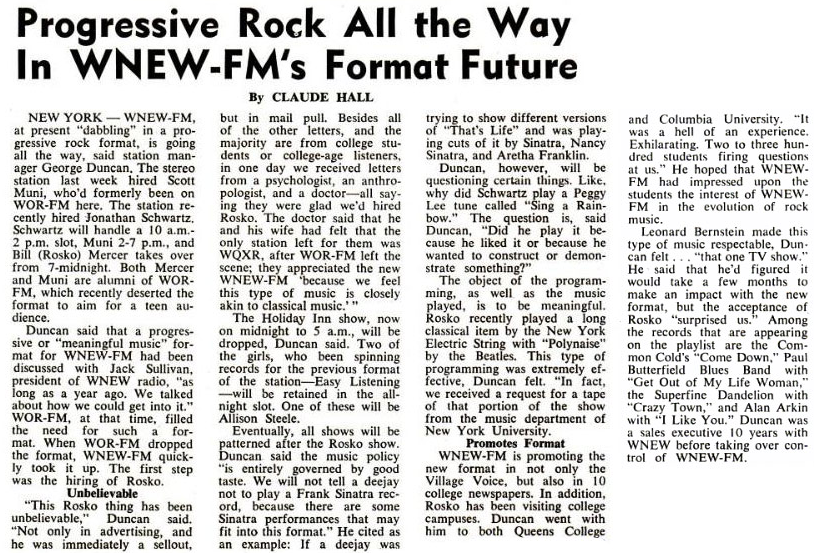
WNEW-FM's early programming also included an automated middle-of-the-road format, followed quickly by a ten-month-long period (July 4, 1966, to September 1967) playing pop music—with an all-female air staff. The gimmick was unique and had not before been attempted anywhere in American radio. The lineup of disc jockeys during this stunt included Margaret Draper, Alison Steele (who stayed on to become the "Night Bird" on the AOR format), Rita Sands, Ann Clements, Arlene Kieta, Pam McKissick, and Nell Bassett. The music format, however, was a pale copy of WNEW (AM)'s adult standards format and only Steele, Sands, and Bassett had broadcast radio experience. The all-female disc jockey lineup endured for more than a year, changing in September 1967 to a mixed-gender staff.

Billboard - December 1967


On October 30, 1967, WNEW-FM adopted a progressive rock radio format, one that it became famous for and that influenced the rock listenership as well as the rock industry.


Ed Goodman - KEZK
In 2015…Veteran radio personality (KEZK, KRJY and KSHE-St. Louis, WIOD-Miami) Ed Goodman, who logged almost five decades on the air in St. Louis, died of cancer.