Saturday, November 15, 2025

Radio History: Nov 16


➦In 1896...Jim Jordan, the man behind the iconic radio sitcom Fibber McGee & Molly, was born.

Jim and his wife Marian Jordan got their major break in radio while performing in Chicago in 1924; Jim said he could give a better performance than the singers they were listening to on the radio, and his brother Byron bet $10 that Jim couldn't do it. By the end of the evening, Jim and Marian had their first radio contract, at $10 per show for 26 weeks as The O'Henry Twins, sponsored by Oh Henry! candy.

He died at the age of 91 in 1988 in Beverly Hills from a blood clot in his brain, caused by a fall.

Mary Margaret McBride

➦In 1899...Mary Margaret McBride was born in Paris, Missouri. She started an advice program on NYC's WOR radio in 1934, and took it national with first CBS in 1937, NBC in 1941, ABC in 1950,and back to NBC 1954-60.  Along the way she mixed in her own unique style interviews with figures well known in arts, entertainment and politics. She died Apr 7, 1976 at age 76.

➦In 1904... John Ambrose Fleming patented the thermionic tube (diode tube) the “kenotron,” a key to developing radio broadcasting.  He was acting as scientific advisor to the Marconi company.

Stan Freberg, Daws Butler

➦In 1916...radio & cartoon voice actor Daws Butler was born in Toledo. He worked on Stan Freberg’s 1957 radio show & his many comedy creations for Capitol records.  On TV he helped voice Beany & Cecil, Woody Woodpecker, Huckleberry Hound, Yogi Bear, The Jetsons, Fred Flinstone & Friends, the Bugs Bunny & Tweety Show, and many others.  He died May 18 1988 at age 71, following a heart attack.

➦In 1940...In Atlanta, the "hillbilly music" show "The WSB Barn Dance" began its 9½-year run.

➦In 1959...National Radio Hall of Famer Harry Harrison debuted on WMCA 570 AM, New York. Here's Harry on WMCA from 1965...

MS NOW Launches


MSNBC, NBCUniversal’s cable news channel, rebrands  to MS NOW starting today, a move that could surprise its loyal viewers despite assurances from hosts that programming and personalities remain unchanged.

Every MSNBC host has repeatedly emphasized in promotional spots, on-air, and in interviews: “We’re not going anywhere and we’re not changing.” Co-host Joe Scarborough stated in a recent Zoom interview, “‘Morning Joe’ will still be ‘Morning Joe.’ Chris Hayes will still be Chris Hayes. Rachel Maddow will still be Rachel. Lawrence O’Donnell will still be Lawrence.”

No programming changes are planned, but the rebrand tests brand awareness in a fractured media landscape. MSNBC retained its name for 29 years, even after Microsoft exited its stake.

MS NOW stands for “My Source for News, Opinion and the World.” The rebrand stems from the progressive network’s spin-off into Versant, a new company also including CNBC, USA Network, Oxygen, E!, and Golf Channel. 

Parent Comcast announced this last year to separate from cable’s decline and boost its stock; Versant becomes publicly traded in January.

The shift separates MSNBC from NBC News, which ran it since 1996. Though Versant initially planned to keep the name, NBCUniversal sought to detach its brand from a channel it no longer controls.

Versant executives may eye Nielsen ratings nervously post-launch, but Julie Doughty, regional executive director of naming and verbal identity at Landor, calls the change minor, predicting quick consumer adjustment.

Industry Forecast Signals Optimism Amid Ad Challenges


U.S. radio broadcasters, grappling with persistent ad market softness, found a dose of "rugged optimism" at the Forecast 2026 conference this week at New York City's Harvard Club, where executives from Cox Media Group, Nexstar Media Group, and the National Association of Broadcasters (NAB) rallied around the medium's irreplaceable community roots as a defense against Big Tech's algorithmic dominance. 

Co-chaired by Cox Media Group Radio President Rob Babin and Nexstar Networks President Sean Compton, the sold-out event—produced by Radio Ink and Radio + Television Business Report—drew C-suite leaders, Wall Street analysts, and policymakers for unfiltered sessions on revenue trends, regulatory hurdles, and digital pivots. 

Opening remarks from Radio Ink President Deborah Parenti framed the day's theme: In an era of AI-driven disruption and economic uncertainty, radio's authentic, local voices—trusted by 84% of listeners per Audacy data—remain a competitive moat that platforms like Meta and Google can't replicate.

A standout session zeroed in on Gen Z's evolving media habits, backed by a November 2025 CivicScience study revealing that 68% of 18- to 24-year-olds crave "honest and conversational" news formats—unscripted, relatable narratives that echo a casual chat rather than scripted broadcasts. 

This preference dovetails perfectly with radio's strengths: 93% of young adults value factual accuracy and honesty in journalism (per Pew Research), qualities local stations deliver through on-the-ground reporting on everything from school boards to traffic snarls. 

Broadcasters were urged to amplify this edge via bite-sized audio extensions—5- to 15-minute podcasts, TikTok voiceovers, and Reels-style clips repurposed from air shifts—to snag Gen Z's fragmented attention. 


Edison Research data shared at the conference showed under-30 podcast listenership up 12% year-over-year, with local news pods boasting 20% higher retention than national fare. As one attendee quipped, "Gen Z isn't anti-audio; they're anti-artifice—radio's neighborhood reporters are the authenticity hack we've been waiting for." 

Yet, challenges persist: Offline media like radio reaches just a sliver of Gen Z directly (per Statista), often via car commutes or parental exposure, underscoring the need for aggressive digital bundling to bridge the gap. 

CivicScience also noted genre shifts, with comedy, true crime, and pop culture pods gaining 2 percentage points since 2024, while news/politics dipped amid post-election burnout—hinting at opportunities for lighter, community-tied content to ease listeners into heavier topics.


The conference's bullish bent was reinforced by S&P Global's October 2025 Broadcast Outlook, which anticipates a 3-5% lift in non-political ad spending for H2 2025, thanks to normalized comps sans the 2024 election's $2.5 billion windfall and rising over-the-air (OTA) sports integrations. S&P projects radio's total ad revenue stabilizing at $11.24 billion for 2025 (down slightly from 2024's political-fueled peak), with digital channels—podcasting, streaming, and connected audio—surging 6.5% to $1.75 billion, en route to $2.31 billion by 2030.

Overall, S&P envisions radio hitting $4.2 billion in annual ad revenue by year-end, buoyed by a 22% podcast ad boom crossing $1 billion—provided stations hybridize linear with CTV and voice tech. BIA Advisory Services echoed this, forecasting OTA radio revenue up 1.83% in 2026 (reversing 2025 dips) and digital climbing 5.01%, fueled by midterm political spends projected at billions across 36 gubernatorial and 33 Senate races. 

15 Day Blackout Ends: Disney, YouTubeTV Make Nice


Disney's networks, including ESPN and ABC, are returning to YouTube TV for about 10 million subscribers after a 15-day dispute.

The multiyear deal restores access immediately and adds Disney's new ESPN Unlimited streaming service to the lineup.

Such programmer-distributor clashes are routine but rarely escalate to blackouts—yet this one pitted two media giants against each other in a heated feud. Both accused the other of bad-faith bargaining and misleading the public.

Talks stalled over Disney's demands for higher carriage fees on ESPN and other channels, versus YouTube TV's push for customer-growth-based pricing adjustments.

YouTube TV also claimed Disney favored its own services like Hulu + Live TV with sweeter terms, which Disney denied, insisting YouTube TV had spurned deals accepted by peers of similar scale.

The outage stung both: ESPN and ABC viewership dipped, while YouTube TV lost subscribers to rivals and issued $20 blackout credits to retain others.


Key elements of the agreement include:
  • Carriage of Disney’s full linear portfolio including all the ESPN networks, ABC, the Disney-branded channels, Freeform, the FX Networks, and the National Geographic channels
  • ESPN’s new direct-to-consumer service (Unlimited Plan) to be made available at no additional cost to YouTube TV subscribers
  • Access to a selection of live and on-demand programming from ESPN Unlimited inside YouTube TV
  • Select networks to be included in various genre-specific packages
  • The ability to include the Disney+, Hulu Bundle as part of select YouTube offerings
“This new agreement reflects our continued commitment to delivering exceptional entertainment and evolving with how audiences choose to watch,’’ said Disney Entertainment Co-Chairmen Alan Bergman and Dana Walden and ESPN Chairman Jimmy Pitaro. “It recognizes the tremendous value of Disney’s programming and provides YouTube TV subscribers with more flexibility and choice. We are pleased that our networks have been restored in time for fans to enjoy the many great programming options this weekend, including college football.”

Brendan Carr Says 'No' To Ending FCC's News Distortion Policy


FCC Chairman Brendan Carr on Friday, rejected a bipartisan petition to repeal the agency’s long-dormant “news distortion” policy, responding with a blunt “How about no” on X.

The petition, filed November 13 by seven former FCC chairs and commissioners—five Republicans and two Democrats—urged full repeal, calling the policy unconstitutional, outdated, and ripe for partisan abuse. Signers included Reagan-era chairs Mark Fowler and Dennis Patrick, Obama-era chair Tom Wheeler, and others spanning 1981–2017.

Carr has revived the policy to target perceived bias in major networks, citing complaints against CBS’s 60 Minutes (Kamala Harris interview editing), ABC’s debate moderation, and Jimmy Kimmel’s monologue. No final rulings have issued, but threats of license revocation have prompted settlements (e.g., CBS parent Paramount paid Trump $16 million) and content changes.

Democratic FCC Commissioner Anna Gomez backs the petition, warning the vague rule chills speech. Senate oversight is set for December 17, 2025; legal challenges may follow if the FCC ignores the plea.

The policy, dormant for decades, bars deliberate staging or slanting of news but clashes with First Amendment protections in today’s multi-platform media landscape.

Key Examples of the Policy's Recent Invocation

The policy's revival under Carr stems from complaints, often filed by conservative groups like the Center for American Rights, targeting mainstream outlets:
  • CBS's 60 Minutes (February 2025): An investigation into alleged deceptive editing of a Kamala Harris interview. This led to a $16 million settlement between CBS parent Paramount and Trump in June 2025, after Trump sued the network.
  • ABC and Jimmy Kimmel (September 2025): Carr cited the policy after Kimmel's late-night monologue suggested the suspect in conservative activist Charlie Kirk's murder was MAGA-linked (contrary to reports). ABC suspended Kimmel briefly, pulled episodes, and faced license revocation threats; the show was reinstated days later.
  • Other Cases: Complaints against ABC over 2024 debate moderation and broader "biased" coverage of Trump, though no final decisions have been issued.
These actions, petitioners claim, create a "chilling effect," prompting networks to alter content to align with administration views.

Trump Deadline For BBC Passes


President Trump declared he has “an obligation” to sue the BBC over a misleading Panorama documentary edit, vowing legal action after the broadcaster’s apology failed to include compensation.

In a November 11, 2025, Fox News interview with Laura Ingraham, Trump said, “I have an obligation to sue the BBC because they defrauded the public with that fake edit,” framing the case as a stand against “fake news.” 

His lawyer demanded a retraction, public apology, and $1 billion in damages by November 14; the BBC apologized and pulled the program but refused payment.

The dispute centers on the October 28, 2024, BBC documentary Trump: A Second Chance?, which aired days before the election and edited Trump’s January 6, 2021, speech to omit context, making “fight like hell” appear as incitement. A leaked internal memo called it an “error of judgment,” triggering resignations of Director-General Tim Davie and News CEO Deborah Turness on November 9.

No lawsuit has been filed as of Friday, but Trump signals readiness to proceed in Florida state court, citing “actual malice.” The case fits his pattern of media suits, with over $80 million in prior settlements directed to his presidential library. Legal experts note jurisdiction and malice hurdles, while the BBC defends its journalism amid UK funding debates.

Morgan Freeman Slams AI Voice Clones


Morgan Freeman, the 88-year-old Oscar-winning actor, expressed frustration over unauthorized artificial intelligence (AI) recreations of his iconic voice, stating in a Guardian interview that his legal team is already handling multiple cases. 

"I'm a little PO'd, you know," Freeman said, emphasizing that such uses feel like "robbing" him as an actor by denying him compensated opportunities. When asked about the number of ongoing disputes, he replied bluntly: "Many, yeah. Quite a few," adding that his lawyers have been "very, very busy" removing these deepfakes from the internet.

Freeman made these comments while promoting his latest film, Now You See Me: Now You Don't—the third installment in the magic-heist franchise where he reprises his role as the sharp-tongued Thaddeus Bradley. The interview, conducted amid his press tour, also touched on broader AI concerns in Hollywood, including Freeman's strong opposition to posthumous voice replication. 

Morgan Freeman
He specifically criticized the late James Earl Jones' decision to license his Darth Vader voice to Lucasfilm for AI use before Jones' death in September 2024, calling it a practice he personally rejects. 

"I'm like any other actor: Don't mimic me with falseness," Freeman declared, underscoring his belief that AI imitations erode authenticity and performers' rights.

His voice—honed through diction training at a Los Angeles community college and famously used in films like The Shawshank Redemption (narrator), Bruce Almighty (God), and documentaries such as March of the Penguins—has become a prime target for AI exploitation in commercials, scams, and online content.

Freeman's remarks echo growing industry backlash against generative AI, which actors' unions like SAG-AFTRA have decried as a "plagiarism machine" trained on copyrighted material without consent. While some stars, like George Clooney, have called AI a "genie out of the bottle," Freeman's proactive legal approach highlights the ethical and financial stakes for voice artists in the AI era. 

No specific details on the lawsuits' targets or outcomes have been disclosed, but Freeman's comments signal an ongoing fight to protect his likeness.

McGraw Milhaven to Host Nationally Syndicated America at Night


Cumulus Media’s Westwood One has announced McGraw Milhaven, the acclaimed morning radio talk show host at KTRS-AM in St. Louis, Missouri, will take the helm of the nationally syndicated program America at Night, beginning December 1st.

Broadcast live weeknights from 9:00 pm to midnight ET, America at Night will feature Milhaven’s signature blend of engaging interviews, sharp commentary, and dynamic listener interaction. Following in the footsteps of talk radio legends Jim Bohannon and Larry King, Milhaven brings a fresh voice and seasoned perspective to the national stage.

McGraw Milhaven
Milhaven will succeed Rich Valdes.  Covering everything from politics and current events to sports and entertainment, Milhaven will ask the questions people want answered—delivering a nightly mix of news analysis, candid conversations with newsmakers, and interactive discussions that keep audiences informed and engaged.

“I’m deeply grateful to Westwood One for entrusting me with America at Night — a show that builds on a proud tradition of engaging listeners during one of radio’s most meaningful times. It’s both an incredible honor and a profound responsibility,” said Milhaven. 

“From listening to Larry King and Jim Bohannon in high school — too intimidated to call in — to now being named host of this show, this journey has exceeded anything I could have imagined. My nightly mission is simple: to seek out great stories from great storytellers — and to share a few of my own along the way.”

“McGraw Milhaven is a trusted voice with a remarkable ability to connect with listeners,” said Collin Jones, President of Westwood One and EVP of Corporate Strategy and Development. “His deep understanding of the issues, combined with his engaging style and journalistic integrity, make him the ideal host to lead America at Night into the future, carrying forward the spirit and tradition of this iconic daypart. We’re thrilled to welcome McGraw to the Westwood One family and excited for the energy and insight he’ll bring to the national conversation each night.”

NYC Radio: 77WABC Presents “The Future of NYC”


New York City is about to go through one of the most transformative times in its history. What’s in store for the 8 ½ million people who call the Big Apple home when Mayor Elect Zohran Mamdani takes office? Mamdani, who identifies as a socialist Democrat, takes the lead in America’s largest city on January 1st. Will it bring prosperity or catastrophe?

Zohran Mandani
77WABC will ask these questions and more during a live press conference on Monday, November 17, at 11am, in Studio 77, the iconic radio station’s state-of-the-art audio/video facility. Participants in this riveting and revealing discussion include some of New York City’s most respected political and business leaders, including billionaire businessman John Catsimatidis, former Governor David Paterson, political activist Fernando Mateo, President of the Partnership for NYC Kathryn Wylde, and more on what they foresee for the next four years and beyond. 

77WABC on-air personality and former City Hall reporter Dominic Carter will host the discussion.

“Our goal is to present all sides and let the public decide,” stated Catsimatidis, owner of 77WABC. “People are concerned, and we will explore all the topics that are on New Yorker’s minds. We’ve gathered a diverse group of leaders to share their predictions for the future of the city we all love.”

Bakersfield Radio: Connoisseur Spins Off Cluster


Connoisseur Media has agreed to sell its four-station Bakersfield, CA cluster—KLLY-FM, KKBB-FM, and KNZR-AM & FM—to locally owned Frequency Broadcasting, operated by Kaitlyn and Danny Hill, with the deal pending FCC approval and expected to close early next year.

The sale follows Connoisseur's September acquisition of multiple markets from Alpha Media, prompting CEO Jeff Warshaw to explain that "Bakersfield was a market that did not fit into the long-term plans we have for Connoisseur." 

He praised Frequency as a local operator able to "devote the time and energy that Bakersfield deserves."

Frequency already owns two Bakersfield stations—Outlaw Country 95.9 FM/1140 AM and Rewind 98.1 FM/93.5 FM—and the Hills expressed excitement about expanding in their hometown, noting they had been in discussions with Connoisseur prior to the Alpha deal.

Wilkinson Barker Knauer, LLP represented Connoisseur, while Smithwick & Belendiuk, P.C. advised Frequency Broadcasting.

Radio History: Nov 15

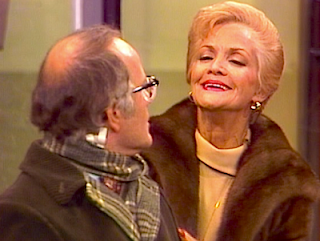
➦In 1919...actress Carol Bruce was born in Great Neck NY. She is best remembered as the domineering station owner Mother Carlson in the sitcom WKRP in Cincinnati. She also had recurring roles in General Hospital & Knot’s Landing. She died from chronic obstructive pulmonary disease Oct. 9 2007 at age 87.

➦In 1921...Westinghouse signed-on KYW in Chicago.

At first, it was jointly operated by Westinghouse and Commonwealth Edison, with Westinghouse later taking over as sole operator.

In 1927, Westinghouse affiliated its four radio stations (KYW, KDKA in Pittsburgh, WBZ in Springfield and WBZA in Boston) with the National Broadcasting Company's (NBC) Blue Network, originating from WJZ in New York City, which had been transferred from Westinghouse to the Radio Corporation of America (RCA) in 1923. Westinghouse had been a founding partner of RCA, NBC's original parent company.

In 1923, Westinghouse established a station, KFKX in Hastings, Nebraska, located near the center of the country. The station was designed to serve a dual purpose, of providing an agricultural service, and for testing the practicality of using shortwave transmitters to link together radio networks, with KFKX receiving much of its programming by shortwave from KDKA in Pittsburgh. In 1928 the project was abandoned, although it was announced that the KFKX programming was being consolidated with KYW.

Westinghouse now controlled two stations in addition to KYW in the Chicago area: KFKX and WEBH. On September 1, 1928 the Federal Radio Commission (FRC) ordered that their operations should be consolidated.  WEBH was deleted, and the two stations were merged, with a dual call letter assignment of KYW-KFKX, although the latter call sign would be rarely if ever used. On May 15, 1933, after the FRC requested that stations using only one of their assigned call letters drop those that were no longer in regular use, KFKX was eliminated and the station reverted to just KYW.

Under the provisions of the FRC's General Order 40, a sweeping reallocation of station frequency assignments was implemented on November 11, 1928. KYW was assigned to the clear channel frequency of 1020 kHz. However, under the provisions of the "Davis Amendment", eight clear channel frequencies were to be allocated to each of five national regions. Chicago was located in Region 4, while the reallocation provisions had reserved 1020 kHz for use in Region 2, a grouping of mid-Atlantic states.
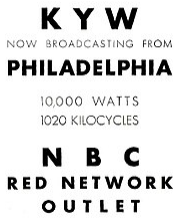
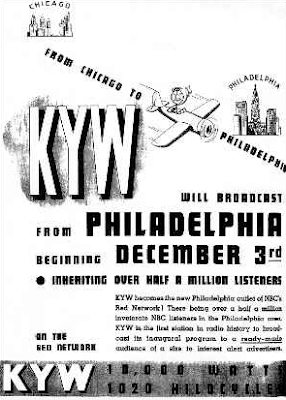
1934 Ad
Westinghouse fought a long legal battle, attempting to keep KYW operating as a clear channel station on 1020 in Chicago. Finally it proposed moving the station to a Region 2 location, settling on Philadelphia.

After broadcasting its last program in Chicago on December 2, 1934, KYW aired its debut Philadelphia program the next day.  The move made KYW the easternmost U.S. radio station with a call sign beginning with "K".  KYW became Philadelphia's NBC-Blue Network outlet, an affiliation that lasted 20 years.

On March 29, 1941, KYW's clear channel assignment was shifted from 1020 to 1060 kHz, its current frequency, as part of a nationwide adjustment of assignments engineered by the North American Regional Broadcasting Agreement (NARBA).

KYW acquired a television counterpart in 1953, when Westinghouse bought Channel 3 WPTZ (now KYW-TV), the nation's third commercial television station and NBC's second television affiliate.[18]

In June 1955, Westinghouse agreed to trade 1060 KYW and TV Channel 3 WPTZ to NBC, in exchange for the NBC's Cleveland properties: 1100 WTAM, 105.7 WTAM-FM and Channel 3 WNBK. Westinghouse also received $3 million in cash compensation. The main impetus for the trade was NBC's desire to acquire an owned-and-operated TV station in the fourth-largest American television market. NBC had to receive a waiver for the swap because 1060 KYW and NBC Radio's New York City flagship, 660 WRCA (now WFAN) were both clear channel stations. At the time, the FCC normally did not allow common ownership of clear channel stations with overlapping nighttime coverage. After clearing the final regulatory hurdles, the swap went into effect on January 22, 1956.

On February 13, NBC changed KYW's call letters in Philadelphia to WRCV (for the RCA-Victor record label). At the same time, Westinghouse changed the call letters of its new Cleveland station from WTAM to KYW.  The Westinghouse-NBC station swap, and its subsequent reversal nine years later, resulted in two alternate ways to recount KYW's history. In the records of the FCC, the station in Philadelphia on 1060 kHz merely underwent two call letter and ownership changes, taking place in 1956 and 1965. However most KYW histories follow the path of the call letters, and refer to KYW moving from Philadelphia to Cleveland in 1956, then returning to Philadelphia nine years later.

Almost immediately after the NBC-Westinghouse trade was finalized, Westinghouse complained to the FCC and the United States Department of Justice that it had been coerced into making the station swap, including a threat by NBC to revoke Westinghouse's NBC-TV affiliations. A lengthy investigation was launched. In September 1959 the Justice Department issued a decision which, in part, instructed NBC to divest WRCV-AM-TV by the end of 1962. Several months later in early 1960, NBC announced it would trade its Philadelphia stations to RKO General in exchange for that company's Boston outlets. That proposed station swap was held up for nearly four years until the FCC issued a final decision in August 1964. The Commission renewed NBC's licenses for WRCV radio and television, on the condition that the 1956 station swap with Westinghouse be reversed. RKO General initially contested the FCC's decision, but soon gave up its efforts and bowed out of the competition.  Following nearly a year of appeals by NBC, Westinghouse regained control of WRCV-AM-TV on June 19, 1965 and subsequently restored the KYW call letters to the radio station.

Today, KYW is owned by Audacy and has been airing an All-News format since 1965.

➦In 1926...The National Broadcasting Company (NBC) began broadcasting comprised of a network of 24 radio stations.

Friday, November 14, 2025

SLC Radio/TV: More Layoffs Reported At KSL


KSL TV/AM/FM Salt Lake City laid off 30 employees Thursday, as part of a restructuring that reunites its broadcast and digital divisions, ending a 16-year separation of operations.

The cuts, confirmed by an internal memo from General Manager Tanya Vea, affected staff in news, sales, engineering, and marketing. 

At least five on-air reporters were among those let go, including Lindsay Aerts, Ashley Fredde, Lauren Steinbrecher, Dan Spindle, and Hugo Rikard-Bell. Vea cited “economic headwinds” and the need to prepare for 2025 as reasons for the consolidation.

Owned by Bonneville International, KSL (NBC affiliate) had operated its digital arm (KSL.com) separately since 2009 under Deseret Digital Media. The new structure places all platforms—TV, radio, and digital—under unified leadership to streamline content and technology use.

KSL's official statement framed the changes positively: "In an ever-evolving media landscape, this unification will position KSL to continue to leverage the best technologies available and to deliver the highest quality content across the state."

This marks the second round of layoffs in a year at KSL. The company described the move as essential to remain competitive in a shifting media landscape, while former staff and local observers expressed concern over reduced local journalism capacity, especially in political and community coverage.

KSL remains a dominant broadcaster in Utah, but the cuts reflect broader industry challenges, including declining ad revenue and digital disruption.

These cuts highlight ongoing consolidation in Utah's news ecosystem, following similar reductions at The Salt Lake Tribune (38% of newsroom staff in 2024) and other Bonneville properties. While KSL remains a top-rated station, the layoffs could strain its ability to cover state-specific stories amid growing national polarization.

BBC Issues Formal Apology to President Trump


The BBC issued a formal apology to U.S. President Donald Trump on Thursday, for a misleading edit in its October 2024 Panorama documentary "Trump: A Second Chance?" that spliced excerpts from his January 6, 2021, speech, creating the false impression of a direct call for violence.

The broadcaster, however, firmly rejected Trump's demands for compensation and a full retraction, stating there is "no basis for a defamation claim" and committing only to withdrawing the program from rebroadcast.

The controversy erupted after Trump's lawyers sent a cease-and-desist letter on November 10, 2025, threatening a $1 billion lawsuit unless the BBC complied by Friday.

The letter accused the documentary of "false, defamatory, disparaging, and inflammatory statements" that caused "overwhelming financial and reputational harm."

In response, BBC Chair Samir Shah personally wrote to the White House expressing regret, while the corporation's legal team emphasized the edit was an "unintentional error of judgment" intended to illustrate the speech's reception among supporters, not to alter its meaning.

The edited clip combined phrases from nearly an hour apart in Trump's Ellipse speech—"We're going to walk down to the Capitol... and if you don't fight like hell, you're not going to have a country anymore"—making it appear as one continuous incitement, just before the Capitol riot.

The BBC acknowledged this "mistaken impression" in a correction note but defended its broader journalism, including U.S. election coverage, against Trump's wider allegations of bias.

The scandal has plunged the BBC into crisis, triggering the resignations of Director-General Tim Davie and News CEO Deborah Turness on November 10, who cited accountability for the "error" amid an internal review criticizing Gaza, Trump, and other coverage.

Legal experts predict Trump faces steep challenges in a potential U.K. or Florida suit, given his 2024 reelection undermines harm claims, and the BBC's partial concessions may defuse the dispute without payment.

Trump has not publicly responded to the apology. The BBC is also probing a similar 2022 Newsnight edit of the same speech. 

FCC Petitioned to Stop Threatening `Broadcaster's Free Speech'


Seven former FCC chairs and commissioners, including five Republicans, have filed a petition urging the agency to immediately rescind its decades-old "news distortion policy." The group argues the rule—dating back to 1949—violates First Amendment protections by enabling government censorship of broadcast news, chilling free speech, and inviting partisan abuse. 

This urgent call comes amid recent threats by FCC Chairman Brendan Carr against major networks like ABC and CBS for content critical of President Donald Trump, highlighting the policy's weaponization in today's polarized media landscape.

The petition, submitted by advocacy groups Protect Democracy and TechFreedom alongside consumer advocates Gigi Sohn and Andrew Jay Schwartzman, unites officials who served from 1981 to 2017 despite their differing views on other issues. 

Mark Fowler
Signatories include former FCC Chair Mark Fowler (R, 1981-1987), who stated, "The news distortion policy allows the government to threaten censorship of speech it doesn’t like; it cannot stand." 

Other commissioners listed are Andrew Barrett, Rachelle Chong, Ervin Duggan, Dennis Patrick, and Alfred Sikes, plus senior staffers Christopher Wright, Kathryn Brown, Jerald Fritz, and Peter Pitsch.

At its core, the policy empowers the FCC to investigate and potentially revoke broadcast licenses for "willfully distorting" news through fabrication, staging, or deliberate misrepresentation—powers rooted in the Communications Act's public interest standards. However, the petitioners contend it's obsolete in a digital era with abundant media sources and conflicts with landmark Supreme Court rulings like CBS v. Democratic National Committee (1973), which barred government interference in editorial judgments. They warn it imposes the FCC's subjective "vision of what presentation of the news is correct," directly contradicting First Amendment prohibitions on viewpoint discrimination.

Holiday Hits Drive Emotional Engagement

Santa Spins the Holiday Hits at iHM's KOST

98% of holiday music listeners say broadcast radio ignites their festive spirit, and 90% report it directly fuels excitement for shopping, according to a new national study from iHeartMedia and Critical Mass Media released ahead of the 2025 holiday season. 

The research underscores radio’s outsized role in driving both emotional engagement and consumer spending during the critical Q4 retail period.

Key findings reveal that 83% of listeners consider hearing Christmas music on the radio as the official signal to begin holiday shopping. This emotional trigger translates into tangible business impact: 75% say they’re more likely to purchase from a brand advertised on their favorite holiday station, while 80% are more inclined to support companies that contribute to the seasonal atmosphere through music programming. 

Another 80% confirm they’re more receptive to radio advertising during the holidays than at any other time of year.

The study, based on a survey of over 1,000 U.S. adults who actively listen to holiday music stations, highlights how audio creates a unique “nostalgia loop.” Listeners report tuning in for warm, comforting, and joyful feelings—emotional states that deepen brand recall and strengthen purchase intent. Nearly 9 in 10 say the music connects them to cherished memories, family traditions, and cultural rituals, making radio a powerful context for brand integration.

“Holiday radio isn’t just background noise—it’s a cultural cue and a commercial catalyst,” said Gayle Troberman, Chief Marketing Officer at iHeartMedia. “When consumers hear ‘Jingle Bells’ or ‘All I Want for Christmas Is You’ on their trusted local station, it doesn’t just put them in a good mood—it puts them in a buying mood.”

With over 500 iHeartMedia stations flipping to all-Christmas formats as early as mid-November—joined by hundreds more independent and network affiliates nationwide—holiday radio reaches tens of millions of listeners. The format dominates in-car listening, where 70% of holiday music consumption occurs, giving advertisers unmatched access to consumers during commute, errand, and travel moments.

For marketers, the implications are clear: contextual alignment with holiday music drives favorability and sales lift. Brands that sponsor playlists, jingle integrations, or festive station events see higher trust and loyalty. The study also found that station-branded holiday content—such as “12 Days of Christmas Giveaways” or local toy drives—further amplifies goodwill and purchase influence.

AM Radio in Cars Gains Momentum


Broadcasters received “very promising news” at the Forecast 2026 conference on November 12, 2025, that the bipartisan AM for Every Vehicle Act of 2025 is gaining traction to mandate AM radio in all new U.S. vehicles, a move seen as critical for emergency alerts and rural access.

Held at the Harvard Club in New York, the panel—moderated by Radio Ink’s Cameron Coats and featuring Cox Media Group’s Alysia Long—delivered real-time updates on the bill (S. 315/H.R. 843), reintroduced in February by Senators Ed Markey (D-MA), Ted Cruz (R-TX), Jacky Rosen (D-NV), and Jerry Moran (R-KS). 

The legislation would require the Department of Transportation, in coordination with the FCC and FEMA, to finalize rules within one year to keep AM receivers standard in passenger vehicles at no extra cost to consumers.

Long emphasized AM’s unmatched role in disaster response—unaffected by cell network failures—and its reach to over 20% of rural Americans without broadband. She warned that without action, AM’s presence in vehicles could vanish by 2030, threatening 80 million weekly listeners and $1.5 billion in annual ad revenue.

The push coincides with the FCC’s 2022 Quadrennial Regulatory Review and its “Delete, Delete, Delete” deregulation initiative, launched in March 2025 under Chairman Brendan Carr. Broadcasters are using both proceedings to advocate for relaxed ownership and technical rules to modernize AM infrastructure, including FM translators and all-digital upgrades.

Eight major automakers, including Ford, GM, and Volkswagen, have already removed or plan to drop AM from EVs due to signal interference from high-voltage batteries. The Consumer Technology Association opposes the mandate, calling AM outdated and warning of innovation setbacks and potential price hikes.

Despite resistance, the bill has cleared Senate committee and could advance in the lame-duck session, possibly bundled with infrastructure or defense legislation. A GAO study on alternatives like satellite alerts is due in 2026.NAB CEO Curtis LeGeyt framed the stakes at Forecast: “Lose AM in cars, and we lose the battle for broadcast’s soul.”

Paramount, Comcast, Neflix Reportedly Prepping Bids for WBD


Warner Bros. Discovery (WBD) has launched a formal auction with a deadline for first-round bids on November 20, 2025, aiming to complete a sale or split by year-end, as Paramount, Comcast, and Netflix prepare competing offers.

Paramount, backed by Skydance, seeks the entire company—including studios, HBO Max, and cable networks like CNN and TNT—to create a global streaming giant with ~30 films annually. It has submitted three prior unsolicited bids, the latest at $23.50 per share in cash, and could go hostile if rejected again.

Comcast targets only the high-value streaming and studio assets, including HBO Max and Warner Bros. film/TV production, to bolster Peacock after spinning off cable networks. CEO Brian Roberts has met with WBD’s David Zaslav and is exploring options via advisors.

Netflix, advised by Moelis & Co., also focuses on studios and HBO Max to secure premium IP like Game of Thrones and DC franchises, but faces intense global antitrust scrutiny as the dominant streamer.

WBD initiated the process after rejecting Paramount’s earlier offers and was already planning to split into streaming/studios and cable units. Shares rose 3–5% in after-hours trading on November 13 following the auction news.


The auction reflects media consolidation amid streaming competition with tech giants. If no full buyer emerges, WBD will proceed with its planned breakup.

Disney Warns Of Potentially Long Dispute


Walt Disney Co. warned investors Thursday, that its carriage dispute with YouTube TV could drag on for months, sending shares down as much as 9.3% in a single session and wiping out billions in market value.

The blackout began October 30, 2025, pulling ABC, ESPN, FX, and other Disney channels from YouTube TV’s roughly 10 million U.S. subscribers. 

Bob Iger
CEO Bob Iger and CFO Hugh Johnston told analysts the company is demanding “fair rates” and has hedged its forecasts for a prolonged standoff, with YouTube TV rejecting terms Disney calls “equal to or better” than deals with other large distributors.

Disney’s stock (DIS) closed down 6–8% at about $105.84, overshadowing Q4 earnings that beat EPS estimates ($1.11 vs. $1.05 expected) but missed on revenue ($22.46 billion). Traditional TV profit fell 21% to $391 million, while streaming profit rose 39% to $352 million. 

The dispute—YouTube TV’s fourth major blackout since August—highlights escalating tensions over carriage fees as cord-cutting accelerates. Analysts estimate Disney loses $4.3 million daily, or $60 million over two weeks. Consumers miss NFL games, college football, and ABC shows like High Potential, with no resolution in sight.

Disney remains focused on streaming (150+ million global subscribers) and plans an ESPN standalone launch in 2026, while exploring AI tools for Disney+.

WaPo Podcasts Partners With Triton Digital


Triton Digital has entered a strategic multi-year partnership with The Washington Post to fully power the publisher’s expanding digital audio ecosystem, encompassing podcast distribution, programmatic and direct monetization, and advanced audience measurement.

The agreement integrates Triton’s comprehensive technology suite—including the Triton Ad Platform, Triton Audio Marketplace, Demos+ demographic targeting, and Podcast Metrics—into The Post’s audio operations. This enables seamless scaling of its award-winning podcasts such as Post Reports, The Daily 202, and narrative series across major listening platforms.

The partnership marks a significant step in The Washington Post’s audio-first strategy, which has seen over 50% year-over-year growth in podcast listenership since 2023. 

By leveraging Triton’s infrastructure, The Post gains:
  • Global distribution to all major podcast directories and smart speakers
  • Programmatic ad sales with real-time bidding and private marketplace deals
  • Precision targeting via Demos+ (age, gender, income, and behavioral insights)
  • IAB-certified measurement through Podcast Metrics for verified downloads and audience demographics
“We’re thrilled to partner with The Washington Post, a brand synonymous with journalistic excellence, as they deepen their investment in audio storytelling,” said John Rosso, President and CEO of Triton Digital. “This collaboration combines premium content with best-in-class technology to drive reach, engagement, and revenue at scale.”

For advertisers, the deal unlocks access to The Post’s highly engaged, affluent audience—over 70% of whom are college-educated and 60% earn $100K+ annually—within a trusted news environment. 

The Washington Post has aggressively expanded its audio slate in recent years, launching live audio events, subscriber-exclusive episodes, and video podcasts on YouTube and Spotify. The Triton integration ensures these formats are fully monetizable and measurable across platforms.

The partnership comes as podcast ad spending is projected to surpass $2.5 billion in the U.S. in 2025, with news and politics remaining top-performing genres. For The Post, aligning with Triton positions it to capture a larger share of brand safety-conscious budgets while maintaining editorial independence.

Rick Dees Honored as 2025 Giant of Broadcasting

The Library of American Broadcasting Foundation (LABF) celebrates Rick Dees, the legendary radio host who dominated Los Angeles airwaves for over two decades, as a 2025 Giant of Broadcasting & Electronic Arts. 

Rick Dees
The accolade underscores his transformative impact on media through decades of innovation, entertainment, and cultural influence, with unparalleled achievements that elevated local radio to global heights and reshaped pop culture along the way. The awards ceremony and luncheon will be held Friday, November 14, at Gotham Hall in New York City.

Rick’s career exploded with the 1976 Grammy-nominated smash hit "Disco Duck," the multi-platinum phenomenon selling well over six million copies worldwide, securing a People's Choice Award, and reaching number one on the Billboard Hot 100—cementing his place as a Platinum Recording Artist.

After arriving in Los Angeles, Dees immediately began redefining morning radio. He transformed KIIS-FM into both the nation's highest-rated and highest-revenue-producing station, delivering extraordinary financial success to the group during his iconic tenure. He launched the Rick Dees Weekly Top 40, syndicating it globally and reaching millions as a true global phenomenon with its hit music and infectious energy. 

The Early Years
A 10-time consecutive Billboard Radio Personality of the Year winner, Marconi Award recipient, National Radio Hall of Fame inductee, and Hollywood Walk of Fame star holder, Dees remains a trailblazing entrepreneur and voice-over artist today, continuing to innovate through his Rick Dees Hit Music app—a brand expansion platform that harnesses the universal power of music to connect and engage on a visceral level—and inspiring even more new ventures that bridge generations and cultures.

"Los Angeles was where the magic truly amplified, turning my passion into a beacon for music lovers everywhere," Dees reflected. "This Giants recognition celebrates all that made it happen. My love for L.A. and Hollywood's heartbeat will always pulse strong in everything I do."

Dees joins an illustrious 2025 class including award-winning actor and producer Kelsey Grammer; ABC News anchor and managing editor David Muir; retired TEGNA Inc. executive vice president Lynn Beall; communications attorney John R. Feore, Jr.; retired Cox Radio Group executive vice president Dick Ferguson; acclaimed actor Gary Sandy, best known for WKRP in Cincinnati; and Hall of Fame sportscaster Lesley Visser. ABC News Radio national correspondent Steven Portnoy will receive the LABF Excellence in Broadcast Preservation Award.

R.I.P.: Jim Avila, Veteran ABC, NBC News Correspondent


Jim Avila, a trailblazing senior correspondent for ABC News known for his incisive coverage of White House politics, major trials, and immigration stories, has died after a long illness. He was 69.

ABC News Live anchor Diane Macedo broke the news on air Thursday, describing Avila's passing as a profound loss for the network and journalism community. ABC News President Almin Karamehmedovic confirmed the death in an internal memo, noting Avila succumbed on Wednesday following health challenges that included a kidney transplant donated by his brother in 2020.

 Karamehmedovic praised Avila as a "gifted journalist and generous colleague" who faced his battles with courage, extending condolences to his three children—Jamie, Jenny, and Evan, the latter a journalist himself—and his family.

Avila's career spanned nearly four decades, marked by high-stakes reporting under relentless deadlines. He joined ABC News in 2004 as a Los Angeles-based senior correspondent, specializing in politics, justice, law, and consumer investigations. 

As Senior Law and Justice Correspondent, he covered landmark trials including those of O.J. Simpson, Michael Jackson, Jerry Sandusky, and the Penn State scandal. He also anchored World News Tonight Saturday and served as a 20/20 correspondent, delivering stories on immigration from the U.S. southern border and the unrest following Freddie Gray's death in Baltimore.

From 2012 to 2016, Avila reported from the White House, earning the White House Correspondents' Association's Merriman Smith Memorial Award for his exclusive scoop on the U.S. and Cuba reopening diplomatic relations—a moment he broke live on air. 

His earlier work at NBC News, where he was a national correspondent for Nightly News, included on-the-ground reporting from Afghanistan and Iraq, coverage of the 9/11 attacks and D.C. sniper shootings, and anchoring at KNBC in Los Angeles. Avila filed a record 130 reports annually at NBC, the highest for any minority journalist in broadcast history at the time.

Radio History: Nov 14


➦In 1901...singer Morton Downey was born in Wallingford Connecticut. His national radio appearances began in 1930, in 1932 he was voted Radio Singer of the Year. In 1949 he debuted on TV, hosting the show Star of the Family in the 1950′s.

He died of a stroke at age 83, Oct. 25 1985.

➦In 1920...singer Johnny Desmond was born in Detroit.   He was featured on Don McNeill’s Breakfast Club (radio& TV), and was a regular on TV’s Your Hit Parade, Face the Music & Songs for Sale.   He died from cancer Sept. 6 1985 at age 64.

➦In 1921...Chicago radio station KYW broadcast the first opera by a professional company. Listeners heard ‘Samson Et Dalila’ as it was being performed at the Chicago Auditorium.

The first words ever broadcast in Chicago were, "My God, but it's dark in here!"

Mary Gardner
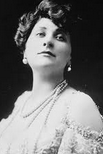
According to radio historian Rich Samuels, they were spoken by Mary Garden, world-class soprano and director of the Chicago Grand Opera Association. They were uttered 98 years ago tonight on radio station KYW, licensed to the Westinghouse Manufacturing and Electric Company.

Ms. Garden said what she said because she couldn't see: the area where she was standing was lit by a single bare light bulb.

In 1934, the assignment of clear channels took a frequency away from Illinois and gave it to Pennsylvania, resulting in Westinghouse moving KYW to Philadelphia.  KYW used the frequency of 1020 AM at the time.

In March 1941, KYW changed frequencies to 1060 AM as part of a nationwide shift of radio frequencies mandated by the North American Radio Broadcasting Agreement. KYW and the other Westinghouse radio stations remained with NBC after RCA was ordered by the FCC to break up its radio networks, aligning with the former Red Network (the predecessor of modern-day NBC) in 1942. KYW acquired a television counterpart when Westinghouse bought WPTZ (channel 3) – the nation's third commercial television station and NBC's second television affiliate – in 1953.

In June 1955, Westinghouse agreed to trade KYW and WPTZ to NBC in exchange for the network's properties in Cleveland, WNBK TV and WTAM-AM-FM. Westinghouse also received $3 million in cash compensation.  The main impetus for the trade was NBC's desire to acquire an owned-and-operated television station in the fourth-largest American television market. NBC had to seek a waiver for the swap since KYW and NBC Radio's New York City flagship, WRCA (now WFAN) were both clear channel stations; at the time, the FCC normally did not allow common ownership of clear-channel stations with overlapping nighttime coverage.

After clearing final regulatory hurdles, the swap went into effect on February 13, 1956. NBC took over the Philadelphia stations, rechristening 1060 AM as WRCV (for the RCA-Victor record label), and Westinghouse moved the KYW call letters to Cleveland.

However, almost immediately after the trade was finalized, Westinghouse complained to the FCC and the Department of Justice about NBC's coercion and an lengthy investigation was launched.  In August 1964, NBC's license for WRCV radio and television was renewed by the FCC – but only on the condition that the 1956 station swap be reversed.  Following nearly a year of appeals by NBC, Westinghouse regained control of WRCV-AM-TV on June 19, 1965 and subsequently restored the KYW call letters to the radio station (the television station became KYW-TV at this point).  To this day, the KYW stations insist that they "moved" to Cleveland in 1956 and "returned" to Philadelphia in 1965.

➦In 1922...The British Broadcasting Corporation (BBC) began its domestic radio service.

➦In 1994...FCC adopted EAS rules.

The Emergency Alert System (EAS) is a national warning system in the United States put into place on January 1, 1997, when it superseded the Emergency Broadcast System (EBS), which in turn superseded the CONELRAD System.

It is jointly coordinated by the Federal Emergency Management Agency (FEMA), the Federal Communications Commission (FCC) and the National Oceanic and Atmospheric Administration (NOAA). The EAS regulations and standards are governed by the Public Safety and Homeland Security Bureau of the FCC.

Thursday, November 13, 2025

NBCUniversal Revives NBC Sports Network


NBCUniversal announced today the revival of its NBC Sports Network (NBCSN), a 24/7 linear cable channel dedicated to premium sports programming, launching exclusively on YouTube TV starting November 17, 2025. 

This marks the network's return after being shuttered in 2021, when its content shifted primarily to the Peacock streaming service and USA Network. The move aims to bridge pay-TV and streaming audiences by aggregating live events from Peacock's sports lineup, including Monday-night NBA games and the "Gold Zone" Olympics whip-around show, providing YouTube TV subscribers immediate access without needing an additional Peacock subscription.

In a statement, Matt Schnaars, president of platform distribution and partnerships at NBCUniversal, emphasized the strategic fit: "NBCUniversal delivers the biggest moments in sports, and the new NBC Sports Network gives pay-TV customers a seamless way to enjoy the wide range of sports in our portfolio, adding an important pillar in our linear and streaming strategy." The channel will roll out to Comcast's Xfinity service shortly after and expand to other pay-TV distributors in the coming months, as part of a broader carriage agreement with YouTube TV that also integrates Peacock into its Primetime Channels lineup.

Key Programming and Content Highlights

NBCSN will focus on high-profile live events that have been streaming exclusives on Peacock, creating a one-stop hub for sports fans on traditional TV platforms. Core offerings include:
  • NBA: Monday-night games, part of NBCU's newly acquired rights.
  • Soccer: Premier League matches, a staple of NBC's sports portfolio.
  • WNBA: Regular-season and playoff coverage.
  • College Football: Big Ten Conference games and Notre Dame matchups.
  • Horse Racing: Kentucky Derby undercard races.
  • Olympics: "Gold Zone" multi-sport highlights, building on Peacock's 2024 Paris Games success.

Upcoming Additions: Expected Major League Baseball games, pending a formal NBC-MLB agreement announcement.

Some premium content, such as a special NFL game and extended Olympics coverage, will remain Peacock exclusives to drive direct-to-consumer subscriptions.