Saturday, August 2, 2025

Radio History: Aug 3


➦In 1902...Ray Bloch born  (Died at age 79  – March 29, 1982). He was a composer, songwriter, conductor, pianist, author and arranger. He is best remembered as the arranger and orchestra conductor for The Ed Sullivan Show during its entire run from 1948 to 1971.
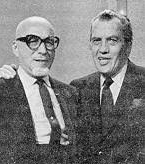
with Ed Sullivan
Bloch and his orchestra were featured on numerous radio variety shows of the late-1930s and 1940s. These included: Johnny Presents (1939-1946), The Gay Nineties Revue (CBS, 1939-1944), Let Yourself Go (CBS, 1944-1945), The Continental Celebrity Club (1945-1946), The Milton Berle Show (NBC, 1948-1949), and The Mary Small Revue (1945).

From 1943 to 1956 Bloch and his orchestra also performed on Here's to Romance, a weekly musical variety show broadcast by the American Forces Network. In 1951 Bloch hosted his own show, The Bloch Party, a 60-minute variety show on CBS Radio featuring Judy Lynn, the Russ Emery Chorus, and the Ray Bloch Orchestra.

The orchestra was a fixture on several game shows, including Take It or Leave It (CBS, 1940-1947). Quick as a Flash (1944–1949) – during which "clues were elaborately dramatized or were musically illustrated by Ray Bloch's orchestra"– and Sing It Again (1948–1951). Bloch also worked on Philip Morris Playhouse (CBS, 1939–1943), and in several Orson Welles drama presentations.

➦In 1907... Irene Tedrow born (Died from a stroke at age 87 – March 10, 1995) was a character actress in stage, film, television and radio.

Irene Tedrow
Among her most notable roles are Janet Archer in the radio series Meet Corliss Archer, Mrs. Lucy Elkins on the TV sitcom Dennis the Menace and Mrs. Webb in the stage production Our Town at the Plumstead Playhouse.

Tedrow's work in radio dated back at least to 1929. As a drama student at Carnegie Institute of Technology, she was master of ceremonies and student director for "Carnegie Tech Day at Gimbel's," which was broadcast on WCAE. A 1937 radio listing shows her as one of the actresses in George Bernard Shaw's Back to Methuselah when it was broadcast on NBC Blue.

During the 1940s and 1950s, Tedrow had quality acting roles in radio productions, including The Baby Snooks Show.

➦In 1918...Actor Larry Haines born (Died at age 90 - July 17, 2008) was an American actor.

Larry Haines
He had been active in dramatics in high school, and while he was in college, he was advised to try acting. After a few months of instruction in dramatics, he passed an audition with CBS radio He dropped out during his sophomore year of college and "went right into radio working on little stations all around New York City," beginning at WWRL.

Haines first became known in the 1930s as an actor on the radio crime series Gangbusters. Playing Joe Lincoln, he was the star of Treasury Agent on the Mutual Broadcasting System in 1947-48, and he had the title role of Mike Hammer in That Hammer Guy on Mutual in 1953-54. He also was featured in The Chase, Cloak and Dagger, Inner Sanctum Mystery, The Man Behind the Gun, and This Is Nora Drake. It was estimated that he acted in more than 15,000 radio programs in the 1940s and 1950s.

Four decades later, he would return to radio, starring in 82 episodes of the CBS Radio Mystery Theater.

WGY Transmitter 1922

➦In 1922...WGY in Schenectady, NY aired the first drama series on radio. The first play was “The Wolf” by Eugene Walter, adapted into a 40-minute radio script by local actor Edward H. Smith. When two 2 X 4’s were slapped together to replicate a door slam, radio sound effects were born.

➦In 1958...Billboard magazine launched its Hot 100 music chart.

➦In 1984...legendary Dick Biondi, joined WJMK-FM, Chicago - an oldies-formatted station.

➦In 1986...William B. Williams died of acute anemia and respiratory failure. (Born - August 6, 1923) He was a disc jockey on New York City radio station WNEW for over four decades hosting the popular program Make Believe Ballroom. Williams is particularly noted for coining the title "Chairman of the Board" for Frank Sinatra.

NFL Deals Red Zone, NFL Media Assets To ESPN


Walt Disney Co. is set to announce that the NFL will acquire an equity stake in ESPN, Disney’s sports media division, according to sources familiar with the matter who were not authorized to speak publicly.

 The announcement is expected during Disney’s earnings call on Wednesday. Neither the NFL nor ESPN provided comments on Friday.

As part of the deal, ESPN is likely to take control of the NFL’s cable assets, including the NFL Network and Red Zone, a channel that provides live updates on Sunday games. The NFL Network holds rights to several late-season regular games. The NFL also owns NFL Films and NFL+, a streaming service for mobile game viewing and related content.

ESPN currently holds broadcast rights to “Monday Night Football” and two Super Bowls under the NFL’s contract through 2033, with a potential renegotiation in 2029. This deal positions the NFL’s other media partners—Fox, NBC, CBS, YouTube, and Amazon—to compete against a Disney entity partially owned by the NFL in future media rights negotiations.

The NFL dominates U.S. TV viewership, per Nielsen, but the rise of streaming has intensified competition for NFL game rights.

In 2022, the NFL granted its Sunday Ticket package to YouTube TV in a seven-year deal, reflecting younger audiences’ shift to streaming. Netflix, the largest subscription-based streaming service, secured Christmas Day game rights, drawing millions of viewers last year as it expands into live programming.

ESPN, the priciest component of the pay TV bundle at nearly $9 per subscriber, is now in 73 million homes, down from 98.5 million in 2013. As streaming overtakes traditional TV—Nielsen reported streaming surpassed broadcast and cable viewing this year—ESPN is launching a $29.99/month standalone streaming service, offering all its channels without a pay TV subscription.

Despite these shifts, ESPN’s TV ratings have risen, and its ad revenue remains robust, as advertisers prioritize live programming audiences.

Corporation for Public Broadcasting Says It's Shutting Down


The Corporation for Public Broadcasting (CPB) announced Friday it will cease operations following a Republican-led campaign to defund local PBS and NPR stations nationwide.

The decision follows President Donald Trump’s signing of a rescissions bill last week, which canceled $9 billion in federal funds, including $1.1 billion allocated to CPB for the next two years.

“Despite the tireless efforts of millions of Americans who advocated to preserve CPB’s federal funding, we must now confront the reality of winding down our operations,” said CPB President and CEO Patricia Harrison in a statement. 

“We are dedicated to meeting our fiduciary duties and supporting our partners with transparency and care during this transition.”

CPB, established over 60 years ago, is prioritizing assistance for local stations facing abrupt budget cuts. 

Harrison cautioned that some stations, especially in rural areas, may close without federal funding.

Since taking office, Trump has prioritized defunding public broadcasters, targeting media outlets he views as unfavorable. He has criticized PBS and NPR, calling them government-funded “left-wing propaganda.” Congress complied with his agenda.

Conservatives, long critical of public media for perceived liberal bias, supported the move.In mid-July, lawmakers passed a “rescission” measure, mostly along party lines, cutting $1.1 billion previously allocated for public broadcasting over two years.

Republicans, led by Trump, have long accused NPR and PBS of liberal bias, a claim intensified by figures like Rep. Marjorie Taylor Greene and former NPR editor Uri Berliner. Trump’s May 2025 executive order, “Ending Taxpayer Subsidization of Biased Media,” directed CPB to halt funding, citing violations of the Public Broadcasting Act’s impartiality clause.

Changing Media Landscape: Critics argue public media is outdated in a streaming era with diverse news options, and taxpayer funds shouldn’t subsidize media. The Cato Institute and others claim rural stations are less necessary with widespread internet access, though advocates counter that public media remains a trusted, free resource.

The rescission was framed as cutting “wasteful” spending to fund priorities like immigration enforcement and tax cuts. House Speaker Mike Johnson called public media funding a “misuse of taxpayer dollars.”

What does this mean for NPR, PBS, and local stations?

National programs like PBS NewsHour, All Things Considered, and children’s shows won’t vanish immediately, but losing CPB funding jeopardizes the financial stability of local stations, especially in rural or underserved areas reliant on federal support to operate.

Without CPB grants, some stations may face staff cuts, reduced programming, or closure. This could hit smaller communities hard, where public media often serves as a critical source of local journalism, educational content, and emergency alerts, filling the void left by declining newspapers and commercial outlets in “news deserts.”

CNN Ratings Plummet to Historic Lows in July


In July 2025, CNN experienced a dramatic collapse in viewership, hitting an all-time low in primetime ratings and falling significantly behind competitors MSNBC and Fox News, despite a month packed with major news events, including political developments and global crises. 

The network’s primetime lineup (8–11 p.m.) averaged just 497,000 total viewers, a catastrophic 42% drop from July 2024, according to Nielsen data. 

Former CNN host Chris Cillizza described the numbers as “disastrously bad,” underscoring the severity of the network’s decline in a post on X.

For context, MSNBC drew 865,000 primetime viewers, nearly doubling CNN’s audience, while Fox News dominated with a commanding 2.41 million viewers, nearly five times CNN’s total. This gap highlights CNN’s struggle to retain relevance in a fiercely competitive cable news landscape.

The ratings crisis extended beyond primetime to the entire broadcast day (6 a.m.–6 a.m.). CNN averaged only 370,000 total viewers, a stark contrast to MSNBC’s 530,000 and Fox News’s 1.5 million daily viewers. This marks a 38% decline from the previous year, reflecting a broader erosion of CNN’s audience across all time slots.

The most alarming figures come from the advertiser-coveted 25–54 demographic, where CNN’s primetime viewership plummeted to just 92,000 viewers, a staggering 55% drop from July 2024. While CNN edged out MSNBC’s 81,000 viewers in this demographic, it lagged far behind Fox News, which attracted 257,000 viewers, nearly triple CNN’s figure. 

This steep decline in the key demo signals potential long-term challenges for CNN’s advertising revenue, as brands prioritize platforms with stronger appeal to younger viewers.

CNN’s viewership freefall coincides with significant financial and operational difficulties. Financial disclosures from a January 2025 trial revealed that CNN’s revenue has plummeted by approximately $400 million over the past three years, driven by shrinking cable carriage fees and advertising income.

The network, owned by Warner Bros. Discovery, has faced cost-cutting measures, including layoffs and reduced programming budgets, which have impacted its ability to compete with better-resourced rivals.

CNN’s struggles are compounded by broader industry trends. Cable news viewership is declining as audiences shift to streaming platforms and social media for news. Nielsen reported in 2025 that streaming services surpassed traditional TV consumption, with platforms like YouTube and X becoming primary news sources for younger viewers. 

NJ Radio: Eric 'EJ' Johnson Returns To WKXW


Eric “EJ” Johnson, a radio veteran and former Program Director (PD) of New Jersey 101.5 (WKXW-FM) in Trenton, has returned to the station to co-host a new midday show with longtime host Judi Franco. 

The program, titled “The Judi & EJ Show,” debuts on Monday, and airs weekdays. Johnson’s return follows the retirement of Dennis Malloy, who ended his 32-year tenure at the station on July 31, 2025, after co-hosting middays with Franco for much of that time.

Judi & E J
Johnson previously served as PD at New Jersey 101.5 from 1999 to 2017, becoming Brand Manager in 2011. During his tenure, he played a key role in the station’s coverage of major events like Superstorm Sandy and the Chris Christie administration, helping maintain its status as a market leader in New Jersey.

“Coming back to New Jersey 101.5 feels like coming home. This station has always had a one-of-a-kind connection to the people of New Jersey.”

After leaving New Jersey 101.5 in 2017, Johnson held several prominent roles in Philadelphia radio. He joined Beasley Media Group as Director of Sports Content for “97.5 The Fanatic” (WPEN-FM), boosting ratings by 40% in two years. He later programmed AC 99.5 WJBR in Wilmington, DE, earning a Service to America Award from the NAB for community service. Most recently, he was PD and midday host at Classic Rock 102.9 WMGK in Philadelphia until his position was eliminated in January 2025. 

Johnson also hosted middays at Classic Hits 105.7 WROR in Boston and programmed WJBR.com. 

Kelly Urges Trump To Not Even Consider Pardoning Diddy


Podcaster Megyn Kelly cautioned that President Donald Trump risks creating "another Epstein" controversy if he pardons Sean "Diddy" Combs. 

Speaking Wednesday about reports that Trump is "strongly considering" a pardon for Combs’ prostitution conviction, the former Fox News host urged against it, warning it would worsen backlash from Trump’s base over his refusal to release an alleged Jeffrey Epstein client list.

The Daily Mail reports Kelly argued that the Epstein decision already fuels perceptions among MAGA supporters that Trump is part of an "elite cabal," betraying his promise to stand apart from such groups. 

Pardoning Combs, she said, would deepen this distrust, as the rapper’s case echoes similar allegations of celebrity misconduct involving young women and drugs at his notorious "freak-off" parties.

She further warned that a pardon could harm the Republican Party, which is losing female voter support, by signaling that "young vulnerable women don’t count." Kelly suggested it would reinforce claims of a cover-up, damaging Trump’s credibility and the party’s standing.

S-F Radio: Greg Papa Discloses Cancer Fight, Steps Sway From KNBR


Legendary Bay Area sportscaster and the radio voice of the San Francisco 49ers, Greg Papa has announced he has been diagnosed with cancer and is stepping away from his broadcasting duties at KNBR (680 AM/104.5 FM) to focus on treatment and recovery. 

Greg Papa
The 62-year-old shared the news in a statement released through KNBR’s social media and read on-air by program director Mike Hohler at 10 a.m. Papa did not disclose the specific type of cancer but expressed optimism about returning soon, stating, “As I fully focus on my treatment and work toward a full recovery, I’m stepping away from my broadcasts but look forward to returning soon. Thanks to everyone for your prayers and good wishes as I begin this fight. Go Niners!”

Papa has been a mainstay in Bay Area sports media since 1986, known for his play-by-play work across multiple teams, including the San Francisco 49ers (since 2019), Oakland Raiders (1997–2018), Golden State Warriors (1986–1997), Oakland Athletics (1991–2003), and San Francisco Giants (2004–2008).

His signature “Touchdown, San-Fran-Cisco!” call has become iconic among 49ers fans. At KNBR, Papa co-hosts the midday show “Papa & Silver” (10 a.m.–2 p.m.) with Greg Silver, a role he assumed in 2024 after the departure of former co-host John Lund. He also contributes to NBC Sports Bay Area as a substitute host for pre- and post-game shows for the Warriors, Giants, and 49ers.

Gray Media To Acquire Block Communications TV Stations


Block Communications has agreed to sell its full portfolio of television stations to Gray Media for $80 million, the companies announced Friday. 

The deal covers local TV stations in four markets: Louisville, Kentucky; Lima, Ohio; Decatur, Illinois; and Toledo, Ohio. Gray Media noted that the transaction requires FCC waivers for the Louisville stations, as it already owns WAVE-TV (Channel 3, NBC) there. FCC rules typically prohibit owning two top-four performing stations in a market unless they are financially distressed.

The deal includes low-power translators of full-power stations, covering:
  • WAMS-LD (Channel 35, ABC/CBS) in Minster, Ohio
  • WAND (Channel 17, NBC) in Decatur
  • WBKI (Channel 58, CW) in Louisville
  • WDRB (Channel 41, Fox) in Louisville
  • WFND-LD (Channel 19) in Toledo
  • WLIO (Channel 8, NBC/Fox) in Lima
  • WOHL-CD (Channel 35, ABC/CBS) in Lima
  • WPNM-LD (Channel 35, ABC/CBS) in Leipsic, Ohio
If approved, the deal will create a rare triopoly in Louisville for Gray Media. Block Communications’ newspapers and cable TV assets are not part of the transaction.

R.I.P.: Country Singer Jeannie Seely, Miss Country Soul'

Jeannie Seely (1940-2025)

Jeannie Seely, known as “Miss Country Soul,” passed away Friday, at Summit Medical Center in Hermitage, Tennessee, at the age of 85. 

Her death was due to complications from an intestinal infection, following a challenging period of health issues, including multiple back surgeries, two emergency abdominal procedures, an 11-day ICU stay, and a bout of pneumonia earlier in the year. Despite these setbacks, Seely remained optimistic, stating in May that she saw “a light at the end of the tunnel” during her recovery.

Born on July 6, 1940, in Titusville, Pennsylvania, Seely was a trailblazer for women in country music, celebrated for her distinctive vocal style and nonconformist spirit. She broke barriers in an era when female country artists faced expectations of subservience, notably by wearing a miniskirt on the Grand Ole Opry stage, a bold move at the time. 

Her signature hit, “Don’t Touch Me,” written by Hank Cochran, earned her a Grammy Award in 1967 for Best Female Country Vocal Performance. Other notable songs include Top 10 hits like “I’ll Love You More (Than You Need)” (1967) and “Can I Sleep In Your Arms?” (1973). Her music was recorded by country legends like Merle Haggard, Ray Price, and Ernest Tubb.


Seely’s career spanned decades, with nearly 5,400 appearances at the Grand Ole Opry, where she became a member in 1967 and the first woman to regularly host segments. She continued performing, recording, and hosting, including her weekly “Sundays with Seely” on Willie Nelson’s SiriusXM channel since 2018. Her final release was a cover of Dottie West’s “Suffertime” in July 2024, recorded at RCA Studio B. The Grand Ole Opry dedicated its Saturday show to her memory.

Radio History: Aug 2


➦In 1922...Alexander Graham Bell died at age 75 (Born - March 3, 1847).  He was a Scottish-born American inventor, scientist, and engineer who is credited with inventing and patenting the first practical telephone. He also founded the American Telephone and Telegraph Company (AT&T) in 1885.

Bell's father, grandfather, and brother had all been associated with work on elocution and speech and both his mother and wife were deaf, profoundly influencing Bell's life's work. His research on hearing and speech further led him to experiment with hearing devices which eventually culminated in Bell being awarded the first U.S. patent for the telephone in 1876. Bell considered his invention an intrusion on his real work as a scientist and refused to have a telephone in his study.

Many other inventions marked Bell's later life, including groundbreaking work in optical telecommunications, hydrofoils, and aeronautics. Although Bell was not one of the 33 founders of the National Geographic Society, he had a strong influence on the magazine while serving as the second president from January 7, 1898, until 1903.

Bell died of complications arising from diabetes on August 2, 1922, at his private estate in Cape Breton, Nova Scotia.  Bell had also been afflicted with pernicious anemia. His last view of the land he had inhabited was by moonlight on his mountain estate at 2:00 a.m. While tending to him after his long illness, Mabel, his wife, whispered, "Don't leave me." By way of reply, Bell signed "no...", lost consciousness, and died shortly after.

➦In 1964...Comedic radio actor Jack Kirkwood died just days short of his 70th birthday. He had a well know repeated role on The Bob Hope Show.  Some called Kirkwood Bob Hope's second banana, but in actuality Bob Hope often played the straight man to Jack Kirkwood's hijinks.

His contributions to golden age of radio was extensive.  He was on such shows as The Bob Hope Show, Edgar Bergen, Ozzie & Harriet, The Alan Young Show, Fibber McGee and Molly, Jack Benny Program, the star-studded show train Railroad Hour, and many more.

➦In 1983...WHTZ 100.3 FM, licensed to Newark, NJ signed-on with Scott Shannon and the "Morning Zoo". It went from "worst to first" in just a few months.

The station went on the air at 6:08 AM.  The first two songs ever played on the station were "Eye of the Tiger" by Survivor, followed by "America" by Neil Diamond.

Initially, the station called themselves by their new call letters, but by late August, they began calling themselves "WHTZ Newark, New York's New Z100". The station signed on from its new and still-incomplete studio in Secaucus, transmitting from the old FM tower site in West Orange, New Jersey, as their antenna was not moved to the top of the Empire State Building until August 4 at 6 AM.

Z100 was the second station that summer to attempt to bring the Top 40 format back to New York, with rock station WPLJ having begun the evolution to top 40 in June. WHTZ was programmed to remind listeners of one-time AM powerhouse WABC, which had gone from a tight Top 40 format to leaning Disco in early 1979 to leaning adult rock later in 1979, to leaning adult contemporary in 1980 and then evolving to Adult Contemporary/Talk in 1981, before it finally flipped to an all-talk format on May 10, 1982.

Within 74 days of signing on, WHTZ had climbed from last place to first in the New York Arbitron ratings book. Over the years, Z100 stayed with a top 40 format, with WPLJ behind them in the ratings.

Friday, August 1, 2025

CPB Says It's Ending Operations


The Corporation for Public Broadcasting (CPB), a private nonprofit established by Congress in 1967 to fund public media, announced Friday that it will begin an "orderly wind-down" of its operations due to the loss of federal funding.

The decision follows a Republican-led effort, supported by President Donald Trump, to rescind $1.1 billion in previously allocated funds for CPB over fiscal years 2026 and 2027, as part of a $9 billion rescissions package passed in July 2025. 

Additionally, the Senate Appropriations Committee’s fiscal 2026 spending bill, released on July 31, 2025, excluded CPB funding for the first time in over 50 years.

CPB, which supports over 1,500 local public radio and television stations, including PBS and NPR affiliates, informed its approximately 100 employees that most staff positions will be eliminated by September 30, 2025. 

Patricia Harrison
A small transition team will remain through January 2026 to manage compliance, final fund distributions, and long-term obligations, such as music rights and royalties for public media. 

CPB President and CEO Patricia Harrison expressed regret, stating, “Despite the extraordinary efforts of millions of Americans who called, wrote, and petitioned Congress to preserve federal funding for CPB, we now face the difficult reality of closing our operations.” 

She highlighted CPB’s role in providing trusted educational content, emergency alerts, and local journalism, particularly in rural and underserved communities.

The funding cuts stem from long-standing Republican criticism of public media, particularly NPR and PBS, for perceived liberal bias. Trump’s May 2025 executive order argued that government-funded media is outdated in today’s diverse media landscape and undermines journalistic independence. Critics of the cuts, including Democrats and public media advocates, warn that the shutdown will devastate local stations, especially in rural areas, where they provide critical news, cultural programming, and emergency alerts. 

Atlanta TV: CBS O&O Staffing Newsroom at WUPA-TV


Paramount CBS is establishing a new newsroom in Atlanta as WUPA-TV prepares to become a CBS affiliate on August 16. 

Currently, 23 job openings, including vice president of sales, social media producer, reporter, meteorologist, and anchor, are listed on Paramount’s job site, reports The Journal-Constitution.

A CBS spokesperson noted that the newsroom, set to launch in September, won’t be operational when WUPA assumes the CBS affiliation from WANF, but declined to share further details on its initial scale. WUPA will broadcast CBS staples like “CBS Mornings,” “The Price is Right,” “The Young and the Restless,” “Beyond the Gates,” “60 Minutes,” “NCIS,” and “The Late Show with Stephen Colbert,” which ends in May 2025.

CBS, which has owned WUPA since 1994, previously operated it as a UPN affiliate, then a CW affiliate from 2006, and an independent station since 2023. 

WUPA will be CBS’s 15th owned-and-operated station. 

Meanwhile, WANF, a CBS affiliate for 31 years, will remain independent, retaining its news operation under Gray Media, which rebranded it as Atlanta News First in 2022 and plans 90 hours of weekly news programming plus expanded sports coverage. 

CBS’s move coincides with Paramount’s recent acquisition by Skydance. The spokesperson emphasized CBS’s commitment to a community-focused Atlanta newsroom.

Paramount Global: Mixed Earnings Report


Paramount Global released its Q2 2025 earnings report on Thursday, highlighting robust growth in its streaming business despite ongoing challenges in its traditional TV media segment.

The report underscores Paramount’s strategic shift toward a streaming-first model as it prepares for its $8 billion merger with Skydance Media, expected to close in early August 2025. 

Highlights for Q2 2025 
  • Revenue: Total revenue increased 1% year-over-year to $6.85 billion, up from $6.81 billion in Q2 2024, driven by streaming gains but tempered by declines in traditional TV. This fell slightly short of analyst expectations, which were not specified in the sources but implied by market reactions.
  • Earnings Per Share (EPS): Paramount reported a profit of $57 million, or $0.08 per share, a significant improvement from a $5.41 billion loss in Q2 2024, which included a substantial impairment charge on its cable networks. Adjusted EPS was not detailed but contributed to a positive market perception.
  • Operating Income: Adjusted operating income before depreciation and amortization (OIBDA) for the direct-to-consumer (DTC) segment surged to $157 million, up $131 million from Q2 2024, reflecting strong streaming revenue growth and cost management.
  • Net Operating Cash Flow: Generated $159 million, with free cash flow at $114 million, indicating effective cash management despite investments in streaming.
Streaming Segment Performance

  • Revenue Growth: The DTC segment, encompassing Paramount+, Pluto TV, and niche services like BET+, saw revenue rise 15% to $2.16 billion, up from $1.88 billion in Q2 2024. Paramount+ revenue specifically surged 23%, driven by:
  • Subscriber Trends: Paramount+ lost 1.3 million subscribers, ending the quarter with 77.7 million global subscribers, down from 79 million in Q1 2025. The decline was attributed to seasonal churn and weaker content releases compared to Q3 2024’s NFL-driven growth. However, global average revenue per user (ARPU) increased 9%, reflecting price hikes implemented in August 2024 and a shift toward premium tiers.
  • Profitability Progress: The DTC segment’s $157 million adjusted OIBDA marked a significant improvement, reducing streaming losses. For the first half of 2025, streaming losses were substantially lower than the $1.18 billion loss in the first nine months of 2024. 
Paramount reiterated its goal of achieving domestic Paramount+ profitability in 2025, with co-CEOs George Cheeks, Chris McCarthy, and Brian Robbins stating, “Streaming revenue growth outpacing linear declines, driven by exceptional performance at Paramount Plus.”

Traditional TV Media Challenges

  • Revenue Decline: The TV Media segment, including CBS, MTV, Nickelodeon, and Comedy Central, saw revenue drop 6% to $4.01 billion from $4.27 billion in Q2 2024. Key factors included:Advertising Headwinds: Linear advertising revenue continued to decline, though specific figures for Q2 2025 were not provided. This follows a 15% ad revenue drop in Q4 2024, driven by global market softness and reduced political advertising.
  • Cord-Cutting Trends: Ongoing churn in cable and satellite subscriptions reduced distribution fees from pay-TV providers, reflecting broader industry shifts toward streaming.
  • Profitability Impact: Linear profits fell, continuing a trend seen in Q3 2024 (down 19%), as cord-cutting and lower carriage fees pressured margins. Paramount’s $6 billion write-down on its cable business in 2024 underscores the segment’s declining value.
While, Paramount’s per-share earnings and revenue missed expectations, signaling challenges for incoming CEO David Ellison. However, Paramount+ showed revenue growth despite ongoing subscriber declines, offering a potential positive. 

Co-CEO Chris McCarthy, speaking for the leadership trio, emphasized the company’s streaming future. Shari Redstone, controlling shareholder of National Amusements, Paramount’s parent, voiced confidence in Skydance’s technology and resources to strengthen Paramount’s legacy and market position.

Amazon Tops Expectations


Amazon.com, Inc. released its second-quarter 2025 earnings report on Thursday, showcasing strong sales and profit growth, though tempered by lighter-than-expected guidance for the third quarter. 

Overview of the earnings:

Earnings Per Share (EPS): Amazon reported an adjusted EPS of $1.68, surpassing the Wall Street consensus estimate of $1.33, as polled by LSEG. This represents a significant increase from $1.26 in Q2 2024, reflecting improved profitability.

Revenue: Net sales reached $167.7 billion, up 13% year-over-year from $148.0 billion in Q2 2024, exceeding analysts’ expectations of $162.09 billion. Excluding a $0.9 billion unfavorable impact from foreign exchange rates, revenue growth was 14%. 

Key segments performance included:
  • Online Stores: Sales grew 11% to $61.49 billion, beating estimates of $59.13 billion, driven by resilient consumer spending and faster delivery times.
  • Amazon Web Services (AWS): Revenue increased 19% to $30.87 billion, slightly above the $30.8 billion forecast, fueled by demand for cloud computing and AI services.
  • Advertising: Ad sales rose 20% to $15.7 billion, topping the $14.9 billion estimate, boosted by sponsored ads and Prime Video advertising.
  • Third-Party Seller Services: Revenue grew 11% to $40.35 billion, exceeding the $38.97 billion forecast.
  • Subscription Services: Sales, including Prime memberships, increased 12% to $12.21 billion, above the $11.92 billion estimate.

Operating Income: 
  • Operating income soared to $18.4 billion, up 20% year-over-year, reflecting cost efficiencies and high-margin growth in AWS and advertising. The operating margin improved to 11.0%, compared to 7.8% in Q2 2024.
  • Net Income: Net income was $17.6 billion, or $1.68 per share, compared to $13.5 billion, or $1.26 per share, in Q2 2024, driven by strong sales and margin expansion.
  • E-Commerce Resilience: Despite tariff uncertainties under the Trump administration, Amazon’s online stores saw robust 11% growth, supported by a record-setting Prime Day event in July 2025, which drove significant sales volume. 
CEO Andy Jassy noted that consumers showed resilience, with some “stocking up” in anticipation of potential tariff-driven price increases.


AWS Growth: AWS, contributing 19% of total revenue, grew 19% year-over-year, driven by AI workload demand and cloud infrastructure expansion. AWS’s operating margin reached 39.5%, the highest since at least 2014, bolstering overall profitability. New AI models like Nova and custom Trainium chips enhanced AWS’s offerings, positioning it to capture AI-driven demand, though growth lagged behind Microsoft’s Azure (31%) and Google Cloud (30%).

Advertising Strength: The advertising unit was a standout, with 20% growth fueled by increased spending on sponsored ads (89% of ad agencies increased budgets, per Wedbush) and new ad formats on Prime Video and shopping carts in physical stores. This high-margin segment significantly boosted profits.

FCC's Carr Pushes Back On Critics


FCC Chairman Brendan Carr has faced accusations of politicizing the agency since assuming the role in January 2025, particularly for his investigations into major media outlets and public broadcasters. 

Carr has defended his actions as efforts to restore public trust in media and ensure broadcasters meet their public interest obligations, while critics argue he is weaponizing the FCC to target outlets critical of the Trump administration, thereby threatening press freedom. Below is a detailed exploration of Carr’s pushback against claims of politicization and his defense of media investigations, based on available information and critical analysis.

Carr’s tenure as FCC Chairman has been marked by a series of high-profile investigations into major broadcasters like CBS, NBC, ABC, NPR, PBS, and KCBS radio, as well as inquiries into corporate diversity, equity, and inclusion (DEI) initiatives at companies like Comcast and Disney. These actions have drawn sharp criticism from Democrats, media experts, and some conservatives, who accuse Carr of using the FCC’s regulatory authority to advance partisan goals aligned with President Donald Trump’s media criticisms. 

Carr launched an investigation into NPR and PBS, alleging their underwriting practices may violate FCC rules by crossing into commercial advertisements, which some see as a pretext to pressure public broadcasters and inform congressional efforts to defund them.

Carr initiated probes into Comcast and Disney’s DEI programs, suggesting they may violate FCC equal employment regulations, aligning with Trump’s executive order banning DEI initiatives. Critics argue these investigations overstep the FCC’s authority and target companies for political reasons.


Carr insists that broadcasters, who use public airwaves, must comply with FCC rules, including avoiding news distortion and adhering to equal-time provisions. He told POLITICO that broadcasters unwilling to meet these standards can “mail in their license” for reallocation to better uses, framing his actions as upholding regulatory accountability rather than political vendettas.

Carr’s pushback hinges on framing his investigations as regulatory enforcement rather than political attacks, but several points undermine this narrative:

Selective Enforcement: The decision to revive complaints against CBS, NBC, and ABC but not Fox News raises questions about impartiality. Critics, including FCC Commissioner Anna Gomez, argue that the CBS probe, for instance, lacks evidence of rule violations, as CBS released unedited “60 Minutes” transcripts showing standard journalistic practices. The selective focus suggests political motivations, especially given Trump’s public calls to revoke CBS’s license.

First Amendment Risks: Legal experts and former FCC officials, like Tom Wheeler and Andrew Jay Schwartzman, contend that Carr’s investigations into editorial content (e.g., news distortion) overstep the FCC’s authority, which is limited to regulating transmission, not content. The Communications Act and First Amendment protect broadcasters from government interference in editorial decisions, and Carr’s actions risk a “chilling effect,” as evidenced by reports of broadcasters self-censoring to avoid FCC scrutiny.

Public Media Investigations: The NPR and PBS probes are seen as thinly veiled attempts to pressure public broadcasters, especially given Carr’s call to defund the Corporation for Public Broadcasting.

iHeartMedia Promotes Licata To President of Markets Group


iHeartMedia announced Thursday that Ann Marie Licata has been promoted to President of Markets Group and Sales Operations, effective September 1, 2025, succeeding Hartley Adkins, who is retiring at the end of the summer after a 32-year career with the company. 

The announcement followed a staff memo from CEO Bob Pittman and COO/CFO Rich Bressler detailing a new leadership structure for the Markets Group, which oversees iHeartMedia’s 860+ radio stations across 160 markets.

Ann Marie Licata
Licata, who joined iHeartMedia in 2014, previously served as Executive Vice President of Sales Operations and Client Success. 

In her new role, she will oversee the operational aspects of iHeartMedia’s local broadcast portfolio and sales organization, focusing on accelerating revenue growth and increasing productivity. Her experience includes building data-driven, client-centric strategies, notably as Activation Director for Madison Square Garden before joining iHeartMedia. Licata also leads the company’s center of excellence for client service, fostering strong partner relationships.

Pittman and Bressler praised Licata’s decade-long leadership, emphasizing her ability to leverage iHeartMedia’s local assets to drive growth. Her promotion aligns with the company’s goal to capitalize on its multi-platform strengths, including podcasting, digital radio, social media, and events, in a rapidly evolving media landscape.

Podcasting Industry: A $28B U-S Valuation


The podcasting industry has experienced significant growth in recent years, with varying estimates of its market value depending on the source and methodology. A report from The Wrap, citing Renub Research, valued the U.S. podcasting market at $27.8 billion in 2024, with a projected growth to $205 billion by 2033, implying a compound annual growth rate (CAGR) of approximately 25%. 

Key Drivers of Growth

  • Rising Listenership: Podcast consumption has surged globally, with over 500 million listeners projected in 2024, driven by increased smartphone penetration, high-speed internet, and demand for on-demand content. In the U.S., approximately 109.1 million people listened to podcasts weekly in 2024, a 5.3% increase from 2023, with penetration highest among 18- to 29-year-olds (66% listened in the past year).
  • Advertising Revenue: U.S. podcast ad revenue reached $2.16 billion in 2024, up 12.4% from 2023, and is projected to hit $2.38 billion in 2025. Globally, podcast ad revenue was estimated at $4.02 billion in 2024, expected to grow to $5.03 billion by 2027 (CAGR of 7.76%). Dynamic ad insertion and host-read ads, which leverage listener trust, have boosted ad effectiveness, with 57% of listeners visiting a brand’s website and 28% making purchases after hearing ads.


  • Content Diversification: The industry has expanded beyond traditional audio to include video podcasts (22% of top YouTube podcasts in 2024) and diverse genres like news and politics (31.7% market share), comedy, and true crime. Interviews (30.6% market share) and solo formats (25.7%) dominate due to low production barriers and listener engagement.
  • Technological Advancements: AI-powered recommendations, spatial audio, and voice-activated devices (e.g., smart speakers) enhance accessibility and user experience. Platforms like Spotify and Apple Podcasts have integrated features like video uploads and subscription models to drive engagement and revenue.
  • Monetization Strategies: Subscription models, premium content, and ad-free offerings are growing, with platforms like Spotify launching “Podcast Subscriptions” in October 2023. Consumer revenue from platforms like Patreon and live events also contributes to the market’s value.

Trump's Tax Policies To Save Comcast $1B Yearly


Comcast Corp. projects annual cash tax savings of approximately $1 billion due to provisions in President Donald Trump’s One Big Beautiful Bill Act (OBBBA), signed into law on July 4, 2025.

The Philadelphia Business Journal reports company executives, speaking during the Q2 2025 earnings call on Thursday, attributed the nine-figure financial boost primarily to the bill’s incentives for U.S. infrastructure and research and development (R&D) investments. Comcast’s tax payments totaled $7.1 billion in fiscal 2024, per financial filings.

Brian Roberts
CEO Brian Roberts highlighted Comcast’s alignment with policies promoting domestic investment, stating, “Any policy that encourages American investment really lines up extremely well with everything we’ve done since the founding of the company.” 

He noted decades of U.S.-focused investments, including building the nation’s largest broadband network, launching theme parks like the $6 billion Epic Universe in 2025, and fostering a high-skilled workforce.

Though not explicitly naming the OBBBA, Comcast officials identified two key provisions driving the savings: the reinstatement of 100% bonus depreciation, enabling full write-offs for capital purchases acquired and placed in service in the same year (retroactive to January 19, 2025), and the restoration of immediate deductibility for domestic R&D expenses, both previously being phased out.

Jason Armstrong
CFO Jason Armstrong emphasized that Comcast’s investments in domestic content production, theme parks, and network infrastructure position it as a major beneficiary. “We’re exactly the type of company this benefits because of the type of investments we’re making,” he said. 

Armstrong added that the tax savings, averaging $1 billion annually for several years including 2025, will fuel “very aggressive” network infrastructure investments.

Comcast reported 2024 revenue of $123.7 billion and capital expenditures of $12.2 billion. In Q2 2025, revenue reached $30.3 billion, up 2.1% year-over-year.

Despite these financial gains, Comcast faces scrutiny from Trump, who has criticized the company and Roberts over NBC News and MSNBC’s White House coverage. On Tuesday, FCC Chair Brendan Carr initiated a probe into Comcast’s influence over local broadcasting affiliates, citing reports of NBC seeking “onerous financial and operational concessions” in negotiations.

Gutfeld! To Guest On The Tonight Show With Jimmy Falllon


NBC has announced that Greg Gutfeld will appear as a guest on The Tonight Show Starring Jimmy Fallon on Thursday, August 7, 2025. Gutfeld, known for his sharp, conservative humor and confrontational style, often critiques network late-night hosts like Stephen Colbert, Seth Meyers, and Jimmy Kimmel, labeling them as predictable liberal voices.

Unlike his peers, Fallon has leaned into music, games, and light celebrity interviews, steering clear of heavy political content. 

According to LateNighter.com. Gutfeld’s booking suggests either an effort to diversify guest perspectives or a strategic move to boost ratings with a high-profile figure.

Since its debut in April 2021, Gutfeld! on Fox News has combined monologue commentary with panel discussions, blending politics and comedy. It leads cable TV in total viewers at 10 p.m. ET/7 p.m. PT and frequently tops cable news in the 25–54 demographic, often outdrawing broadcast late-night shows.


This marks Gutfeld’s first network talk show appearance since guesting on The Daily Show with Trevor Noah and Full Frontal with Samantha Bee in 2016, before launching his own program.

Gutfeld will be the second guest, following the Jonas Brothers, who return to the show for the first time since 2023. Good Charlotte is slated as the musical guest.

The comedian and political pundit has long criticized late-night hosts like Seth Meyers and Jimmy Kimmel. But he expressed a soft spot for Fallon during a Thursday, July 31 episode of the Fox News conservative cable hit "The Five."

Fox News' Lara Trump Talks Saturday With Charlamagne tha God


Lara Trump, co-chair of the Republican National Committee and daughter-in-law of former President Donald Trump, will interview Charlamagne tha God on her Fox News show My View with Lara Trump this weekend, airing Saturday from 9-10 PM ET. 

The interview expected to cover topics such as the New York City mayoral race, the state of the Democratic Party, and President Trump’s second term so far. Charlamagne is also expected to discuss personal topics, including his struggles with addiction and his mental health journey, alongside current news events. This follows a previous Breakfast Club interview in October 2024 where Charlamagne laughed at Lara’s claim that Donald Trump isn’t racist, highlighting their contrasting perspectives

He’s been a vocal critic of both political parties, often expressing frustration with Democrats for failing to connect with working-class voters and praising Donald Trump’s ability to disrupt traditional political language, though he’s not a Trump supporter. His influence extends to shaping political discourse, particularly among younger and Black audiences, with nationally syndicated radio show The Breakfast Club serving as a key platform during election cycles.

Charlamagne tha God
Charlamagne tha God is a prominent radio personality, author, and cultural commentator, best known as the co-host of the nationally syndicated radio show The Breakfast Club on Power 105.1 FM in New York City. 

Born Lenard Larry McKelvey on June 29, 1978, in Moncks Corner, South Carolina, he has become a significant voice in media, particularly within Black communities, due to his candid discussions on politics, race, culture, and mental health. 

His nickname, "Charlamagne tha God," was inspired by his childhood fascination with Charlemagne (Charles the Great) and a playful nod to his bold persona.

Charlamagne started his career in radio in South Carolina, working under mentors like Wendy Williams, before rising to fame with The Breakfast Club alongside DJ Envy and Jess Hilarious (formerly Angela Yee). 

The show is known for its unfiltered interviews with high-profile figures, including politicians like Kamala Harris and celebrities like Kanye West. Charlamagne’s interviewing style is direct and provocative, often challenging guests on controversial topics, which has earned him both praise and criticism. 

Beyond radio, he’s a bestselling author (Black Privilege and Get Honest or Die Lying), a podcast host (Brilliant Idiots), and a mental health advocate, openly sharing his struggles with anxiety and therapy.

Apple’s iPhone Sales Blow Past Estimates


Apple Inc. reported its fiscal third-quarter (Q3) 2025 earnings for the period ending June 28, 2025, on Thursday, exceeding Wall Street expectations, particularly for iPhone sales. 

The strong performance was partly driven by U.S. consumers rushing to purchase iPhones ahead of potential price increases due to tariffs imposed by the Trump administration.

Key Financial Highlights for Q3 2025 Earnings Per Share (EPS): 
  • Net income: reached $24.43 billion, up from $21.45 billion year-over-year.
  • Revenue: Total revenue was $94.04 billion, a 10% year-over-year increase from $85.78 billion, beating analyst expectations of $89.53 billion. This marked Apple’s largest quarterly revenue growth since December 2021.
  • iPhone Sales: iPhone revenue reached $44.58 billion, up 13% from $39.67 billion in Q3 2024, significantly exceeding Wall Street’s forecast of $40.22 billion. The growth was driven by strong demand for the iPhone 16, with CEO Tim Cook noting “strong double-digit” sales increases compared to the iPhone 15.E
  • Revenue hit a record $27.42 billion, up 13.3% from $24.2 billion, topping estimates of $26.8 billion. This includes App Store, Apple Music, Apple TV+, Apple Pay, and iCloud.
Apple’s iPhone sales were boosted by U.S. consumers rushing to buy devices in April and May 2025, anticipating price hikes due to tariffs imposed by President Donald Trump. UBS analysts noted a surge in demand early in the quarter, though sales dropped 18% year-over-year in June as the initial panic buying subsided. Approximately 1 percentage point of the 10% revenue growth was attributed to this tariff-related buying surge.

Apple estimated a $900 million cost impact from tariffs in the June quarter, primarily due to a 20% tariff on goods from China, where Apple still manufactures a significant portion of its products for non-U.S. markets. To mitigate this, Apple has shifted production, with 44% of U.S.-bound iPhones now assembled in India (up from 13% in Q2 2024) and most iPads, Macs, and Apple Watches sourced from Vietnam. 

CEO Tim Cook emphasized that the majority of iPhones sold in the U.S. in Q3 were made in India, reducing exposure to China’s 145% tariffs.

While Apple has not raised iPhone prices yet, Jefferies analysts suggested a potential $50 price hike for some iPhone 17 models (expected in September 2025) to offset tariff costs.

Atlanta Radio: WSB Talker Eric Erickson Expands Digital Footprint


Erick Erickson, a WSB early afternoon radio host, now posts a daily YouTube news update called “Four Things to Know This Afternoon” after his three-hour syndicated show ends at 3 p.m. Frustrated by breaking news occurring as his show wraps, he scans headlines, writes a summary, and records a 6- to 10-minute video by 3:30 p.m., uploading it to YouTube by 4 p.m. 

The segment offers a quick, conservative-leaning rundown of key stories for busy listeners, according to Rodney Ho at ajc.com. The video currently averages 2,000–3,000 viewers per video and is also available on Spotify and other podcast platforms.


Beyond YouTube, Erickson’s broader audience growth is evident through his radio show’s national syndication. In 2024, “The Erick Erickson Show” expanded to 27 affiliates, and by January 2025, it added 29 more, reaching a total of 56 stations, including markets like Anchorage, AK, and Jackson, MS. This expansion, facilitated by Compass Media Networks, reflects significant terrestrial radio growth, likely boosting his digital audience as well. 

His live events, such as “The Gathering” in 2024, which drew 1,000 attendees from 47 states, further amplify his reach by fostering direct listener engagement. Erickson’s strategy of covering travel costs for affiliate visits and events underscores his focus on building audience loyalty without burdening stations.

Erickson’s Substack newsletter also contributes to his audience growth, offering in-depth conservative commentary and direct reader interaction, which fosters a loyal subscriber base. The platform’s model allows him to bypass traditional media constraints, appealing to readers distrustful of legacy outlets. While exact Substack subscriber numbers are unavailable, its role as a “go-to source” for conservative readers suggests a growing digital footprint.

Pelosi Investment Trading Draws Scrutiny


Nancy Pelosi, a former House Speaker and current Representative from California, continues to face ongoing scrutiny for the stock trading activities primarily conducted by her husband, Paul Pelosi, a venture capitalist and investor. 

Their portfolio, which reportedly achieved a 54% return in 2024—outpacing the S&P 500’s 25% gain—has drawn attention for its consistent market outperformance. Key trades include investments in tech giants like NVIDIA, Alphabet, Amazon, and smaller AI-focused companies like Tempus AI, with notable gains such as $4.7 million in a single day in 2025 from NVIDIA call options.

Critics, including President Donald Trump and some Republican lawmakers, have alleged that the Pelosis’ success stems from access to nonpublic information, though no definitive evidence of insider trading has been substantiated. 

Pelosi has consistently denied involvement in her husband’s trades, stating she does not own stocks herself and has no prior knowledge of his transactions. 

White House Press Secretary Karoline Leavitt  Thursday referenced Pelosi’s stock trading during a press briefing, highlighting her wealth accumulation as a reason for renewed interest in banning congressional stock trading. Leavitt noted Pelosi’s $174,000 congressional salary contrasted with her estimated $413 million net worth, stating, “The reason that this idea to put a ban on stock trading for members of Congress is even a thing is because of Nancy Pelosi.” 

President Trump Thursday accused Pelosi of profiting from “inside information” and calling her trading success “disgraceful.”

The White House’s focus appears to be less about direct concern over Pelosi’s specific trades and more about leveraging her high-profile case to push for broader policy changes. There is no indication of an active White House-led investigation into Pelosi’s trades.