In his first profile on CBS 60 Minutes this past Sunday, Sir Paul McCartney walks down memory lane while looking through old pictures and videos and talks about how he still feels the need to prove himself with his music.
McCartney was funny and reflective as 60 Minutes used rare photos and film to walk him through some very personal Beatles stories. The piece also included a bit of a revelation, the man who has sold an estimated billion records and may be rock and roll's best bass player-can't write or read music.
McCartney also told correspondent Sharyn Alfonsi that he still listens to the radio:
A former executive editor of the New York Times says the paper’s news pages, the home of its straight-news coverage, have become “unmistakably anti-Trump.”
Jill Abramson, the veteran journalist who led the newspaper from 2011 to 2014, says the Times has a financial incentive to bash the president and that the imbalance is helping to erode its credibility. according to Howard Kurtz at Fox News.
In a soon-to-be published book, “Merchants of Truth,” that casts a skeptical eye on the news business, Abramson defends the Times in some ways but offers some harsh words for her successor, Dean Baquet. And Abramson, who was the paper’s only female executive editor until her firing, invoked Steve Bannon’s slam that in the Trump era the mainstream media have become the “opposition party.”
“Though Baquet said publicly he didn’t want the Times to be the opposition party, his news pages were unmistakably anti-Trump,” Abramson writes, adding that she believes the same is true of the Washington Post. “Some headlines contained raw opinion, as did some of the stories that were labeled as news analysis.”
What’s more, she says, citing legendary 20th century publisher Adolph Ochs, “the more anti-Trump the Times was perceived to be, the more it was mistrusted for being biased. Ochs’s vow to cover the news without fear or favor sounded like an impossible promise in such a polarized environment.”
Abramson describes a generational split at the Times, with younger staffers, many of them in digital jobs, favoring an unrestrained assault on the presidency. “The more ‘woke’ staff thought that urgent times called for urgent measures; the dangers of Trump’s presidency obviated the old standards,” she writes.
Comcast’s Telemundo unit will pay $495,000 to settle allegations that some stations failed to air enough children’s programming and incorrectly reported information to the Federal Communications Commission, according to philly.com.
The FCC said the stations preempted required educational programming for live sports coverage and didn’t reschedule the kids' shows. The agreement with the FCC also settles issues involving stations' failing to file quarterly reports on time, and either omitting or erring what it presented in “significant numbers” of children’s programming reports.
The issues date back as far as 1996, and stations preempted children’s shows for events including the Summer and Winter Olympics, according to NBC/Telemundo.
“NBC/Telemundo worked with the FCC to resolve all outstanding matters in a cooperative and constructive manner,” a spokesperson said. “The NBC and Telemundo owned stations have a long and rich legacy of delivering high-quality programming to viewers of all ages, including our youngest audience members.”
Ryuk, a malware program believed to have been used in an attack last weekend that hobbled newspapers nationwide, including the Los Angeles Times, is a sophisticated twist on an extortionate classic.
Once Ryuk gets into a network, it automatically spreads from computer to computer, node to node, encrypting important files along the way with an unbreakable code. Try to access the encrypted data, and the malware presents a ransom note: deposit bitcoin into an anonymous wallet and receive a key to decrypt your entire system. Refuse to pay, and the files remain locked for good.
This piece of ransomware managed to throw a monkey wrench into Tribune Publishing newspaper operations, which under-gird its printing plants as well as those of The Times and the San Diego Union-Tribune. The Times and Union-Tribune are no longer owned by Tribune Publishing — they were purchased by Dr. Patrick Soon-Shiong in June — but still share many systems.
The problem surfaced near midnight Thursday, when sports editors at the Union-Tribune struggled to transmit finished pages to the printing facility. It spread rapidly over the following day, impeding distribution of the Saturday editions of The Times and Union-Tribune, as well as papers in Florida, Chicago and Connecticut and the West Coast editions of the Wall Street Journal and New York Times, which are printed in downtown Los Angeles.
By Monday, problems in production and delivery were largely resolved, said Marisa Kollias, spokeswoman for Tribune Publishing.
A screenshot of affected company files obtained by The Times shows a ransom note titled RyukReadMe that is similar to messages reported in other Ryuk incidents. No ransom amount was specified. The company would not confirm that it had been affected by Ryuk in particular or a ransomware attack in general.
The name Ryuk appears to be a reference to a character in the popular anime and manga series “Death Note.” In the comics, Ryuk is a demon of death who, bored with his immortality, decides to introduce into the world a notebook that allows its finder to kill anyone by writing their name.
With the new year upon us, many people are already worrying about shedding all of those holiday pounds. A survey about New Year's resolutions published by Inc. has found that diet and healthy eating is top of the resolution list for Americans as they welcome 2019. Exercising more comes second (65 percent) followed by losing weight (54 percent).
Widely known as "Little Georgie Hack," the host was known through Delmarva in the 1950s and 1960s on WBOC radio and television.
George hosted the Dr. Pepper Teen Dance Party live every Saturday afternoon with his wife Julia. On Saturday mornings he hosted Dr. Pepper Silver Dollar Man. During the show, he would call viewers and ask them how many Dr. Peppers would be in their fridge. George would give them a silver dollar for each soda, up to ten.
Viewers who remember the show say they would keep their fridges stocked with the soda every Saturday morning just in case they were called by Little Georgie Hack.
George was also the morning show host from 6-10 a.m. In the 1950 George was mainly accompanied by WBOC personality Lanny Layton and then in the 1960s with Tom MaGuire. The radio music format was popular adult favorites.
George was friends with world-famous host, Dick Clark. The two once emceed a fundraising dance party in Salisbury.
Ed Baer, New York area legendary broadcaster and lifelong Westport resident, died Tuesday at Norwalk Hospital from complications from pneumonia, his son Jeff said.
WMCA Good Guy Ed Baer
He was 82.
Baer spent more than a 60 years on New York area stations, including as a “Good Guy” on WMCA 570 AM, followed by stints on WCBS 101.1 FM, WYNY, WHN 1050 AM, and WHUD among others.
Baer began in New York radio at WMCA in the fall of 1961, at age 25, the youngest member of the air staff. He remained there for 12 years, doing music, news and talk shows. Then, on to WHN, playing Country Music for 10 years, followed by 4 years at WYNY, where he also did sports on the NBC Radio Network. In 1986, he took over mornings with the Ed Baer Affair on 100.7 WHUD while also beginning fill-in stints on WCBS-FM, and often heard on their Radio Greats Weekends.
Circa 1969
After retiring from the WHUD morning show in 2000 and the start of his weekend show, “Pop Rewind,” Ed also began a four year run with Sirius Satellite Radio, where he did the morning show on the 50’s and 60’s channel, Monday through Friday, and their Country channel on weekends.
➦In 1904...radio actress Bernardine Flynn was born in Wisconsin.
She is revered by all Vic & Sade fans for for her portrayal of Sade Gook in the unique daily domestic smilefest from its beginnings in 1932 until its final broadcast in the mid-1940’s. She recreated the role for several TV incarnations of Vic & Sade as late as 1957. She also had the lead role in the first US TV soap opera, Hawkins Falls, Population 6200, which ran on NBC from 1951 to 1955.
She died March 20 1977 at age 73.
➦In 1904...operatic tenor James Melton was born in Moultrie Georgia. By the 1930’s he was starring on radio in The Ziegfield Follies of the Air and The Intimate Review, the show that introduced us to Bob Hope. By the 40’s he was featured on the Bell Telephone Hour, the Harvest of Stars, & The Texaco Star Theatre. On TV he sang 4 times on The Ed Sullivan Show, and was host of The Ford Festival. Melton died of pneumonia April 21 1961 at age 56.
Ben Grauer circa early '40s
➦In 1908...announcer Ben Grauer was born in New York City.
He began as a child actor in the 20’s, and started his more than 40 year announcing career with NBC in 1932. He covered Olympic Games, presidential inaugurations, international events, and hosted on radio and TV the annual New Year’s Eve broadcasts live from Times Square. He emceed over half a dozen TV programs including game shows, quiz shows, concerts and news programs, before leaving NBC when he turned 65 in 1973.
Grauer suffered a heart attack & died May 31 1977 at the age of 68.
➦In 1921...KDKA 1020 AM in Pittsburgh, Pennsylvania broadcast the first religious program on radio. Dr. E.J. Van Etten from the Calvary Episcopal Church appeared and preached. Two months after KDKA's first broadcast, KDKA aired the first religious service in the history of radio.
Julius LaRosa
It was a remote broadcast far from a radio studio held by Westinghouse form Pittsburgh's Calvary Episcopal Church. The junior pastor, Rev. Lewis B. Whittemore, preached. After that broadcast, KDKA soon presented a regular Sunday evening service from Calvary Episcopal Church. The senior pastor, Rev. Edwin Van Ettin, become the regular speaker. The program continued until 1962.
➦In 1930...singer Julius Larosa was born in Brooklyn. Hired in 1951 to be a member of Arthur Godfrey’s troupe of entertainers on his radio & TV shows, Larosa has the distinction of being fired on the air after he hired an agent and manager, contrary to Godfrey’s wishes. Godfrey told the press Larosa was terminated because he “lacked humility.” For much of the rest of his career Julius was a disk jockey at New York’s WNEW radio. He died of natural causes May 12 2016 at age 86.
➦In 1936...Bing Crosby began a 10-year tenure as host of the NBC Radio program "Kraft Music Hall."
➦In 1944...WJZ 770 AM (later WABC) transmitter moved to Lodi, NJ.
WABC made its first broadcast as a federally-licensed commercial radio station on October 1, 1921, as WJZ, owned by the Westinghouse Electric Corporation and was originally based in Newark, New Jersey. The call letters stood for their original home state, New Jer(Z)sey.
WJZ Studio - date unknown
In July 1926, WEAF also became an RCA station and on November 15, 1926, both WJZ (then on 660 kHz) and WEAF (then on 610 kHz) were under the umbrella of the newly formed National Broadcasting Company.
On January 1, 1927, the NBC Blue Network debuted, with WJZ as the originating station. WJZ and the Blue Network presented many of America's most popular programs, such as Lowell Thomas and the News, Amos 'n' Andy, Little Orphan Annie, America's Town Meeting of the Air, and Death Valley Days. Each midday, The National Farm and Home Hour brought news and entertainment to rural listeners. Ted Malone read poetry and Milton Cross conveyed children "Coast To Coast on a Bus," as well as bringing opera lovers the Saturday matinée Metropolitan Opera radio broadcasts.
In 1942, the Federal Communications Commission (FCC) ruled that no broadcaster could own more than one AM, one FM and one television station in a single market. On January 23, 1942, the FCC approved the transfer of WJZ's operating license from Radio Corporation of America to the Blue Network, Inc. A year later, on October 12, 1943, WJZ and the NBC Blue Network were sold to Edward J. Noble, then the owner of WMCA. Technically, this spun off network was simply called "The Blue Network" for little over a year.
On June 15, 1945, "The Blue Network" was officially rechristened the American Broadcasting Company, when negotiations were completed with George B. Storer, who had owned the defunct American Broadcasting System and still owned the name.
In November 1948, WJZ and the ABC network finally got a home of their own when studios were moved to a renovated building at 7 West 66th Street. On March 1, 1953, WJZ changed its call letters to WABC, after the FCC approved ABC's merger with United Paramount Theatres, the movie theater chain owned by Paramount Pictures which, like the Blue Network, was divested under government order. The WABC call letters were once used previously on CBS Radio's New York City outlet, before adopting their current WCBS identity in 1946.
After acquiring Channel 13 WAAM in Baltimore, Maryland in 1957, Westinghouse applied to change the calls to WJZ-TV in honor of its pioneer radio station. The FCC granted the unusual request (perhaps because Westinghouse was highly regarded as a licensee by both the industry and the FCC at that time), and the Baltimore TV station, now owned and operated by CBS, retains the call letters to this day, along with sister radio stations WJZ 1300 AM and WJZ 105.7 FM.
William Bendix
➦In 1953...After ten years on radio starring William Bendix, and a one-year television version with Jackie Gleason as the title character, "The Life of Riley" with William Bendix began a six-season run on NBC-TV. Life of Riley radio show aired from January 16, 1944 - June 8, 1945 on the Blue Network/ABC and aired September 8, 1945 - June 29, 1951 on NBC.
➦In 1959...the CBS Radio Network discontinued the broadcast of four soap operas: "Our Gal Sunday", "This is Nora Drake", "Backstage Wife" and "Road of Life".
➦In 1981..."Night Time America," a groundbreaking five-hour music and call-in show originating in New York City, debuted on the RKO Radio Network. Hosted by Bob Dearborn, it was the first live, daily, satellite-delivered music show in radio history. Eventually, the program was heard on 154 affiliate radio stations throughout the U.S., from Bangor to Hilo, from West Palm Beach to Fairbanks, and in major cities including Chicago, Detroit, Boston, Pittsburgh, Houston, Seattle, Denver, St. Louis, San Diego, Memphis, Cincinnati, Sacramento, Raleigh-Durham, Salt Lake City, Nashville, Buffalo, and New Orleans. (Airchecks, Click Here)
➦In 1997...the Howard Stern Radio Show premiered in Columbus, Ohio on WBZX 99.7 FM.
➦In 2004..legendary agriculture broadcaster Orion Samuelson at age 69, did his last farm report on WGN 720 AM, concluding a 43 year run. However he continued to co-host TV’s US Farm Report for another year, and has since been hosting a similar weekly show on cable’s RFD-TV.
Margot Stevenson
➦In 2011...longtime stage actress Margot Stevenson died at age 98. In 1938 she had played the female lead Margo Lane on radio’s The Shadow, opposite Orson Welles.
➦In 2007...WNEW-FM NYC adopted a soft contemporary format called "Fresh" and 7-days later changed call letters to WWFS.
The 102.7 FM frequency was first assigned in the mid-1940s as WNJR-FM from Newark, New Jersey. Intended to be a simulcasting sister to WNJR (1430 AM, now WNSW), the FM station never made it to the air despite being granted several extensions of its construction permit. WNJR gave up and turned in the FM license to the Federal Communications Commission (FCC) in 1953.
In 1955 the FCC awarded a new permit for 102.7 FM to a group called Fidelity Radio Corporation, based in West Paterson, New Jersey. The station was later granted the call sign WHFI, and a year later the community of license was moved back to Newark from West Paterson. Once again, the owners failed to put the station on the air.
In November 1957, the WHFI construction permit was purchased by the DuMont Broadcasting Corporation, which already owned WABD (later WNEW-TV) and earlier in the year bought WNEW radio. In January 1958, WHFI was renamed WNEW-FM and DuMont completed its build-out, moving the license to New York City. The station finally came on the air on August 25, 1958, partially simulcasting WNEW 1130 AM with a separate popular music format. DuMont Broadcasting, meanwhile, would change its corporate name twice within the next three years before settling on Metromedia in 1961.
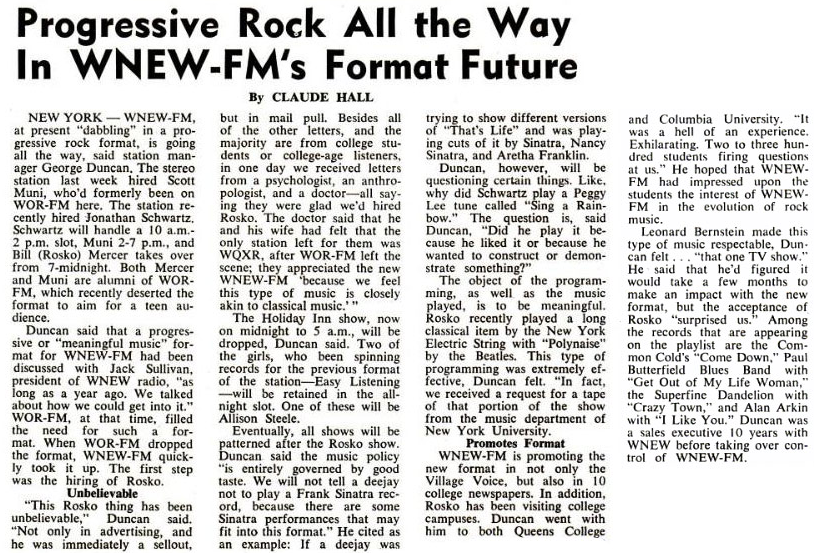
WNEW-FM's early programming also included an automated middle-of-the-road format, followed quickly by a ten-month-long period (July 4, 1966, to September 1967) playing pop music—with an all-female air staff. The gimmick was unique and had not before been attempted anywhere in American radio. The lineup of disc jockeys during this stunt included Margaret Draper, Alison Steele (who stayed on to become the "Night Bird" on the AOR format), Rita Sands, Ann Clements, Arlene Kieta, Pam McKissick, and Nell Bassett. The music format, however, was a pale copy of WNEW (AM)'s adult standards format and only Steele, Sands, and Bassett had broadcast radio experience. The all-female disc jockey lineup endured for more than a year, changing in September 1967 to a mixed-gender staff.
Billboard - December 1967
On October 30, 1967, WNEW-FM adopted a progressive rock radio format, one that it became famous for and that influenced the rock listenership as well as the rock industry.
Ed Goodman - KEZK
➦In 2015…Veteran radio personality (KEZK, KRJY and KSHE-St. Louis, WIOD-Miami) Ed Goodman, who logged almost five decades on the air in St. Louis, died of cancer.
Entertainer Jimmy Osmond is being treated for the effects of a stroke that was diagnosed after he came off stage following a pantomime performance in England on Thursday.
Osmond, 55, was playing Captain Hook in Peter Pan at the Birmingham Hippodrome.
His spokesperson said the star went to hospital after "pushing through" the evening's performance. There are no further details about his condition.
He is part of the famous Osmond family and had chart hits including 1972's Long Haired Lover From Liverpool.
Jimmy Osmond is president of Osmond Entertainment. He has developed and supervised most of the Osmonds' merchandising business, as well as producing hundreds of hours of programming for networks including ABC, PBS, the BBC and the Disney Channel.
Ray Sawyer of Dr. Hook has died, Page Six is told.
Sawyer, perhaps best known for singing lead vocal on “Cover of Rolling Stone,” passed away in Daytona Beach, Fla., according to The NY Post citing his publicist.
Sawyer, 81, stopped performing around three years ago due to declining health.
The Alabama-born Sawyer – who founded the group with Dennis Locorriere, Billy Francis and George Cummings – was a member of Dr. Hook & The Medicine Show from 1969 to 1981. A few years before the band’s formation, Sawyer lost his right eye in a car accident; Sawyer wore an eyepatch that made him resemble the Peter Pan villain Captain Hook, which served as the inspiration for the Dr. Hook moniker, according to Rolling Stone magazine.
In 1970, Dr. Hook & The Medicine Show’s demo tapes wound up in the hands of author and songwriter Shel Silverstein, who recruited the band to become a vessel for his music: The group would turn Silverstein-written tracks like “Sylvia’s Mother” and “The Cover of ‘Rolling Stone'” into hits and released two albums of Silverstein-penned songs, 1971’s Dr. Hook and 1972’s Sloppy Seconds.
Following their Silverstein partnership, the band shortened their name to Dr. Hook and enjoyed a string of hit singles in the mid- to late-Seventies, including “Only Sixteen,” “A Little Bit More,” “Sexy Eyes” and “When You’re in Love With a Beautiful Woman,” which became a Number One hit in the United Kingdom. Bruce Springsteen also notably served as Dr. Hook’s opening act in 1973.
After nine albums with Dr. Hook, Sawyer left in 1983 to pursue a solo career; he previously released a self-titled solo LP in 1977. While Locorriere maintained ownership of the official Dr. Hook moniker, Sawyer toured as Dr. Hook featuring Ray Sawyer over the past few decades. However, health issues forced Sawyer to stop performing live in 2015.
➦In 1923...the very first radio broadcast of the Rose Bowl was beamed in Los Angeles over KHJ radio — some 42 years before 93/KHJ became Boss Radio.
➦In 1925...Lucrezia Bori and John McCormack of the famous Metropolitan Opera made their singing debuts on radio. The broadcast over New York’s WEAF Radio soon to be the NBC flagship.
➦In 1927...The Blue Network aired its first program. The Blue Network (previously the NBC Blue Network) was the on-air name of the now defunct American radio production and distribution service, which ran from 1927 to 1945. Beginning as one of the two radio networks owned by the National Broadcasting Company, the independent Blue Network was born of a divestiture in 1942, arising from anti-trust litigation, and is the direct predecessor of the American Broadcasting Company (ABC..see below) - organized 1943-1945 as a separate independent radio network and later TV broadcaster.
The Blue Network dates to 1923, when the Radio Corporation of America acquired WJZ Newark from Westinghouse (which had created the station in 1921) and moved it to New York City in May of that year. When RCA commenced operations of WRC, Washington on August 1, 1923, the root of a network was born, though it did not operate under the name by which it would later become known. Radio historian Elizabeth McLeod states that it would not be until 1924 that the "Radio Group" formally began network operations.
The core stations of the "Radio Group" were RCA's stations WJZ and WRC; the Westinghouse station WBZ, then in Springfield, Massachusetts; and WGY, the General Electric station in Schenectady, New York.
RCA's principal rival prior to 1926 was the radio broadcasting department of the American Telephone & Telegraph Company. AT&T, starting in 1921, had been using this department as a test-bed for equipment being designed and manufactured by its Western Electric subsidiary.
The RCA stations operated at a significant disadvantage to their rival chain; AT&T used its own high-quality transmission lines, and declined to lease them out to competing entities, forcing RCA to use the telegraph lines of Western Union, which were not as well calibrated to voice transmission as the AT&T lines.
Nevertheless, the WJZ network sought to compete toe-to-toe with the AT&T network, which was built around WEAF (today's WFAN). For example, both stations sent announcer teams to cover the 1924 Democratic National Convention, which was held in Madison Square Garden in New York City. Promotional material produced in 1943 claimed certain "firsts" in broadcasting by WJZ, such as the first educational music program in April 1922, the first World Series broadcasts in 1922, and the first complete opera broadcast, The Flying Dutchman, from the Manhattan Opera House.
RCA (as well as its consortium partners General Electric and Westinghouse) were to receive a break in 1926, when AT&T made a corporate decision to exit the broadcasting business and focus on its telecommunications business.
The Decatur Review (Illinois) for Sunday, December 12, 1926 reported the following in an article describing a broadcast to be sponsored by the Victor Talking Machine Company and aired the following New Year's Day, January 1, 1927, which is a description of this first Blue Network broadcast—note that it makes it clear that January 1, 1927 marked the debut of the Blue Network:
"TWO BIG NETWORKS: The network to be used for the first concert will consist of a combination of chains of stations affiliated with WEAF and WJZ, New York. It is also announced that this opening Victor program inaugurates a new chain system to be operated by the National Broadcasting Company, with WJZ as the "key" station. This new chain, which will be known as the "blue" network, will allow simultaneous broadcasting from WJZ through WBZ, Springfield and Boston, KDKA, Pittsburgh, and KYW, Chicago. For broadcasting of the first program, therefore, the "blue" network will be joined with the "red" network, as the WEAF chain is designated, as well as other stations in various cities. Following the New Year's night program, the concerts will be given bi-monthly, through the "blue" network (...)
Allegedly, the color designations came from the way the networks were represented on maps, with red lines (or pushpins) denoting the WEAF network circuits, and blue the WJZ circuits
➦In 1927...The Rose Bowl football game was aired for the first time, coast-to-coast, on network radio.
First local broadcast of the New Years Day Rose Bowl Football Game from Pasadena by KHJ, Los Angeles aired in 1923. (USC played Penn State. The broadcast of the game, which was then called the East vs West Football game.)
➦In 1930..."The Cuckoo Hour" was broadcast for the first time on the NBC-Blue Network (it later became the ABC Radio Network).
➦In 1934...the classic radio horror show Light’s Out was heard for the first time on WENR Chicago. The show became an ‘almost midnight’ NBC thriller 16 months later.
➦In 1940…Broadcasting from the Empire State Building in New York City, radio station W2XDG, the first FM station licensed by the U.S. Federal Communications Commission, became the first to broadcast with the new Frequency Modulation technology. ➦In 1941...Lorne Greene was appointed first announcer for the Canadian Broadcasting Corporation's new national radio news service. Years before his emergence as Pa Cartwright on the TV western series "Bonanza," Greene's stentorian tones in nightly wartime broadcasts earned him the nickname, "The Voice of Doom."
➦In 1945...WKSE, Buffalo signed on as WHLD-FM. It changed its call sign to WZIR in 1980, WRXT in 1984, and the current call sign in 1985. It currently runs a Top 40 format, which has been in place since September 1984. The station is now owned by Entercom.
➦In 1950...Twenty-six-year-old disc jockey Sam Phillips opened his Memphis Recording Service where, in July of 1953, Elvis Presley spent $3.98 to make his first recording.
➦In 1953...legendary Hank Williams died at the young age of 29 from a drug/alcohol-related heart attack. You may recall or even be able to sing along with some of the songs Hank wrote or co-wrote: “Cold, Cold Heart”, “Half as Much”, “Jambalaya”, “Your Cheatin’ Heart”, “Hey, Good Lookin”, & “I’m So Lonesome I Could Die.” Indisputedly the biggest star in the history of country music, Williams’ legacy is being carried on by his son, Hank Williams, Jr.
➦In 1961...106.7 FM In NYC went on the air as WRVR, a religious station owned by Riverside Church that also played some jazz. A remnant of this period is a 5 A.M. Sunday morning sermon from the church that airs on the station. As time went on, WRVR was a full-time jazz station with a strong following, but low ratings.
In 1976 WRVR was purchased by Sonderling Broadcasting, owner of WWRL, with the hope that it could move to an urban format and compete against WBLS, which had cut into WWRL's ratings. However, community opposition prevented the format change and WRVR remained a jazz station under Sonderling ownership. At that time it developed the precursor to what would later become known as the "smooth jazz" format.
In 1980 Viacom bought the Sonderling chain, and the station adopted a country music format as "Kick" WKHK. The station was known as "Kick 106.7 FM." The format change, from jazz to country, took place in the middle of the night. The change brought many protests from New York jazz fans, and a petition to the FCC to deny the station's license renewal, which was denied. The WRVR calls were then moved to Memphis, TN.
However, ratings were low, as they were unable to compete with WHN, which also had a country music format at the time. In 1988, a new jazz station appeared on the New York airwaves, with the call letters WQCD "CD101.9" later changing calls to WEMP, then back to WRXP, and now WFAN-FM.
On January 23, 1984, Viacom dropped country and changed the calls to WLTW. The station became an MOR station known as "Lite FM 106.7 WLTW".
➦In 1968...the ABC Radio Network split into 4 networks: the Information, Entertainment, Contemporary and FM networks.
ABC Radio originally began after the split of NBC Red and NBC Blue (later Blue Network) networks with ABC taking over operations from RCA in 1943 before adopting its name 2 years later.
ABC Radio was known to broadcast the first nationwide report of the assassination of President John F. Kennedy. Kennedy was shot in a motorcade in Dallas, Texas at 18:30 UTC on November 22, 1963 and ABC Radio's Don Gardiner anchored the network's initial bulletin at 1:36:50 EST, minutes before any other radio or television network followed suit.
Despite a number of different owners (Capital Cities Communications and later Disney), the radio division remained under ABC's wing until June 12, 2007 when it was sold to Citadel Broadcasting as well as its O&O stations (not including Radio Disney and ESPN Radio nor its affiliates) in a restructuring effort. The radio division has kept the ABC name for about 2 years until Citadel renamed it Citadel Media. Then sometime in September 2011, Cumulus Media has absorbed the now-defunct Citadel Broadcasting and rebranded it to the current Cumulus Media Networks. In 2013, Cumulus Media Networks merged with Dial Global Radio Networks to form Westwood One.
On August 7, 2014, the Walt Disney Company announced that ABC will relaunch its radio network division on January 1, 2015. When its current distribution deal with Cumulus comes to an end, ABC will revamp its radio programming services under a new deal with Skyview Networks. ABC will continue to make its radio news programming via ABC News Radio.
Alison Steele
➦In 1968...Alison Steele started at AOR WNEW 102.7 FM.
Steele was born in Brooklyn, New York. In the 1950s while running errands for a local television station at the beginning of her career, at the age of nineteen, she met and married orchestra leader Ted Steele, who was twenty years her senior. They eventually went their separate ways.
Steele achieved her greatest following as a disc jockey on WNEW-FM, where she hosted the night shift in a new format when contemporary rock music began to be featured on FM radio. FM stations broadcast in high fidelity and, typically, had featured classical or instrumental music in the New York market. This all changed in the 1960s when this station led the switch to FM stations for the musical preferences of the counter culture of the 1960s and 1970s. After a major change in station programming from a briefly instituted all-female middle of the road (MOR) music format to what was becoming known as progressive rock radio occurred at WNEW-FM, she took the new late night position.
Steele acknowledged that she did not know much about progressive rock when she started the program, and apparently, neither did the management of the station, but the new programming was being extended to the growing market. Steele was given complete freedom to plan and present her program. In the process, she developed her persona as The Nightbird, and acquired a massive, loyal audience. Her audience was estimated in 1971 at approximately 78,000 nightly, with the majority of listeners being men between the ages of 18 and 34.
Steele began her show by reciting poetry over Andean flute music, before introducing her show in her well-known sultry, smoky voice with,
“The flutter of wings, the shadow across the moon, the sounds of the night, as the Nightbird spreads her wings and soars, above the earth, into another level of comprehension, where we exist only to feel. Come, fly with me, Alison Steele, the Nightbird, at WNEW-FM, until dawn.”
She then made a transition to recordings of some of the more exceptional and experimental music being recorded at the time, as well as featuring the best of the familiar favorites of her audience.
Her show became an instant hit and did much to push WNEW 102.7 FM into the forefront of progressive rock radio. At one point, she also served as the music director of the station. Steele became the first woman named as Billboard Magazine FM Personality of the Year.
Steele left WNEW-FM 102.7 in 1979 and worked as a writer, producer, and correspondent for Limelight on CNN until 1985. Steele held several positions that overlapped during the decades of the 1980s and 1990s. She worked as a disc jockey on New York's WNEW from 1980–1981. She served as the announcer for the daytime soap opera, Search for Tomorrow, from 1981 to 1984, after replacing Dwight Weist; Her announcing jobs on SFT started in the final months on CBS and the first few years on NBC. In late 1984/early 1985 she left Search and was replaced by The Edge Of Night's announcer Hal Simms. For a number of years, Steele was also the "disc jockey" for the pop/rock in-flight audio entertainment channel on board Trans World Airlines.
From 1989 to 1995, she was on WXRK along with some work for VH1.
Steele died of stomach cancer on September 27, 1995, aged 58.
➦In 1968…Albums were outselling 45-RPM singles for the first time, according to Billboard magazine.
➦In 1971...the tobacco industry was banned from buying advertisements on television and radio.
➥In 1975...the NBC Radio Network began on-the-hour news, 24 hours-a-day.
NBC launched the NBC News and Information Service (NIS) in 1975. It allowed local radio stations to launch all-news formats, providing affiliates with up to 55 minutes of news per hour.
NBC aired the service on its Washington station, WRC. It also added the all-news format on its network-owned FM stations in New York City, Chicago and San Francisco.
Many stations signed on with the service, but by 1976, NBC was not sure if its network would ever become profitable. Affiliates got a six-month notice that the service would end. NIS closed in 1977.
➦In 1992...The ESPN Radio Network debuted.
Keith Olbermann
ESPN Radio launched on January 1, 1992. Keith Olbermann hosted the first program. The top story that night was that Danny Tartabull signed with the New York Yankees as a free agent.
At first, ESPN Radio broadcast only on weekends. By 1996, it expanded to weekdays with a show hosted by The Fabulous Sports Babe, Nancy Donnellan. One hour of that show was simulcast on ESPN2 (1-2 p.m. Eastern time). Two years later, Tony Bruno and Mike Golic were brought together for a new morning show, the "Bruno & Golic Morning Show" which aired until Bruno left the network in 2000. Mike Greenberg was named as Bruno's replacement, and the morning show became "Mike & Mike", which still airs today (and is also simulcast on ESPN2). In January, 2010, Mike & Mike celebrated their 10 year anniversary on ESPN Radio. Dan Patrick was a mainstay in afternoons until his departure from ESPN in 2007.
Gradually, ESPN added more dayparts and became a 24-hour service.
➦In 1997...EAS Rules go in effect
➦In 2006...former Chicago radio personality, Alan Stagg, died of complications from pneumonia.
A classic rock disc jockey with a deep, booming voice--"He had the voice of God, if God was a cowboy," said his onetime boss Bill Gamble-- Stagg was on the air in Chicago for most of the 1990s on stations that included WCKG-FM and WDRV-FM.
"Sanctuary" aired in the late 1990s on WXCD-FM, where Gamble was program director. A re-creation of the early days of FM radio, "Sanctuary" was a free-form melange of rock from the 1960s and 1970s, audio clips from movies and other sources, and Mr. Stagg's sometimes skewered take on life. Wind chimes tinkled in the background.
Alan Stagg
"He did radio like actors do theater; it wasn't just time and temp," said Gamble, now program director at 92.5 "The Wolf" in Denver. "He created theater of the mind."
The show later migrated to WCKG-FM, where Mr. Stagg was hired by former station executive Jeff Schwartz.
"To me, `Sanctuary' is exactly what radio is all about," said Schwartz, now a radio and media consultant. "It was like the hippier version of [former Chicago rock jock] Ron Britain's `Subterranean Circus.'"
Allan Stagg was the longest-running of several names Mr. Stagg used professionally, but he also used the name in everyday life, his wife said. Born Juris H. Josts, Mr. Stagg grew up in Grand Rapids, Mich., and started as an intern at a local radio station while in high school.
He knew he wanted to get into radio ever since having listened to the far-reaching signal of Chicago's WLS-AM as a boy. "He loved Dick Biondi," his wife said.