➦In 1856…Nikola Tesla was born. (Died – 7 January 1943). He was an inventor, electrical engineer, mechanical engineer, and futurist who is best known for his contributions to the design of the modern alternating current (AC) electricity supply system.
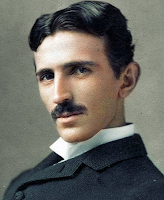 |
| Nikola Tesla |
Tesla, one of history’s most under-appreciated and under-acknowledged engineers. Credit for his work is often gray and debated, sometimes due to unscrupulous competitors and sometimes due to timing.
Indeed, Tesla is known to have worked on a radio before Marconi, an X-Ray machine before Roentgen, an induction motor around the same time Ferrari claimed his, and experimented to find “small charged particles” years before Thomson was credited with proving the existence of electrons.
Tesla is perhaps best known within engineering circles for his work on AC (alternating current) and his “War of Currents” feud with Thomas Edison (side note: Edison, an employer of Tesla’s for some time, is known in some engineering circles as the man who copied and used Tesla's ideas).
Even with such challenges and a lifetime of illnesses, Tesla accrued about 300 patents. He died penniless and in debt in his New York apartment on January 7, 1943, at the age of 86. After his death, much of Tesla’s papers and works were impounded by the United States' Alien Property Custodian office. This was despite the fact that Tesla had become a US citizen at 35 years old.
Eventually many of his personal notebooks and works were declared “top secret” by the FBI and shuttered away from public view. Reasons given for doing so were that Tesla had done significant work with various US government agencies.
Tesla's theories on the possibility of the transmission by radio waves go back as far as lectures and demonstrations in 1893 in St. Louis, Missouri, the Franklin Institute in Philadelphia, Pennsylvania, and the National Electric Light Association. Tesla's demonstrations and principles were written about widely through various media outlets. Many devices such as the Tesla Coil were used in the further development of radio.
Tesla's radio wave experiments in 1896 were conducted in Gerlach Hotel (later renamed The Radio Wave building), where he resided.
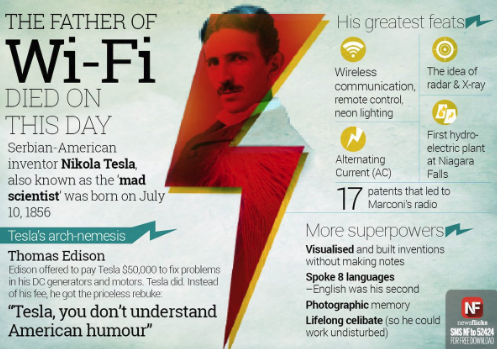 |
| Tesla died January 7, 1943 |
In 1898, Tesla demonstrated a radio-controlled boat—which he dubbed "teleautomaton"—to the public during an electrical exhibition at Madison Square Garden. The crowd that witnessed the demonstration made outrageous claims about the workings of the boat, such as magic, telepathy, and being piloted by a trained monkey hidden inside. Tesla tried to sell his idea to the U.S. military as a type of radio-controlled torpedo, but they showed little interest. Remote radio control remained a novelty until World War I and afterward, when a number of countries used it in military programs. Tesla took the opportunity to further demonstrate "Teleautomatics" in an address to a meeting of the Commercial Club in Chicago, while he was travelling to Colorado Springs, on 13 May 1899.
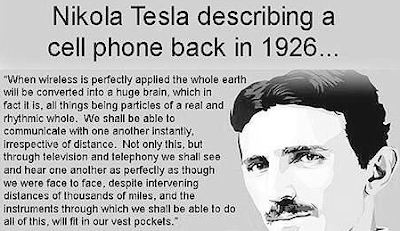
In 1900, Tesla was granted patents for a "system of transmitting electrical energy" and "an electrical transmitter." When Guglielmo Marconi made his famous first-ever transatlantic radio transmission in 1901, Tesla quipped that it was done with 17 Tesla patents. This was the beginning of years of patent battles over radio with Tesla's patents being upheld in 1903, followed by a reverse decision in favor of Marconi in 1904. In 1943, a Supreme Court of the United States decision restored the prior patents of Tesla, Oliver Lodge, and John Stone. The court declared that their decision had no bearing on Marconi's claim as the first to achieve radio transmission, just that since Marconi's claim to certain patents were questionable, he could not claim infringement on those same patents (there are claims the high court was trying to nullify a World War I claim against the U.S. government by the Marconi Company via simply restoring Tesla's prior patent).
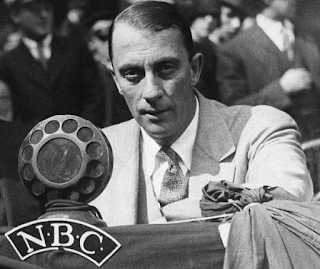 |
| Graham McNamee |
➦In 1888...Graham McNamee born (Died – May 9, 1942). He was a radio broadcaster, who originated play-by-play sports broadcasting for which he was awarded the Ford C. Frick Award by the Baseball Hall of Fame in 2016.


