The deadliest avalanche in modern California history has killed eight backcountry skiers near Castle Peak in the Sierra Nevada mountains above Lake Tahoe, with a ninth person still missing and presumed dead.
Rescue crews recovered the bodies of eight victims Wednesday, but hazardous weather continues to delay full recovery efforts and the search for the remaining skier, according to the Nevada County Sheriff's Office. Officials expect operations to extend into the weekend.
The incident occurred Tuesday during the final day of a three-day guided backcountry ski tour organized by Blackbird Mountain Guides. Six people were rescued about six hours after the slide.
Kate Vitt
The first identified victim is Kate Vitt, 43, a former SiriusXM executive, Boston College graduate, and mother of two young sons. She lived in Marin County (Greenbrae/Mill Valley area) with her husband Geoff, a sales and marketing partner in the Bay Area. Neighbors described her as vibrant, friendly, devoted to her children, and full of "verve and zest for life." Her parents are grieving a "profound loss," confirmed through a family friend.
Many victims were mothers connected to the elite Sugar Bowl Academy, a competitive ski-focused school near Norden, California, in the Lake Tahoe region. The group appears to have been part of an informal annual parents' ski trip, not officially affiliated with the academy, where fathers and mothers sometimes split into separate excursions. It is unclear if Vitt's sons attended the academy.
Hours of historic St. Louis radio broadcasts are now being added to the Library of Congress, preserving key moments and everyday life from the city's airwaves thanks to decades of work by Frank Absher, executive director of the St. Louis Media History Foundation.
According to the St. Louis magazine, the accepted recordings include standout highlights such as the KMOX live broadcast from the Anheuser-Busch brewery marking the end of Prohibition in April 1933, which was fed nationwide over the CBS Network, and Harry Caray's coverage of the St. Louis Cardinals' sale on KXOK in 1947.
The Library of Congress is also incorporating everyday snapshots of mid-20th-century life. Absher notes that airchecks from stations like KXOK's top-40 format in the 1960s reveal what people heard: local topics, advertisements, and cultural details. Other examples include KSD’s “Alpine Varieties,” a music program sponsored by Alpen Brau Beer, and KMOX’s “Barnyard Follies,” a live hillbilly show networked on CBS from 1949–1950.The federal archive provides superior long-term preservation beyond cloud storage and makes the material accessible to researchers studying events like Prohibition's end or daily life in 1950s St. Louis.
Absher, a former KMOX announcer, has collected and preserved St. Louis radio since 1987, gathering airchecks, recordings of live broadcasts, and digitizing fragile 16-inch electronic transcription discs (ETs) with help from a Missouri Humanities Council seed grant and private donations.
His efforts gained traction two years ago through the National Radio Preservation Task Force, leading to initial sample submissions and now approval for more. He plans to eventually donate the original ETs as well.Looking ahead, Absher aims to post the recordings on the St. Louis Media History Foundation’s website, though music licensing issues from organizations like BMI or ASCAP have delayed this. He is editing out copyrighted music to avoid royalty claims, even for non-commercial use.
(Real Name Charles Thomas Aldrich, Jr., died from lung cancer June 30, 1995) is best remembered as Lucille Ball's longtime television foil—and particularly as cantankerously combustible, tightfisted bank executive Theodore J. Mooney, on Ball's second television situation comedy.
Gale Gordon
Gordon's first big radio break came via the recurring roles of "Mayor La Trivia" and "Foggy Williams" on Fibber McGee and Molly, before playing Rumson Bullard on the show's successful spinoff, The Great Gildersleeve.
Gordon and his character of Mayor La Trivia briefly left the show in December 1942 when Gordon enlisted in World War II and the storyline followed. He was the first actor to play the role of Flash Gordon, in the 1935 radio serial The Amazing Interplanetary Adventures of Flash Gordon. He also played Dr. Stevens in Glorious One.
In 1950, Gordon played John Granby in the radio series Granby's Green Acres, which became the basis for the 1960s television series Green Acres. Gordon went on to create the role of pompous principal Osgood Conklin on Our Miss Brooks, carrying the role to television when the show moved there in 1952. In the interim, Gordon turned up as Rudolph Atterbury on My Favorite Husband, which starred Lucille Ball in a precursor to I Love Lucy.
Jim Jewell
➦In 1906...James Jewell was born. He was a radio actor, producer and director at radio station WXYZ, Detroit, Michigan. (Died from a heart attack August 5, 1975 at age 69)
Jewell first got into radio in 1927. with a background of summer stock, vaudeville, burlesque, and even touring with a troupe of marionettes. In June 1932, George Trendle, the owner of radio station WXYZ Detroit, decided to drop network affiliation and produce his own radio programs. Jewell was hired as the dramatic director for the radio station. He supplied the actors from his own repertory company, the "Jewell Players".
Jewell was part of the station staff that worked out the original concepts for The Lone Ranger. Jewell is also credited for selecting The William Tell Overture as the theme music for the series. "Ke-mo sah-bee", Tonto's greeting to the masked Ranger, was derived from the name of a boys' camp owned by Jewell's father-in-law Charles W. Yeager. Camp Kee-Mo-Sah-Bee operated from 1911 until 1941 on Mullet Lake south of Mackinac, Michigan. After the radio show became popular, Yeager held "Lone Ranger Camps" at his camp.
Jewell produced, directed and occasionally wrote many of the early episodes for The Lone Ranger and The Green Hornet. He was the director for both series from their beginning up until 1938.
Jewell left WXYZ in 1938, and moved to Chicago and worked as a director-producer at WBBM (AM), the CBS radio affiliate in Chicago.
He directed Jack Armstrong, the All-American Boy beginning in 1938 until the series ended in 1951. From 1951-1955, Jewell was the producer/director of The Silver Eagle, a mountie adventure which ran on ABC and starred Jim Ameche, the brother of movie star Don Ameche.
As the era of radio dramatic series came to an end, attempted to bring The Silver Eagle to television.
➦In 1914...John Charles Patrick Croghan Daly was born (Died February 24, 1991). Known as John Daly, he was a radio and television personality, CBS News broadcast journalist, ABC News executive and TV anchor and a game show host, best known as the host and moderator of the CBS television panel show What's My Line?
Daly began his broadcasting career as a reporter for NBC Radio, and then for WJSV (now WTOP), the local CBS Radio Network affiliate in Washington, D.C., serving as CBS' White House correspondent. He appears on the famous "One Day in Radio" tapes of September 21, 1939, in which WJSV preserved its entire broadcast day for posterity.
Through covering the Roosevelt White House, Daly became known to the national CBS audience as the network announcer for many of the President's speeches. In late 1941, Daly transferred to New York City, where he became anchor of The World Today. During World War II, he covered the news from London as well as the North African and Italian fronts. Daly was a war correspondent in 1943 in Italy during Gen. George S. Patton's infamous "slapping incidents". After the war, he was a lead reporter on CBS Radio's news/entertainment program CBS Is There (later known on TV as You Are There), which recreated the great events of history as if CBS correspondents were on the scene.
As a reporter for the CBS radio network, Daly was the voice of two historic announcements. He was the first national correspondent to deliver the news of the attack on Pearl Harbor on Sunday, December 7, 1941, and he was also the first to relay the wire service report of the death of President Franklin D. Roosevelt on April 12, 1945, interrupting the program Wilderness Road to deliver the news. Transcriptions of those bulletins have been preserved on historical record album retrospectives and radio and television documentaries. Among the first were the Columbia Records spoken word series I Can Hear It Now and the later CBS Television series, The Twentieth Century.
In July, 1959, along with the Associated Press writer John Scali, he reported from Moscow on the famous Kitchen Debate between USSR General Secretary Nikita Khrushchev and then U.S. Vice President Richard M. Nixon in 1959.
➦In 1922...WGY-AM, Schenectady, NY signed-on. As early as 1912, General Electric company in Schenectady began experimenting with radio transmissions, being granted a class 2-Experimental license for 2XI on August 13, 1912 by the Commerce Department.
WGY signed on on February 20, 1922 at 7:47pm at 360 meters wavelength (about 833 kHz), with Kolin Hager at the mike, or as he was known on the air, as KH. Hager signed on with the stations call letters, explaining the W is for wireless, G for General Electric, and Y, the last letter in Schenectady.
Major League Baseball's broadcast landscape is undergoing its most significant transformation in decades heading into the 2026 season, driven by the collapse of traditional regional sports networks (RSNs), a shift toward league-controlled production and streaming, and new national media rights deals emphasizing digital platforms.
The decline of RSNs and rise of MLB-controlled local broadcasts represent the biggest trend. The fallout from Diamond Sports Group (now Main Street Sports/FanDuel Sports Network)'s bankruptcy and ongoing financial struggles has forced many teams to abandon traditional cable RSNs.
In 2026, MLB's in-house media unit now handles local broadcasts or distribution for about half the league—15 teams—including recent additions like the Brewers, Cardinals, Marlins, Rays, Reds, Royals, Angels, Tigers, and others (such as the Diamondbacks, Guardians, Rockies, Twins, Padres, Mariners, and Nationals from prior years).
This centralization allows MLB to offer direct-to-consumer in-market streaming subscriptions (often blackout-free) via the MLB App or ESPN App for many clubs, priced around $99.99/season or bundled with out-of-market MLB-TV.
This move provides teams more control and future-proofing amid cord-cutting, though it trades guaranteed RSN fees for potentially variable streaming revenue. Nearly half of MLB teams now fall under this model, with in-market streaming available for 21 clubs overall.
National rights have been reshuffled with new three-year deals (2026-2028) involving ESPN, NBCUniversal/Peacock, and Netflix.
Key changes include:
ESPN distributes the out-of-market MLB.TV package (which set a record 19.4 billion minutes watched in 2025, up 34%) and streams over 150 out-of-market games daily, plus about 30 regular-season games.
NBC/Peacock takes over Sunday Night Baseball, MLB Sunday Leadoff, Opening Day/Labor Day primetime games, and the full Wild Card Round postseason.
Netflix exclusively airs standalone events like Opening Night, the Home Run Derby, and the Field of Dreams Game.
Meta CEO Mark Zuckerberg took the stand Wednesday in a Los Angeles courtroom, facing intense questioning from plaintiffs' lawyers in a high-stakes civil trial that accuses social media giants of deliberately engineering addictive platforms that have fueled a widespread teen mental health crisis.
The case, often likened by experts and plaintiffs' attorneys to the tobacco industry's "Big Tobacco" reckoning of the 1990s, centers on claims that Meta (owner of Instagram and Facebook) and other companies like Google's YouTube knowingly designed features, such as infinite scrolling, recommendation algorithms, and engagement-maximizing tools, to hook young users, treating them like "digital casinos" and prioritizing profit over safety.
This could mark a pivotal "Big Tobacco" moment for the social media industry, potentially establishing major legal precedents for corporate liability related to product design, youth protection, and internal decision-making on harmful elements like beauty filters or underage access.
The trial, which began earlier this month in Los Angeles County Superior Court, is considered a bellwether for thousands of similar lawsuits filed by minors, parents, school districts, and state attorneys general. It focuses on allegations that these platforms are defective and harmful products, sidestepping traditional Section 230 protections by targeting design choices rather than user-generated content.
At the heart of the current case is a now-20-year-old plaintiff, referred to in court documents as "Kaley" or "K.G.M." (or similar anonymized identifiers), and her mother. They allege that her exposure to Instagram and YouTube starting as a young child—sometimes for hours or even over 16 hours in a single day—led to severe issues including anxiety, body dysmorphia, depression, self-harm, suicidal thoughts, bullying, and sextortion.
NBC executives are privately weighing contingency plans for the Today show if co-anchor Savannah Guthrie remains absent for an extended period, or chooses not to return, amid the ongoing disappearance of her 84-year-old mother, Nancy Guthrie.
While NBC's primary focus remains supporting Guthrie during this difficult time and responsibly covering the developing story involving one of its top anchors, internal discussions at 30 Rock involve scenarios for prolonged fill-ins or potential permanent changes, according to multiple television news veterans familiar with the conversations.
Nancy Guthrie was reported missing from her home in the Catalina Foothills area near Tucson, Arizona, on February 1, 2026, after last being seen on January 31. Authorities, including the Pima County Sheriff's Department and the FBI, treat the case as a suspected abduction or kidnapping.
Key developments include:
Ransom demands (including bitcoin requests) reported to media, though no confirmed follow-up contact.
DNA from a glove found near the home showed no matches in national databases like CODIS, and investigators are pursuing leads such as genetic genealogy.
A person (and later a mother and son) detained or searched but released without charges.
No suspects named publicly; the family, including Savannah and her siblings, has been fully cleared.
Efforts to track Nancy's pacemaker and outreach to Mexican authorities for cross-border leads.
An active FBI reward (amounts reported up to $100,000 in some coverage) for information leading to her location or the arrest/conviction of those responsible.
Savannah Guthrie has been on leave since early February to support the family and search efforts. She was also excused from NBC's 2026 Winter Olympics coverage in Milan. Fill-in anchors such as Hoda Kotb, Craig Melvin, Sheinelle Jones, and others have handled hosting duties, with the show showing subtle support (e.g., yellow ribbons and roses in the studio).
FCC Chair Brendan Carr announced Wednesday that he supports Nexstar's proposed $3.54 billion acquisition of Tegna, a deal that would create the largest U.S. regional TV station operator by combining their stations and reaching about 80% of TV households in key markets.
"I support that transaction. We're going to be moving forward," Carr told reporters. He did not specify whether the FCC would handle approval at the staff level or through a full commission vote.
The merger, announced in 2025, has already received public backing from President Donald Trump earlier this month. It would require the FCC to lift or waive the current national ownership cap, which limits a single company to stations reaching no more than 39% of U.S. TV households (with some discounts for weaker signals).
Brendan Carr
The deal comes amid challenges for local broadcast media, including declining revenues and subscriber losses due to the rise of streaming services. Broadcasters, including the National Association of Broadcasters, have long argued that the 85-year-old ownership rule is outdated and unfair, as it does not apply to Big Tech platforms.
Carr has previously stated he believes the FCC can revise the cap without congressional approval. However, Democratic FCC Commissioner Anna Gomez has opposed this view, arguing the agency lacks such authority and has called for the full commission to vote on the Nexstar-Tegna deal.
Critics, including Newsmax CEO Chris Ruddy, have defended the existing cap as a key safeguard for competition and diversity in broadcasting. Carr, in contrast, has argued that national players like Comcast and Disney hold excessive power, and that approving the merger would introduce meaningful competition against them.
Trump has often criticized mainstream media coverage and pushed for regulatory actions against broadcasters. The merger remains under FCC review, with no final decision announced.
The YES Network has streamlined its New York Yankees broadcast booth for the 2026 season, reducing the number of announcers to create greater consistency and familiarity for viewers.
In 2026, the booth will feature just two play-by-play announcers—lead voice Michael Kay and backup Ryan Ruocco—and three rotating analysts: David Cone, Paul O’Neill, and Joe Girardi. Sideline reporter Meredith Marakovits will continue in her role.
This marks a significant shift from 2025, when YES employed four different play-by-play announcers and six analysts, leading to more variability in broadcasts.
YES executive producer and vice president of production Jared Boshnack told Newsday that the change prioritizes audience preferences for predictability in baseball's daily rhythm.
“I think that's what most of the audience wants,” Boshnack said. “I think they know the excellence of our coverage. It's well documented. But at the end of the day, there is something to be said for the rhythm of baseball, that it's every single night... I think it's going to really be beneficial for the audience to know every single game, ‘Hey, this is who’s going to be covering it.’”
The network is betting that “less is more,” with more frequent appearances by its core talent—Kay, Cone, Girardi, and O’Neill—in two- or three-man configurations to build better continuity and identity.
During January, FOX News Digital delivered its best month ever with over 187 million total digital multiplatform unique visitors, according to Comscore.**
Additionally, FOX News led all news brands and broadcast networks with 1.9 billion multiplatform views and 3.7 billion multiplatform minutes during January.*
This marks the 21st consecutive month that FOX News has been number one with multiplatform views and the 59th consecutive month it has led the way with multiplatform minutes. In fact, FOX News was up double digits month-over-month across all three key performance indicators.
On YouTube, FOX News delivered 466 million video views in January according to Emplifi, increasing its YouTube viewership 14% year-over-year and 60% compared to December leading MS Now (339 million views), CNN (237 million views), ABC News (124 million views), NBC News (118 million views) and CBS News (56 million views). Additionally, FOX News Clips generated 49.3 million video views in January, a 92% increase month-over-month.
The FOX News Mobile app drew 6.5 million unique viewers during the month of January leading the CNN mobile app which saw 3.2 million unique viewers.**
FOX News Media also led all news brands on social media with interactions according to Emplifi and Shareablee. FOX News delivered 175 million social media interactions for the month with 104 million interactions on Facebook, 25.4 million interactions on Instagram and 7 million interactions on X. Meanwhile on TikTok, FOX News drove 38.3 million interactions.****
Additionally, FOX News commanded its second-best month ever with social media video views driving over 2.6 billion views.
FOXBusiness.com drove 198.8 million multiplatform minutes in January, finishing third in the business competitive set. Additionally, the business site delivered 114.5 million multiplatform views and 28.7 million total digital multiplatform unique visitors.***
The FCC has launched enforcement proceedings against ABC's The View for potentially violating the equal-time rule following its recent interview with Democratic Texas Senate candidate James Talarico.
FCC Chairman Brendan Carr confirmed the probe Wednesday, stating the agency is holding broadcasters accountable to prevent legacy media from "picking winners and losers in elections."
The action follows the show's appearance by Talarico and, weeks earlier, his primary rival Rep. Jasmine Crockett (D-TX). Carr emphasized on Fox News that the rule applies here, as talk shows like The View do not qualify for the longstanding "bona fide" news exemption under current FCC guidance.
The View co-host Ana Navarro, speaking on CNN Newsnight shortly after the confirmation, called the equal-time rule "outdated" and accused the Trump administration of "selective" enforcement targeting her program.
Navarro argued the regulation—originating in 1927 for radio, reformed in 1934, and updated in 1959 to exempt news programs—fails to reflect today's media landscape, where platforms like YouTube, streaming, and social media draw larger audiences than traditional network or cable TV. She noted The View operates under ABC's news division.
WATCH: Ana Navarro asserts that Trump, VP Vance, and other Republicans duck shows such as The View, preferring instead "the bubble" of Fox News. Who are the Republicans ducking these shows? Their booking history suggests otherwise.
She warned that such selective application could backfire: "There may come a president in the next term who decides... to apply it to talk radio. Let’s see how Republicans like it." Navarro also mocked Trump and his allies for avoiding invitations to non-conservative programs: "They b*tch and moan about equal time, but... they choose not to come on because they like to go to the safety bubble of Fox News."
FCC Advances Rules for Historic Noncommercial FM Translator Filing Window (Late 2026 Target): The FCC is progressing with plans for the first-ever filing window allowing noncommercial educational (NCE) stations—including noncommercial FM, LPFM, and noncommercial AM licensees—to apply for FM translators in the reserved band (88.1–91.9 MHz). This could significantly expand coverage and fill-in service for educational and community broadcasters.Key proposals include limiting applications (e.g., max 10 per applicant, fewer for LPFM/Tribal stations) to prevent abuse. The window is tentatively set for late 2026.
Station and Translator Sales Activity (Deal Digest Highlights): Several transactions closed or were filed this week, showing ongoing consolidation and transfers in local radio markets:
Encouragement Media Group closed a million-dollar deal expanding its reach across California, Nevada, and Utah (specific stations not detailed in initial reports).
In West Palm Beach, FL: Shekinah Radio International acquired gospel station WSWN "Sugar 900" for $725,000 from Sugar Broadcasting.
In Pennsylvania: A translator (W207AE 89.3 FM in Reading) donation filed to Family Life Ministries to relay a contemporary Christian station.
Media Industry:
FCC Launches Enforcement Proceedings Against ABC's "The View" Over Equal Time Rule Violations: Chairman Brendan Carr confirmed during the commission's February open meeting that the agency has initiated enforcement proceedings against ABC's daytime talk show "The View" for alleged breaches of the equal time rule related to political candidates. This stems from an interview with Texas Democratic Senate candidate James Talarico, where the show reportedly failed to provide equivalent opportunities to opposing candidates. Carr emphasized that the FCC will hold broadcasters accountable, signaling broader scrutiny of talk formats (TV and potentially radio) that have historically skirted strict equal time obligations by claiming news/exemption status.
FCC Chair Warns Equal Time Rules Apply to Talk Radio; Addresses Stephen Colbert/CBS Controversy: Carr explicitly stated that equal time rules apply "across the board" to broadcast media, including talk radio, not just TV. This warning followed claims by CBS's Stephen Colbert that network lawyers blocked him from airing an interview with the same candidate (James Talarico) due to fears of FCC retaliation over equal time obligations.Carr dismissed suggestions of government censorship as "fake news" and reiterated no direct pressure was applied to CBS. The comments tie into the ongoing "The View" probe and could prompt increased compliance burdens for news/talk stations amid primary season.
U-S News
U.S. Military Positions Assets for Potential Strikes on Iran: The U.S. has moved significant military forces (including naval and air assets) into place near Iran amid escalating tensions. President Trump has not made a final decision on action, but officials indicate the military could be ready for strikes as early as this weekend or early next week. Diplomatic talks continue, but the buildup follows reports of failed breakthroughs and Iran's naval drills with Russia. This marks a critical moment in U.S.-Iran relations, with analysts noting Trump's opaque rationale and internal deliberations.
Trump Hosts Inaugural Meeting of the "Board of Peace" in Washington: President Trump presides over the first meeting of his newly formed Board of Peace (housed at the renamed Donald J. Trump Institute of Peace). The gathering focuses on Gaza reconstruction, pledges for billions in aid, and an international stabilization force amid a fragile ceasefire. Dozens of countries participate, but major European allies (e.g., UK, Germany, France, EU Commission) declined invitations, citing concerns over funding, mandate, and political implications. The event doubles as a high-profile fundraiser.
The FCC Chairman Brendan Carr denied on Wednesday that the U.S. government censored CBS's The Late Show host Stephen Colbert from airing an interview with Democratic Texas Senate candidate James Talarico, calling claims of censorship a "hoax" and attributing the decision to CBS's own compliance with equal-time rules.
Carr confirmed the FCC has launched an enforcement action to investigate whether ABC's The View violated the equal-time provision following an earlier interview with Talarico.
The Republican-led FCC issued guidance in January stating that daytime and late-night talk shows no longer automatically qualify as "bona fide" news programs exempt from equal-time obligations, which require broadcasters to provide comparable airtime to opposing candidates if one appears.
Carr stated there was "no censorship here at all," explaining that Colbert could have aired the Talarico interview by also providing equal time to competing Democratic candidates (such as Rep. Jasmine Crockett) or by limiting the broadcast outside Texas.
In January 2026, the FCC warned that late-night and daytime talk shows, previously often exempt, must comply with the longstanding "equal time" rule (Section 315 of the Communications Act) if appearances are deemed political rather than news or exempt. Carr has criticized perceived partisan bias in shows like "The View" and pushed for broader application, though experts note the rule is narrow and the guidance emphasizes "more speech, not less."
Broadcasters remain responsible for ensuring their programming complies with FCC rules, and non-compliance could lead to liability, he added.
Carr dismissed Colbert's criticisms personally, suggesting the host perceives his "limelight fading" but insisting it does not alter the facts.
The FCC held its Open Commission Monthly Meeting Wednesday, in Washington, DC, where it considered and acted on four major items focused on program integrity, spectrum expansion, broadcasting efficiency, and telecommunications reforms.
The Commission advanced reforms to the Lifeline program by issuing a Notice of Proposed Rulemaking (NPRM) seeking public comment on measures to ensure benefits reach only eligible low-income Americans (such as U.S. citizens and legal residents), boost program integrity and provider compliance, prevent duplicate support, introduce usage tracking with de-enrollment for non-use, set minimum service standards (including data speeds and capacity), and streamline rules for greater efficiency, transparency, and accountability. This NPRM addresses the program that provides discounted voice and broadband services.
In a significant spectrum decision, the FCC adopted a Report and Order enabling broadband deployment across the full 10 MHz of the 900 MHz band (896–901/935–940 MHz). This expands access for utilities, critical infrastructure, enterprises, and private wireless networks to support innovation and economic growth, while preserving narrowband options and applying appropriate licensing and technical rules.
The Commission issued a Public Notice proposing limits on applications for the upcoming 2026 filing window for new noncommercial educational (NCE) reserved band FM translator stations, including eligibility restrictions and a cap (such as up to 10 applications per entity). The aim is to enhance efficiency, curb speculative filings, and reserve spectrum for legitimate secondary services.
Finally, the FCC released an NPRM exploring updates to the intercarrier compensation regime, which governs how carriers compensate each other for traffic, to accelerate the transition to all-IP networks, modernize deployment, and address related issues like interexchange services and support mechanisms.
97.1 The Ticket (WXYT-FM), an Audacy station in Detroit, announces a multi-year extension of its broadcast partnership with the Detroit Lions. The station will continue as the team’s radio home, broadcasting all pre-, regular and post-season games.
“In Detroit, the Lions represent our resilience and our pride. We are honored to extend our long-standing partnership with the team, serving as the bridge between the field and the fans,” said Debbie Kenyon, Senior Vice President and Market Manager, Audacy Detroit. “This extension underscores our deep commitment to the team and to delivering the most authentic and highest quality game-day experience to the dedicated Lions fans across the region and beyond.”
“We are grateful to continue our partnership with 97.1 The Ticket as the radio home of Detroit Lions football,” said Rod Wood, President and CEO, Lions. “This is a partnership that ensures a strong connection to our fans through the most prominent sports station in the area for years to come.”
There are ongoing industry whispers and speculation about a potential merger or acquisition involving Comcast (owner of NBCUniversal, Peacock streaming, and Universal Pictures) and Paramount Skydance (the entity formed from the 2025 merger of Paramount Global and Skydance Media, which includes Paramount Pictures, CBS, Paramount+, and more).
There are unconfirmed rumors rather than formal talks or announcements. no official negotiations have been reported.
Key Context and Drivers Behind the Rumors: The speculation stems from challenges in the streaming wars, where both companies' platforms (Peacock and Paramount+) continue to face profitability issues despite subscriber growth efforts and content investments.
Industry analysts suggest a combination could create a stronger competitor to dominant players like Netflix by merging complementary libraries:
Peacock's strengths in live sports (e.g., NBC Olympics, Premier League) and NBCUniversal content.
Paramount+'s film catalog (e.g., Star Trek, Mission: Impossible), series, and additional streaming assets like Pluto TV.
Taylor Swift has been named the Biggest-Selling Global Artist of 2025 by the IFPI (International Federation of the Phonographic Industry), marking her fourth consecutive year at the top and her sixth time overall winning the award.
The achievement solidifies Swift's unprecedented dominance in the recorded music industry. The IFPI Global Artist Chart ranks artists based on total global consumption of their entire catalog including physical sales, digital downloads, and streaming (paid and ad-supported) converted into standardized chart units accounting for regional differences.
Swift's win comes after a massive 2025 driven by her 12th studio album, The Life of a Showgirl, which achieved record-breaking sales and chart performance, along with strong ongoing streams from her catalog and related content like the documentary miniseries The End of an Era about her Eras Tour.
The fifth season of Audacy’s “Gone South” – the Edward R. Murrow Award-winning original investigative franchise written and hosted by Jed Lipinski – will launch on Wednesday, February 18, 2026, everywhere podcasts are available. New episodes will be released weekly on Wednesdays throughout the season. Listen to the first episode and follow the show here.
The true crime juggernaut has been a fixture on the top podcast charts, bringing in 20 million downloads to date. In its fifth season, “Gone South” returns with another 40 weekly episodes rooted in the American South. But this time, the scope is wider than crime alone.
➦In 1878...Inventor Thomas Alva Edison got patent for the phonograph. Edison began his career as an inventor in Newark, New Jersey, with the automatic repeater and his other improved telegraphic devices, but the invention that first gained him wider notice was the phonograph in 1877. This accomplishment was so unexpected by the public at large as to appear almost magical. Edison became known as "The Wizard of Menlo Park," New Jersey.
His first phonograph recorded on tinfoil around a grooved cylinder. Despite its limited sound quality and that the recordings could be played only a few times, the phonograph made Edison a celebrity.
Joseph Henry, president of the National Academy of Sciences and one of the most renowned electrical scientists in the US, described Edison as "the most ingenious inventor in this country... or in any other". In April 1878, Edison traveled to Washington to demonstrate the phonograph before the National Academy of Sciences, Congressmen, Senators and US President Hayes. The Washington Post described Edison as a "genius" and his presentation as "a scene... that will live in history". Although Edison obtained a patent for the phonograph in 1878, he did little to develop it until Alexander Graham Bell, Chichester Bell, and Charles Tainter produced a phonograph-like device in the 1880s that used wax-coated cardboard cylinders.
"Mary had a little lamb" were the first words that Edison recorded on the phonograph and he was amazed when he heard the machine play them back to him. In 1878, Edison established the Edison Speaking Phonograph Company to sell the new machine.
Edison 1878
Edison suggested other uses for the phonograph, such as: letter writing and dictation, phonographic books for blind people, a family record (recording family members in their own voices), music boxes and toys, clocks that announce the time, and a connection with the telephone so communications could be recorded. How many of these uses have become a reality today?
Many of the uses Edison suggested for the phonograph have become a reality, but there were others he hadn't imagined. For example, the phonograph allowed soldiers to take music off to war with them. In 1917, when the U.S. became involved in World War I, the Edison Company created a special model of the phonograph for the U.S. Army. This basic machine sold for $60. Many Army units purchased these phonographs because it meant a lot to the soldiers to have music to cheer them and remind them of home. This is an audio clip of Edison himself in which he expresses his pride in the soldiers and reminds Americans of the enormous sacrifice and contribution made by the other allied nations.
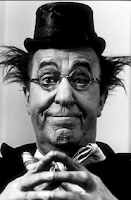
➦In 1922...Comedian, Ed Wynn became the first vaudeville star to agree to a radio contract.
In the early 1930s Wynn hosted the popular radio show The Fire Chief, heard in North America on Tuesday nights, sponsored by Texaco gasoline. Like many former vaudeville performers who turned to radio in the same decade, the stage-trained Wynn insisted on playing for a live studio audience, doing each program as an actual stage show, using visual bits to augment his written material, and in his case, wearing a colorful costume with a red fireman's helmet. He usually bounced his gags off announcer/straight man Graham McNamee; Wynn's customary opening, "Tonight, Graham, the show's gonna be different," became one of the most familiar tag-lines of its time; a sample joke: "Graham, my uncle just bought a new second-handed car... he calls it Baby! I don't know, it won't go anyplace without a rattle!"
Wynn reprised his Fire Chief radio character in two movies, Follow the Leader (1930) and The Chief (1933). Near the height of his radio fame (1933) he founded his own short-lived radio network the Amalgamated Broadcasting System, which lasted only five weeks, nearly destroying the comedian. According to radio historian Elizabeth McLeod, the failed venture left Wynn deep in debt, divorced and finally, suffering a nervous breakdown.
Wynn died June 19, 1966 in Beverly Hills, California of throat cancer, aged 79.
➦In 1935...the longtime iconic voice of the Seattle Mariners Dave Niehaus was born in Princeton Indiana. For 34 years, from the start of the franchise, he led the M’s play-by-play coverage on radio & TV. He suffered a massive heart attack and died Nov. 10, 2010 at age 75. “My oh my!!”
➦In 1981... George Harrison was ordered to pay ABKCO Music the sum of $587,000 for ‘subconscious plagiarism.’ The court found his song, “My Sweet Lord” was strikingly similar to the Chiffons early 1960s hit, “He’s So Fine.” He claimed to have used the out-of-copyright "Oh Happy Day", a Christian hymn, as his inspiration for the melody.
➦In 2007...the SIRIUS and XM Satellite Radio services announced their intention to merge.