➦In 1904...Harry Lillis "Bing" Crosby born (some sources list May 2 – Died from heart attack October 14, 1977).
Bind Crosby
He was the first multimedia star, Crosby was a leader in record sales, radio ratings, and motion picture grosses from 1931 to 1954. His early career coincided with recording innovations that allowed him to develop an intimate singing style that influenced many male singers who followed him, including Perry Como, Frank Sinatra, Dick Haymes, and Dean Martin. Yank magazine said that he was "the person who had done the most for the morale of overseas servicemen" during World War II. In 1948, American polls declared him the "most admired man alive", ahead of Jackie Robinson and Pope Pius XII. Also in 1948, Music Digest estimated that his recordings filled more than half of the 80,000 weekly hours allocated to recorded radio music.
Crosby won an Academy Award for Best Actor for his role as Father Chuck O'Malley in the 1944 motion picture Going My Way and was nominated for his reprise of the role in The Bells of St. Mary's opposite Ingrid Bergman the next year, becoming the first of six actors to be nominated twice for playing the same character. In 1963, Crosby received the first Grammy Global Achievement Award. He is one of 33 people to have three stars on the Hollywood Walk of Fame, in the categories of motion pictures, radio, and audio recording. He was also known for his collaborations with longtime friend Bob Hope, starring in the Road to... films from 1940 to 1962.
Crosby influenced the development of the postwar recording industry. After seeing a demonstration of a German broadcast quality reel-to-reel tape recorder brought to America by John T. Mullin, he invested $50,000 in a California electronics company called Ampex to build copies. He then convinced ABC to allow him to tape his shows. He became the first performer to pre-record his radio shows and master his commercial recordings onto magnetic tape. Through the medium of recording, he constructed his radio programs with the same directorial tools and craftsmanship (editing, retaking, rehearsal, time shifting) used in motion picture production, a practice that became an industry standard. In addition to his work with early audio tape recording, he helped to finance the development of videotape, bought television stations, bred racehorses, and co-owned the Pittsburgh Pirates baseball team.
On September 2, 1931, Crosby made his nationwide solo radio debut. Before the end of the year, he signed with both Brunswick and CBS Radio. Doing a weekly 15-minute radio broadcast, Crosby became a hit.
Zimmer Radio of Mid-Missouri is calling on the FCC eliminate longstanding local radio ownership limits, arguing the decades-old rules are outdated and prevent broadcasters from competing effectively against digital streaming platforms and large online advertisers.
In a letter filed in MB Docket No. 22-459, company President John P. Zimmer said the current ownership caps, largely unchanged since 1996, no longer reflect marketplace realities. He urged the FCC to loosen or remove the restrictions as part of its ongoing review of media ownership rules.
Zimmer wrote that Congress has directed the FCC to periodically update these rules, yet the limits continue to block broadcasters from achieving economies of scale needed for stronger local service and long-term financial stability.
The company, which owns and operates 10 stations across six Missouri markets, faces intensifying revenue pressure as advertising dollars shift to digital platforms. Smaller and mid-sized market stations, in particular, struggle with limited local ad bases while still covering high operational, staffing, and programming costs.
Staffing reductions driven by these pressures can directly harm a station’s ability to deliver essential local services, especially during emergencies such as severe weather, when radio often provides continuous, life-saving information to communities.
Zimmer noted that his company has diversified by acquiring a local magazine and launching a digital advertising business. However, FCC rules still restrict further investment and growth in its core radio operations.
According to the filing, relaxing ownership caps would enable broadcasters to:
Acquire additional stations.
Spread programming and operational costs.
Increase content diversity.
Better compete for audiences and advertising revenue.
Boston-based GBH and Springfield-based New England Public Media (NEPM) announced plans Friday to formally merge their operations by summer 2026, creating one of the largest statewide public media organizations in Massachusetts while preserving separate branding, headquarters, and signature programming.
GBH President and CEO Susan Goldberg will continue leading the combined organization. The move builds on seven years of collaboration and aims to expand reach, improve efficiencies, and enhance sustainability amid challenges facing public media, including potential federal funding cuts.
The merger is expected to create a unified entity reaching more than 1.3 million people across Massachusetts each week with trusted local news, information, and entertainment. Both organizations’ boards have approved the deal. The transfer of NEPM’s broadcast licenses to GBH remains subject to approval by the FCC.
“This is a forward-thinking plan to scale our journalism while maintaining our focus on local coverage,” Goldberg said in a statement. “By becoming a more sustainable business operation, we ensure that every resident of the Commonwealth has access to fact-based reporting and stories that matter — even in the face of federal defunding.”
The chairman of the FCC has denied that the White House pressured the agency to open an early license review of Disney’s eight ABC television stations, saying the probe was driven solely by the company’s diversity practices.
FCC Chair Brendan Carr stated the decision was made internally with “no pressure from the outside” and “no call for agency action from the outside.” He emphasized that “the FCC should not operate as the speech police.”
The announcement came one day after President Donald Trump publicly pressured Disney to remove ABC late-night host Jimmy Kimmel, calling it a “serious mistake” to keep him on air.
“I don’t understand how he can be on air. I think ABC is putting themselves in great jeopardy, actually,” Trump told Newsmax on Thursday.
Carr opened the investigation into Disney’s diversity practices in March 2025. He said Disney submitted documents last week that he deemed insufficient, and he is considering additional early reviews. He declined to say whether similar scrutiny of Comcast and NBC is forthcoming.
Urban One, parent company of Radio One, is acquiring two prominent Dallas-Fort Worth FM stations from a longtime local owner, reshaping the market’s urban and R&B radio landscape while spinning off another signal to a Christian broadcaster.
On Friday, Urban One announced an agreement to purchase KKDA 104.5 FM (“K104,” hip-hop) and KRNB 105.7 FM (“Smooth R&B 105.7,” adult R&B) from Hymen Childs’ Service Broadcasting Group.
Simultaneously, Radio One is transferring its 94.5 KZMJ-FM (R&B) to the Encouragement Media Group (EMG), which plans to launch its Spanish Christian “Fuzión” format on that signal.
Both deals are subject to FCC approval, with financial terms undisclosed.
Curtis Media Group, a Raleigh-based broadcasting company, has closed on a $1.75 million deal to acquire five radio stations and two translators in and around Wilmington, significantly expanding its presence in coastal North Carolina.
The acquired stations include:
Modern Rock 98.7
Jammin 99.9
Sunny 103.7
Z107.5
ESPN Wilmington
95.9 The Breeze
The stations are located in Jacksonville (98.7 FM), Boiling Spring Lakes (99.9 FM), Southport (107.5 FM), Wrightsville Beach (103.7 FM), and Wilmington (95.9 FM).
Two new DJs are joining KCRW-FM 89.9 as the Santa Monica public radio station overhauls its music programming lineup and parts ways with a longtime on-air personality.
DJ J.Rocc, founder of the influential Beat Junkies turntablist collective, will host a new weekly show Sundays from 6 p.m. to 8 p.m. Olive Kimoto, a DJ and musician known for her work in the trip-hop band Locust, will follow with her own program Mondays from 8 p.m. to 10 p.m.
At the same time, the station let go of veteran DJ Dan Wilcox, who had been on staff for 19 years after years as a volunteer. His longtime slot is being replaced by J.Rocc’s new show as part of broader programming updates.
“The magic of KCRW’s music programming is that it’s made by people with something to say, not just something to play,” said Alejandro Cohen, KCRW’s music director. “While J.Rocc and Olive are equipped with deep musical expertise, what we’re most excited about is the way their specific voices and cultural authority will compel listeners to discover things they didn’t realize they were looking for.”
USA Today Co. reported first-quarter 2026 revenue of $548.5 million, down 4% from the prior year, but swung to a net income of $19.9 million — a $27.2 million improvement from a $7.3 million loss in Q1 2025 — driven by digital growth, higher subscription revenue per user, and significant cost reductions.
The company highlighted ongoing progress in its digital transformation, with digital revenue reaching $261.9 million (47.8% of total revenue) and growing 5.2% on a same-store basis.
Digital-only subscription revenue rose to $45.9 million, marking a return to year-over-year growth and the third consecutive quarter of sequential gains.
USA Today Co. ended the quarter with approximately 1.46 million paid digital subscriptions (some reports cite 1.33–1.5 million digital-only), supported by a record-high average revenue per user (ARPU) of $10.30, up sharply from the prior year.
At least 40% of the Pittsburgh Post-Gazette newsroom is expected to lose their jobs Monday as the newspaper’s new nonprofit owners assume control, the Newspaper Guild of Pittsburgh said Friday.
The Guild anticipates the newsroom workforce could ultimately be cut in half once all employees receive formal notice. The reductions will significantly shrink coverage of local news, high school and college sports, arts, editing, and production at Pittsburgh’s oldest newspaper.
The Venetoulis Institute for Local Journalism — the nonprofit publisher of the Baltimore Banner — is acquiring the Post-Gazette from Block Communications Inc. The sale was announced April 14. Institute founder Stewart Bainum previously indicated the nonprofit would likely reduce the roughly 100-person newsroom due to industry pressures.
Staff were required to reapply for their positions and undergo 20-minute interviews with Institute leaders. Job offers went to about half the newsroom starting Wednesday, while others began receiving non-retention notices Thursday.
Alex Jones signed off from Infowars on Thursday night after nearly three decades on air, but immediately vowed to continue his broadcasts on a new platform.
In a defiant final episode from the Austin studio, Jones told viewers the power would be cut at midnight and framed the shutdown not as an end, but as the start of a renewed fight. He directed his audience to AlexJonesLive.com and a companion app, which he said were already operational, along with plans for a new studio.
“We’ve only just begun to fight,” Jones declared, urging followers to join him on the new venture while promoting merchandise, supplements, and donations. Less than a day later, he relaunched under the Alex Jones Network banner.
The National Association of Broadcasters (NAB) has announced that the 2026 Marconi Radio Award nomination window is open through May 31. The prestigious NAB Marconi Radio Awards, established in 1989 and named after inventor and Nobel Prize winner Guglielmo Marconi, recognize stations and individuals for their excellence and performance in radio.
The winners of the 2026 Marconi Radio Awards will be announced during a special dinner program on Tuesday, Oct. 20, 2026, at the Edison Ballroom the night before NAB Show New York held on Oct. 21 – 22.
The Marconi Radio Award finalists are selected by an independent body of broadcasters and will be announced in summer 2026.
All nominations must be submitted through the NAB member portal. The complete list of entry rules and qualifications can be found here.
Contact Tobi Hall at thall@nab.org for questions regarding the NAB Marconi Radio Awards, nomination process or station eligibility.
FOX News Channel’s (FNC) FOX & Friends (weekdays, 6-9 AM/ET) has set off on an all-American road trip in celebration of America250.
Co-hosts Steve Doocy, Brian Kilmeade, Ainsley Earhardt and Lawrence Jones are traveling across the country in a branded RV to host the top-rated morning show from local restaurants and establishments in six different cities. The seven-week tour will conclude in Wildwood, New Jersey on June 12th, following which the fully outfitted RV will be given away to one lucky fan live during July 3rd’s edition of FOX & Friends.
The “For All America” road trip kicked off this past week at the Armadillo Palace in Houston, Texas and will visit five additional cities over the next six weeks, including:
The Big Biscuit in Lenexa, Kansas, on May 6
Fudpuckers in Destin, Florida, on May 15
Tortuga Jacks in Jekyll Island, Georgia, on May 28
Lulus in Myrtle Beach, South Carolina, on June 5
Duffer’s Restaurant and Homemade Ice Cream Parlor in Wildwood, New Jersey, on June 12
The station shared time with Dallas stations WFAA and WRR. It was the first station in the United States to have an audible logo signal similar to the NBC chimes, the WBAP cowbell. According to President Herbert Hoover, the station's call letters stood for "We Bring A Program".
On May 15, 1923, the Federal Radio Commission expanded the broadcast band, and WBAP and WFAA moved to 630 kHz. Another expansion moved WBAP to 600 kHz effective April 15, 1927, and this frequency was shared with WOAI in San Antonio. On November 11, 1928, WBAP moved to 800 kHz, and on June 1, 1929, WFAA also moved to 800 kHz, sharing time (and NBC Red network affiliation) with WBAP.
Station owner Amon G. Carter was unhappy with having to share time on 800 kHz with WFAA. In May 1938, Carter Publishing purchased KGKO Wichita Falls (570 kHz) and moved it to Fort Worth as an affiliate of the NBC Blue network (which became ABC), and more importantly as a second frequency to be used when 800 kHz was not available. On March 29, 1941, as a consequence of the Treaty of Havana, WBAP and WFAA moved one last time, to 820 kHz.
Carter eventually sold half of KGKO to A.H. Belo, owners of WFAA, and on April 27, 1947, KGKO was replaced by a second shared frequency between WBAP and WFAA.
The dual frequency sharing arrangement between WBAP and WFAA continued through the 1950s and 1960s, with the stations switching frequencies several times a day. When WBAP changed frequencies, it signaled the change with a cowbell, which became widely associated with the station.
Even though the stations swapped frequencies several times each day, the network affiliations remained constant: NBC network programming stayed on 820 kHz and ABC network programming stayed on 570 kHz. This frequently proved confusing for announcers and listeners alike.
On May 1, 1970, the unique dual split-frequency lives of WBAP and WFAA ended when WBAP paid $3.5 million to WFAA in exchange for sole occupancy of 820 kHz (and the NBC affiliation).
WFAA took on 570 kHz (and the ABC affiliation) full-time. Once the frequency-sharing with WFAA ended in 1970, both stations were free to program musical formats, and WBAP began programming country music.
It also gained the added benefit of 820's clear-channel signal; previously WFAA controlled it during these prime nighttime hours. After a series of network affiliation changes in the late 1970s among WBAP, KRLD and WFAA, WBAP switched affiliations to ABC.
The original license for what would become KPQ was granted in 1927 to radio station entrepreneur Louis Wasmer, who named Seattle as the city of license and chose the call letters KGCL. He sold the not-yet-broadcasting station to a local sporting goods store, who officially changed the calls to KPQ. The store then resold it to Westcoast Broadcasting, who in 1928 "moved out" the station to Wenatchee.
➦In 1932...the first scheduled radio show featuring Jack Benny debuted on the NBC Blue Network. Here's a video clip from 1942.
Jack Benny first appeared on radio as a guest of Ed Sullivan in March 1932. He was then given his own show later that year, with Canada Dry Ginger Ale as a sponsor —The Canada Dry Ginger Ale Program, beginning May 2, 1932, on the NBC Blue Network and continuing there for six months until October 26, moving the show to CBS on October 30. Benny stayed on CBS until January 26, 1933.
Arriving at NBC on March 17, Benny did The Chevrolet Program until April 1, 1934 with Frank Black leading the band. He continued with The General Tire Revue for the rest of that season, and in the fall of 1934, for General Foods as The Jell-O Program Starring Jack Benny (1934–42) and, when sales of Jell-O were affected by sugar rationing during World War II, The Grape Nuts Flakes Program Starring Jack Benny (later the Grape Nuts and Grape Nuts Flakes Program) (1942–44). On October 1, 1944, the show became The Lucky Strike Program Starring Jack Benny, when American Tobacco's Lucky Strike cigarettes took over as his radio sponsor, through the mid-1950s. By that time, the practice of using the sponsor's name as the title began to fade.
The show returned to CBS on January 2, 1949, as part of CBS president William S. Paley's "raid" of NBC talent in 1948-49. There it stayed for the remainder of its radio run, which ended on May 22, 1955. CBS aired repeats of previous 1953-55 radio episodes from 1956 to 1958 as The Best of Benny for State Farm Insurance, who later sponsored his television program from 1960 through 1965.
➦In 1941...the FCC okayed the regular scheduling of TV broadcasts by commercial TV stations to begin on July 1. But the onset in the US of WW2 delayed the effective start television until the end of the decade.
➦In 1960...WLS 890 AM, Chicago, Illinois, flipped its format from Country to Top 40.
WLS had been wholly owned and operated by the radio division of the American Broadcasting Company (ABC) since the purchase of its parent company in 1959. Five years earlier WLS was merged with WENR, a station with which WLS had shared its frequency since the 1920s
Press Gazette’s latest annual ranking of the biggest English-language news publishers on YouTube shows strong subscriber growth across the board, with the platform solidifying its role as a key destination for news consumption.
The analysis highlights how traditional broadcasters, newspapers, and digital outlets are expanding their audiences on the video platform.
The BBC now leads with 19.7 million subscribers, climbing four spots since the previous ranking in January 2025 to surpass Vice News (19.1 million), ABC News (19.5 million), and CNN (19.5 million). USA Today remains the largest U.S. newspaper on YouTube with 7.5 million subscribers (up 3%), while The Sun leads U.K. newspapers with 6.4 million (up 7%).
Key Highlights from the Ranking
Press Gazette identified 122 English-language news publishers with more than one million YouTube subscribers, up from previous counts, with seven new entrants crossing the threshold (including LBC, The Independent, Novara Media, and others). A separate list of 28–31 major news influencers also showed even faster growth.
Overall growth:
The 115 publishers tracked from the prior ranking grew subscribers by an average of 16%. News influencers averaged 20% growth.
Top performers: Fifteen publishers now exceed 10 million subscribers, including Al Jazeera English (18 million), NDTV (15.7 million), and Fox News (15.2 million).
U.S. and U.K. newspaper leaders: USA Today and The Sun hold their positions as the biggest in their respective markets.
YouTube’s importance for news continues to rise. The platform reported over 15 billion hours of news watched in the first half of 2025 alone, with half of polled voters now getting more news from YouTube than traditional TV. Publishers plan to invest heavily in the platform this year, according to industry reports.
The ranking, Press Gazette’s third since 2022, also tracks views, upload volume, and fastest-growing channels. For instance, Indian outlet Firstpost added the most subscribers (2.9 million, +45%), while channels like India Today lead in video output.
Among influencers, figures like Johnny Harris and Joe Rogan (20.9 million subscribers) draw massive engagement.
This data underscores YouTube’s shift from a supplementary platform to a core distribution channel for news organizations worldwide, driving both subscriber gains and strategic pivots toward video content tailored for younger audiences.
The FCC is preparing to place a radio operator under early license renewal scrutiny over public interest obligations, just days after ordering Disney’s eight local ABC television stations to file renewals two years ahead of schedule.
FCC Chair Brendan Carr announced the upcoming radio review Thursday but did not name the broadcaster.
He emphasized the agency’s focus on accountability. “We’ve been very clear that we’re holding broadcasters accountable to their obligations,” Carr said. “It’s gone all the way to the Supreme Court, and they’ve said that holding broadcasters to their public interest obligations isn’t censorship and it isn’t a violation of their First Amendment.”
A group of television consumers filed a federal lawsuit in California on Friday seeking to halt Paramount Global’s proposed acquisition of Warner Bros. Discovery (WBD), arguing the deal would violate antitrust laws by reducing competition in the streaming and entertainment industry.
The plaintiffs contend that the merger would lead to higher prices for consumers, fewer choices in streaming services and content, and a reduction in new productions, ultimately harming viewers. They are asking the court to block the transaction before it can close.
Paramount responded that the lawsuit lacks merit and vowed to defend the deal vigorously. The company maintains that the combination would create a stronger competitor in the rapidly evolving media landscape dominated by tech giants like Netflix, Amazon, and Disney.
Five additional states have joined a federal antitrust lawsuit seeking to block or unwind Nexstar Media Group’s $6.2 billion acquisition of Tegna Inc., expanding the challenge to a bipartisan coalition of 13 states and intensifying legal pressure on the deal that has already closed.
California Attorney General Rob Bonta announced Thursday that Indiana, Kansas, Massachusetts, Pennsylvania, and Vermont have joined the suit, which was originally filed last month by eight states.
The amended complaint argues the merger violates federal antitrust laws by creating an overly concentrated local television market, potentially leading to higher advertising and consumer prices, reduced competition, job cuts in newsrooms, and diminished local programming.
The coalition now includes attorneys general from: California, Colorado, Connecticut, Illinois, Indiana, Kansas, Massachusetts, New York, North Carolina, Oregon, Pennsylvania, Vermont, and Virginia.
FCC Targets Radio Broadcaster for Early License Review: The FCC is preparing to place an unnamed radio operator under early license renewal scrutiny over public interest obligations. The move comes just days after the FCC ordered Disney’s eight local ABC television stations to file renewals two years ahead of schedule. FCC Chair Brendan Carr announced the radio review Thursday but did not identify the broadcaster. He stressed the agency’s commitment to enforcing public interest obligations, citing Supreme Court precedent that such oversight does not violate the First Amendment.
Salem Media Launches National Morning Show: Larry O’Connor is host of new national morning program, “O’Connor & Company,” launching May 4 from 6:00–9:00 a.m. Eastern. The show will air on more than 140 stations across the Salem Radio Network and simulcast on the Salem News Channel. O’Connor will continue hosting the same slot on WMAL in Washington, D.C.
RIP: Chad Hasty: Longtime West Texas radio host Chad Hasty died Thursday at age 43. The influential conservative voice in Lubbock and state politics passed away peacefully in his sleep at his Lubbock County home, according to Townsquare Media, owner of News/Talk 95.1 & 970 KFYO. His cause of death has not been released, but officials believe it was natural.
Apple delivered strong iPhone sales and healthy profit margins in its latest quarter, providing a solid financial foundation for incoming CEO John Ternus.
The company reported quarterly revenue of $111.2 billion, beating Wall Street expectations, driven by a 21.7% surge in iPhone sales to nearly $57 billion. Customers upgraded devices at a brisk pace, fueled by excitement over the iPhone 17 lineup.Apple’s gross profit margin reached 49.3%, also exceeding forecasts and underscoring the strength of its premium business.
iPhone sales in China jumped 28% in the quarter, marking a second straight period of strong growth after years of weakness. The results helped Apple claim the top global smartphone market share position in the March quarter for the first time, according to Counterpoint Research. Its dominance in the premium segment helped shield it from rising component costs.
FCC Chairman Brendan Carr said Thursday that the agency’s decision to order an early license review for Disney’s ABC television stations stems from an ongoing investigation into the company’s diversity, equity and inclusion practices, not from President Trump’s public feud with late-night host Jimmy Kimmel.
“This was based on DEI conduct and not speech,” Carr said at a press conference following the FCC’s monthly meeting.
The review focuses on whether Disney’s DEI initiatives violate the FCC’s equal employment opportunity rules that prohibit discrimination based on race and gender. Carr said information received from Disney has raised suspicions of noncompliance, and he accused the company of being slow and evasive in its responses. “It felt like they were playing rope-a-dope,” Carr said of Disney’s handling of document requests.
The 2026 FIFA World Cup returns to the United States for the first time in over 30 years, creating a powerful advertising window where global scale, emotion, and real-time consumer attention converge.
Spanning 11 host cities from June 11 to July 19, the tournament offers brands a rare chance to connect with highly engaged domestic audiences during one of the year’s biggest media moments.Radio stands out as an essential channel during the event. As fans follow matches across time zones while commuting, working, running errands, or multitasking, AM/FM radio provides constant, always-on access to live action and conversation—reaching consumers even when screens are unavailable.
Michael Massimino, Jane Seymour, Merrill Reese, David Yadgaroff
Audacy has announced legendary sports broadcaster Merrill Reese has been named a 2026 recipient of the prestigious Common Wealth Award of Distinguished Service for his outstanding contributions to mass communications and his lasting impact on sports broadcasting.
Reese was honored at the 2026 awards ceremony on April 24 at the Hotel DuPont in Wilmington, DE. Fellow 2026 honorees include astronaut Michael Massimino and actress Jane Seymour.
“Merrill Reese is a Philadelphia institution and one of the greatest play-by-play broadcasters in NFL history,” said David Yadgaroff, Senior Vice President of Sales, Audacy Philadelphia. “His passion, professionalism and unmistakable voice have defined generations of Eagles football on the radio. We’re incredibly proud to have him on our team and see him receive this well-deserved and remarkable achievement.”
Audacy has announced the appointment of two new members of its Board of Directors, Walker Jacobs, DAZN Global Chief Revenue Officer and President of DAZN USA, and Gabriel Brotman of Soros Fund Management.
”The appointments of Walker and Gabe to the Audacy Board of Directors further advance our ability to capture all the opportunities we see across the fast-changing audio landscape,” said Kelli Turner, President and Chief Executive Officer, Audacy. “Their expertise and guidance will be invaluable as we continue to evolve our platform, strengthen our partnerships, and drive long-term value for our audiences, advertisers and shareholders.”
Salem Media has named Larry O’Connor as the host of its new national morning program, “O’Connor & Company,” launching May 4 from 6:00–9:00 a.m. Eastern.
The show will air across the Salem Radio Network on more than 140 affiliated stations and simulcast on the Salem News Channel, expanding O’Connor’s reach as one of conservative media’s most prominent voices.
O’Connor will continue hosting his flagship “O’Connor & Company” morning show in the same 6:00–9:00 a.m. Eastern slot on WMAL in Washington, D.C., while the program simultaneously becomes Salem’s national morning flagship.
Cumulus Media is accelerating its commitment to data-driven sales by partnering with The Media Audit and TOMA.Solutions. The move brings sophisticated market and consumer intelligence to Cumulus stations across a growing number of U.S. markets, providing a level of local clarity that goes far beyond traditional audience metrics.
The Media Audit provides granular local market data on consumer lifestyles, purchasing behavior and cross-platform media usage. TOMA.Solutions adds a powerful layer of competitive insight by measuring "Top-of-Mind Awareness," revealing which local brands own the first-to-mind position in their categories. Together, these tools give Cumulus teams a clearer view of the local marketplace—helping identify high-potential audiences, uncover category demand, and pinpoint exactly where brands stand against their competitors.
Dave Roberts who has had a highly decorated career of nearly five decades in the media industry, will retire from his position as ESPN Executive Vice President, Executive Editor, Sports News and Entertainment at the end of August.
Roberts, who joined ESPN in 2004 as a coordinating producer, currently oversees ESPN’s vast news operation including sports news and coverage, investigative and enterprise journalism, research and digital editorial and all editions of SportsCenter. He also has oversight of studio shows including First Take, Get Up, PTI, NFL Live and fantasy shows, ESPN Audio, ESPN podcast content, ESPN digital shows, the Creative Content Unit and the Studio Enhancement Team.
“This has been both a real honor and a blessing to work for and with the most talented people in the industry,” Roberts said. “I am extremely humbled and grateful to have had the opportunities afforded me as a member of the ESPN leadership team. It has been simply an awesome 22 years.”
Chad Hasty, longtime West Texas radio host and influential voice in Lubbock and state politics, died Thursday at age 43.
Hasty passed away peacefully in his sleep early Thursday morning at his Lubbock County home, according to Townsquare Media, which operates News/Talk 95.1 & 970 KFYO. His cause of death was not immediately released, but officials believe it was from natural causes.
"News/Talk 95.1 & 970 KFYO and Townsquare Media are deeply saddened to share the news that longtime host, beloved personality, and Lubbock institution Chad Hasty passed away peacefully in his sleep on Thursday morning," the media group said in a statement posted Thursday afternoon.
➦In 1907...Kate Smith born in Greenville, VA (Died – June 17, 1986). She was considered to be The First Lady of Radio, best-known for her rendition of Irving Berlin's "God Bless America". She had a radio, television, and recording career spanning five decades, which reached its pinnacle in the 1940s. Smith became known as The Songbird of the South after her endearing popularity during World War II.
Smith was a major star of radio, usually backed by Jack Miller's Orchestra. She began with her twice-a-week NBC series, Kate Smith Sings (quickly expanded to six shows a week), followed by a series of shows for CBS: Kate Smith and Her Swanee Music (1931–33), sponsored by La Palina Cigars; The Kate Smith Matinee (1934–35); The Kate Smith New Star Revue (1934–35); Kate Smith's Coffee Time (1935–36), sponsored by A&P; and The Kate Smith A&P Bandwagon (1936–37).
The Kate Smith Hour was a leading radio variety show, offering comedy, music, and drama with appearances by top personalities of films and theater for eight years (1937–1945). The show's resident comics, Abbott and Costello and Henny Youngman, introduced their comedy to a nationwide radio audience aboard her show, while a series of sketches based on the Broadway production of the same name led to The Aldrich Family as a separate hit series in 1940.
Smith continued on the Mutual Broadcasting System, CBS, ABC, and NBC, doing both music and talk shows on radio until 1960.
➦In 1918...Jack Paar born in Canton, OH (Died at age 85 – January 27, 2004). He is best known for his stint as the second host of The Tonight Show from 1957 to 1962.
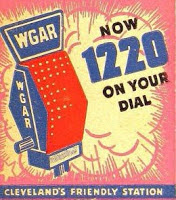
He first worked near home as a radio announcer at WIBM in Jackson, Michigan, and later as a humorous disc jockey at Midwest stations, including WJR in Detroit, WIRE in Indianapolis, WGAR in Cleveland, and WBEN in Buffalo. In his book P.S. Jack Paar, he recalled doing utility duty at WGAR in 1938 when Orson Welles broadcast his famous simulated alien invasion, The War of the Worlds, over the CBS network (and its WGAR affiliate). Attempting to calm possibly panicked listeners, Paar announced, "The world is not coming to an end. Trust me. When have I ever lied to you?"
Paar was drafted into the military in 1943 during World War II, interrupting his tenure as host of WBEN's morning show The Sun Greeter's Club (he opted not to return to the station at war's end, instead seeking opportunities in network radio and film). He was assigned to the U.S.O. in the South Pacific to entertain the troops. He was a clever, wisecracking master of ceremonies whose impersonations of officers nearly got him into trouble.
After World War II, Paar worked in radio as a fill-in on Don McNeil's Breakfast Club show and appeared as a panelist on The $64,000 Question. He got his big break when Jack Benny, who had been impressed by Paar's U.S.O. performances, suggested that Paar serve as his 1947 summer replacement. Paar was enough of a hit on Benny's show that Benny's sponsor, the American Tobacco Company, decided to keep him on the air, moving him to ABC for the fall season.
➦In 1931...Kate Smith began her radio show on the CBS Radio Network.
➦In 1935...the first radio tube to be made of metal was produced in Schenectady, New York.
➦In 1957...Larry King got his first job in radio. The manager of a small station, WAHR (now WMBM) in Miami Beach, hired him to clean up and perform miscellaneous tasks. When one of the station's announcers abruptly quit, King was put on the air. His first broadcast was on May 1, 1957, working as the disc jockey from 9 a.m. to noon. He also did two afternoon newscasts and a sportscast. He was paid $50 a week.
SiriusXM added paid subscribers sequentially and posted better-than-expected earnings in the first quarter, even as its paid subscriber base shrank slightly year-over-year to 31.2 million, down 109,000 from a year ago. Total subscribers, including trial users, stood at about 33 million and remained essentially flat compared with the prior year.
The company reported revenue of $2.09 billion, up 1% year-over-year, and net income of $245 million. Earnings per diluted share rose 22% to 72 cents from 59 cents, beating Wall Street expectations. Advertising revenue grew 5% to $372 million, driven by a 37% surge in podcasting revenue that offset softer demand in streaming music.
Churn improved to a record-low 1.5% for a first quarter, even after the company’s first back-to-back annual price increase in February. SiriusXM described churn as a “standout” area that continues to improve.
David Allan Coe (often misspelled as "Cole"), a pioneering figure in outlaw country music, died on April 29, 2026, at the age of 86. No official cause of death has been publicly disclosed, though reports noted he had been in declining health and was in intensive care in the period leading up to his passing.
Early Life and Rise to FameBorn September 6, 1939, in Akron, Ohio, Coe had a turbulent youth marked by time in reform schools and prisons. He turned to music after his release in the late 1960s, busking in Nashville (famously living out of a hearse) and initially performing blues before shifting to country.
He became a key part of the 1970s outlaw country movement alongside artists like Waylon Jennings and Willie Nelson. Coe cultivated a rebellious, larger-than-life persona, complete with long hair, rhinestone suits, a Lone Ranger mask gimmick ("The Mysterious Rhinestone Cowboy"), and biker associations—that often put him at odds with Nashville's establishment but endeared him to fans.
The National Association of Broadcasters slammed the FCC’s move to target ABC for an early license renewal in the wake of Jimmy Kimmel and Donald Trump’s latest controversy.\
The NAB released a statement on Wednesday calling for a united front as the FCC pressures Disney’s broadcast license.
“The FCC’s broadcast license renewal process must be grounded in predictability, fairness and transparency, principles reflected in the license terms Congress established and later extended,” NAB President and CEO Curtis LeGeyt said. “The Media Bureau’s nearly unprecedented request for one company to quickly reapply for all of its licenses – rather than utilize its traditional enforcement process – runs contrary to these principles and creates significant uncertainty for all broadcasters.”
He continued: “Broadcast stations already face intense challenges as they work to deliver trusted journalism, lifesaving emergency services, community programming and election coverage. The FCC must be careful to avoid actions that create further instability for the local stations viewers and listeners depend on.”
FOX News Channel (FNC) closed April leading ABC and NBC in primetime for the month, according to Nielsen Big Data + Panel. Averaging 3,224,000 viewers in weekday primetime, FNC outpaced both ABC (3,125,000 viewers) and NBC (3,047,000 viewers).
In Monday-Sunday primetime, FNC drew 2.9 million viewers and 284,000 in the 25-54 demo. Across total day, FNC delivered 1.8 million viewers and 173,000 in the 25-54 demo in April. FNC also ranked number one in cable among Asian, Hispanic and upscale viewers throughout total day. Additionally, FNC saw year-over-year gains with viewers in total day and primetime. This month marked FNC’s third most-watched April with total day and primetime viewers in the network’s history. FNC commanded nearly 60% of the cable news share across both total day and primetime.
Notably, April marked historic lows for CBS. The network averaged under four million viewers in primetime for the first time this century. CBS Evening News anchor Tony Dokoupil continued to reach new lows slumping to 3.9 million viewers and 497,000 in the 25-54 demo, the show’s worst month since he became anchor. The program has now recorded three consecutive weeks under four million viewers and has marked nine weeks under this mark since Bari Weiss took over in October. Ahead of its final episode in May, The Late Show with Stephen Colbert posted its worst April ever in the 25-54 demo with just 292,000 viewers. Additionally, CBS Mornings cratered to 1.8 million viewers and 282,000 in the 25-54 demo this month, its worst April in history.
For the week of April 20–26, 2026, primetime viewership (and overall linear TV) was led by news programs and established broadcast hits, particularly on CBS, amid typical spring programming and some sports overlap (e.g., NBA playoffs and NFL Draft).
CBS performed strongly with scripted series. Top shows included Tracker (8.17 million viewers), Marshals (7.61 million), 60 Minutes (~7.33 million), and others like Georgie & Mandy's First Marriage, Survivor, NCIS, and Fire Country frequently in the broader top ranks. CBS generally led or competed closely in total viewers for the period.
ABC benefited heavily from ABC World News Tonight (multiple airings in the overall top 10, e.g., Monday edition ~8.85 million earlier in related data; weekly averages around 8.5 million). Other notables: American Idol, Will Trent, and 9-1-1. ABC ranked competitively in primetime, often behind CBS but ahead of NBC in some metrics.
NBC had solid but lower showings overall, with NBC Nightly News (6.17–6.39 million weekly), Chicago Med (5.44 million), NBA Playoffs coverage, and The Voice. NBC trailed the other two big networks in many traditional primetime rankings this week.
📺Evening news summary for the week (national live+same-day):
ABC World News Tonight led with ~8.54 million total viewers and ~1.06 million A25-54; NBC Nightly News ~6.17 million / ~831k A25-54; CBS Evening News ~3.77 million / ~467k A25-54.
Broader context: CBS has been a season-long leader in many categories, though NBC was projected to challenge or surpass it in total viewers for the full 2025-26 season due to sports (e.g., Olympics, Super Bowl). April 2026 saw lower overall numbers for some networks, with Fox News Channel often outperforming ABC and NBC in weekday primetime for the month (~3.22 million vs. ABC ~3.13 million and NBC ~3.05 million).
FOX News Channel (FNC) ended the week of April 20 averaging 2.9 million weekday primetime viewers and 263,000 in the 25-54 demo, outpacing ESPN (2.6 million) during the NBA and NHL playoffs.
Notably, the network’s breaking news coverage surrounding the White House Correspondents’ Dinner led all of television with 5.6 million viewers during the 10 PM/ET hour on Saturday. Leading all of cable news for the week, FNC dominated MS NOW (1.4 million and 145,000 A25-54) and nearly quadrupled CNN (734,000 and 109,000 A25-54) in total viewers, according to Nielsen Media Research Big Data + Panel.
In Monday – Sunday primetime, FNC drew 2.9 million viewers and in Monday – Sunday total day, FNC drew over 1.7 million viewers. Meanwhile, CBS Evening News (3,771,000 million viewers) recorded its lowest rated week since host Tony Dokoupil began helming the program and saw its third consecutive week with under four million total viewers.
The Five maintained its stronghold in the afternoon with 3,642,000 million viewers and 283,000 in the 25-54 demo. In the 6 PM/ET hour, Special Report with Bret Baier secured nearly 2.8 million viewers and 223,000 in the 25-54 demo. At 7 PM/ET, The Ingraham Angle garnered just over 2.6 million viewers and 225,000 in the 25-54 demo. During the 8 PM/ET hour, Jesse Watters Primetime notched nearly 3.2 million viewers and 253,000 in the 25-54 demo. At 9 PM/ET, Hannity delivered roughly 2.8 million viewers and 238,000 in the 25-54 demo. During the 11PM/ET hour, FOX News @ Night with Trace Gallagher nabbed close to 1.6 million viewers and 177,000 in the 25-54 demo.
Universal Music Group (UMG) will sell half of its equity stake in Spotify and use the proceeds to fund an expanded $1.167B share buyback program, the company announced Wednesday alongside its Q1 2026 financial results.
The move comes just three weeks after Bill Ackman’s Pershing Square launched a $64 billion takeover bid for UMG that called for liquidating the company’s entire Spotify holding to help finance the deal.
UMG’s board has not yet ruled on Ackman’s proposal.
A UMG press release confirmed that, consistent with its artist compensation policy, artists will share in the proceeds from the Spotify sale. UMG’s portion will initially support the buyback program.
Cumulus Media reported a 12% drop in revenue as it moves forward with a prepackaged Chapter 11 reorganization. The U.S. Bankruptcy Court for the Southern District of Texas has confirmed the company’s Chapter 11 Plan of Reorganization, which is expected to take effect once it receives FCC approval and meets remaining conditions.
FCC's Carr Overstepping Authority: Republican Sen. Ted Cruz criticized FCC Chairman Brendan Carr for overstepping his authority after the agency ordered Disney to file an early license renewal for ABC’s eight local broadcast stations. The request, due within 30 days or by May 28, stems from an investigation into potential violations of the Communications Act of 1934 and FCC rules, including the ban on unlawful discrimination. It follows Carr’s earlier warnings regarding Disney’s broadcast licenses over the company’s diversity, equity, and inclusion (DEI) initiatives.
Audacy is changing the format of its 97.1 FM station in Los Angeles to all-sports as “The Fan,” launching on May 11 and becoming the market’s first all-sports FM station. The company announced it will end the simulcast of its all-news station KNX on 97.1 FM. KNX will continue its news programming exclusively on its AM signal at 1070 and on 97.1 HD2.
FOX Business Network (FBN) outpaced CNBC across business day, market hours and total day in April 2026, according to Nielsen Media Research Big Data + Panel. Led by FBN’s market open and close programs, Varney & Co. and Kudlow placed as the top two business programs in television and besting their CNBC counterparts for the 50th and 55th consecutive months, respectively.
For the 12th straight month, FBN outranked CNBC in business day securing 254,000 viewers and besting them by 11%. In market hours (251,000 viewers), FBN led CNBC with a 6% win and in total day viewers, FBN reigned over CNBC for the second straight month garnering 151,000 viewers, an 8% win. Notably, FBN posted double-digit year-over-year increases in total viewers in business day and market hours.
“World News Tonight with David Muir” stood as the No. 1 program in Total Viewers (8.537 million) on all of broadcast and cable for the second straight week during the week of April 20, 2026, based on Live+Same Day Big Data Plus Panel Program Ratings from Nielsen Media Research.
Republican Sen. Ted Cruz accused FCC Chairman Brendan Carr of overstepping his authority after the agency demanded Disney file for an early license renewal of ABC’s eight local broadcast stations.
“It is not government’s job to censor speech, and I do not believe the FCC should operate as the speech police,” Cruz told Punchbowl News.
Alphabet beat Wall Street expectations and posted robust first-quarter results after the market closed Wednesday, driven by continued strength in artificial intelligence and cloud services.
Revenue rose 22% year-over-year (19% in constant currency) to $109.9 billion, marking the company’s 11th straight quarter of double-digit growth. Google Services revenue climbed 16% to $89.6 billion, led by a 19% increase in Google Search, a 19% jump in subscriptions, platforms and devices, and an 11% rise in YouTube advertising.
The company now has more than 350 million paid subscriptions across YouTube and Google One. It delivered its strongest-ever quarter for consumer AI products, powered by rapid adoption of the Gemini app.
YouTube Music and Premium also posted their largest quarterly gain in non-trial subscribers both globally and in the U.S. YouTube Premium finished the quarter fully launched in 23 countries and plans to enter a dozen more in Q2.
Alphabet has now beaten earnings estimates for 10 consecutive quarters. Over the past year, its stock has surged more than 114%, largely on the back of AI and cloud momentum.


%20-%20Copy.png)


.png)




.png)
