The Federal Trade Commission (FTC) sent a warning letter to Apple CEO Tim Cook on Wednesday alleging that the Apple News app may be violating consumer protection laws by systematically promoting left-leaning news outlets while suppressing or excluding conservative ones.
FTC Chairman Andrew Ferguson (appointed under the Trump administration) stated that such curation practices could breach Section 5 of the FTC Act, which prohibits unfair or deceptive acts in commerce. He cited reports—including a Media Research Center study claiming no articles from right-leaning sources like Fox News, Breitbart, the New York Post, Daily Mail, or The Gateway Pundit appeared in top stories from January 1–31, 2026—while left-leaning outlets (e.g., The Washington Post, NBC News, The Guardian) and some center ones dominated.
Ferguson argued this may deceive users if it contradicts Apple's terms of service, representations about the app, or reasonable consumer expectations for neutral news aggregation used by tens of millions of Americans. He emphasized that while the First Amendment protects editorial choices and Big Tech speech, it does not shield material misrepresentations, omissions, or unfair practices—even those involving content curation.
The letter urges Apple to conduct a comprehensive review of its curation policies, terms of service, and practices, and to take swift corrective action if inconsistencies are found. Ferguson clarified the FTC is not demanding ideological balance or acting as "speech police," but focusing on potential consumer deception and injury without offsetting benefits.
Apple has not yet issued a public response. This is a warning and inquiry, not a formal investigation or enforcement action so far.
This development highlights ongoing debates over tech platforms' news aggregation and content moderation in the current regulatory climate.
FCC Regulatory Activity: The Federal Communications Commission (FCC) published a rule in the Federal Register titled "Radio Broadcasting Services; Various Locations". This appears to involve routine or specific allocations/changes for radio stations in multiple areas, which could affect licensing, frequency assignments, or service expansions for broadcasters.
World Radio Alliance Report Reinforces Radio's Trust Leadership: A key global study from the World Radio Alliance (in collaboration with egta), highlighted around World Radio Day themes and still prominent in industry discussions, confirms radio as the most trusted medium in the U.S. and worldwide. In non-European countries (including the U.S.), 70% of people view radio as the most reliable information source—higher than other media. This trust edge bolsters radio's role in news, emergency alerting, and community engagement, especially valuable amid competition from digital platforms and ongoing debates about media credibility.
Media Industry
Lingering Debate Over FCC Broadcast Media Ownership Rules: Momentum from Monday's Senate Commerce Committee hearing ("We Interrupt This Program: Media Ownership in the Digital Age") persists, with ongoing discussions on modernizing or repealing rules like the 39% national TV household reach cap. Witnesses, including Newsmax CEO Chris Ruddy and industry advocates, argued the cap is outdated in a streaming-dominated era, potentially limiting broadcasters' ability to compete with Big Tech. Concerns include impacts on local journalism, media diversity, and conservative representation. The pending Nexstar-TEGNA merger (announced 2025, potentially closing in late 2026 pending approvals) remains a flashpoint—if approved without cap changes, it could exceed household limits significantly. No action occurred on February 12, but the hearing fuels calls for congressional or FCC updates.
Paramount Skydance's Enhanced Hostile Bid: Paramount (led by David Ellison) further sweetened its all-cash $30 per share offer for the entire WBD (valuing it at ~$108.4 billion enterprise value). Key additions to pressure shareholders and demonstrate confidence: A $0.25 per share "ticking fee" (~$650 million quarterly) payable to WBD shareholders for each quarter the deal doesn't close after December 31, 2026. Activist Investor Pushback: Ancora Holdings (holding a ~$200 million WBD stake) publicly opposed the Netflix deal as "flawed" and "inferior," citing lower value, spinoff uncertainty, and regulatory risks. Ancora plans to vote against Netflix at the shareholder meeting, solicit proxies against it, and urges WBD's board to engage with Paramount. It criticizes the Netflix path as rushed and less certain.
U.S. News
Nancy Guthrie Missing/Abduction Case Enters Day 12: Key updates include:
No suspects are in custody, but the Pima County Sheriff indicated more detentions are likely as investigators process thousands of tips (over 18,000 total since February 1, with more than 4,000 in the last 24 hours after releasing new evidence).
FBI agents are scouring rugged desert terrain, roadways, and foothills near her Catalina Foothills home. A black glove (matching one worn by a suspect in surveillance footage) was reportedly found on a dirt path nearby.
The U.S. labor market showed a notable hiring rebound in January 2026: Key highlights:
Nonfarm payrolls increased by 130,000 jobs in January. This significantly exceeded economists' expectations, which had ranged around 55,000 to 70,000 jobs added.
It represented the strongest monthly job growth since December 2024, following a period of extremely sluggish hiring throughout much of 2025.
The unemployment rate edged down to 4.3% from 4.4% in December
House Rebukes Trump on Canada Tariffs: In a rare bipartisan move, the Republican-led U.S. House voted to block or end President Trump's imposed tariffs on Canada, with several Republicans crossing party lines. This signals growing midterm election anxieties over economic fallout from his trade agenda. The vote increases pressure on the administration to adjust course amid broader tariff threats.
NBC's The Today Show has experienced a significant 23% surge in viewership during the week ending February 6, 2026, drawing an average of 3.32 million viewers as audiences tuned in for updates on the disappearance of co-anchor Savannah Guthrie's mother, Nancy Guthrie, alongside coverage of the Winter Olympics.
This marked a gain of approximately 624,000 viewers compared to the same period in 2025, with the program capturing 41% of morning TV audiences, outperforming ABC's Good Morning America (2.91 million viewers, 36% share) and CBS Mornings (1.84 million viewers, 23% share).
The boost is attributed in part to public fascination with the Nancy Guthrie case, as the show served as a key source for developments in the investigation, including breaking news segments and expert analysis. However, the concurrent broadcast of the Milan Cortina Winter Olympics on NBC and Peacock also played a role, as Olympic events historically elevate morning show ratings during such periods.
Savannah Guthrie has been absent from the program since her mother's abduction, with co-host Hoda Kotb stepping in to anchor alongside others.
Nancy Guthrie, 78, was last seen at her Tucson, Arizona, home on January 31, 2026, and authorities are treating her disappearance as a kidnapping, with no suspects identified as of February 11, 2026. The case has drawn widespread media attention, including increased security at the Today Show's New York studio out of caution, and speculation about potential high-ratings specials on NBC's Dateline.
The FBI has reported a surge in tips following the release of surveillance footage, and other networks like ABC's World News Tonight have also covered developments with expert breakdowns.
Historically, The Today Show has maintained strong ratings under Savannah Guthrie's co-anchorship since 2012, often leading in the key 25-54 demographic, though personal crises like this one highlight the program's role as both a news outlet and a perceived "family" for viewers.
Radio remains the most trusted and widely used mass medium in the U.S., according to fresh data compiled by the World Radio Alliance (WRA). This reaffirms radio's resilience and credibility in an era of declining overall media trust and increasing fragmentation from digital platforms.
Key findings from the WRA include:79% of U.S. adults aged 18 and older rate radio as very trustworthy or trustworthy. This edges out newspapers (77%), television (68%), magazines (68%), and dramatically surpasses social media (28%).
The WRA, a global coalition of radio industry bodies (including the U.S. Radio Advertising Bureau), compiles these metrics to showcase radio's strengths for advertisers, audiences, and public information roles. The data highlights radio's local, live, and community-oriented nature as key factors in its perceived authenticity and accuracy—qualities often lacking in algorithm-driven social feeds or polarized TV/news outlets.
This trust advantage holds amid broader skepticism toward mass media. For context, a September 2025 Gallup poll found overall trust in newspapers, TV, and radio combined at a historic low of just 28% (for reporting news "fully, accurately, and fairly"), down from prior years. Radio consistently outperforms in targeted surveys, including a recent Katz Radio Group study showing it as the top trusted medium among adult women at 83%—ahead of newspapers (79%), TV (74%), podcasts (70%), magazines (69%), and social media (48%).
Radio's enduring reach—especially in cars, workplaces, and daily routines—combined with high engagement in ad-supported formats, continues to make it a dominant audio force despite competition from streaming and podcasts. The WRA's emphasis on these figures, often tied to World Radio Day promotions and global comparisons (where radio also leads in trust in markets like the EU), positions it as a credible, high-impact medium in a distrustful landscape.
Salem Media has announced two key leadership appointments impacting its Pittsburgh market.
Jason Mosher has been promoted to Regional General Manager overseeing the Pittsburgh market in addition to Atlanta. Dave Cuddihy has been named General Sales Manager for Salem’s Pittsburgh radio and digital operations.
Cuddihy, a Pittsburgh native, will spearhead local advertising sales and strategic business development for Salem’s Pittsburgh portfolio, including WORD-FM (101.5 FM), WPGP-AM The Answer (1250 AM), and WPIT (730 AM), along with Salem Surround, the company’s full-service digital marketing division. He most recently served as Publisher of the Latrobe Bulletin and Ligonier Echo in Westmoreland County and brings more than two decades of proven media and advertising leadership, along with deep-rooted relationships throughout the Pittsburgh business community. His appointment strengthens Salem’s commitment to delivering integrated marketing solutions across broadcast and digital platforms.
Jason, Dave
Allen Power, President of Broadcast Media, commented, “We are excited to combine Jason’s leadership track record at Salem with Dave’s deep market knowledge of Pittsburgh. They are focused on growing our sales team in the market with a commitment to providing outcome-based solutions for advertisers.”
“Pittsburgh has always been about relationships, work ethic, and trust,” Cuddihy said. “I’m proud to be from this area and to work with local businesses as a neighbor who understands how success is built here. One factor that stood out to me in joining the team at Salem Media is that our stations and complete digital portfolio allow us to reach deeply engaged Christian and conservative audiences while delivering modern marketing solutions that drive real, measurable results for our partners.”
Mosher is based in Salem Media’s Atlanta office and will provide strategic leadership and operational oversight for multiple markets, including Pittsburgh. Mosher has been with Salem Media for six years and was recently promoted from Regional Sales Director where he led sales efforts for Pittsburgh, Atlanta and Cleveland and brings 20 plus years of broadcast leadership experience, including leadership roles with iHeartMedia and CBS Radio.
“We are committed to growth in Pittsburgh,” Mosher added. “In the near future, we are looking to bring on additional media strategists to build out the local team.”
SiriusXM will offer listeners extensive coverage of the 68th running of the DAYTONA 500 on February 15, as well as other live races happening during NASCAR’s Speedweek, access to in-car audio from drivers, and daily coverage from Daytona International Speedway.
NASCAR fans can hear it all in their cars and on the SiriusXM app on the exclusive 24/7 SiriusXM NASCAR Radio channel (channel 90).
On DAYTONA 500 race day, Sunday, Feb. 15, SiriusXM will broadcast live from the track starting at 7 am ET. When the green flag drops (approximately 2:30 pm ET) listeners will hear every lap of the race live, followed by post-race coverage that will include interviews with the 2026 DAYTONA 500 Champion and other drivers. In addition to the main race broadcast on SiriusXM NASCAR Radio, SiriusXM will also offer 10 additional Driver2Crew ChatterTM channels that will carry the in-car communication feeds of several teams throughout the race.
SiriusXM NASCAR Radio will also provide live coverage of the America 250 Florida Duel at DAYTONA on Thursday, Feb. 12 at 7 pm ET, the Fresh from Florida 250 NASCAR Craftsman Truck Series race on Friday, Feb. 13 at 7:30 pm ET, and on Saturday, Feb. 14, both the General Tire 200 NASCAR ARCA Series race at noon ET and the United Rentals 300 NASCAR O’Reilly Auto Parts Series race at 5 pm ET.
In addition to airing the live race broadcasts, the SiriusXM NASCAR Radio channel will broadcast from the infield at Daytona International Speedway throughout the week. Hosts Dave Moody, Danielle Trotta, Larry McReynolds, Mike Bagley, Pete Pistone, Brad Gillie, Todd Gordon, Mike and Angie Skinner, John Roberts, Pat Patterson and others will be live on site interviewing drivers, crew chiefs, owners and others, and providing insight on everything happening around the track.
On Thursday, SiriusXM will team up with Dirty Mo Media, the multimedia content platform of Dale Earnhardt Jr., for a series of special fan-facing shows at the Daytona Fan Zone Stage. Fans at the track will be able to watch as Dale Jr. hosts a live episode of his popular podcast, “Dale Jr. Download,” from 3-4 pm ET. Dale Jr. will be joined on stage by 2023 NASCAR Cup Series champ Ryan Blaney.
Following the episode of the “Dale Jr. Download,” several SiriusXM NASCAR Radio and Dirty Mo personalities including Danielle Trotta, Jordan Bianchi, Pete Pistone and others will team up for a live show from 4-4:30 pm ET. SiriusXM’s Dave Moody will then host a special episode of “SiriusXM Speedway” live from the stage from 4:30-6 pm ET, leading into live coverage of that night’s America 250 Florida Duel at DAYTONA.
On Monday, Feb. 16, on “The Morning Drive,” hosts Mike Bagley and Pete Pistone will be back at the track to recap Sunday’s race and interview the 2026 DAYTONA 500 champion driver, crew chief and owner.
Gallup will stop tracking and publishing presidential approval ratings after more than eight decades, the polling organization confirmed Wednesday.
The decision, effective this year, ends the long-running Gallup Presidential Approval Rating — a key metric widely cited by media to gauge public views of a president's performance. Gallup will no longer publish approval or favorability ratings for individual political figures.
"This reflects an evolution in how Gallup focuses its public research and thought leadership," a spokesperson said. "Our commitment is to long-term, methodologically sound research on issues and conditions that shape people’s lives."
The change aligns with Gallup's broader mission, with ongoing work continuing through efforts like the Gallup Poll Social Series, World Poll, and other U.S. and global surveys on topics such as workplace engagement, AI views, and institutional trust.
The announcement comes as President Trump's Gallup approval stood at 36% in December 2025 — among the lowest recorded since the 1930s — after peaking at 47% earlier in his second term.
For historical context, Gallup data showed:
Former President Truman averaged 45% (1945–1953)
Former President Biden averaged 42% (2021–2025)
Former President Kennedy averaged 71% (1961–1963)
Former President Eisenhower averaged 61% (1953–1961)
Gallup emphasized the shift is driven solely by its research priorities, with no input from the White House or administration. A spokesperson told The Hill: "This is a strategic shift solely based on Gallup’s research goals and priorities."
Former pop superstar Britney Spears has sold the rights to her entire music catalog to independent music publisher Primary Wave, in a major deal reportedly worth around $200 million that underscores the booming market for legacy artist catalogs.
The transaction, finalized on December 30, 2025, transfers Spears' ownership share—including publishing rights, artist royalties, and master recordings—to Primary Wave, according to legal documents reviewed by multiple outlets and confirmations from sources familiar with the agreement.
Neither Spears nor Primary Wave has issued an official comment, and exact terms remain under non-disclosure agreements, though the figure aligns with other high-profile catalog sales like Justin Bieber's $200 million deal in 2023.
Spears' catalog spans nine studio albums and includes some of the most iconic pop hits of the late 1990s and 2000s, such as "...Baby One More Time," "Oops!... I Did It Again," "Toxic," "I'm a Slave 4 U," "Circus," "Gimme More," and "I'm Not a Girl, Not Yet a Woman." These songs defined Y2K-era bubblegum and teen pop, helping Spears sell over 150 million records worldwide and become one of the best-selling female artists in history.
She has not released a new album since Glory in 2016 or performed live in years, following the end of her 13-year conservatorship in 2021.Primary Wave, a New York-based company founded in 2005, specializes in acquiring and managing iconic music catalogs. It now controls rights from legends including Prince, Bob Marley, Whitney Houston, Stevie Nicks, Notorious B.I.G., James Brown, and others—representing thousands of Top 10 hits.
The Spears acquisition adds one of the most commercially enduring modern pop repertoires to its portfolio, likely for use in licensing, sync deals (films, ads, TV), re-releases, and creative expansions.
Throwback 100.3 / WTBC Chicago once again rallied its listeners to collect and deliver thousands of handmade Valentine’s Day cards to La Rabida Children’s Hospital as part of its 11th annual Valentine’s Day Cards for Kids campaign.
“The Cards for Kids program is a unique way to surprise our patients and brighten their spirits each February. We are extremely grateful to Throwback 100.3 for coordinating this exciting delivery year after year and want to thank everyone who sent a special card to the children in our care. Your kindness makes a difference," says Dr. Rolla Sweis, President and CEO of La Rabida Children’s Hospital.
Chris Eagan, Vice President of Brand and Content for Throwback 100.3, added, “I’m continually amazed by the generosity our listeners show for programs like Cards for Kids. Their support has a real impact, and we’re incredibly thankful to La Rabida Children’s Hospital for their continued partnership and dedication to this campaign.”
Over the past 11 years, Throwback 100.3 and its listeners have hand-crafted and donated more than 150,000 Valentine’s Day cards to children at La Rabida Children’s Hospital.
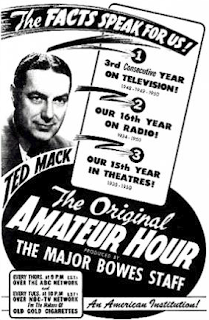
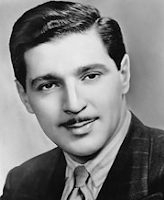
➦In 1904...radio/TV talent show host Ted Mack was born William Edward Maguiness in Greeley Colorado. Mack died July 12, 1976 at age 72.
Mack succeeded Major Bowes as host of The Original Amateur Hour for the period 1948-52 on radio, and until 1970 on TV. His discoveries include Gladys Knight, Pat Boone, & Teresa Brewer. He also hosted TV’s Ted Mack Family Hour, a show similar to Ed Sullivan.
The Original Amateur Hour began on radio in 1934 as Major Bowes' Amateur Hour, and ran until the 1946 death of its creator, Major Bowes. Mack, a talent scout who had directed the show under Bowes, revived it in 1948 for ABC Radio and the DuMont Television Network.
The show lasted on radio until 1952 and until 1970 on television, where it ran on all four major networks, ending as a Sunday afternoon CBS staple. A success in the early days of television, the program set the stage for numerous programs seeking talented stars, from The Gong Show to Star Search to American Idol to America's Got Talent.
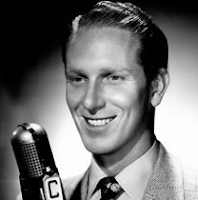
➦In 1909...singer/producer Barry Wood was born in New Haven Conn. He was the singing star of radio’s Lucky Strike Hit Parade in the early 40’s just ahead of Frank Sinatra, and went on to perform in lesser-known radio shows. In the TV era he was host of several shows including Places Please & Backstage with Barry Wood, and producer for The Bell Telephone Hour & Wide Wide World. He died July 19 1970 at age 61.
➦In 1910...Longtime radio announcer Ken Roberts born (died at age 99 June 19, 2009). He was known for his work during the Golden Age of Radio and for his work announcing the daytime television soap operas The Secret Storm, Texas and Love of Life, each for a two-decade span.
Ken Roberts
His first announcing job was at WMCA in New York lasting three weeks. Next at WLTH in Brooklyn. In an interview for the book The Great American Broadcast, Roberts told Leonard Maltin that he had started at the Brooklyn station in 1930, where his responsibilities included answering phones and sweeping the floors, in addition to on-air roles playing piano and reading poetry.
During the 1930s and 1940s, at the height of the radio era, Roberts' voice appeared widely in live programming to introduce programs, moderate game shows and do live reads for commercials. Despite his Errol Flynn-like good looks and the frequent broadcasts featuring his voice, as often as several times each day, few listeners knew who he was or would have recognized him in public.
Radio credits include The Shadow (including the 1937-38 season on the Mutual Broadcasting System with a 22-year-old Orson Welles starring in the role of Lamont Cranston), the comedy Easy Aces, along with soap operas Joyce Jordan, M.D. and This is Nora Drake. In 1941, he achieved his goal of hosting his own quiz show, with Quick As a Flash on the Mutual network.
He also announced or hosted a number of game shows, such as What's My Name? and the parody It Pays to Be Ignorant, in which he would pose questions to actors portraying contestants such as "Who came first: Henry I or Henry VIII?" that would be answered incorrectly. At various times, he performed on eponymous programs for Fred Allen, Milton Berle, Victor Borge and Sophie Tucker.
In 1941, he achieved his goal of hosting his own quiz show, with Quick As a Flash on the Mutual network.
➦In 1912..Bigtime radio announcer Del Sharbutt was born in Cleburne Texas.
Del Sharbutt
His first appearance on radio was in 1929 as a singer on WBAP in Fort Worth, Texas. He became a staff announcer for CBS Radio in 1933, and is best remembered as spokesman for Campbell’s Soup (“Mmm mmm Good!”) beginning in the ’30’s. He was also TV announcer for Your Hit Parade, and worked until retirement in 1976 as newscaster for the Mutual Radio network. He died April 26, 2002 at the ripe old age of 90.
Old-time radio shows for which Sharbutt was an announcer included The Man I Married, Lavender and Old Lace, Guy Lombardo, Jack Pearl, Ray Noble, Bob Hope, The Song Shop, Hobby Lobby, Myrt and Marge, The Hour of Charm, Melody and Madness, Colgate Ask-It-Basket, Lanny Ross, Amos 'n' Andy, Club Fifteen, The Jack Carson Show, Lum and Abner, Your Hit Parade, The Campbell Playhouse, Request Performance, Meet Mr. McNutley and Meet Corliss Archer.
In 1958,Sharbutt became a disc jockey on 77WABC in New York City. He and another old-time radio announcer, Tony Marvin, began "hosting afternoon record shows in their distinctively deep voices."
He died April 26, 2002 at the ripe old age of 90.
➦In 1915...newscaster/actor Lorne Greene was born in Ottawa. He was called “The Voice of Doom” as the nightly newsreader on CBC Radio during World War Two.(1939-42) On TV he starred in Bonanza, Battlestar Gallactica & Code Red. He died Sept 11, 1987 after an operation for a perforated ulcer, at age 72.
➦In 1924…The Eveready Hour was the first commercially sponsored variety program in the history of broadcasting. It premiered February 12, 1924 (other sources: December 4, 1923 or November 4, 1923) on WEAF Radio (now WFAN) in New York City. Radio's first sponsored network program. it was paid for by the National Carbon Company, which at the time owned Eveready Battery
In early 1924 The Eveready Hour began to be carried simultaneously by a second station, WJAR in Providence, Rhode Island, and the number of outlets was expanded to a group of Eastern and Midwestern stations "as quickly as WEAF could add stations" to its "WEAF chain" radio network. On election night, November 4, 1924, the program, hosted by Wendell Hall, was carried by 18 stations, with Will Rogers, Art Gillham, Carson Robison and the Eveready Quartet entertaining between election returns given by Graham McNamee. Joseph Knecht led the Waldorf-Astoria Dance Orchestra.
The Bowery Boys were featured on the Eveready Hour
In 1926 the WEAF chain operations were purchased by the Radio Corporation of America, becoming the basis of the National Broadcasting Company (NBC) in early 1927. The Eveready Hour continued as a featured broadcast on NBC until 1930.
Calvin Coolidge
➦In 1924...President Calvin Coolidge became the first President to make a political speech on the radio. It originated from New York City and was broadcast on five radio stations to an audience of an estimated 5M listeners. During his presidency, Coolidge made around 50 broadcasts. He soon learned how to make best use of the new technology, adding a consultant to his staff to help him polish his radio persona.
While Coolidge was a radio pioneer, the American president most associated with radio is Franklin D. Roosevelt. From 1933 to 1944, Roosevelt delivered 30 “fireside chats,” in which he addressed the American people in a friendly, plainspoken manner about his efforts to bolster the depressed economy through innovative government programs and about global challenges in the run-up to World War II.
➦In 1940…New York radio station WOR presented the first broadcast featuring the comic-strip hero, “Superman“. The 15-minute juvenile adventure became a feature of the Mutual Broadcasting System in 1942, three times a week to start, then daily.
\On Mutual, it was broadcast from August 31, 1942, to February 4, 1949, as a 15-minute serial, running three or, usually, five times a week. From February 7 to June 24, 1949, it ran as a thrice-weekly half-hour show. The series shifted to ABC Saturday evenings on October 29, 1949, and then returned to afternoons twice a week on June 5, 1950, continuing on ABC until March 1, 1951. In all, 2,088 original episodes of The Adventures of Superman aired on American radio.
The Man of Steel first appeared in Action Comics #1 in 1938. When Superman was first heard on radio less than two years after the comic book appearance, the character took on an added dimension with Bud Collyer in the title role.
During World War II and the post-war years, the juvenile adventure radio serial, sponsored by Kellogg's Pep, was a huge success, with many listeners following the quest for "truth and justice" in the daily radio broadcasts.
➦In 1951...Radio Personality, Pat St. John, was born in Detroit.
Pat St John age 18
In early 1969, at the age of 18, he landed his first gig as a radio personality on Windsor's CKLW, where he also worked for CKLW's 20/20 news doing newscasts one day a week, and part-time booth announcing on CKLW-TV Channel 9. In late 1970 he moved across the border to WKNR and was then hired in early 1972 at the ABC-owned album-oriented rock (AOR) station WRIF until 1973.
In April 1973, St. John began an almost 15-year stint at New York's WPLJ. He survived the station's transition from AOR to top 40 in 1983.
He left WPLJ in 1987, and returned to his rock roots on WNEW-FM, which had been WPLJ's rival during its AOR years. He became the station's program director in the early 1990s. St. John remained with the station until it switched to a hot talk format in 1998.
Authorities have briefly detained 36-year-old Carlos Palazuelos for questioning in the disappearance of Nancy Guthrie, the 84-year-old mother of "Today" show host Savannah Guthrie, just hours after the FBI released chilling surveillance footage showing a masked and armed individual tampering with her home's doorbell camera in Tucson, Arizona. After initial questioning, Palazuelos was released.
The detention occurred during a traffic stop in Rio Rico, Arizona Tuesday evening and authorities executed a search warrant at a nearby home, seizing electronic devices, though Palazuelos has not been officially named a suspect and Guthrie remains missing.
Palazuelos, a package delivery driver drives a white van, was reportedly staying with his mother-in-law, Josefina Maddox, in Rio Rico after an eviction. Maddox told reporters her son-in-law is a "good guy" with no criminal history and does not resemble the figure in the video, insisting he had nothing to do with the case.
The development followed an influx of tips after the FBI's release of the recovered footage, which authorities believe could break the case wide open.
The black-and-white surveillance video, retrieved from backend systems with assistance from Google engineers who own the Nest camera brand, depicts a person wearing a ski mask, gloves, and a backpack, approaching Guthrie's front door on the morning of February 1, 2026, with what appears to be a holstered handgun.
The individual is seen checking the camera, picking up vegetation or brush from the ground, and using it to cover the lens, effectively disabling the recording. FBI Director Kash Patel shared the images and short clips on social media, noting the person kept their head down to avoid facial identification.
Nancy Guthrie vanished from her home in the Catalina Foothills area of Tucson on February 1, 2026, prompting an extensive search involving the Pima County Sheriff's Department and the FBI. Authorities have described the case as an abduction and believe she is still alive, though no ransom demands or definitive leads had emerged until the video's release led to the recent detention.
Savannah Guthrie has publicly appealed for information, posting updates on social media as the investigation continues into its second week.
The Senate Committee on Commerce, Science, and Transportation held a hearing Tuesday titled "We Interrupt This Program: Media Ownership in the Digital Age". Chaired by Sen. Ted Cruz (R-TX), the session examined the FCC broadcast media ownership rules in the context of modern media consumption, where streaming services, social media, and digital platforms dominate video and audio content delivery. The focus was on whether these rules—originally designed to promote competition, diversity, and localism—remain relevant or require updates, particularly amid arguments that they asymmetrically hinder traditional broadcasters compared to unregulated tech giants like Google, Netflix, and Spotify.
A key point of discussion was the statutory 39% national cap on television household reach for a single broadcaster, which some argue can only be altered by Congress, not the FCC. Concerns were also raised about potential reductions in conservative viewpoints if rules are relaxed, allowing further media consolidation.
Witnesses included:
Curtis LeGeyt, President and CEO of the National Association of Broadcasters (NAB), who advocated for modernization, arguing that outdated rules prevent broadcasters from scaling to compete effectively and invest in local journalism.
Chris Ruddy, CEO of Newsmax, who opposed lifting the 39% TV cap, warning it could lead to excessive consolidation and fewer independent, conservative-leaning outlets.
Thomas Johnson, Partner at Wiley Rein LLP, who provided legal analysis on the FCC's authority and the need for rules to reflect current competition.
Steve Waldman, President of Rebuild Local News, who emphasized protecting local journalism from the harms of over-consolidation.
The hearing tied into the FCC's ongoing 2022 Quadrennial Regulatory Review, mandated by Congress every four years to assess if ownership rules are still necessary due to competition. No immediate outcomes or votes occurred, but it highlighted bipartisan interest in updating regulations before the 2026 midterm elections, with some lawmakers questioning the FCC's legal ability to modify certain caps without legislative action.
NAB President/CEO Curtis LeGeyt spoke at the hearing: “Without modernizing these ownership rules, local television news – the last bastion of truly local journalism in many communities – will suffer the same fate as thousands of local newspapers,” said LeGeyt. “Outdated ownership rules also limit broadcasters’ ability to provide viewers access to marquee sports and entertainment. Instead of subscribing to a new streaming service every time they want to watch a game, viewers overwhelmingly prefer to watch sports on broadcast TV.
“However, keeping broadcasters artificially small makes it harder to compete for increasingly expensive sports rights against our unregulated streaming rivals,” LeGeyt continued. “Broadcasting’s share of viewership is already less than half our streaming competitors. This decline will continue as premium sports content further migrates behind streaming paywalls.”
Regarding impacts on radio broadcasting, while the hearing's primary emphasis was on television rules (e.g., the 39% cap and local TV duopolies), broadcast ownership regulations encompass radio as well. The FCC's quadrennial review is evaluating the Local Radio Ownership Rule, unchanged since 1996, which limits a single entity to owning up to 8 commercial stations in the largest markets (with no more than 5 in one service—AM or FM—to preserve sub-band diversity).
Broadcasters like the NAB argue for relaxing or repealing these caps to enable consolidation, allowing radio groups to achieve economies of scale, attract more investment, and better compete with digital audio platforms (e.g., podcasts, streaming services like Spotify). This could lead to increased spending on local content, news, and emergency alerts, potentially stabilizing struggling stations amid declining ad revenues.
However, critics contend that easing rules could spike mergers, reducing ownership diversity and local voices, especially in smaller markets where one company might dominate. For AM radio, lifting FM/AM subcaps might accelerate migration to FM by large owners, further marginalizing AM stations, though some see opportunities for niche AM programming. Overall, any overhaul could reshape radio by fostering larger networks but risking homogenized content and job losses in local operations. The FCC is expected to propose changes in 2026, with public comments influencing the final decision.
The Seattle Seahawks' 29-13 victory over the New England Patriots in Super Bowl LX drew an average of 124.9 million U.S. viewers across NBC, Peacock, Telemundo, NBC Sports Digital, and NFL+, according to Nielsen's Big Data + Panel ratings released Tuesday.
This ranks as the second-most-watched Super Bowl in U.S. history, trailing last year's record of 127.7 million for the Philadelphia Eagles' win over the Kansas City Chiefs on Fox.
The broadcast set an all-time U.S. television record with a peak of 137.8 million viewers during the second quarter (7:45-8 p.m. ET), surpassing the previous high of 137.7 million from last year's game. It also marked the most-watched program in NBC's history as the network celebrates its 100th anniversary.
Bad Bunny's halftime performance averaged 128.2 million viewers from 8:15-8:30 p.m. ET, ranking as the fourth-most-watched halftime show ever—behind Kendrick Lamar (133.5 million in 2025), Michael Jackson (133.4 million in 1993), and Usher (129.3 million in 2024).
The show generated a record 4 billion social media views in the first 24 hours, a 137% increase over the prior year, with over 55% from international markets.
The game ended a four-year streak of audience growth for the Super Bowl and was the fifth straight year exceeding 100 million average viewers. Despite high ratings, the matchup lacked late drama: it was only the second Super Bowl with no touchdowns in the first three quarters, with Seattle leading 12-0 entering the fourth.
Advertisers paid up to $10 million for 30-second spots.
The selection of Bad Bunny (Benito Antonio Martínez Ocasio) to headline the halftime show—performed entirely in Spanish with tributes to Puerto Rico, surprise guests Lady Gaga and Ricky Martin, and a nod to Daddy Yankee—drew criticism from President Donald Trump and conservatives over his language choice and views on U.S. immigration policy.
Conservative group Turning Point USA countered with an "All-American Halftime Show" featuring Kid Rock and others, which peaked at 5 million on YouTube at one point and amassed over 21 million views by Tuesday night (compared to Bad Bunny's 61 million+). Nielsen did not measure YouTube streams.
ESPN is reviving the traditional TV bundle model for baseball by taking over sales of MLB.tv and planning to expand into local games.
ESPN is now selling the out-of-market MLB.tv package for $149.99 per season (or $29.99 monthly), allowing fans to watch games not blacked out in their local area. New subscribers receive a one-month free trial of ESPN Unlimited (which auto-renews at $29.99/month unless canceled), while existing ESPN Unlimited subscribers can buy MLB.tv at a discounted $134.99 for 2026.
The package is accessible via both ESPN and MLB apps/platforms.This move comes as part of ESPN's three-year deal with MLB (through 2028), which provides the network with more overall baseball content, thousands more hours, despite losing flagship events like Sunday Night Baseball, the Home Run Derby, and postseason games. ESPN now airs 30 midweek games exclusively.
Next year (2027), ESPN plans to sell in-market (local) telecasts for roughly half of MLB's 30 teams, potentially integrating them into ESPN Unlimited or as add-ons. MLB itself produces and distributes local streams for at least 14–20 teams this year, giving ESPN rights to those.
The strategy positions ESPN as a broader digital destination for baseball fans, leveraging its integration with Disney+ and Hulu to reach more viewers beyond traditional cable bundles.
John Lasker, ESPN's executive vice president for programming and acquisitions, emphasized this as a core opportunity rather than a test: "We think it’s not an experiment, it’s what we should be doing," he said, highlighting better service to fans through live local games and digital platforms.
According to The Athletic, Media consultant Patrick Crakes sees it as ESPN betting on super fans and bundling power to recapture value lost to cord-cutting and fragmented viewing, where local games once reached wider audiences via pay TV but now target core bases.
The deal follows tensions last year when ESPN exited the final years of a prior long-term contract over perceived declining value, before renegotiating terms that maintain MLB's annual payout around $550 million while granting ESPN expanded game access.
This doesn't fully solve baseball's fragmented media landscape—viewers still face blackouts, varying platforms, and multiple subscriptions—but ESPN aims to become the preeminent digital hub for the sport, starting with out-of-market access and expanding locally.
The out-of-market MLB.tv primarily benefits relocated fans (e.g., a Dodgers supporter in D.C.) or those wanting league-wide coverage beyond their home team. In-market fans (e.g., Mets supporters in Queens) need separate local packages due to territorial blackouts, a longstanding system now challenged by streaming shifts.
A Media Research Center (MRC) study claims Apple News featured zero articles from right-leaning outlets among 620 top stories in January 2026, while heavily favoring left-leaning sources. The conservative media watchdog analyzed high-traffic morning feeds from Jan. 1–31, using AllSides media bias ratings (a nonpartisan system with balanced expert panels and public surveys).
Of the 620 stories:
440 came from left-leaning outlets.
180 came from centrist outlets.
0 from right-leaning ones (including Fox News and the New York Post).
Top sources included:
Washington Post: 72 articles
Associated Press: 54
NBC News: 50
Wall Street Journal (centrist): 54
The Guardian: 34
NPR: 25
The study also notes Apple News had gone 96 consecutive days (as of Feb. 10, 2026) without featuring a conservative publication in top stories. The last such story was Nov. 5, 2025, from the (lean-right) British outlet The Telegraph.
MRC highlighted that featured headlines often portrayed President Donald Trump’s foreign policy and immigration actions negatively, with "provocative" framing from sources like The Washington Post and NBC News.
Julie Mastrine of AllSides called the results unsurprising, stating that reliance on Big Tech for news denies users balanced perspectives.
Apple's response: A spokesperson said the app provides access to over 3,000 publications, including Fox News, Wall Street Journal, Washington Examiner, New York Post, and others. Users can customize by following or blocking specific sources/topics.
MRC's Dan Schneider emphasized that Apple News comes pre-installed on iPhones (held by nearly half of voting-age Americans) and delivers "cherry-picked" content many users encounter without realizing potential bias.
The analysis focused on editor-curated "top stories" (checked around 8:30–10 a.m. ET), including some original Apple content and sports from The Athletic.
AllSides previously rated Apple News as "lean left" in a 2023 review of aggregators.
Radio BroadcastingDigital revenue surges as radio's primary growth driver: The Radio Advertising Bureau (RAB) reports that digital advertising now accounts for about one-quarter of radio industry revenue, hitting $2.3 billion in 2025. This offsets declines in traditional on-air sales, with more operators adopting "digital-first" or hybrid models.
FCC Commissioner warns on consolidation risks: FCC Commissioner Anna Gomez cautioned that further media consolidation could "hollow out" broadcasting, drawing parallels to the decline in local journalism seen in newspapers. This contrasts with another commissioner's view favoring deregulation to boost competition, amid the ongoing 2022 Quadrennial Review of ownership limits.
Radio outperforms TV for certain ad categories: Research from Cumulus Media highlights that radio delivers better results for travel brands compared to linear TV, despite lower ad spend allocation (only 4% to AM/FM radio vs. 18% to TV in 2025 travel ads). This suggests untapped potential in targeting specific audiences.
AM/FM remains dominant in listening and cars: Edison Research data shows most AM/FM listening (87%) still occurs via traditional receivers, with radio leading ad-supported audio. Public support for built-in radio in vehicles stays strong (96% consider it essential), fueling efforts like the AM Radio for Every Vehicle Act amid some automakers reducing or removing it.
Media Industry
Major journalism layoffs continue to hit legacy outlets: The Washington Post announced cuts of more than 300 staff members (about one-third of the company, including over 300 journalists from its roughly 800-person newsroom) on February 4, marking the biggest media layoffs so far in 2026. This follows the Atlanta Journal-Constitution laying off about 50 people (15% of staff, half from the newsroom) on February 5 as part of its digital transformation. These reflect ongoing financial pressures on traditional news organizations amid declining ad revenue and audience shifts.
FCC actions spark free speech concerns: Recent FCC notices targeting broadcasters (including attempts to rein in programs like The View and Saturday Night Live) have drawn criticism for potentially curtailing free speech. Combined with rising corporate media ownership, observers warn of backsliding in U.S. media freedom, drawing parallels to international examples.
Streaming dominance and TV viewing shifts accelerate: Nielsen data shows streaming reached a record 47.5% of total TV viewing in December 2025 (with peaks like 55.1 billion minutes on Christmas Day), while broadcast and cable continue to decline. Netflix projected strong 2026 growth, expecting ad revenue to nearly double as ads become central. Meanwhile, cord-cutting pressures mount, with YouTube TV introducing lower-priced sports/news bundles to retain subscribers.
U.S. News
Nancy Guthrie disappearance investigation intensifies: Authorities in Arizona detained a person of interest (reportedly a relative's son-in-law) for questioning after a traffic stop near the U.S.-Mexico border in connection with the abduction of Nancy Guthrie, mother of TODAY show co-anchor Savannah Guthrie. The FBI released surveillance photos and video of a masked, armed individual at her doorstep prior to the incident. The detained individual was later released, but the search and house raids continue, drawing widespread national attention amid the high-profile family's public pleas.
Trump-Netanyahu White House meeting on Iran and Middle East: Israeli Prime Minister Benjamin Netanyahu met with President Donald Trump at the White House to push for a tougher U.S. stance in nuclear talks with Iran, including expanding discussions to cover ballistic missiles. Trump indicated he believes Tehran wants a deal but mentioned weighing a second U.S. naval "armada" deployment to the region for leverage. Gaza ceasefire oversight and broader peace efforts (via the newly formed "Board of Peace") were also expected topics.
Bipartisan governors' gathering unravels: The annual National Governors Association meeting in Washington faced disruption after the White House planned to exclude Democratic governors from key events, including a traditional dinner. This led to boycotts by 18 Democratic governors and the NGA canceling formal White House sessions, highlighting deepening partisan divides.
Audacy has released its 2026 State of Audio: Sports Fandom guide, revealing key shifts in how fans engage with sports amid a packed year featuring the World Cup, Winter Olympics, World Baseball Classic, and continuous coverage across NFL, NBA, MLB, NHL, and March Madness.
The research underscores audio's growing dominance in sports consumption, particularly for diehard fans and marketers seeking deeper connections.
Key findings include:
Diehard fans are 1.4 times more likely to watch pre- and post-game shows on radio than on TV.
79% of fans report that sports foster a sense of community; many prefer muting national TV broadcasts to tune into local radio for authentic city-specific emotion and history.
Audacy now leads in sports talk reach across radio and television, outpacing ESPN and FS1.
Gen Z fans remain highly engaged but gravitate toward personalities, podcasts, and audio creators over traditional networks.
Sports audio delivers broad marketing impact beyond beer and betting ads, boosting web traffic on air days: +105% for financial services, +42% for home improvement, +22% for grocery, and +10% for automotive.
Fandom extends far beyond game time—audio sustains engagement 24/7 before, during, and after events, building loyalty in a fragmented media environment.
The guide positions sports fandom as an ongoing conversation driven by trusted local voices, strengthening radio's (and Audacy's) unique role amid streaming and digital competition.
105.5 Kiss Chattanooga (, an Audacy station in Chattanooga, has launched “The Dex & Barbie T Morning Show.” The duo can be heard weekday mornings from 6:00 a.m. to 10:00 a.m. ET.
“The Dex and Barbie T Morning Show” delivers high-energy entertainment, hilarious stories and laugh-out-loud moments. Their popular segments include “Ghosted,” where listeners confront exes who disappeared, and “$1,000 Minute To Win It,” which gives listeners a chance to test their trivia knowledge for cash.
“We are excited to welcome Dex and Barbie T to the Chattanooga community,” said Nichole Hartman, Senior Vice President and Market Manager, Audacy Chattanooga. “They bring a refreshing blend of relatable, funny, and engaging content that perfectly captures the spirit of our city. With Dex’s deep roots and familiarity with Tennessee, we know they’ll feel right at home connecting with our listeners from day one."
“Growing up here, I used to listen to the radio and imagine being on the mic in Chattanooga,” said Dex. “Now our show is actually on in my hometown, and I am so pumped!”
“CHATTANOOGA! Can’t wait to wake up with you every morning,” said Barbie T. “We’re bringing the laughs, the sass, and of course, reminding all my ladies out there that you got value, honey! Buckle up because this ride is about to get lit!”
The new weekday lineup for 105.5 Kiss Chattanooga is as follows.
6:00 a.m. – 10:00 a.m. ET: “The Dex & Barbie T Morning Show”
11:00 a.m. – 3:00 p.m. ET: “The Bru Show”
3:00 p.m. – 7:00 p.m. ET: Abbey
📻Listeners can tune in to 105.5 Kiss Chattanooga (WKXJ-FM) on-air and nationwide on the Audacy app and website. Fans can also connect with the station via X, Facebook and Instagram.