
➦In 1891...David Sarnoff born (Died: December 12, 1971 at age 80). He was a businessman and pioneer of American radio and television. Throughout most of his career he led the Radio Corporation of America (RCA) in various capacities from shortly after its founding in 1919 until his retirement in 1970.
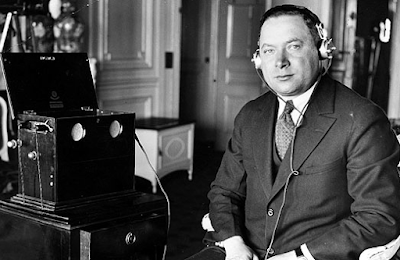 |
| David Sarnoff |
He ruled over an ever-growing telecommunications and media empire that included both RCA and NBC, and became one of the largest companies in the world. Named a Reserve Brigadier General of the Signal Corps in 1945, Sarnoff thereafter was widely known as "The General."
Sarnoff is credited with Sarnoff's law, which states that the value of a broadcast network is proportional to the number of viewers.
Unlike many who were involved with early radio communications, viewing radio as point-to-point, Sarnoff saw the potential of radio as point-to-mass. One person (the broadcaster) could speak to many (the listeners).
When Owen D. Young of the General Electric Company arranged the purchase of American Marconi and turned it into the Radio Corporation of America, a radio patent monopoly, Sarnoff realized his dream and revived his proposal in a lengthy memo on the company's business and prospects.
His superiors again ignored him but he contributed to the rising postwar radio boom by helping arrange for the broadcast of a heavyweight boxing match between Jack Dempsey and Georges Carpentier in July 1921. Up to 300,000 people heard the fight, and demand for home radio equipment bloomed that winter. By the spring of 1922 Sarnoff's prediction of popular demand for broadcasting had come true, and over the next eighteen months, he gained in stature and influence.
In 1926, RCA purchased its first radio station (WEAF, New York) and launched the National Broadcasting Company (NBC), the first radio network in America. Four years later, Sarnoff became president of RCA. NBC had by that time split into two networks, the Red and the Blue. The Blue Network later became ABC Radio.
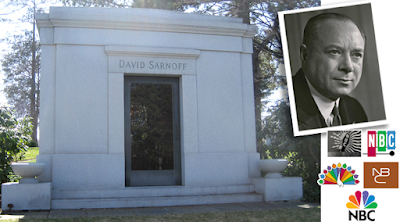
Sarnoff was instrumental in building and established the AM broadcasting radio business which became the preeminent public radio standard for the majority of the 20th century. This was until FM broadcasting radio re-emerged in the 1960s despite Sarnoff's efforts to suppress it.
➦In 1927..The first National Radio Conference kicked off in Washington, D.C., led by then-Secretary of Commerce Herbert Hoover. This wasn’t a single-day affair—it ran through March 2—but its start on February 27 marked a turning point. Radio was exploding in popularity, with stations popping up everywhere, and the airwaves were turning into a chaotic mess. Hoover brought together industry folks, engineers, and government officials to figure out how to tame the beast. They talked frequencies, licensing, and interference—dry stuff, maybe, but it laid the groundwork for organized broadcasting in the U.S. Think of it as the moment radio started growing up from a wild experiment into something structured. By the end of the decade, this conference helped pave the way for the Radio Act of 1927, which birthed the Federal Radio Commission to keep things in line.
➦In 1940...Actor Howard Hesseman born. He is best known for his role as anti-disco disc jockey John "Dr. Johnny Fever" Caravella on the television sitcom WKRP in Cincinnati from 1978 to 1982, a role Hesseman prepared for by working as a DJ in San Francisco at KMPX-FM for several months.
He was nominated for a Prime-Time Emmy Award for Outstanding Supporting Actor in a Comedy Series in 1980 and 1981 for his portrayal of Fever. He reprised the role in nine episodes of The New WKRP in Cincinnati, and also directed several episodes of the 1991-93 series revival.
Hesseman died on January 29, 2022.
➦In 1965...Personality Murray the K aired his last show at 1010 WINS-AM.


