➦In 1901...William S. Paley, the chief executive, who built Columbia Broadcasting System (CBS) from a small radio network into one of the foremost radio and television network operations in the United States, was born.
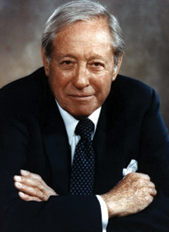 |
| Will Paley |
In 1927, Paley's father, brother-in-law and some business partners bought a struggling Philadelphia-based radio network of 16 station called the Columbia Phonographic Broadcasting System. Samuel Paley's intention was to use his acquisition as an advertising medium for promoting the family's cigar business, which included the La Palina brand. Within a year, under William's leadership, cigar sales had more than doubled, and, in 1928, the Paley family secured majority ownership of the network from their partners. Within a decade, William S. Paley had expanded the network to 114 affiliate stations.
Paley quickly grasped the earnings potential of radio and recognized that good programming was the key to selling advertising time and, in turn, bringing in profits to the network and to affiliate owners. Before Paley, most businessmen viewed stations as stand-alone local outlets or, in other words, as the broadcast equivalent of local newspapers. Individual stations originally bought programming from the network and, thus, were considered the network's clients.
.png)
Paley changed broadcasting's business model not only by developing successful and lucrative broadcast programming but also by viewing the advertisers as the most significant element of the broadcasting equation. Paley provided network programming to affiliate stations at a nominal cost, thereby ensuring the widest possible distribution for both the programming and the advertising. Affiliates were required to carry programming offered by the network for part of the broadcast day, receiving a portion of the network's fees from advertising revenue. At other times in the broadcast day, affiliates were free to offer local programming and sell advertising time locally.
During his prime, Paley was described as having an uncanny sense for popular taste and exploiting that insight to build the CBS network. As war clouds darkened over Europe in the late 1930s, Paley recognized Americans' desire for news coverage of the coming war and built the CBS news division into a dominant force just as he had previously built the network's entertainment division.
During World War II, Paley served in the psychological warfare branch in the Office of War Information, under General Dwight Eisenhower, and held the rank of colonel. It was while based in London, England, during the war when Paley came to know and befriend Edward R. Murrow, CBS's head of European news. In 1946, Paley promoted Frank Stanton to president of CBS. CBS expanded into TV and rode the post-World War II boom to surpass NBC, which had dominated radio.


.png)


